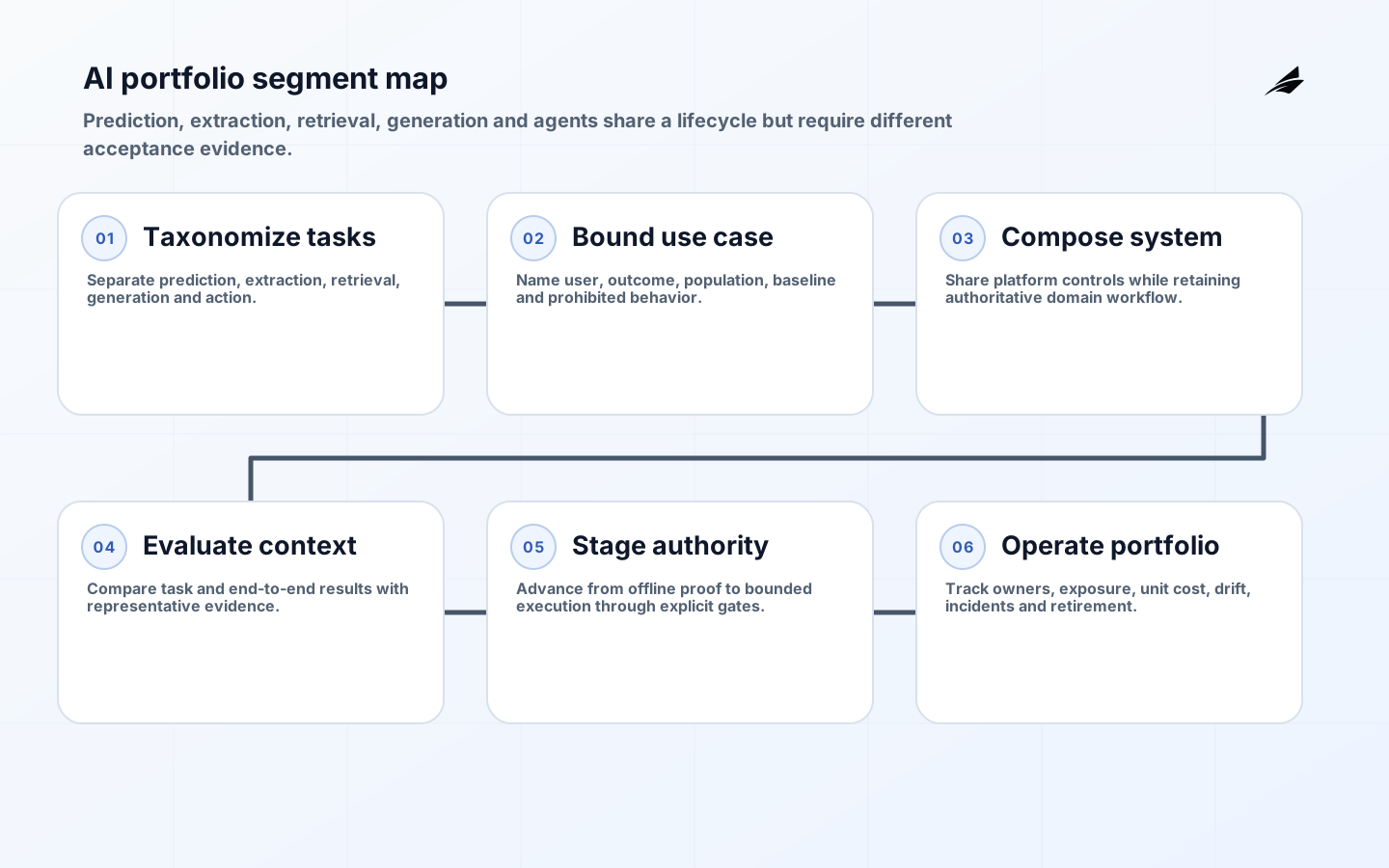
AI solutions segments are useful when they separate materially different tasks and consequences. A prediction model, document extractor, retrieval assistant, generator and tool-using agent should not share one undifferentiated scope or approval path. Segmenting the portfolio clarifies data, architecture, evaluation, human authority and operating cost. The segment belongs to the deployed use case, not the vendor model; the same foundation model can appear in a low-impact drafting tool and a consequential customer workflow.
This delivery plan pairs with the AI segments implementation checklist and AI solutions segments FAQ. It applies NIST AI RMF’s govern, map, measure and manage functions continuously. The plan begins with outcome and context, creates segment-specific evidence, releases capability in bounded steps and preserves a non-AI path where uncertainty or failure cannot be accepted.
1. Define the portfolio taxonomy and outcomes
Create a small taxonomy based on task: prediction or ranking, detection, extraction, retrieval, generation, decision support and action through tools. Add dimensions for autonomy, affected population, data sensitivity, external exposure, reversibility and harm. Do not turn the dimensions into a score that averages away severe consequence. Define routing rules and an escalation forum for ambiguous use cases. Publish examples and non-examples so teams classify consistently.
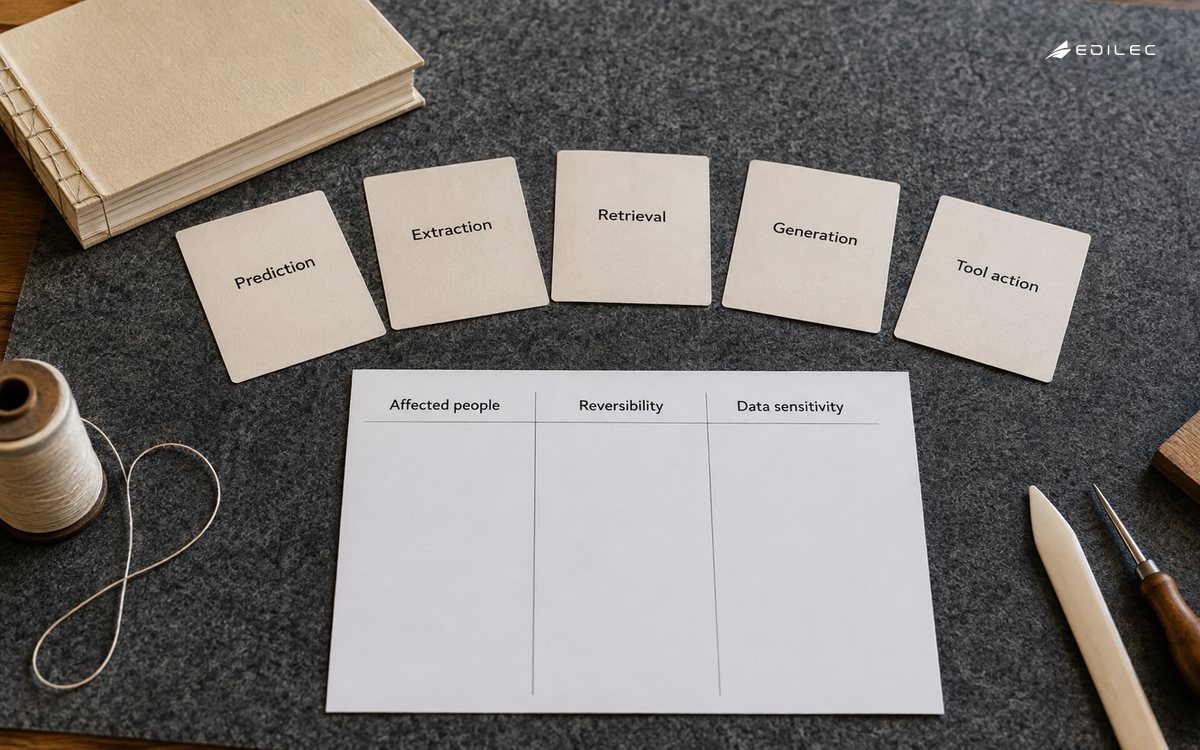
For each candidate, name the user, affected party, current workflow, intended decision or action and measurable benefit. Establish a baseline for quality, time, cost and harm. State prohibited use and the manual alternative. Remove proposals whose outcome is merely “use AI.” Group remaining candidates into segments that can share platform capabilities and controls without pretending their evaluation is identical.
2. Bound scope and select a first use case
Select a use case with representative data, a committed owner, measurable output and reversible consequence. Include a real integration and exception path so the first delivery proves more than a demonstration. Scope the complete decision boundary: inputs, retrieval, model, deterministic validation, human review, system of record and feedback. Excluding downstream confirmation makes it impossible to measure whether the AI changed an outcome correctly.
Write acceptance claims before building. Examples include extraction field accuracy by document type, retrieval coverage for current policy, recommendation error by subgroup or agent task completion without prohibited tools. Set thresholds, sample sizes and stop conditions with risk owners. Record assumptions about model access, volume, latency, languages and source quality. A pilot whose success criteria change after results arrive cannot support a scale decision.
| Segment | Representative task | Key evidence |
|---|---|---|
| Prediction | Forecast or rank | Calibration, subgroup error and decision impact |
| Extraction | Convert evidence to fields | Field accuracy and reconciliation |
| Retrieval or generation | Answer, summarize or draft | Source coverage, grounding and correction |
| Agent | Select and invoke tools | Authorization, task success and action confirmation |
3. Design shared and segment-specific architecture
Shared services can provide identity, model access, prompt and configuration versioning, retrieval, policy enforcement, secrets, logging, evaluation and cost allocation. Keep their interfaces narrow and observable. Segment-specific applications retain workflow, authoritative data and business rules. A platform should accelerate safe delivery, not force every task into chat or one model gateway. Preserve portability where it matters by separating business contracts from provider-specific APIs.
Place deterministic authority around probabilistic components. Validate schemas, permissions, destinations, value limits and policy before an output affects a record or person. Filter retrieval by identity and effective context. Treat prompts, retrieved documents and model output as untrusted. Constrain agent tools, network paths and recursion. Record model, prompt, source and tool versions for consequential events so later investigation can reconstruct behavior.
4. Build an evaluation and assurance workstream
Create governed evaluation datasets from representative conditions, edge cases and adversarial inputs. Keep them separate from development and document provenance, consent or authority, subgroup coverage and limitations. Use task-specific metrics plus human rubrics where meaning requires judgment. Compare against the current process and simpler non-AI methods. A complex model must earn its operational burden through meaningful improvement.
Test end-to-end behavior: authorization, retrieval, grounding, interface transformation, human use, tool execution and reconciliation. Evaluate harmful bias, privacy, security, resilience and misuse proportionate to context. Calibrate human reviewers and analyze disagreement. Red-team work explores unexpected attacks, while systematic tests establish repeatable acceptance; neither substitutes for the other. Retest after material model, prompt, data, tool or population change.
5. Model full lifecycle cost and capacity
Separate discovery, data preparation, model experimentation, application engineering, evaluation, integration, security, change management and release costs. Recurring cost includes inference, retrieval, storage, observability, human review, exceptions, support, re-evaluation and vendor governance. Estimate volume and token or compute distributions, not one average request. Include retry loops, peak demand and model fallback. Price the non-AI service path that remains necessary.
Measure value as realized outcome after quality and risk, not model usage. Saved minutes become financial benefit only when capacity changes or is redeployed. Segment cost by use case and tenant so shared platform spending does not hide uneconomic workloads. Establish quotas, anomaly alerts and approval for more expensive models or higher autonomy. Compare buy, configure and build options over the same lifecycle and exit assumptions.
| Cost layer | Variable | Control |
|---|---|---|
| Model | Requests, tokens or compute | Routing, quotas and caching |
| Knowledge | Indexing, storage and refresh | Source lifecycle and deletion |
| People | Review, exception and support | Eligibility and interface improvement |
| Risk | Evaluation, security and incident work | Segment-based assurance plan |
6. Deliver through progressive evidence gates
Move from offline evaluation to shadow operation, user assistance, bounded execution and broader scale only where the segment permits. Each stage needs cohort, duration, monitoring, support, stop condition and accountable approval. Include unfamiliar users and messy cases before scale. Use safe-default feature flags and retain exact configuration. Rehearse provider outage, retrieval failure, tool rejection, cost runaway and rollback.
Treat release as a risk decision. The evidence pack should contain the use-case card, data approvals, model and system card, evaluation, threat model, human authority, user guidance, open limitations, incident plan and monitoring thresholds. High-consequence segments need independent challenge and affected-party considerations. Expansion to new geography, language, population, source or tool is a scope change requiring re-mapping.
7. Establish portfolio operations and retirement
Assign business, technical, data, model-risk, security and support owners. Keep a registry with segment, capability, version, exposure, provider, data, tools, last evaluation and unresolved risks. Monitor output quality, drift, override, complaint, incident, latency, availability and unit cost. Some measures require sampled semantic review. Link every threshold to an action such as investigate, narrow, revert or suspend.
Review the portfolio for duplication and diminishing value. Retire unused prompts, models, indexes and agents; revoke credentials and delete data under policy. Maintain provider exit and model substitution paths for critical services. Report portfolio health through realized outcomes and controlled exposure, not experiment counts. The operating model is mature when teams can stop an AI system as deliberately as they launched it.
For ai solutions segments: scope, cost, risks and delivery plan, maintain an acceptance ledger that links each material requirement to an owner, implementation evidence, test result, residual limitation and review date. Sample the evidence with people who operate the service, not only its builders. Re-open acceptance when a provider, data source, integration, user population or authority boundary changes. This ledger prevents a successful launch label from concealing expired assumptions, incomplete handover or controls that were demonstrated once but cannot be exercised by the permanent team.
Create a portfolio dependency map before several segments share one model gateway, vector store, evaluator or approval service. Identify capacity, data and failure concentration, then set service objectives and tenant boundaries for the shared component. A platform change must be tested against representative prediction, retrieval, generation and agent consumers because the same modification can alter them differently. Preserve an emergency route for critical non-AI work and a controlled method to disable one use case without interrupting every AI-enabled service in the organization.
Budget evaluation data as a maintained product. New policies, languages, user behavior and failure reports should enter governed test sets without contaminating blind acceptance samples. Track who may add or remove cases, how sensitive examples are protected and how retired use cases affect retention. Reliable portfolio comparison depends on evaluation assets remaining current and independently reviewable.
Key takeaways
- Use task and consequence to segment the AI portfolio.
- Write measurable acceptance claims before experimentation.
- Keep business authority in deterministic systems and accountable roles.
- Include review, evaluation and exit in lifecycle cost.
- Scale through staged evidence and retire weak or unused capability.
Frequently asked questions
How many AI segments should an organization use?
Use the smallest taxonomy that changes controls meaningfully. Too few groups hide consequence; too many create governance overhead. Start with task families and escalation dimensions, then refine from delivery evidence.
Should generative AI be its own segment?
It can be a useful task family because grounding, content and prompt risks differ, but consequence and autonomy still determine controls. A private drafting assistant and a public tool-using agent should not share one approval path.
Can shared platforms reduce cost?
Yes, when identity, evaluation, logging, policy and model access are genuinely reusable. Shared platforms also concentrate dependency and data, so assign product ownership, reliability objectives, allocation and exit capability.
Conclusion
AI solutions segments turn an abstract AI strategy into a portfolio that can be costed, tested and governed. They reveal where shared platforms help and where specific business context demands different evidence. Most importantly, they prevent a model name from becoming a substitute for risk analysis.
Deliver one representative use case end to end, preserve a baseline and scale only when measured benefit survives review, exceptions and operating cost. Maintain the registry and re-segment on material capability change. This creates a portfolio that can expand responsibly and contract when evidence no longer supports it.