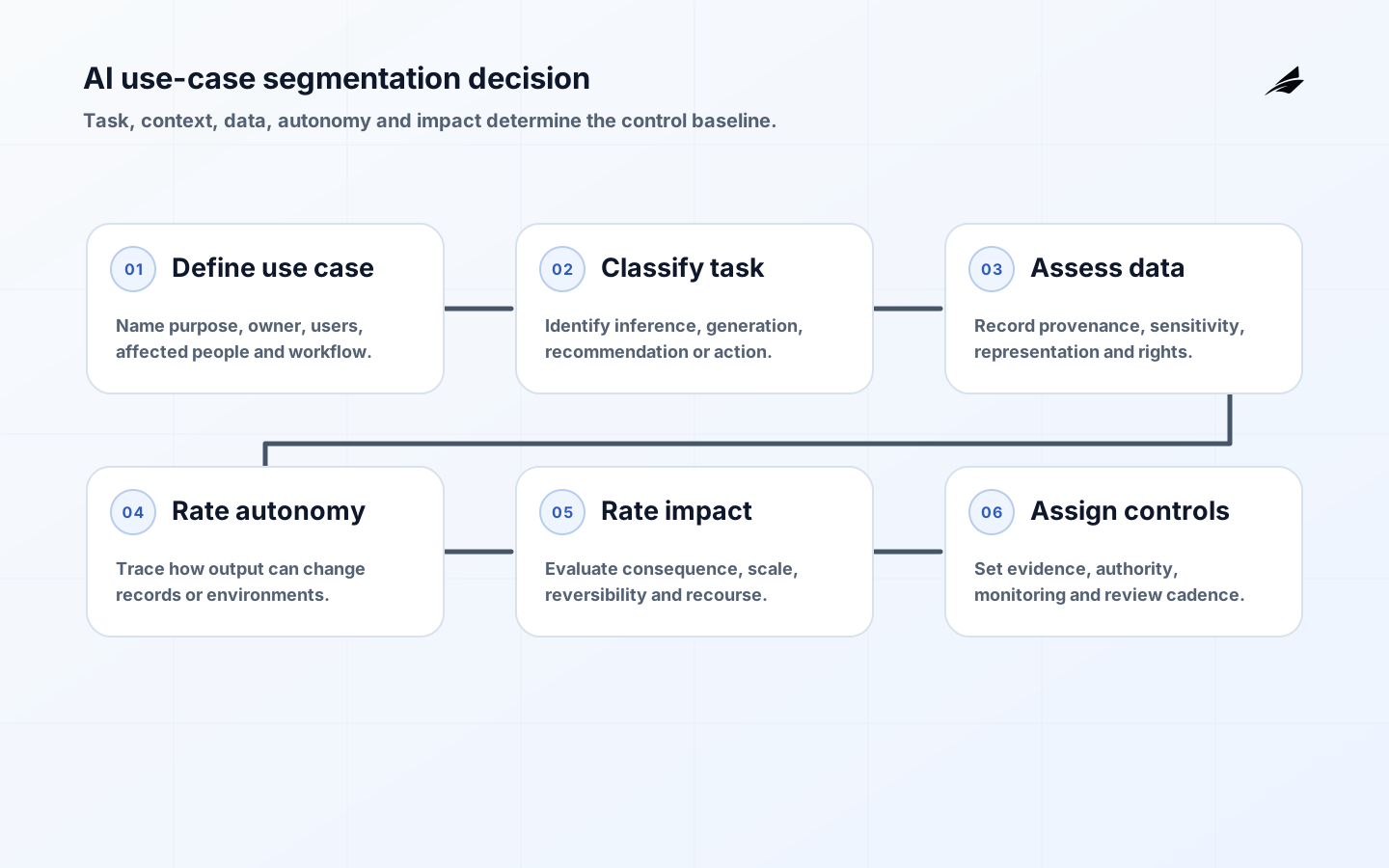
AI solution segmentation is the practice of grouping concrete AI use cases by characteristics that change their value, risk and operating requirements. Useful segments are not “chatbot,” “machine learning” and “agent” alone. The same model can summarize public marketing text or influence a high-impact employment process; those deployments need different evidence and authority. Portfolio segmentation helps leaders fund, govern and monitor each system proportionately.
This FAQ complements the scope and cost guide, the segmentation implementation checklist and the strategy-to-operations alignment checklist. It uses the OECD dimensions and NIST risk-management concepts as practical references, while legal classification must be confirmed for each jurisdiction and deployment.
Why segment AI solutions?
Without segmentation, organizations either apply one heavy process to every experiment or allow high-impact systems to inherit lightweight controls. Both fail. Segmentation creates a common description for what the system does, where it operates, whose data it uses, who is affected and how an output becomes action. That description supports comparable investment, review and incident decisions across vendors and technical approaches.
Segment the use case, not merely the model. One foundation model can support many systems, and one business workflow can combine several models, rules and human decisions. Maintain a registry linking use case, owner, purpose, users, affected parties, model and data dependencies, autonomy, impact, validation, controls and current status. Reclassify when any material element changes.
| Dimension | Question | Why it changes controls |
|---|---|---|
| Context | Where and for whom is it used? | Rights, expectations and sector duties differ |
| Task and output | What does it generate or infer? | Error modes and evaluation methods differ |
| Data and input | What sources and people are represented? | Privacy, bias and provenance differ |
| Autonomy | How directly can output change state? | Human and technical intervention differ |
| Impact | What harm can failure cause? | Assurance and escalation must be proportionate |
What business task segments are useful?
Start with the output: recognition or extraction, retrieval and summarization, generation, forecasting, recommendation, decision support, optimization or action execution. Then add workflow context. A summarizer for internal research differs from a summarizer that prepares medical evidence. A recommender for entertainment differs from one influencing credit. Task labels guide evaluation, but context and impact determine assurance.
Distinguish productivity aids from process components. A user-controlled drafting tool can be reviewed before use; a service that routes thousands of cases may affect deadlines before anyone notices. Separate customer-facing, employee-facing and back-office systems. Record whether people know AI is involved and whether they can obtain help, correction or appeal.
How should impact and autonomy be tiered?
Define tiers with observable consequences rather than adjectives. A low-impact tier might produce optional content that a trained employee reviews. A moderate tier may prioritize operational work or communicate externally with bounded effects. A high tier may influence access, employment, finance, health, safety or legal interests. A prohibited tier covers uses the organization will not deploy. Map applicable legal categories separately; internal tiers do not replace law.
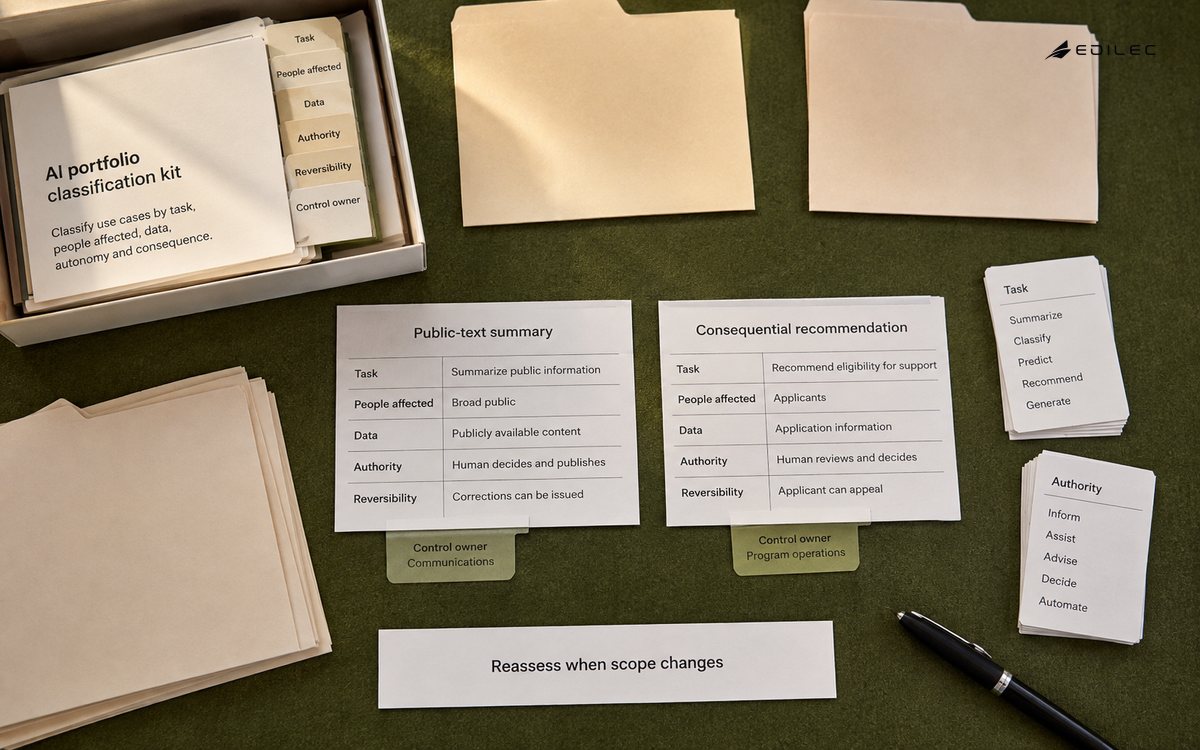
Autonomy raises exposure when the system can invoke tools, update authoritative records or scale decisions. Evaluate reversibility, speed, affected population, detectability and available human intervention. A reversible calendar suggestion is not equivalent to a payment, account suspension or public disclosure. Require stronger authorization, transaction limits, simulation, monitoring and approval as the distance between output and consequence shrinks.
| Portfolio tier | Typical deployment | Minimum governance response |
|---|---|---|
| Assistive | Draft or search with active user review | Owner, data rules, basic evaluation and feedback |
| Operational | Classification or routing with bounded effects | Workflow tests, monitoring, fallback and sampled review |
| Consequential | Output influences material rights or safety | Independent review, strong evidence, contest and incident controls |
| Autonomous action | Tools create external or irreversible effects | Capability limits, transaction policy, staged rollout and rapid stop |
| Prohibited | Use conflicts with law, rights or risk appetite | Block procurement and deployment; monitor attempted use |
How do segments map to controls?
Create a control baseline for each tier, then add task- and data-specific controls. Common controls include purpose approval, data minimization, supplier review, representative evaluation, security testing, disclosure, human oversight, logging, incident response and retirement. Higher tiers increase independence, sample size, review authority, monitoring and release gates. They should not simply add paperwork; each control needs an owner and verifiable evidence.
Use inherited controls carefully. A platform may provide identity, logging and model access, but the use case still owns workflow evaluation, affected-person recourse and downstream actions. Record control source, scope, evidence, limitations and exceptions. If one platform setting changes, the registry should reveal which use cases need reassessment.
What evaluation belongs in each segment?
Evaluate the complete system against its intended task and foreseeable misuse. Retrieval systems need source relevance and support; extraction needs field-level precision and abstention; generation needs factuality and harmful-content tests; forecasting needs calibration and drift analysis; tool-using systems need policy and side-effect tests. Segment results by case type and affected group, not only portfolio averages.
Set thresholds before release and include fallback behavior. Low-impact tools can use lighter evidence, but they still need to avoid data leakage and misleading users. Consequential systems need independent challenge, representative data, override analysis and an appeal path. Re-evaluate after changes to model, prompt, data, policy, integration or user population.
How should a segmented portfolio be operated?
Use stage gates from idea to retirement: intake, classification, feasibility, validation, deployment, monitoring and closure. Route each stage to the right roles. Security, privacy, legal, domain experts, affected stakeholders and operations should participate according to the use case, not attend every review by default. Time-box experiments and prevent production credentials or sensitive data until approved conditions are met.
Portfolio reporting should show use cases by tier, owner, lifecycle state, overdue review, incident, exception and supplier concentration. Track realized outcomes as well as risk. Stop systems that do not create value, because unused or redundant deployments still carry access and maintenance exposure. Archive decisions and remove data, keys and integrations at retirement.
What segmentation mistakes should teams avoid?
Do not classify from vendor marketing, model size or a single risk score. Do not label a system low risk because a human appears somewhere in the process; review may be rushed or unable to change the outcome. Avoid static classification at procurement when the real workflow is not yet designed. Unknown data, users or actions should raise the review requirement rather than default to a lower tier.
Keep the scheme understandable. Too many labels encourage debate without better decisions. Pilot the taxonomy on real use cases and check whether independent reviewers reach similar results. Document edge cases and an escalation owner. A useful segment changes evaluation, authority or monitoring; if it changes nothing, remove it.
Calibrate the segmentation scheme with real cases
Select use cases from several functions and ask independent reviewers to classify them using only the written scheme and registry evidence. Compare disagreements about task, autonomy, affected people and impact. Rewrite ambiguous criteria and add examples until the same facts usually lead to the same baseline, while preserving an escalation path for genuinely novel cases. Do not tune labels to force an easier review for a favored project.
Then test whether classification changes an actual decision: evaluation depth, approver, data access, release gate, monitoring or review cadence. Track exceptions and their expiry. Recalibrate after incidents or legal and policy changes. A taxonomy that cannot be applied consistently or does not alter controls creates administrative confidence without improving accountability.
Publish the final scheme with a short intake form and worked examples from the organization. Train product, procurement and risk teams on the same cases, then measure how often submissions arrive with missing owners, affected-party analysis or action paths. Improve the intake where omissions recur. The portfolio office should report classification quality and overdue evidence, not reward a growing count of registered experiments.
When a use case spans several jurisdictions, sectors or user groups, preserve those contexts in the registry rather than averaging them into one tier. A low-impact internal deployment may become consequential when offered to customers or used at larger scale. Expansion approval should compare the proposed context with the evidence boundary of the original release and require new validation where they differ.
Connect supplier inventory to use-case segmentation. The same external model, data platform or evaluation service may support several tiers, so a supplier outage, policy change or security finding can have portfolio-wide effects. Record substitutability, data return and exit dependencies, then test how affected use cases suspend or fall back when a shared component is unavailable.
Key takeaways
- Classify deployed use cases, not models in isolation.
- Combine task, context, data, autonomy and impact dimensions.
- Map each tier to owned, testable controls and release evidence.
- Reclassify after material workflow, model, data or population changes.
- Use segmentation to improve both investment and risk decisions.
Frequently asked questions
Is segmentation the same as risk assessment?
No. Segmentation groups systems with similar characteristics and establishes a control starting point. A system-specific risk assessment then analyzes particular harms, likelihood, controls and residual risk.
Can one use case belong to several segments?
Yes. A system may generate content and execute tools, or serve several populations. Record all material characteristics and apply the strongest relevant controls rather than forcing one simplistic label.
Should prototypes be registered?
Register experiments once they access organizational data, users, integrations or budget beyond a trivial sandbox. A lightweight intake can preserve visibility without imposing full production review.
How often should classifications be reviewed?
Review on material change and on a cadence based on tier. Also trigger review after incidents, policy changes, supplier changes, drift or expansion to new users and regions.
Conclusion
AI solution segmentation makes a diverse portfolio governable by describing what each system actually does and how it can affect people or operations. Task, context, data, autonomy and impact create a defensible basis for proportionate controls. The result should be a living registry that routes decisions and evidence, not a taxonomy slide that remains detached from production.