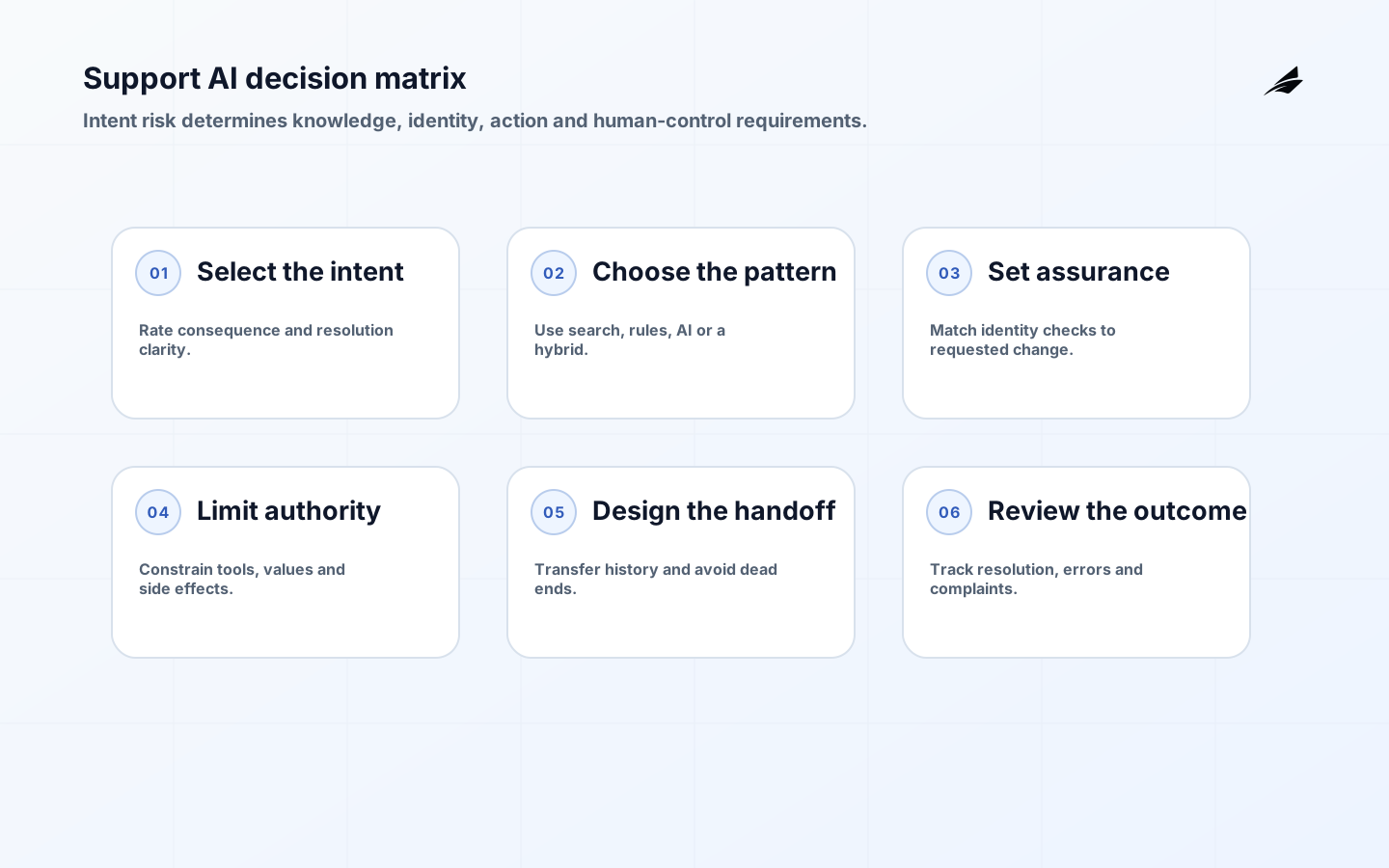
This conversational AI support FAQ answers the questions teams face after deciding a chatbot demo is not a delivery plan. The central distinction is between language and service: a fluent interface may help explain or gather information, but a support service must also respect identity, policy, authority, accessibility, escalation and recovery.
For the end-to-end program, use Edilec's conversational AI delivery plan and implementation checklist. The support automation checklist helps connect chat to the underlying workflow.
Key takeaways
- Choose a pattern by intent consequence, reversibility and evidence requirements.
- Retrieval improves access to knowledge but does not guarantee a supported answer.
- Identity and authorization belong outside the model in deterministic controls.
- Customers need an accessible human route that carries context.
- Evaluate the complete resolution path and measure outcomes after the conversation.
Which support requests are good AI candidates?
Start with requests that are common, bounded and supported by stable knowledge. The expected outcome should be observable, and failure should be easy to contain. Examples include explaining a return policy for a known market, checking an authenticated order state, gathering troubleshooting facts or helping an agent summarize a case. Sample real conversations before finalizing the list because labels in a ticket system often hide several different intents.
Avoid autonomous handling where facts are contested, policy requires discretion, the customer may be vulnerable, or a wrong action causes significant legal, financial or safety harm. AI may still assist a qualified person by locating evidence or drafting a response. The NIST AI RMF encourages risk management tailored to context; candidate selection is where that context first becomes operational.
| Support need | Likely pattern | Why | Human role |
|---|---|---|---|
| Find a current policy | Search or grounded generation | Evidence is the product | Own source and handle ambiguity |
| Collect diagnostic facts | Guided conversation | Language helps structured intake | Take over on risk or frustration |
| Change account data | Authenticated workflow | Authority matters more than fluency | Approve sensitive exceptions |
| Resolve a complaint | Human-led with AI assistance | Judgment and remedy are contextual | Own decision and communication |
| Detect emerging themes | Offline classification and review | Aggregate patterns need validation | Interpret and prioritize |
Should we use rules, retrieval, an LLM or an agent?
Use the least complex pattern that meets the need. Rules work for eligibility and fixed routing. Search works when users need source documents. Retrieval-augmented generation can synthesize approved passages. A model with tools can execute bounded actions. An agentic loop is appropriate only when variable planning creates demonstrated value and every action remains constrained, observable and recoverable.

Hybrid designs are normal. A model can classify the request; deterministic code can check identity and policy; retrieval can provide evidence; a typed tool can fetch status; and a person can approve an exception. Keep component boundaries visible in traces and tests. Do not call a multi-step system autonomous if operators cannot see which component chose or performed an action.
Does grounding stop incorrect answers?
No. Retrieval may miss the right source, return stale or conflicting content, cross an access boundary or find a passage that does not support the final claim. Give support content owners, effective dates, markets and access classifications. Test retrieval separately with expected relevant passages, then test whether the response remains faithful. Provide citations that help agents or customers verify the answer.
When evidence is weak, the service should ask a clarifying question, offer relevant source material or hand off. It should not fill gaps with a plausible policy. The NIST Generative AI Profile identifies risks and suggested actions across governance, content provenance, testing and incidents; provenance is especially important when policy answers affect customer rights.
How should identity and tool use work?
Match identity assurance to the requested action and channel. General information may require none; account data and changes require authenticated context; high-risk actions may need step-up verification. The model should never decide that friendly conversation is proof of identity. Session state, authorization and policy checks belong in application controls with explicit failure behavior.
Expose narrow tools such as get-order-status or reschedule-delivery, not broad database or browser access. Define typed parameters, allowed values, timeouts, rate limits, idempotency and confirmation. Use separate service identities and short-lived credentials. The OWASP Top 10 for LLM and generative AI gives teams a practical threat list including prompt injection, sensitive-information disclosure and excessive agency.
| Action risk | Example | Assurance | Automation boundary |
|---|---|---|---|
| Public information | Store hours | No account identity | Answer from approved source |
| Private read | Order status | Authenticated session | Read only permitted object |
| Reversible change | Delivery date | Authentication plus confirmation | Allowed values and rollback |
| Financial or legal effect | Refund exception | Step-up and human approval | Prepare evidence, do not decide |
| Security concern | Account takeover report | Protected escalation | Minimize disclosure and preserve evidence |
What makes a human handoff effective?
Let the customer ask for a person and trigger handoff on defined risk, repeated misunderstanding, unsupported intent, tool failure, vulnerability indicators or strong frustration. Transfer request, transcript, identity state, attempted steps, evidence and tool results. Tell the customer what will happen, expected timing and available alternatives. Do not reset them into a generic queue without context.
The receiving agent needs authority and usable controls, not a dense machine summary that hides uncertainty. Show source links and failed actions. Let agents correct classifications and flag harmful responses. Monitor whether transfers are accepted, resolved and repeated. A high handoff rate can indicate prudent scope, poor design or both; investigate by intent and reason.
What privacy and accessibility requirements apply?
Map personal data across prompts, retrieval, tools, vendor processing, logs and evaluation. Minimize collection, redact secrets, define retention and restrict access. Explain material AI involvement and available alternatives where required. The ICO's AI and data-protection guidance provides a detailed risk-based reference, but teams must identify the laws and contracts that govern their actual customers.
Provide keyboard access, screen-reader semantics, visible focus, adequate time, plain error recovery and text alternatives for voice. Do not make chat the only support route. Test with disabled users and multiple input modes. W3C's digital accessibility user requirements include natural-language interface work and help teams look beyond visual chatbot styling to actual user needs.
How should quality and cost be measured?
Create representative test conversations with expected outcome, evidence and prohibited result. Include ambiguous, multilingual, adversarial, inaccessible and outage cases. Evaluate intent, retrieval, factual support, policy, tool choice, tool result, handoff and final resolution. Run regression tests for every model, prompt, knowledge, routing or tool change, then sample production traffic under appropriate privacy controls.
Measure verified resolution, repeat contact, customer effort, safe handoff, unsupported answers, tool failure, complaints, latency and cost per resolved case. Include model usage, search, voice, storage, observability, review, agent handling and engineering. Containment is useful only beside outcome and harm measures. Track by intent because aggregate improvements can hide a dangerous subgroup.
Who owns the service after launch?
One service owner should be accountable for customer outcomes and operating health. Knowledge owners approve content; engineering owns runtime reliability; support operations owns handoff; security and privacy own their controls; accessibility needs explicit responsibility; model-risk or quality owners govern evaluations. Define who approves new intents, models, tools and permissions.
Maintain runbooks for provider outage, retrieval failure, tool errors, harmful output, data exposure and demand spikes. Provide kill switches by intent and action. Review incidents, complaints, drift, vendor changes and stale content. A chatbot that no one can pause or explain is not a production support service.
Worked choice: procurement-document support
A support team receives repeated requests for security, privacy and procurement documents. Public documents can use search with direct source links. Customer-specific agreements require authenticated access. Questions about whether a clause satisfies a buyer's legal requirement go to a qualified person. One broad chatbot intent would hide these three different authority levels.
The first release retrieves approved public documents by product and effective date. It can collect the buyer's requested framework and create a case, but it cannot promise certification, interpret contract language or send restricted reports. The handoff includes requested document, company, authenticated account, retrieved sources and unresolved question. Access checks occur before retrieval, not after generation.
Evaluation includes obsolete reports, similarly named products, a former customer's account, malicious instructions inside an uploaded questionnaire and accessibility testing for linked documents. Success means the buyer receives the correct current material or reaches the right specialist with context. Containment alone would reward the assistant for confidently mishandling the requests that matter most.
The service inventory therefore records each document class, owner, audience, effective date, access policy and permitted response pattern. A weekly review samples public answers, authenticated retrieval and specialist handoffs separately. Complaints, access denials and missing-document requests become product signals, while expired material is removed from retrieval before replacement content is promoted.
Frequently asked questions
How many intents should the first release cover?
Usually a small number that share knowledge and operating ownership. Depth of tested resolution matters more than a large menu. Expand only after outcome and exception evidence is stable.
Should customers be told they are speaking with AI?
Be clear enough that users understand the system, its limits and how to reach a person. Exact requirements vary by jurisdiction and context; do not design disclosure solely as a compliance banner.
Can a vendor provide all necessary evaluation?
No. Vendor evidence can inform selection, but only the deploying organization has its intents, knowledge, tools, customers and policies. Run local end-to-end evaluation and monitor production outcomes.
Conclusion
Conversational AI support succeeds when the architecture matches the intent and the operating model respects customer rights. Choose simple patterns, ground claims, keep authority deterministic, preserve accessible human help and evaluate resolution. A useful assistant knows both what it can do and when the service needs a person. Review that boundary as policies and tools change.