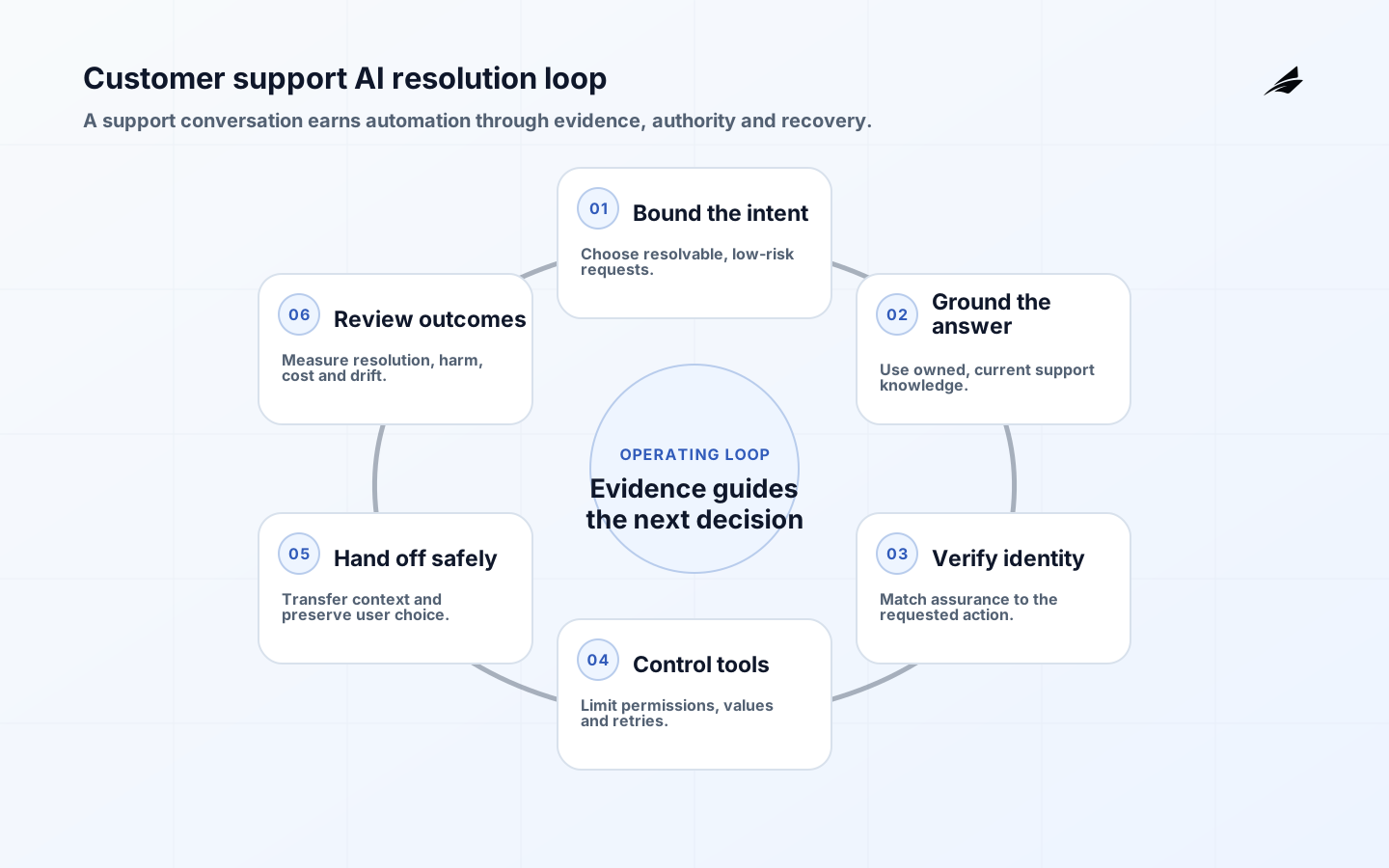
Conversational AI for customer support should resolve a defined customer need, not merely produce fluent replies. A dependable service understands a bounded intent, retrieves approved information, verifies identity when necessary, performs only authorized actions and transfers the case to a person without making the customer repeat the story. This plan turns those requirements into a sequence a product, support and engineering team can deliver.
Start with Edilec's conversational support implementation checklist for release evidence, use the support AI FAQ when choosing patterns, and connect the work to the wider business process solutions plan. The assistant is one component in a support operating system; knowledge ownership, case routing and recovery still determine whether the customer gets help.
Key takeaways
- Begin with a narrow set of intents that have clear resolution evidence and a safe fallback.
- Separate answering from acting; account changes need identity, authorization, validation and audit controls.
- Evaluate complete conversations, including retrieval, tools and handoff, rather than model output alone.
- Measure verified resolution and repeat contact alongside containment, latency and cost.
- Fund knowledge maintenance, quality review and incident response as ongoing service work.
Scope the customer outcome and authority
Choose two or three high-volume intents by reading real conversations and observing agents. Good starting candidates have a stable policy, a recognizable request, a short resolution path and a reversible or read-only outcome. Order status, opening hours, warranty eligibility and a guided troubleshooting step are often easier than complaints, hardship, regulated advice or suspected fraud. Volume alone is not enough: an intent with many hidden exceptions can consume more review effort than it saves.
Write an intent contract. Name eligible users, channels, supported languages, required facts, permitted answer sources, allowed tool calls, prohibited outcomes, escalation conditions and proof of resolution. Define what the system must say when evidence is missing. The NIST AI RMF organizes risk work through Govern, Map, Measure and Manage; an intent contract makes that work concrete for one support journey.
| Intent characteristic | Recommended starting pattern | Required evidence | Avoid when |
|---|---|---|---|
| Stable informational answer | Grounded answer with citations | Current approved article and retrieval test | Policy varies by customer or jurisdiction |
| Read-only account lookup | Authenticated workflow plus response | Identity test and source-system status | The channel cannot provide suitable assurance |
| Reversible account change | Constrained tool with confirmation | Authorization, validation, audit and rollback | Downstream effects cannot be reversed |
| High-consequence judgment | Human-led case with AI assistance | Reviewer competence and visible provenance | The assistant could appear to make the decision |
Design the complete resolution path
The runtime path should preserve state across intent detection, retrieval, clarification, identity, tool execution and handoff. Give each knowledge item an owner, audience, market, effective date and review date. Retrieve only content the current customer and agent are allowed to see. When sources conflict or the answer is not supported, ask a focused question, offer a human route or state that the information cannot be confirmed.

Treat tool calls as privileged transactions. The model may propose a typed action, but deterministic code should validate identity, authorization, allowed values, prerequisites and idempotency before execution. Display a plain-language confirmation for consequential changes. Keep tool credentials outside prompts, restrict them by purpose and environment, and reject unexpected arguments. The OWASP guidance for LLM and generative AI is useful for threat modeling prompt injection, sensitive disclosure and excessive agency.
Handoff is a product feature, not a failure bucket. Transfer the customer's request, authenticated state, relevant transcript, attempted steps, retrieved sources and tool results. State the expected wait and preserve an alternative channel. Let the customer request a person at any point. A handoff that silently creates a ticket while implying live help has arrived damages trust even if the underlying routing technically succeeds.
Evaluate conversations before and after launch
Build an evaluation set from representative, difficult and out-of-scope conversations. Include misspellings, short replies, emotional language, accessibility needs, ambiguous identity, stale knowledge, conflicting documents, malicious instructions and unavailable tools. Label the expected outcome and unacceptable outcome, not one ideal sentence. Score whether the assistant understood the request, used permitted evidence, chose the right action, communicated uncertainty and completed or escalated correctly.
Run deterministic tests for routing and tool contracts, model-based or rule-based graders for scalable signals, and sampled human review for nuanced quality. Calibrate automated graders against reviewers and preserve disagreement. The NIST Generative AI Profile emphasizes pre-deployment testing and incident disclosure among its risk-management considerations; these practices should continue after model, prompt, policy or knowledge changes.
| Metric | What it answers | Useful denominator | Common trap |
|---|---|---|---|
| Verified resolution rate | Did the need stay solved? | Eligible conversations with outcome evidence | Counting a confident final reply as resolution |
| Repeat contact rate | Did customers return for the same issue? | Resolved intents within a defined window | Ignoring channel switching |
| Safe handoff rate | Did escalation preserve context and access? | Conversations requiring a person | Treating every transfer as success |
| Unsupported-answer rate | Were claims missing approved evidence? | Reviewed substantive answers | Reviewing only customer complaints |
| Cost per resolved case | Is the service economically useful? | Verified resolutions | Excluding review, platform and support labor |
Protect people, data and access
Minimize the personal data sent to models, logs and evaluation stores. Redact secrets and unnecessary identifiers before telemetry leaves the application boundary. Define retention by purpose and restrict transcript access by role. The ICO guidance on AI and data protection describes a risk-based approach to lawfulness, fairness, transparency and individual rights; teams must map equivalent duties for every jurisdiction in which the service operates.
Support cannot become chat-only by accident. Preserve keyboard navigation, screen-reader semantics, visible focus, sufficient time, text resizing and a non-conversational route. Test with users who rely on assistive technology and with people who have cognitive, language, hearing or speech-related access needs. The W3C's digital accessibility user requirements include work on natural-language interfaces and provide a useful requirements starting point, while applicable accessibility standards remain the acceptance baseline.
Plan cost, rollout and ownership
Model cost per eligible conversation and per verified resolution. Include model input and output, retrieval, reranking, speech services, tool calls, observability, storage, human review, agent handling, vendor support and engineering. Segment by intent and channel because a short tracking answer and a long troubleshooting conversation have different economics. Add sensitivity ranges for retries, context growth, peak concurrency, model changes and escalation.
Release in stages: internal replay, agent-only assistance, a small authenticated audience, limited production traffic and broader availability. Use a kill switch and independent fallback. At every gate, compare against the prior support path on resolution, customer effort, safety, agent workload and cost. Roll back when unsupported answers, failed tool actions or inaccessible interactions exceed the agreed threshold, even if containment looks attractive.
Assign a service owner, knowledge owners, an engineering owner, support operations, security, privacy, accessibility and model-risk roles. Define who can approve a new intent, model, tool permission or knowledge source. Review incidents and near misses with the same seriousness as conventional production failures. A vendor can host components, but it cannot own the organization's customer promise or legal accountability.
Worked example: authenticated delivery rescheduling
A retailer chooses delivery rescheduling because policy is stable and the action is reversible within a defined window. The intent contract excludes international shipments, address changes, hazardous goods and orders already loaded. The assistant may explain options without identity, but it must use an authenticated session before retrieving an order or presenting customer-specific dates.
The application retrieves current carrier slots through a read-only tool, displays allowed dates and asks for confirmation. Deterministic code checks order ownership, rescheduling cutoff, address and allowed date before the change tool runs with an idempotency key. If the carrier times out, the service queries the transaction before retrying and tells the customer that confirmation is pending rather than claiming success.
Evaluation covers duplicate confirmation, expired slots, two orders in one conversation, a request to change address and a customer who asks for a person. Operations measure sustained reschedule success, repeat contact, tool uncertainty and handoff resolution. The team expands only after reconciliation shows that carrier and order systems agree. This example demonstrates why the valuable unit is a verified resolution, not a completed chat.
The release record names the eligible order types, policy version, identity level, tool scopes, evaluation set, rollback owner and next review date. That compact artifact helps support, engineering and risk teams distinguish an approved capability from a new behavior that appeared through configuration drift.
Conversational AI release checklist
- Intent contract names eligible cases, prohibited outcomes and escalation triggers.
- Knowledge sources have owners, effective dates, access rules and freshness tests.
- Tool calls use typed schemas, least privilege, confirmation, idempotency and audit logs.
- Evaluation covers normal, adverse, multilingual, accessibility and outage scenarios.
- Dashboards join technical telemetry to verified customer and agent outcomes.
- On-call staff can disable actions, change routing and communicate incidents.
Frequently asked questions
What is a good containment rate?
There is no universal target. Set it by eligible intent after establishing verified resolution, repeat contact, complaint and safety measures. A lower containment rate with accurate routing can be healthier than a high rate that traps customers.
Does retrieval eliminate hallucinations?
No. Retrieval can return irrelevant, stale, conflicting or unauthorized material, and a model can still misstate it. Test retrieval and answer support separately, show useful provenance and provide a safe response when evidence is weak.
Should every support intent use the same model?
Not necessarily. Route by task requirements, latency, language, context and consequence. Deterministic workflows or search may be better for some intents. Any routing policy needs versioned evaluations and a fallback.
Conclusion
Conversational AI for customer support creates value when it completes a bounded job safely and leaves the customer with a clear next step. Scope authority, engineer the full resolution path, evaluate real conversations, preserve accessible human help and measure outcomes after the chat ends. That operating discipline matters more than how convincingly the assistant can talk.