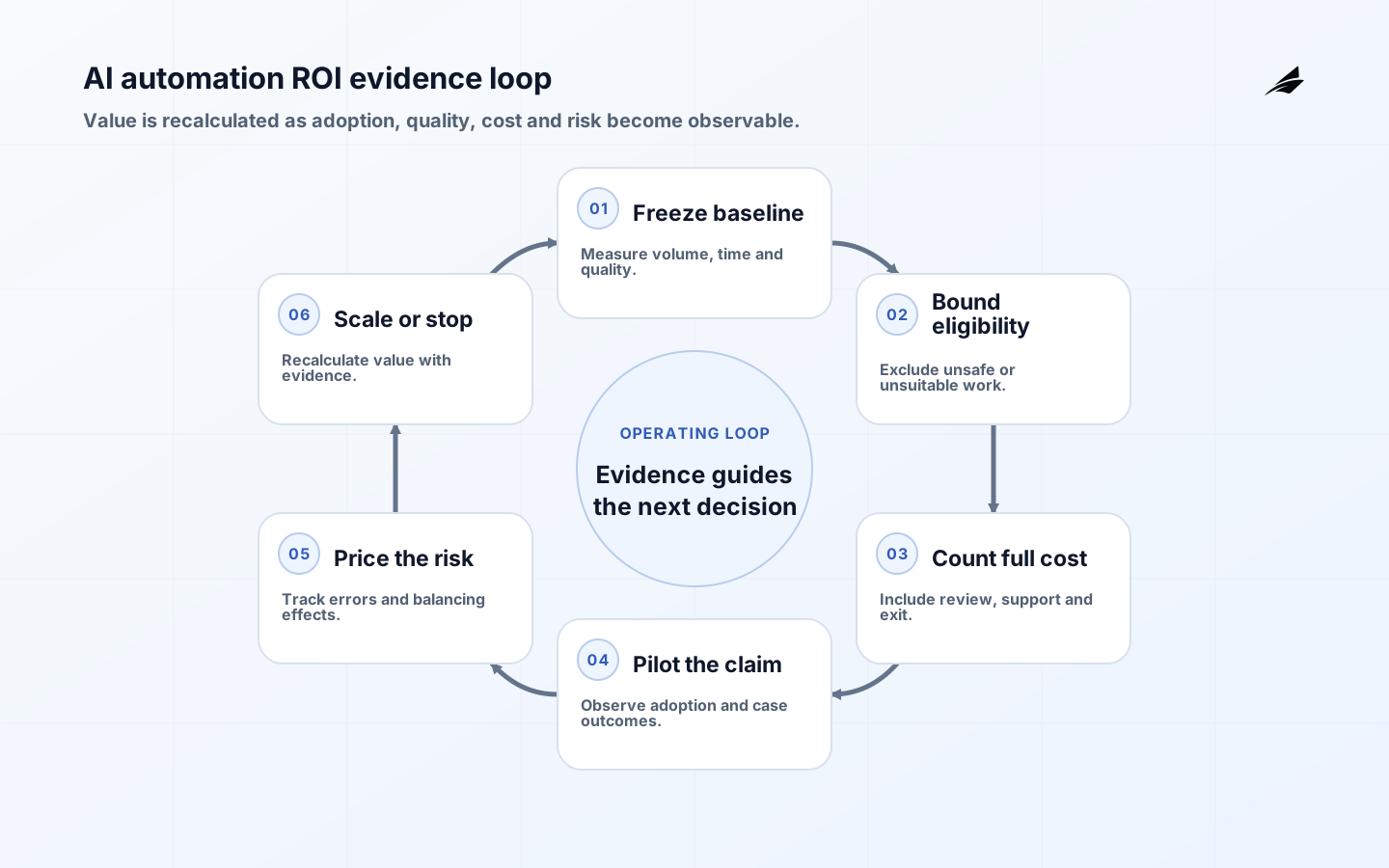
AI automation ROI planning is credible only when it models a real workflow, not a model demonstration. The value comes from changed operating outcomes after human review, exceptions, adoption, controls, and support are included. Use this guide with Edilec’s IT manager ROI framework, ROI planning mistakes guide, and human escalation design guide.
Establish the operating baseline
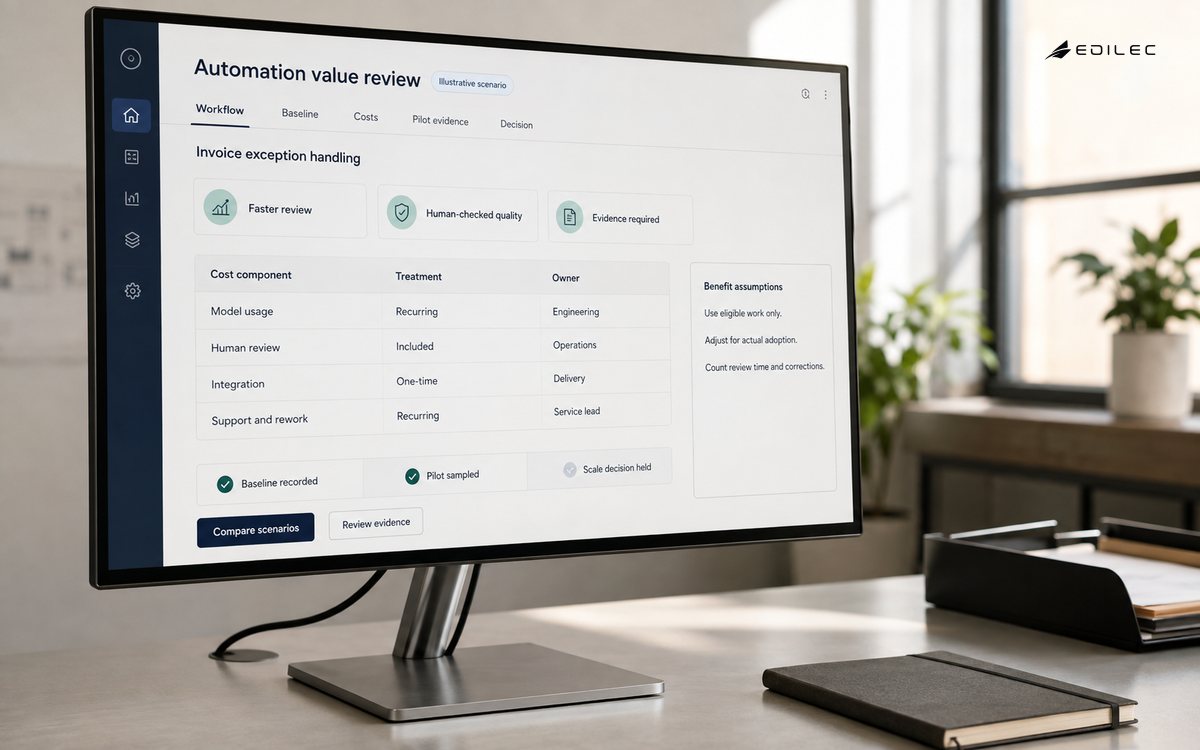
Build the ROI baseline from a defined unit of work and a representative period. For invoice exception handling, count eligible invoices, seasonal mix, end-to-end cycle time, active analyst minutes, handoffs, corrections, escalations, duplicate payments avoided, and cost of upstream and downstream systems. Separate time spent on standard cases from complex tax, supplier, or purchase-order exceptions. Sample work directly and reconcile it with system reports; queue timestamps often include waiting that cannot become labour savings. Record current quality, service level, backlog, and business loss so speed is not valued at the expense of accuracy. Note confidence intervals and data gaps. Adoption, automation rate, and future model performance belong in the assumption register, not the baseline. This factual starting point makes later comparisons resistant to volume changes, case-mix shifts, and optimistic recollection.
| What to inspect | Evidence to collect | Decision it informs |
|---|---|---|
| Demand and variation | Weekly volume, peaks, channels, and incomplete inputs. | Whether the change covers representative demand. |
| Decision complexity | Rules, judgment calls, delegated authority, and policy exceptions. | Which work may assist and which must remain human. |
| Quality and delay | Corrections, returns, complaints, queue age, and service commitments. | Which outcome matters beyond speed. |
| System context | Sources of truth, permissions, identifiers, and retention. | Whether integration and evidence are feasible. |
| Accountability | Named operator, policy owner, technical owner, and escalation contact. | Who can change, pause, or review the service. |
Set a bounded first scope
Select a pilot where the AI contribution and the business outcome can be isolated. An invoice example might cover one legal entity, one document format, matched purchase orders, and a draft exception classification reviewed by accounts-payable staff. Exclude handwritten documents, new suppliers, tax anomalies, and final payment authorization until separate evidence exists. Define the eligible population from source fields, the output schema, reviewer decision, confidence or abstention policy, correction capture, and manual fallback. State what value is being tested—reduced analyst touch time, faster exception routing, or fewer avoidable errors—and prevent double counting among them. The AI automation ROI planning for IT managers discusses related implementation choices. A bounded scope makes cost per eligible item, review burden, failure causes, and realized capacity observable before a broad business case is approved.
- Name the user, outcome, and decision served by the first release.
- Specify accepted inputs, missing-information handling, and rejected-input reasons.
- Preserve the record identifier and source evidence with every result.
- Set a confidence or policy threshold for human review.
- Choose a small cohort and a representative evaluation period.
- Define the rollback path before production actions are enabled.
Design controls into the workflow
Price controls as part of the service rather than treating them as nonproductive overhead. The NIST AI Risk Management Framework offers practical Govern, Map, Measure, and Manage functions for assigning ownership, understanding context, evaluating performance, and responding to risk. For the pilot, include identity checks, source access, data minimization, output validation, reviewer authority, sampled quality assurance, audit events, incident handling, vendor oversight, and retention. Increase review and segregation when an output could affect payment, access, employment, safety, or legal position. Model the labour and latency of these controls in unit economics; a proposal that assumes human review but omits reviewer time overstates return. Design an interface that gives reviewers source evidence and a clear correction route, because unusable safeguards become hidden manual work or are bypassed under volume pressure.
| Control | Practical implementation | What to review |
|---|---|---|
| Access boundary | Use role-based access and restrict sources to the task purpose. | Unexpected users, data paths, and privilege changes. |
| Evidence trail | Store source reference, proposed result, human decision, and timestamp. | Whether a later reviewer can reconstruct the case. |
| Human handoff | Route conflicting evidence or policy exceptions to a named queue. | Queue age, resolution quality, and repeated causes. |
| Change control | Version instructions, rules, integrations, and evaluation cases. | What changed and whether quality moved afterward. |
| Recovery | Allow pause, correction, replay, and manual completion. | Whether a failure can be contained without losing work. |
Run a pilot that tests the claim
Run the pilot prospectively against pre-registered acceptance criteria. Randomly assign or time-match eligible work to assisted and current-process cohorts where operations allow, and keep case mix visible. Measure analyst touch time, end-to-end time, completion, corrected outputs, escalations, downstream errors, reviewer acceptance, system and token use, support effort, and control exceptions. Analyse both per eligible item and per successfully completed item so low coverage cannot masquerade as efficiency. Inspect high-value, low-confidence, corrected, and abstained examples with operators. Record model, prompt, retrieval, policy, and interface changes during the trial; otherwise improvement caused by iterative tuning will be attributed incorrectly. Include a post-pilot observation period for rework that appears later. The decision is whether measured benefits survive review, integration, support, and exception costs at expected volume—not whether the system performs well on a curated demonstration set.
- Test clean, incomplete, duplicate, conflicting, and urgent cases.
- Ask operators why they accepted, corrected, or rejected a result.
- Measure handoff time and burden shifted to exception reviewers.
- Check records and permissions after integration failures.
- Rehearse a pause, rollback, and manual catch-up procedure.
- Set a decision meeting to approve, revise, extend, or stop.
Price the full service
Construct a total-cost schedule across discovery, process redesign, data preparation, integration, security and privacy review, evaluation, user experience, deployment, change management, and contingency. Recurring costs include model inference, retrieval or storage, platform licences, observability, human review, exception handling, vendor support, incident response, re-evaluation, prompt or model maintenance, and upstream-data changes. Allocate shared platform and governance expense with a stated method, and run sensitivity ranges for volume, coverage, token or compute price, reviewer minutes, error cost, and adoption. Distinguish cash savings from redeployed capacity: saved minutes create financial return only when staffing, overtime, outsourcing, backlog, or additional productive output changes measurably. For quality and speed benefits, agree a defensible monetary proxy and avoid valuing the same improvement twice. Report cost per eligible, assisted, and accepted transaction so selective automation remains visible.
Operate, learn, and change deliberately
Reforecast value with production evidence at an agreed monthly or quarterly cadence. Compare eligible volume, actual adoption, automation coverage, reviewer minutes, corrections, exception backlog, downstream defects, service availability, usage charges, support labour, and realized business outcomes with the approved ranges. Explain variance by case mix, source changes, model or prompt revisions, user behaviour, and work displaced to other queues. Finance should recognize savings or capacity only under the original rules; operations should confirm that service and quality have not deteriorated. Sample cases as well as totals to detect under-reporting or avoidance. The NIST Cybersecurity Framework is a useful companion for maintaining governance, protection, detection, response, and recovery as the service changes. Use each review to continue, constrain, improve, or retire the investment—not merely to refresh a benefits dashboard.
Worked example: service-email triage economics
Assume a team receives 20,000 service emails a month and proposes AI classification and draft replies. Baseline volume by type, handling-time distribution, wait time, routing error, reopen rate, quality defects, and peak staffing. The addressable share excludes sensitive, ambiguous, unsupported-language, and high-impact cases. Estimate minutes avoided only for cases where the draft is accepted after review; subtract review, correction, escalation, quality sampling, and new exception work. Apply expected adoption rather than assuming every agent uses the feature.
Count discovery, integration, evaluation, security, privacy, change management, training, licenses, inference, observability, human review, incident response, model or prompt updates, vendor management, and exit. Compare a low, expected, and adverse case. During the pilot, calculate contribution from observed case-level evidence and track balancing measures such as wrong routing, inappropriate replies, customer effort, employee workload, and subgroup performance. Scale when the expected case remains positive at realistic volume and risk; narrow or stop when control cost or harm erases the benefit.
Key takeaways
- Start with observed work and name the decision that matters.
- Keep the first scope bounded, reversible, and owned by operators.
- Make evidence, access, escalation, and recovery part of design.
- Test representative difficult cases, not just favourable demonstrations.
- Count operating cost and review effort alongside delivery cost.
- Use a recurring review to decide what should change next.
Frequently asked questions
What is the smallest sensible starting point?
The smallest sensible start is one measurable AI assist inside an existing controlled process. Choose a frequent, reversible task with reliable source evidence—for example, proposing a category for one invoice type while a trained analyst confirms it. Use one cohort, one output schema, one review queue, and one fallback. Instrument time, acceptance, correction, abstention, support, and usage from the first case. This scope is large enough to test economics and small enough to trace every failure without exposing a consequential final decision to unproven automation.
How should success be measured?
Measure the stated value equation. The numerator should be realized labour, throughput, quality, loss avoidance, or cycle-time value under finance-approved rules; the denominator should include delivery amortization and full recurring service cost. Alongside ROI, report eligible volume, coverage, adoption, reviewer effort, corrections, abstentions, exceptions, downstream outcomes, and cost per accepted item. Compare with a credible baseline or control and adjust for case mix. Assign investigation and stop thresholds so an attractive average cannot conceal shrinking coverage, transferred work, or costly failure classes.
When should a team stop or redesign the work?
Pause or redesign when production quality misses the pre-agreed boundary, reviewers cannot verify outputs, sensitive data cannot be controlled, manual exceptions consume the expected benefit, adoption stays below the viable range, or total unit cost exceeds the valued outcome. Also stop when downstream harm cannot be reconciled or the fallback lacks capacity. Document the tested hypothesis, observed ranges, failure causes, sunk and avoidable costs, reusable assets, and conditions for reconsideration. Ending a weak case early preserves capital and produces evidence for a better-scoped opportunity.
Conclusion
A credible AI automation ROI case connects a defined unit of work, measured baseline, bounded intervention, controlled pilot, and full lifecycle cost. Separate evidence from assumptions, price human review and exceptions, and recognize benefits only when operations and finance can observe them. Reforecast with production cohorts and representative cases. This approach supports expansion when value survives real service conditions—and an informed stop when it does not.