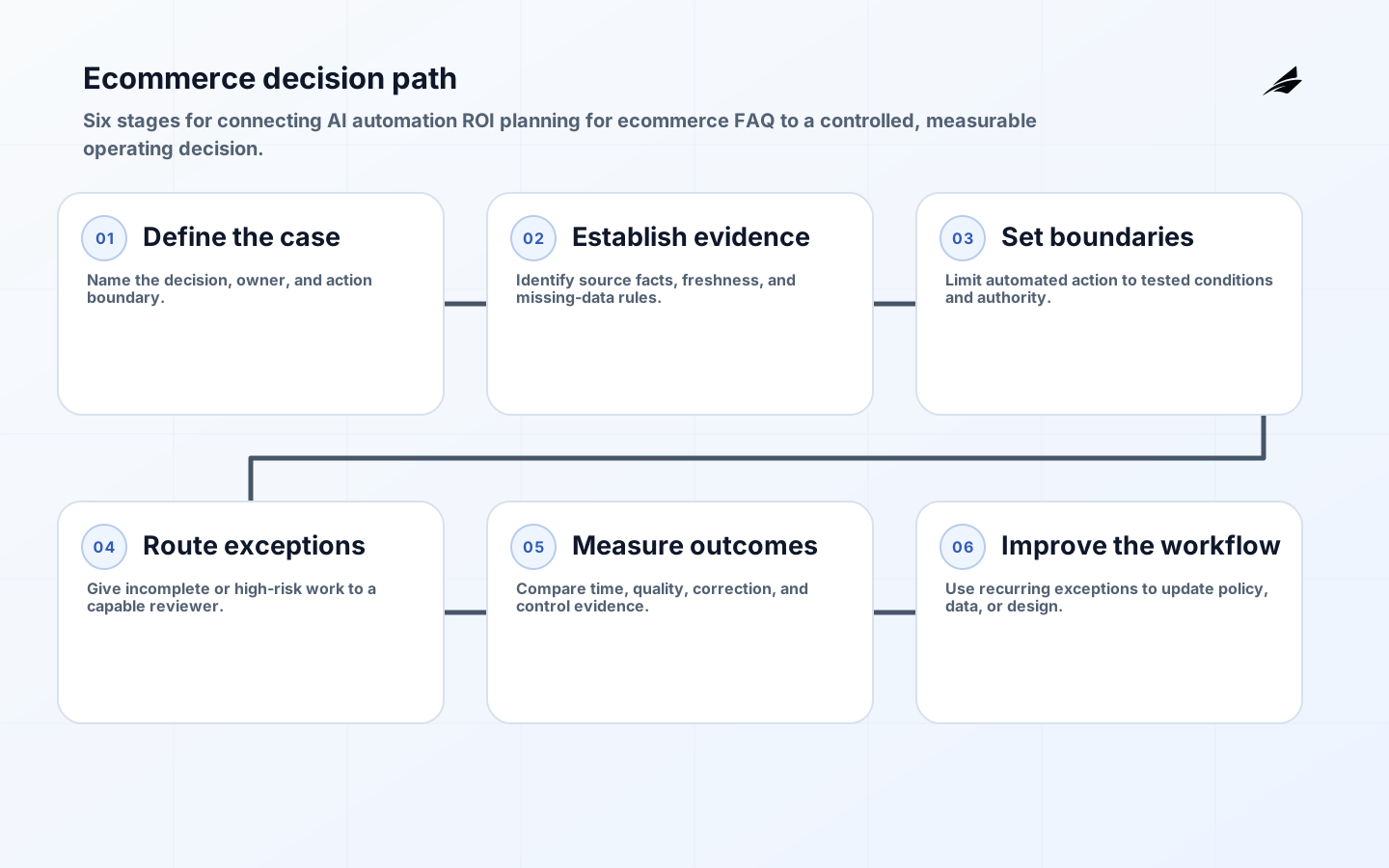
AI automation ROI planning for ecommerce FAQ should begin with a business decision, not a model selection exercise. In ecommerce, teams often see a tempting queue of repetitive work in product-content operations, service-request routing, returns decisions, and merchant back-office review. The useful question is whether a proposed system can improve a measurable improvement in customer and team work, rather than a polished demonstration with no accountable owner. That requires a baseline: who performs the work now, what evidence they consult, how often the decision is corrected, and what happens when the input is incomplete. Treat an estimate of time saved as a hypothesis until it is tested against a real operating period. A credible plan also prices the work that remains human: review, exception handling, access administration, quality sampling, and incident response.
Define the operating case
Start by naming the customer interaction, order exception, product attribute, or return request and the decision: whether a proposed automation should progress, pause, or be redesigned. Put a business owner beside a technical owner, then write the action boundary in plain language. For example, a system may summarize and route a complete request, but it should not invent evidence, override a required control, or communicate a commitment outside the approved policy. Describe the current path from intake through decision and correction. Capture volumes and variation, but do not assume a high-volume task is a good first candidate; a low-volume decision with expensive errors may deserve more attention. The first release should improve one bounded path and leave a visible way to stop, correct, and learn.

Build an ROI baseline people can challenge
| Baseline component | What to capture | How it changes the decision |
|---|---|---|
| Work demand | Count customer interaction, order exception, product attribute, or return requests by type, urgency, channel, and incomplete-input rate over a representative period. | Separates stable routine work from exceptional work that needs a different design. |
| Human effort | Record touch time, waiting time, handoffs, and the evidence reviewers actually use. | Prevents a savings estimate that ignores coordination, follow-up, and quality review. |
| Quality cost | Track corrections, reversals, missed deadlines, and the business consequence of hallucinated product claims, privacy leakage, uneven customer treatment, and unmeasured manual rework. | Sets a guardrail: faster processing is not value when the correction cost rises. |
| Change cost | Budget integration, data cleanup, testing, training, monitoring, and the owner time needed after launch. | Makes the investment comparable with a manual improvement or simpler workflow redesign. |
Make evidence and data fit the decision
An automation should receive only the information needed for its declared action. Identify the source of truth for each material fact, its freshness expectation, and the role permitted to change it. Distinguish a missing value from an uncertain value and an out-of-date value; collapsing those conditions invites confident but wrong output. Test representative normal cases alongside difficult cases: conflicting records, late updates, unfamiliar language, duplicate submissions, and a request that should be refused. Keep a retrievable record of the source references, the route chosen, the recommendation or draft, the human override, and the final outcome. That record supports quality review without pretending that a log alone proves the system was correct. Use the NIST AI Risk Management Framework to structure ownership and risk discussion, the Generative AI Profile to examine model-specific failure modes, the Secure Software Development Framework for build discipline, and the OWASP Application Security Verification Standard when the workflow exposes an application or integration surface. In ecommerce, also test catalog changes, promotion windows, and a customer request that arrives after a policy update; the decisive fact can change within a trading day. This AI-0717 plan focuses on ai automation roi planning for ecommerce faq.
- Define the minimum facts required before the system can act on a customer interaction, order exception, product attribute, or return request; route incomplete items to a named owner instead of guessing.
- Version the policy, prompt, routing rules, and source mappings so a later reviewer can explain what governed a specific decision.
- Separate production records from test material and remove or protect sensitive fields before they reach an evaluation environment.
- Sample outcomes by risk and scenario, not only by average accuracy; rare, consequential cases deserve deliberate review.
- Record the source timestamp and retrieval time when freshness can change the appropriate whether a proposed automation should progress, pause, or be redesigned.
- Set retention and deletion rules for inputs, outputs, and logs that reflect contractual, regulatory, and operational needs.
- Give reviewers a way to mark the reason for an override, because a correction is feedback about the workflow, not merely a failure.
- Test access with real roles and least privilege; service accounts should not inherit broad human permissions for convenience.
Design controls around exceptions
The core control is not a generic “human in the loop.” It is a specific person with authority, context, and time to act when the system reaches its boundary. Define thresholds that trigger review, the evidence a reviewer sees, and the rule for resuming work after a correction. Ensure that urgent handling does not erase the normal approval or evidence trail. A useful exception queue shows age, priority, owner, missing information, and the reason an item was routed there. Review recurring exceptions jointly with process owners and developers; recurring exceptions often reveal an ambiguous policy, an upstream data problem, or a workflow that should remain human-led. Risk treatment should be proportionate to hallucinated product claims, privacy leakage, uneven customer treatment, and unmeasured manual rework, not copied wholesale from another use case.
| Control question | Practical control | Operating signal |
|---|---|---|
| Who may act? | Map roles, delegated authority, and escalation for the whether a proposed automation should progress, pause, or be redesigned; enforce the boundary in the workflow. | Unauthorized route attempts, privilege changes, and decisions awaiting an owner. |
| What may be automated? | Allow only bounded actions with validated inputs; require review for conditions outside the tested envelope. | Override rate, false escalation rate, and outcomes reversed after action. |
| Can the result be explained? | Retain the input references, rule or policy version, route, and final human decision in one case record. | Cases that cannot be reconstructed during a sample or incident review. |
| Can work recover? | Provide a pause, manual route, retry rule, and tested restoration procedure for integration or model failure. | Queue age, retry volume, duplicate processing, and recovery time after disruption. |
Release in stages and measure the whole workflow
Use a staged release: observe the current workflow, run the proposed route in shadow or advisory mode, enable a limited action for a controlled group, then expand only when quality and ownership evidence holds. Compare the system with the baseline at the same mix of work. Monitor time to resolution, sampled accuracy, assisted completion, rework volume, and customer-impacting exceptions, but also speak with the people receiving exceptions; an apparent efficiency gain may be a transfer of difficult work into an unmeasured queue. Assign a review cadence with authority to change routing, pause automation, or retire it. ROI is earned when the organization can show a sustained improvement after the cost of operating controls, correction work, and change management is included.
Key takeaways
- AI automation ROI planning for ecommerce FAQ is credible only when it measures a bounded decision against a real baseline.
- Start with product-content operations, service-request routing, returns decisions, and merchant back-office review; avoid automating a broad category before evidence, ownership, and exception behavior are known.
- Treat quality, correction effort, and control operation as ROI inputs, not overhead that can be excluded from a business case.
- Keep source facts, route logic, reviewer action, and final outcome connected so that a disputed customer interaction, order exception, product attribute, or return request can be understood.
- Expand only after real users can resolve exceptions without private knowledge or an informal side channel.
- Use measured outcomes to improve the process itself; the best next step may be a policy or data fix rather than more automation.
Frequently asked questions
How should a team calculate ROI? Compare the fully loaded cost of the current path with the fully loaded cost of a controlled future path, including integration, review, monitoring, correction, and training. Do not count a predicted time saving until the work mix and quality sample support it. What is a sensible first release? Choose a reversible, bounded decision with a clear owner and enough historical cases to test, rather than the most politically visible process. When is human review required? Require it where the evidence is incomplete, the action crosses an authority threshold, the potential harm is high, or the case falls outside tested conditions. Can a small team use formal controls? Yes: a named owner, written threshold, case record, and periodic sample are more valuable than elaborate documentation nobody operates. How often should ROI be revisited? Review after meaningful policy, volume, data, model, or integration changes and at a sustainable routine cadence. For ecommerce teams, the review should also test the scenario that changes the authority, evidence, or timing of the AI automation ROI planning for ecommerce FAQ. Its decision record is tailored to AI-0717, not copied from a neighboring workflow.
Conclusion
A useful AI automation ROI planning for ecommerce FAQ plan makes the next operational decision easier to take and easier to defend. Give the workflow a bounded purpose, traceable evidence, a capable exception owner, and measures that include quality as well as speed. That is how an organization earns value from automation without making its important work harder to trust.