Business Process Solutions FAQ
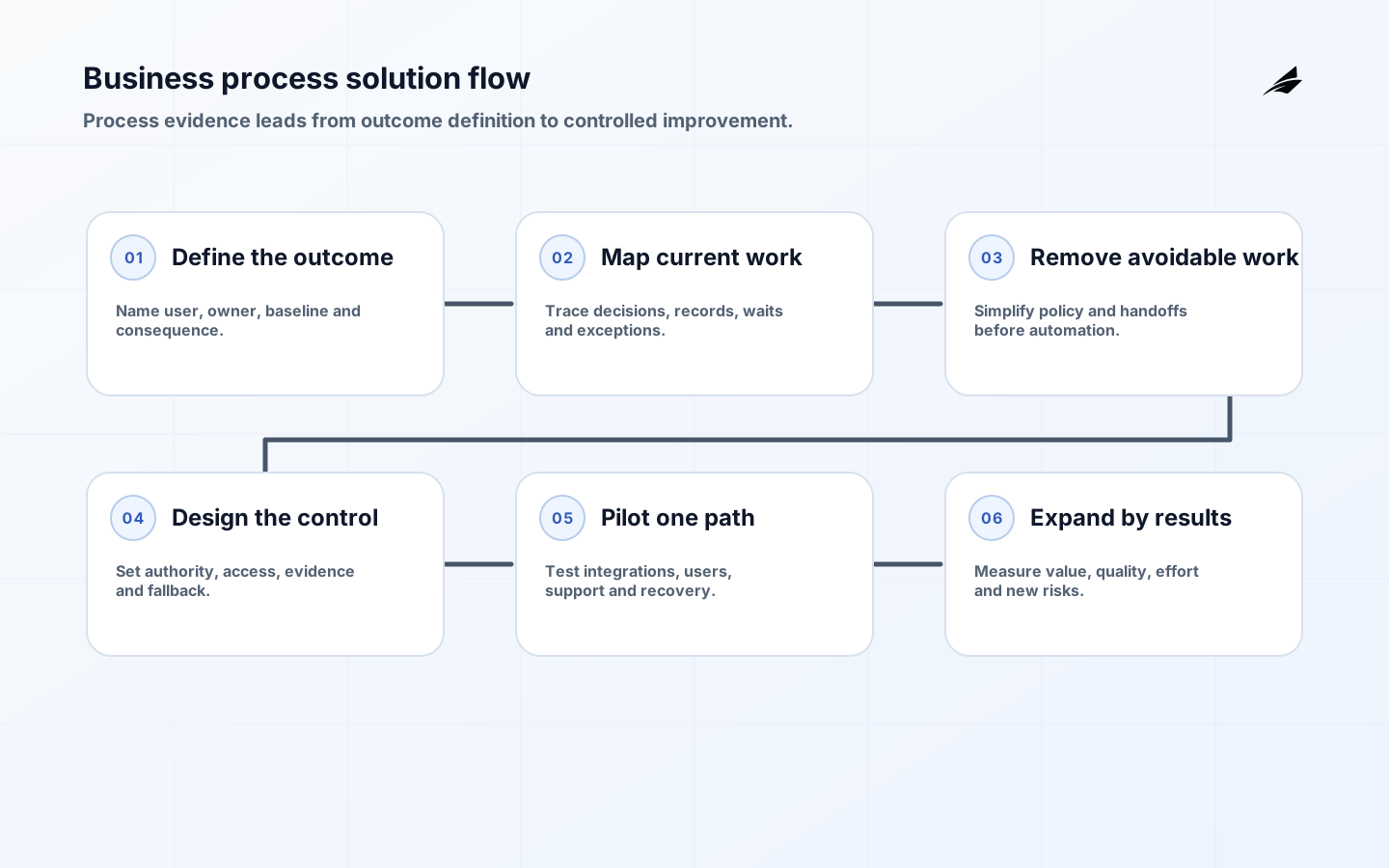
Business process solutions combine process design, roles, policy, information, integration, and technology to improve a repeatable business outcome. They are not synonymous with buying a workflow tool or automating every step. This business process solutions FAQ builds on Edilec’s scope and delivery guide, implementation checklist, and data and AI guide.
What makes a solution useful?
A useful solution improves a defined outcome for a named user without shifting hidden cost or risk onto the next team. It may reduce a wait, eliminate rekeying, make status visible, or ensure that exceptions reach the right expert sooner. Start with evidence from actual work rather than a generic claim of efficiency. Map a recent case, including the places where someone searched for information, corrected a record, or used personal judgment. Then decide whether the right intervention is a policy change, a clearer interface, an integration, an automation, or a combination. If a proposed system cannot describe its intended outcome and its boundaries in plain language, it is too early to choose technology.
| Question | A useful answer includes | Warning sign |
|---|---|---|
| What improves? | A specific user outcome and time or quality boundary. | Only a vague promise of transformation. |
| Who owns it? | A business decision owner and operating contact. | Ownership delegated entirely to a vendor. |
| What can it decide? | A defined authority and escalation point. | Automatic action with no exception route. |
| How will it fail? | A safe fallback and communication plan. | A promise that the service will never fail. |
When should we automate?
Automate a step when its inputs and decision boundary are stable enough to state, the result can be checked, and an error will not cause disproportionate harm. Repetition alone is not enough. A high-volume process may contain exceptional cases where discretion protects customers, staff, or legal obligations. Begin with preparation, routing, or data validation when that preserves human judgment at the consequential point. In decision-support work, show the source context and a reason for a recommendation so reviewers can disagree intelligently. The point is not to preserve manual work for its own sake; it is to keep authority aligned with the uncertainty and consequence of the case.
- Automate deterministic checks before discretionary judgments.
- Use a review queue for missing, contradictory, or unusual information.
- Make any action affecting money, rights, safety, or access explicit.
- Allow an operator to correct the record without bypassing audit history.
- Revisit the rule when exception patterns change.
Who is accountable?
Accountability remains with the organization using the process, even when a software provider hosts the service or a consultant configures it. The business owner defines the intended outcome, acceptable trade-offs, and authority for exceptions. A technical owner maintains the interfaces, identity controls, changes, and monitoring. Frontline users contribute evidence about edge cases and workable recovery. Privacy, security, legal, and risk functions should be involved according to the process and jurisdiction, not added as a ceremonial final gate. The NIST Privacy Framework can help connect data choices to organizational privacy risk, particularly when a process combines information that was previously used in separate contexts.
| Role | Core decision | Routine evidence |
|---|---|---|
| Business owner | Outcome, scope, and exception authority. | Review of results and unresolved cases. |
| Technical owner | Integration, access, and release readiness. | Change record and service signals. |
| Process user | Whether the handoff works in practice. | Feedback, corrections, and workarounds. |
| Control partner | Whether risks are understood and treated. | Risk assessment and follow-up actions. |
What controls are needed?
Controls should be proportionate to the process. At minimum, know which system is authoritative, who may access each data set, how changes are approved, and where a significant action is recorded. Keep temporary access time-bound and ensure logs identify the action, actor, time, and relevant version. For systems that influence operational or customer outcomes, test the fallback rather than treating it as a document-only requirement. NIST SP 800-53 Rev. 5 is a detailed control reference; use it to ask better questions, not to claim that every workflow needs the same implementation.
How do we measure value?
Measure the outcome the user experiences and the work the organization absorbs to achieve it. Depending on the process, that can include completion time, queue age, first-pass quality, rework, escalation volume, abandonment, and the time required to resolve an exception. Establish a baseline before changing the workflow, then keep the population and period comparable. Interpret metrics with interviews and case review: a faster queue that creates more downstream corrections is not an unqualified gain. Avoid invented return-on-investment precision when key assumptions are uncertain. Instead, state the assumption, owner, and decision that would change if the evidence moves.
How should we roll out?
Roll out by limiting exposure, not by declaring a project finished. Pick a representative but bounded cohort, preserve the previous method long enough to recover safely, and make support easy to reach. Tell users what is changing, which cases should be escalated, and how to report a confusing result. Compare normal operations with the pilot, but also inspect rare cases that reveal hidden dependencies. A pause criterion is a sign of preparation, not pessimism. Management guidance such as ISO/IEC 42001 emphasizes ongoing monitoring and improvement; the local operating review is where that discipline becomes useful.
Worked example: redesign supplier onboarding
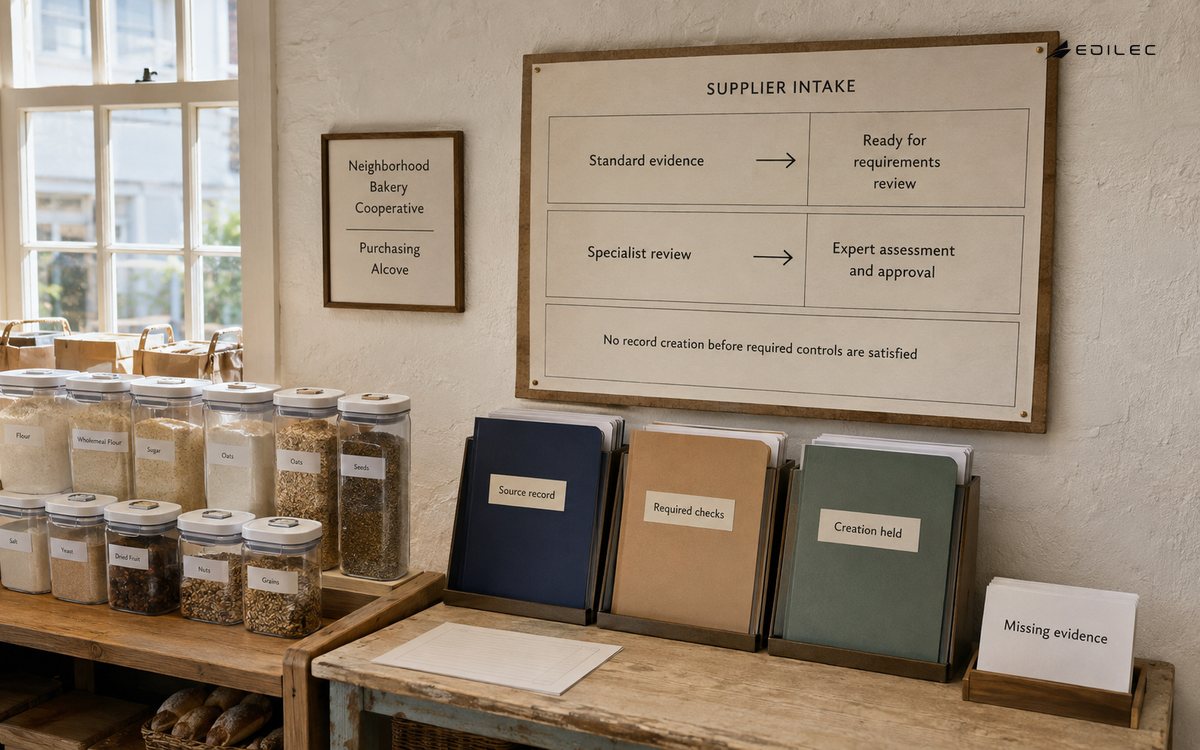
A supplier-onboarding problem may appear to be a missing portal, but evidence might show unclear evidence requirements, duplicate checks, inconsistent risk ownership, and no authoritative supplier state. Map the request from business sponsor through tax, sanctions, security, finance, contract, and ERP creation. Record the purpose, input, decision, owner, waiting time, exception, and system at each step. Remove duplicate or obsolete work before choosing automation.
A bounded first release could support domestic, low-risk suppliers with standard contracts while retaining an expert route for international, high-risk, or incomplete cases. Reuse verified identity and organization data, make decisions and missing evidence visible, and prevent ERP creation until required controls pass. Compare lead time, first-time completeness, rework, policy exceptions, control defects, supplier effort, support demand, and duplicate records with the baseline. Expand by evidence category or risk tier only after the operating owner can support it.
Which steps should remain manual?
Keep a step manual when judgment is rare but consequential, evidence is incomplete, policy is changing, or the organization cannot yet detect and recover from automation error. Manual does not mean uncontrolled: define who decides, what evidence they use, the permitted outcomes, the time expectation, and the record retained. Automate stable preparation, validation, routing, and notification around that decision first. Revisit the boundary when exception data shows a repeatable rule and the operating owner can accept the resulting risk.
Key takeaways
- Define the workflow and user outcome before selecting a platform.
- Keep consequential judgment with an accountable person or explicit authority.
- Use controls that fit the actual data and consequence.
- Treat pilots as evidence-gathering, with a planned pause route.
- Judge value by the whole workflow, including rework and recovery.
Frequently asked questions
Can a small team use business process solutions? Yes. A small team may gain most from clarifying a handoff, standardising an intake, or reducing duplicate entry; the solution does not need to be a large suite. Do we need a consultant? External help can be useful for unfamiliar capabilities or independent challenge, but ownership of the operating decision should not leave the organization. How often should we review the process? Review after material changes, significant incidents, or a recurring exception pattern, with a regular cadence that reflects the process consequence.
- Is a dashboard enough? No; it must lead to an owner, decision, or corrective action.
- Can we use production data in a pilot? Only with an appropriate purpose, access controls, and handling plan.
- What should users see? The current status, source or reason where appropriate, and a path to challenge or correct the result.
What should be documented?
Keep documentation close to the work and short enough that it is actually used. The useful minimum is a process purpose, owner, current map, authoritative data sources, decision authority, exception path, access expectations, release record, and manual fallback. Add a small set of examples showing normal and difficult cases. Update the record when a policy, system, role, or integration changes materially. Documentation should not become a substitute for talking with operators, but it gives those conversations a shared reference and prevents essential knowledge from living only with a project team. In a review, ask a new support person to use the material to trace a case and identify who can make a decision. Their experience is a practical test of whether the process is truly operable.
A practical review meeting should be short, case-based, and connected to action. Bring one routine case, one corrected case, one exception, and one example of work that happened outside the designed path. Ask what delayed the work, which information was missing, whether the solution made a decision understandable, and who owns the next correction. Review current access and temporary exceptions as part of the same discussion, because workarounds often reveal a mismatch between policy and operating need. Capture a small number of changes with an owner and target date, then return to the cases after the change. This cadence creates improvement without asking staff to treat every workflow as a special project. It also makes evidence from users visible to the people responsible for process priorities.
Conclusion
The right business process solution is the one a team can run responsibly on an ordinary Tuesday and a difficult one. Keep the initial question concrete, make accountability visible, and make recovery part of the design. Those choices produce a better basis for improvement than a broad promise of automation.