A digital automation services implementation checklist should prove that a workflow can run faster without making errors, exceptions or accountability harder to see. Automation may use rules, scripts, integration platforms, robotic process automation, machine learning, generative AI or combinations of them. The technology choice follows the work: stable deterministic tasks generally need deterministic controls, while probabilistic components require evaluation, uncertainty handling and human judgment appropriate to their effect.
Confirm the automation scope, cost and delivery plan before execution, and use the digital automation FAQ when stakeholders need to resolve tradeoffs. A completed checklist item should leave observable proof in the service: a process baseline, approved rule, interface contract, least-privilege identity, test result, dashboard, runbook or trained operating owner.
Select a workflow with measurable value
Document the workflow from trigger to completed business outcome. Identify roles, systems, records, volumes, arrival pattern, handoffs, queue time, touch time, error and rework categories, service commitment and seasonal variation. Observe real work and exceptions rather than relying only on the official procedure. A process with high volume can still be a poor candidate when inputs are unstable, policy is disputed or each case requires contextual judgment that cannot be reduced safely.
- Name the business owner and the people affected by the workflow.
- Measure current cycle time, quality, cost, backlog and escalation.
- Separate stable rules from judgment, negotiation and exception handling.
- Confirm the source of truth for every record the automation reads or changes.
- Define a successful completed case and the safe manual alternative.
- Set a learning budget and stop criteria for the first release.
Prioritize a bounded workflow that can expose representative integration and control needs. Avoid selecting a trivial demonstration that proves no production path or a mission-critical process with no rollback. Estimate benefit from completed outcomes: reduced waiting, fewer errors, improved compliance, released capacity or better customer service. Do not count every automated minute as financial return unless staffing, throughput or quality actually changes.
Redesign the process before automating it
Remove obsolete approvals, duplicate data entry and compensating steps whose original reason no longer exists. Clarify policy and decision authority. Standardize inputs only where that does not erase necessary variation. Design the target state with users who perform and receive the work. Automation of a confusing process often increases the speed and scale of confusion, while making frontline staff less able to correct it.
Specify normal flow, business exceptions, technical failures and deliberate abuse. For each branch, define action, owner, evidence, timeout and escalation. Decide when the automation should retry, wait, request human review, compensate a prior action or stop. Retries must be bounded and idempotent where possible so a timeout does not create duplicate payments, messages or records. Provide a case state that support teams can understand without reading raw platform logs.
| Workflow element | Implementation question | Acceptance evidence |
|---|---|---|
| Trigger | Is the event authentic, complete and deduplicated? | Replay and duplicate-event tests |
| Decision | Are policy, data and authority explicit? | Approved decision table and edge cases |
| Action | Is permission limited to the required transaction? | Scoped identity and authorization tests |
| Exception | Can a person understand and resolve the case? | Timed exception-handling exercise |
| Record | Is the authoritative state preserved and auditable? | Reconciliation and history review |
| Recovery | Can partial work be resumed, reversed or compensated? | Failure injection and recovery result |
Control data, records and retention
Inventory every field read, inferred, created and written. Record authority, meaning, quality expectation, sensitivity, permitted purpose, location, retention and deletion behavior. Minimize data movement and avoid copying production records into unmanaged development or prompt tools. Validate schemas and business constraints at interfaces. Decide how corrected source data affects queued or completed automation, and preserve lineage needed to explain a material decision.
If an AI component interprets documents or messages, create a representative evaluation set with approved handling. Measure failure categories, not only aggregate accuracy, and define abstention or review thresholds. The NIST AI Risk Management Framework supports continuous governance, context mapping, measurement and risk treatment. Apply it proportionately to affected people and decisions, including foreseeable misuse, harmful bias, privacy and transparency concerns.
Secure identities, integrations and software supply chains
Give each automation a managed workload identity rather than a shared human account. Scope access to exact systems, records and actions; separate development and production; rotate secrets; constrain network routes; and protect administrative access with strong authentication. Log security-relevant actions and alert on unusual volume, destinations, denied access and configuration changes. Maintain an inventory with owner, purpose, privileges, dependencies and retirement date so unattended automations do not become unknown access paths.
Treat scripts, connectors, prompts, packages and infrastructure as software. The NIST Secure Software Development Framework provides practices for protected development environments, well-secured software and vulnerability response. Use reviewed repositories, pinned and monitored dependencies, canonical builds, artifact integrity, security tests and controlled promotion. Threat-model malicious input, prompt injection, unsafe output use, connector compromise, secret leakage and excessive automated agency where applicable.
Build reliable, observable integrations
Prefer documented APIs and event contracts over fragile screen automation when viable. Define authentication, schema version, rate limits, pagination, timeouts, retries, idempotency, ordering and error semantics. When robotic interaction is unavoidable, isolate selectors, monitor target changes and keep a supported manual path. Contract tests should detect interface drift before production, while synthetic transactions can confirm that the end-to-end route still works.
Observe business state as well as technical health. Dashboards should show arrivals, completions, queue age, exception reasons, human review, duplicate prevention, downstream reconciliation, cost and version. Correlate a case across systems using a safe identifier. Alert when action is required, not merely when a component emits noise. Establish retention and access for logs so investigation evidence does not become an uncontrolled copy of sensitive content.
Run a six-stage automation delivery roadmap
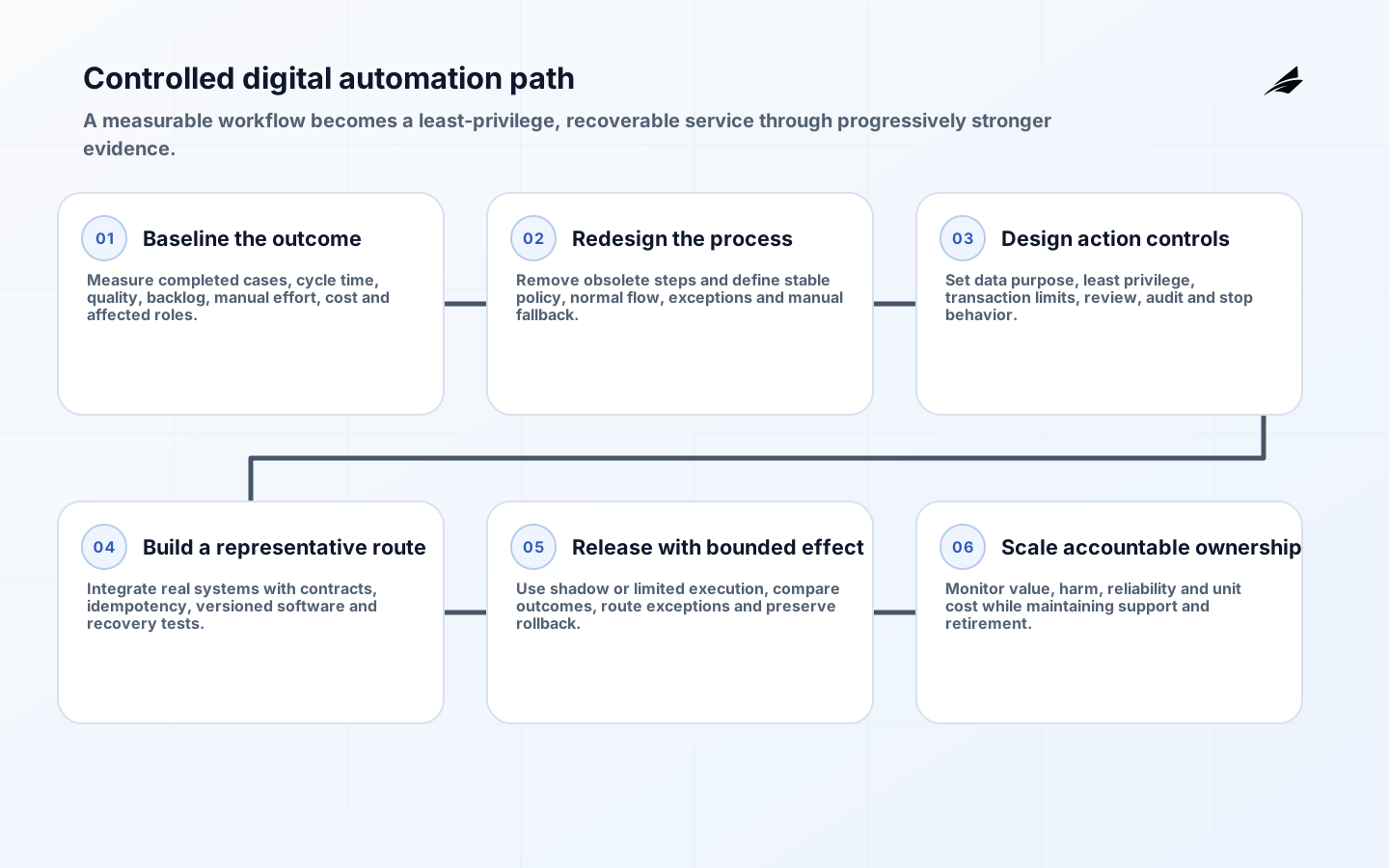
Move through outcome baseline, process redesign, control design, representative build, shadow or limited release, and scaled ownership. In shadow mode, compare proposed decisions without executing them when the workflow permits. Limited release can constrain users, transaction value, region or action type. Each stage should retire a named uncertainty and have rollback criteria. The roadmap keeps discovery and controls attached to delivery rather than turning them into separate documents.

Use repeatable release practices. DORA's continuous-delivery guidance emphasizes version control, test and deployment automation, continuous testing and fast feedback. Add workflow simulations, connector contract tests, authorization tests, reconciliation and versioned AI evaluation. Keep production releasable and use the normal pipeline for urgent fixes where possible, so emergency changes do not bypass the evidence needed most.
Design useful human review and change adoption
Human review needs a defined purpose. Show the source context, automation proposal, uncertainty or rule, prohibited actions and available alternatives. Give reviewers sufficient time and authority, and measure whether they detect seeded errors rather than merely clicking approval. Route cases by skill and workload. Capture override reason in structured form where appropriate, then use patterns to improve policy, data or design without penalizing legitimate challenge.
Explain how roles change, who supports exceptions and how employees can report unintended effects. The OECD accountability principle emphasizes traceability and systematic risk management throughout the AI lifecycle. Accountability should be reflected in operating roles, decision logs and escalation, not placed on an individual reviewer who lacks control over data, design or staffing.
Measure value, risk and operating cost
Compare production outcomes with the baseline: completion time, first-time-right rate, backlog, customer effect, compliance exceptions, manual effort and capacity. Segment results by case type and affected group so aggregate improvement does not conceal concentrated harm. Track false automation, missed cases, overrides and incidents. Use a controlled comparison or staged rollout when feasible. Agree who validates benefit and how often the business case is refreshed.
Count licenses, platform consumption, integration, model use, observability, security, support, human review, rework, supplier minimums and maintenance when source applications change. Report cost per correct completed case, not per bot run. Retire obsolete automations and licenses quickly after reconciliation. CISA's Cybersecurity Performance Goals can inform a practical security baseline, while the workflow's specific impact determines additional controls.
| Outcome | Metric pair | Gate question |
|---|---|---|
| Speed | End-to-end cycle time and queue age | Did waiting fall without hidden rework? |
| Quality | First-time-right and correction rate | Are records and downstream actions accurate? |
| Human impact | Review effort and override quality | Can people challenge and resolve exceptions? |
| Control | Unauthorized actions and reconciliation breaks | Are privileges and transaction limits effective? |
| Reliability | Completion and recovery time | Can partial failures be contained and resumed? |
| Economics | Cost and benefit per completed case | Does realized value justify ongoing ownership? |
Complete operating acceptance and retirement planning
Before scale, require approved process and decision rules, data map, threat model, access review, test and evaluation results, deployment record, monitoring, alert ownership, exception procedure, recovery exercise, unit economics, supplier contacts and a rollback. Have internal operators deploy a change, trace a case, stop execution, revoke access, reconcile a partial failure and explain the dashboard. Close temporary accounts and test data after acceptance.
Every automation needs a retirement trigger and procedure. Identify dependencies, scheduled work, credentials, retained records, active cases, contracts and manual alternatives. Stop new intake, finish or transfer queued cases, reconcile systems of record, revoke identities, remove integrations and retain only required evidence. Confirm users are not relying on old reports or notifications. A dormant automation with valid privileges is an unmanaged service, not a harmless archive.
Digital automation checklist takeaways
- Select a stable, measurable workflow with a safe manual alternative.
- Redesign policy and exceptions before encoding them.
- Use least-privilege workload identities and controlled software delivery.
- Test partial failures, duplicate events, retries and reconciliation.
- Measure correct completed outcomes and human impact, not bot activity.
- Accept scale only after operators can stop, recover and retire the service.
Frequently asked questions
Should we automate the highest-volume process first? Only if its rules, data and exception path are sufficiently understood. Is RPA obsolete when APIs exist? No; it can bridge systems, though APIs are often more stable and observable. Does adding AI make automation intelligent? It adds probabilistic capability and new risks; value depends on workflow fit. Can human approval make every action safe? No. Review can fail through overload, poor context or weak authority.
How many automations can one team support? Capacity depends on criticality, change rate, platform standardization and exception load; use service ownership and operational metrics. When should an automation be stopped? When material harm or control loss is credible, or when a bounded remediation cannot restore value and reliability. What is the best pilot? A representative workflow with measurable outcomes, controlled consequences, real exceptions and enough integration to prove the production model.
Conclusion
Digital automation delivers durable value when process, data, authority and exception handling are engineered as carefully as the happy path. Choose a measurable workflow, simplify it, constrain access, test recovery and release progressively. Keep humans equipped to challenge consequential output and measure the complete business result. With explicit ownership and retirement, automation becomes a maintained service rather than a growing collection of unattended scripts.