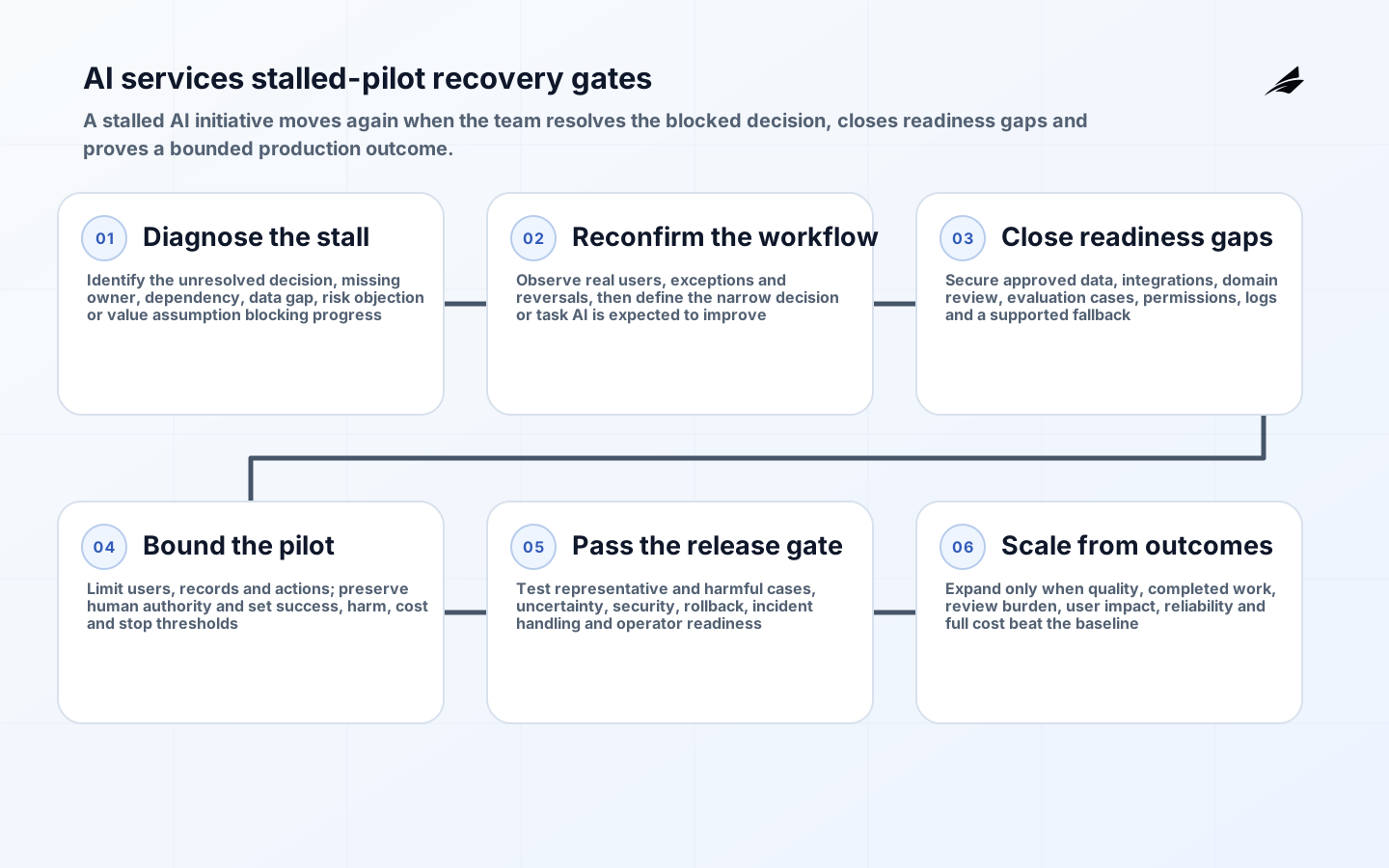
AI projects usually stall for ordinary reasons: the problem has no owner, source data is unreliable, success means an impressive demo, integration was postponed, or nobody will accept the residual risk. More model experimentation rarely resolves those gaps. An AI services stop stalling implementation checklist should narrow the workflow, make uncertainty testable and force a real release or stop decision.
This guide turns the broader AI stalling scope and delivery plan into implementation gates and pairs with the stalled AI FAQ. It applies to prediction, extraction, ranking and generative systems. Consequential uses need domain, legal, safety, privacy and affected-user review beyond a generic checklist.
1. Diagnose why the AI initiative is stalled
Run a short evidence review with the sponsor, workflow owner, users, data owner, engineering, security and risk. Ask which decision the work is meant to improve, what baseline exists, who acts on output, which dependency blocks progress and what evidence would justify stopping. Distinguish technical uncertainty from organizational avoidance. A team cannot tune its way out of an unresolved policy or ownership question.
Inspect the prototype and records directly: prompts or features, source versions, labels, model and provider versions, evaluations, costs, user feedback, incidents and integration assumptions. Mark claims as observed, inferred or unknown. Set a brief recovery window with one accountable decision date. Freeze unrelated features so the team can prove or disprove the core value and risk assumptions.
| Stall signal | Likely underlying gap | Recovery action |
|---|---|---|
| Endless prompt tuning | No representative evaluation or acceptance threshold | Build a versioned test set |
| Pilot users disengage | Output does not fit the decision workflow | Observe work and redesign handoff |
| Risk review never closes | Authority and prohibited outcomes are vague | Bound action and name risk owner |
| Costs surprise the sponsor | No workload or unit model | Measure complete cost per accepted outcome |
2. Reduce the project to one owned workflow

Describe a complete episode: trigger, authorized user, source context, model task, decision, system action, communication, correction and fallback. Choose a frequent task where output can be reviewed or reversed. Define excluded populations, languages, data and outcomes. NIST's AI RMF is use-case agnostic but emphasizes managing risks to people, organizations and society throughout design, deployment and use.
Baseline current quality, cycle time, effort and downstream result using representative cases. Set a target and a failure condition. Assign a workflow owner who can change policy and staffing, not only an AI product owner. Decide whether AI interprets content, recommends an option or takes an action. Keep deterministic eligibility, permissions, calculations and transaction invariants outside probabilistic output unless there is strong evidence and explicit authority.
3. Establish a usable data and evaluation contract
Register each source with authority, purpose, lawful basis, sensitivity, lineage, freshness, quality limits and owner. Separate training, retrieval, evaluation and operational logging uses. Remove uncontrolled production data from experimentation. For retrieval systems, test permissions at query and result time and preserve source citations. For supervised systems, document label instructions, disagreement and missing segments rather than treating labels as objective truth.
Build a versioned evaluation set from routine, boundary, rare, adversarial and historically difficult cases. Include affected segments and prohibited outcomes. Define scoring instructions and independent review for subjective tasks. The NIST AI RMF Playbook offers suggested actions aligned to Govern, Map, Measure and Manage; select those relevant to the context instead of presenting the entire playbook as a linear compliance checklist.
4. Build the smallest production-shaped architecture
Separate model invocation from source retrieval, policy, authorization, validation and business action. Use structured outputs where downstream code expects fields, then validate type, range, reference and permission. Limit tool credentials and arguments, treat retrieved and user content as untrusted, cap retries and preserve idempotency. Provide abstention and a human route when evidence is weak or policy forbids automation.
Pin or record model, prompt, retrieval index, code and policy versions for every evaluated release. Protect development and deployment using the principles in NIST's Secure Software Development Framework. Instrument latency, token or compute consumption, retrieval quality, validation failures, reviewer changes and downstream outcomes. A notebook demo without identity, failure handling and observability cannot answer production questions.
5. Use explicit evidence gates
Define gates before running the next experiment. Offline evaluation should clear minimum quality and severe-error thresholds. Shadow operation should verify real inputs, latency, integration and monitoring without influencing decisions. An assisted pilot should measure user acceptance, correction, task result and fallback. Bounded production should limit users, volume, authority and consequence. Each gate needs an approver and a stop action.
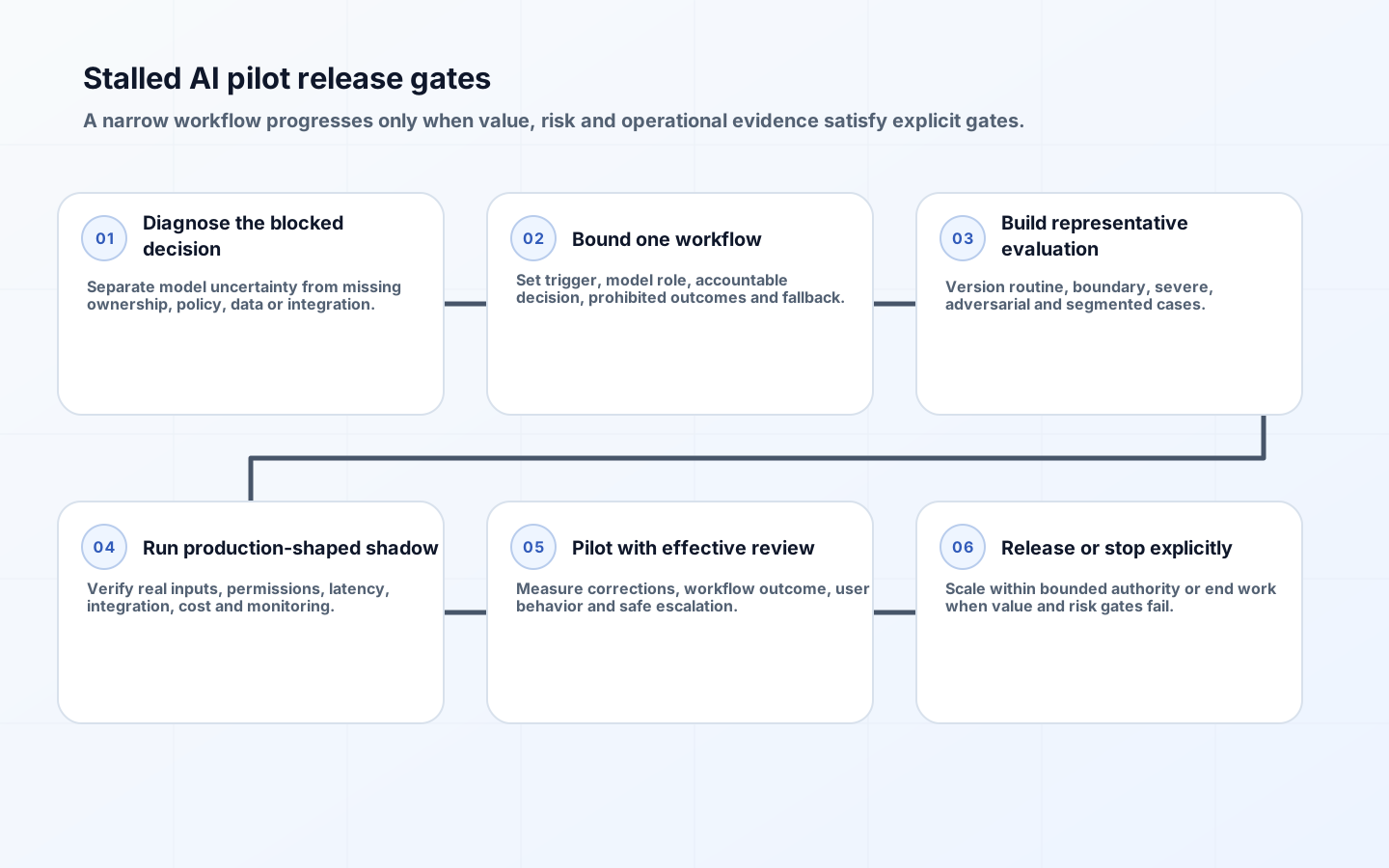
Do not average away unacceptable harm. Report severe classes and meaningful segments separately, with uncertainty where sample sizes are small. Compare against the existing process and a simple non-AI alternative. GAO's artificial intelligence accountability resources group practices around governance, data, performance and monitoring, a useful check that a high benchmark score has not displaced accountability or ongoing oversight.
| Gate | Evidence to pass | Stop or rollback trigger |
|---|---|---|
| Offline | Baseline comparison, severe errors, segments and cost | Prohibited error or no material value |
| Shadow | Real input coverage, latency, integration and monitoring | Unbounded data or operational failure |
| Assisted pilot | Reviewer correction, workflow result and safe fallback | Users cannot detect or repair errors |
| Bounded production | Outcome, drift, incident and unit economics | Threshold breach or material unreviewed change |
6. Make human review effective
Human in the loop is not a control unless the person has time, evidence, competence and authority to disagree. Show the source context, uncertainty or reason for escalation; avoid interface defaults that encourage automatic acceptance. Measure corrections and detect automation bias. Route high-consequence or ambiguous cases to specialists with response objectives. Preserve the user's original input and the final accountable decision.
Design recourse for people affected by an output. Explain when AI materially contributes where appropriate, provide a correction or appeal channel and prevent a rejected recommendation from silently reappearing. Protect reviewers from excessive monitoring and include their qualitative reports. Repeated overrides may indicate model weakness, stale policy, poor data or interface design; investigate the system cause instead of treating every correction as individual resistance.
7. Operate, monitor and decide whether to scale
Assign service, model, data, risk and incident owners. Monitor input and output shifts, severe errors, abstentions, overrides, latency, cost, source freshness, tool denial and downstream outcome. Sample quality continuously rather than relying only on automated scores. Define material change for models, providers, prompts, retrieval or policy and state which changes require re-evaluation or renewed approval.
The NIST Generative AI Profile identifies risks that generative systems can intensify and supports risk-specific actions. Maintain rollback to a known model or non-AI process, exercise provider outage and track unresolved incidents. Scale only when the pilot produces repeatable user value, acceptable residual risk, supportable unit economics and demonstrated operational ownership.
Set a commercial gate as well as a technical one. Calculate provider inference, retrieval, guardrails, observability, human review, rework and support per accepted workflow outcome. Test sensitivity to longer inputs, retries and peak demand. Negotiate data use, model change notice, service limits and exit before volume grows. A cheap demonstration can become an uneconomic service when correction and exception handling are counted honestly.
Close the recovery window with a written decision. If proceeding, publish the bounded production scope, owners, thresholds and next evidence review. If stopping, revoke provider keys, dispose of data, archive decision evidence and communicate why. Preserve reusable learning without keeping an unmanaged endpoint alive. Explicit closure restores capacity and prevents a dormant prototype from becoming shadow production through casual internal use.
Preserve an experiment register even when several teams use the same platform. Record the workflow hypothesis, owner, approved data, provider, dates and closure state. This prevents duplicate pilots, abandoned credentials and contradictory evaluations. It also helps leaders identify reusable data or integration capability without forcing unlike use cases into one misleading success metric.
AI delivery takeaways
- Diagnose the blocked decision before changing the model.
- Bound one workflow, accountable owner, model role and fallback.
- Version representative evaluation and separate severe error classes.
- Progress through offline, shadow, assisted and bounded production gates.
- Scale from measured workflow outcomes, residual risk and operating capability.
Frequently asked questions
Should a stalled pilot be rebuilt? Only after identifying whether architecture caused the stall. When should a project stop? When it lacks a legitimate use, cannot beat the baseline, creates unacceptable harm, has no accountable owner or costs more than the outcome supports. Can a better model solve data quality? It may tolerate some noise, but it cannot establish authority, lawful purpose or missing ground truth.
How large must the evaluation set be? Large enough to support the decisions and critical segments; use risk and statistical reasoning rather than a universal count. Is human approval always required? No. Match review to consequence, reversibility and measured performance. What usually unlocks progress fastest? A narrower workflow, a real evaluation set and a sponsor willing to make a release or stop decision.
Conclusion
To stop AI services stalling, replace open-ended experimentation with a sequence of accountable decisions. One workflow, production-shaped architecture, representative evidence and bounded authority will reveal whether the idea deserves operation. A disciplined stop is a successful outcome when value or safety cannot be shown. When gates pass, the same evidence becomes the foundation for careful scale rather than another permanent pilot.