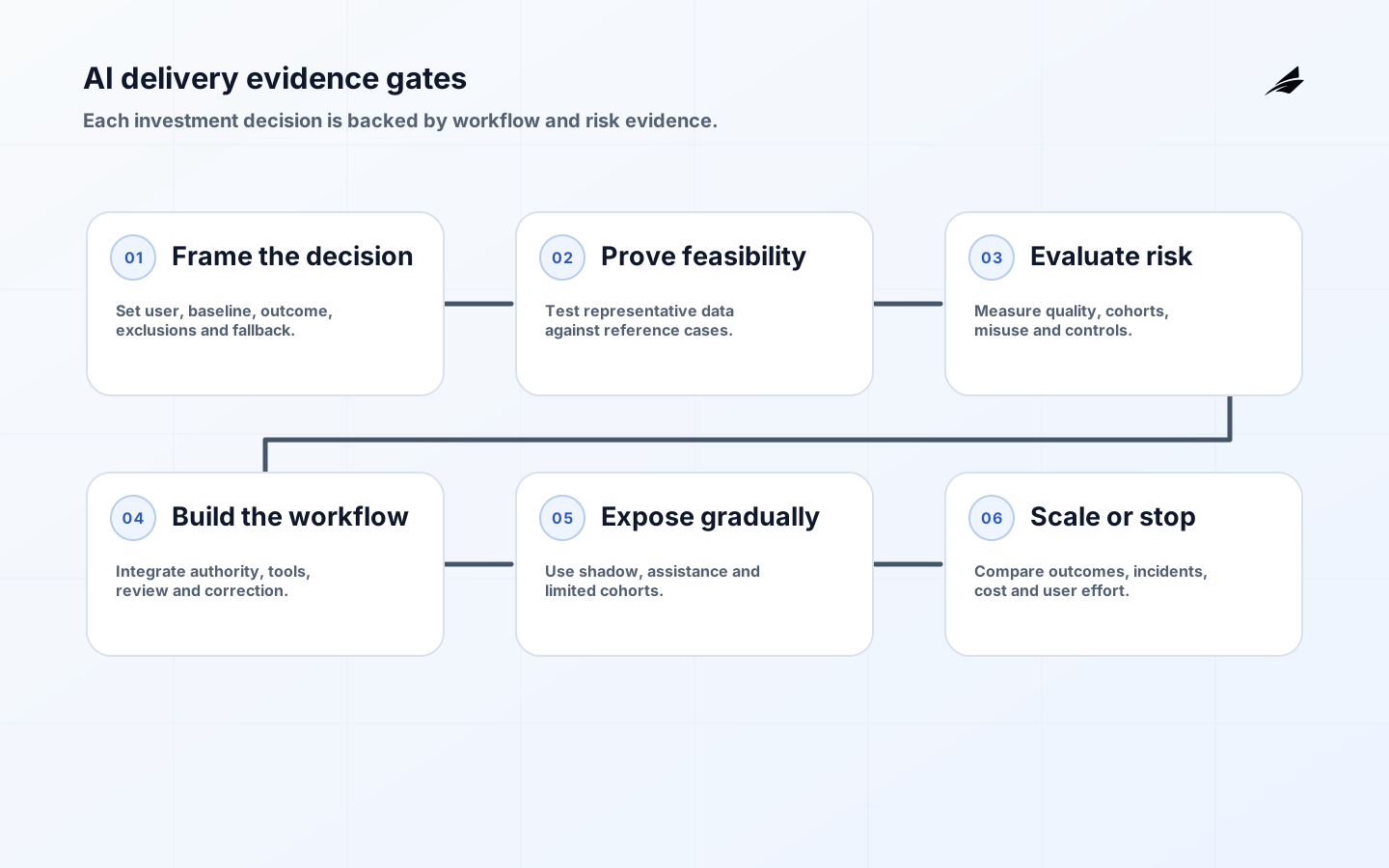
AI services stall when a compelling demonstration never becomes an owned, evaluated and supportable workflow. Common causes include broad ambition, inaccessible data, unclear authority, no reference cases, missing integration, uncontrolled risk and a business case that counts model output instead of completed work. To stop AI services from stalling, leadership needs explicit decisions: what problem is worth solving, what evidence permits the next stage, and what result means redesign or stop.
Use this guide with Edilec's AI production implementation checklist, AI services production FAQ and enterprise AI stop-or-scale plan. They help convert the gates below into team-level work and governance.
Diagnose the stalled decision, not the model demo
Map the user, trigger, input, current work, decision, action, consequence, exception and feedback. Baseline volume, cycle time, quality, rework, loss, user effort and service cost. State what has actually stalled: sponsor decision, data access, legal review, evaluation, integration, user adoption, reliability or economics. Each requires a different intervention. Buying a newer model will not resolve an absent process owner or an undefined acceptable error.
Write a one-page service hypothesis: for a named user and case population, the configured AI workflow will improve a measurable outcome while staying within defined cost and risk. List exclusions and a non-AI fallback. The NIST AI RMF 1.0 asks organizations to Govern, Map, Measure and Manage AI risk. NIST notes that version 1.0 is under revision in 2026, so use the current framework deliberately and track the update.
| Stall | Evidence to collect | Decision | Wrong response |
|---|---|---|---|
| Unclear value | Current outcome and user task | Narrow or stop | Add more features |
| Data blocked | Purpose, rights, quality and alternatives | Approve, minimize or redesign | Copy data into a prototype |
| Quality disputed | Representative labeled cases | Set threshold or change method | Debate isolated examples |
| Integration delayed | Authority and interface map | Fund workflow or reduce scope | Keep demo separate |
| No adoption | Observed tasks and incentives | Redesign workflow | Mandate model usage |
Create evaluation evidence before scaling
Build a versioned evaluation set from representative cases, difficult cohorts, edge conditions and foreseeable misuse. Establish reference answers or outcome criteria with domain experts, including how disagreement is resolved. Measure task correctness, groundedness, refusal, policy compliance, latency, cost and escalation. For decisions affecting people, examine performance and impact across relevant groups. Keep evaluation data separate from casual demonstrations and protect its privacy and licensing.
The GAO artificial intelligence resource summarizes its accountability framework around governance, data, performance and monitoring. Use its questions to expose missing accountability even outside government. For generative AI, apply the cross-sector NIST Generative AI Profile to relevant risks such as confabulation, information integrity, privacy, security and human-AI configuration. Evaluate the complete configured service, not only the base model.
Build the smallest complete production workflow
A complete slice includes identity, authorized data, prompt or feature preparation, model call, validation, policy, human review, tool action, logging, monitoring, fallback and correction. Keep business authority outside probabilistic output. Validate structured data at every boundary, constrain tools by purpose and make side effects idempotent. Record model and workflow version, relevant sources, decision and final action while minimizing sensitive content.

Treat model and dependency delivery as software delivery. The NIST Secure Software Development Framework provides practices for preparing, protecting, producing and responding. Apply them to source, workflow definitions, dependencies, containers, evaluation code and release artifacts. Separate development and production access, scan dependencies, review changes, preserve rollback and respond to vulnerabilities in both conventional components and model integrations.
| Gate | Required evidence | Advance when | Stop or redesign when |
|---|---|---|---|
| Problem | Baseline and owned decision | Outcome is valuable and bounded | No action follows output |
| Feasibility | Representative data and prototype | Task signal beats baseline | Rights or quality are inadequate |
| Safety | Threat and impact evaluation | Controls meet approved threshold | Consequential risk lacks treatment |
| Workflow | End-to-end pilot with fallback | Users complete work reliably | Integration or review erases value |
| Production | SLO, cost and support evidence | Service remains stable by cohort | Correction or cost exceeds limit |
Fund integration, evaluation and operations
Estimate discovery, data preparation, expert labeling, model usage, retrieval, integration, security, evaluation, observability, human review, support and incident correction. Model cost per completed case, not per token or prediction. Include failed attempts, retries, peak demand and vendor minimums. Compare with the full baseline cost and opportunity, including quality and delay. A pilot can look cheap because experts quietly correct every result.
Tie funding to evidence gates rather than a single production date. Release budget when the decision, feasibility, safety, workflow and production criteria are met. Keep a contingency for data and integration discoveries, but cap indefinite experimentation. Require customer-controlled artifacts, decision records, evaluations and runbooks from external providers. State data use, model change, service levels, exit and deletion terms before production.
Roll out through reversible authority
Move through offline evaluation, shadow use, internal assistance, limited cohort and broader production. Each stage should change one dimension of authority or exposure and have health, pause and rollback thresholds. Shadow mode tests disagreement without action; assistance tests user workflow while a person decides. Do not call a manual pilot autonomous or hide the labor in a separate cost center. Preserve a known fallback and reconcile any side effects after recovery.
Observe users completing real tasks. Measure whether context switching, review and exception handling erase the nominal time saved. Provide feedback and contest routes, train on limits and preserve user responsibility. DORA's 2025 AI-assisted software development research describes AI as an amplifier of underlying organizational strengths and weaknesses. The same operating lesson applies broadly: improve data, workflow and feedback rather than expecting a model to compensate for them.
Operate, learn and make a real stop decision
Monitor service availability, latency, model and retrieval versions, input drift, evaluation samples, policy denials, escalation, corrections, user outcomes and total cost. Link incidents to affected cases and preserve a route to correct business state. Rerun regression and safety suites when models, prompts, tools, sources or policies change. Sample apparently successful outputs because silent error may not generate a complaint.
At 30, 60 and 90 days, compare cohorts with baseline and decide expand, constrain, redesign or stop. Stop when the decision is not valuable, data cannot be used responsibly, quality remains below threshold, controls destroy utility, users reject the workflow or total economics stay unfavorable. Stopping with retained evidence is a successful portfolio decision. It frees attention and prevents a demonstration from becoming an unsupported service.
Manage AI work as a portfolio of evidence
Maintain a register of experiments and services with sponsor, user, decision, data, model, risk class, stage, spend, next gate and review date. Consolidate duplicate retrieval, evaluation and monitoring capabilities where their requirements match. A shared register prevents several teams from buying access to the same data or repeating an unsuccessful pattern without seeing prior evidence. It also identifies production services that no longer have an accountable owner.
Limit work in progress. A small cross-functional team completing one end-to-end slice learns more than many isolated model prototypes. Reserve domain, security, legal, data and platform capacity at the start instead of requesting reviews after the demo. Sequence work so scarce evaluation and integration specialists are not spread across every idea. Publish queue and decision criteria to reduce political escalation.
Use common evidence templates without forcing common risk treatment. Every initiative should record hypothesis, baseline, data rights, evaluation, threat model, human authority, cost and result. Higher-consequence services need deeper impact assessment, independent challenge and monitoring. Low-risk internal assistance can move faster when it cannot create external effects and has an easy fallback. Tailoring should be explicit, approved and revisited when scope changes.
Review the portfolio quarterly for realized outcome, operating cost, incidents, supplier concentration and reuse. Retire dormant endpoints, credentials, indexes and evaluation data according to policy. Redirect funding from repeated pilots toward shared foundations only after real services prove the need. A platform built ahead of evidence can become another stalled AI program at larger scale.
Report decisions in plain business terms. Separate technical evaluation from realized value, and show uncertainty, cohort and period. Leadership should see how many initiatives advanced, stopped or changed; production outcome and cost; significant incidents; and concentration in models, data or vendors. Do not aggregate unlike accuracy measures into one portfolio score. A transparent stop decision is stronger evidence of governance than a dashboard where every pilot appears green.
When an initiative advances, transfer it from experiment sponsorship to a funded service owner with a support model, lifecycle budget and retirement trigger. Confirm data and model licenses for ongoing use, remove researcher privileges and establish production change control. This transition is often the missing gate between a celebrated pilot and dependable service.
Key takeaways
- Diagnose the blocked business and operating decision.
- Create representative evaluation evidence before integration grows.
- Build one complete workflow with authority, fallback and correction.
- Estimate total cost per completed case.
- Increase exposure and authority through reversible stages.
- Use explicit evidence to scale, redesign or stop.
AI services delivery FAQ
How long should an AI pilot run?
Long enough to cover representative cases and operating variation, with a fixed evidence deadline. A pilot without criteria or decision date is continuing research, not a delivery stage.
What accuracy is good enough?
It depends on consequence, fallback and error type. Set thresholds by task and cohort, distinguish false acceptance from rejection, and include end-to-end business outcomes.
When should a team stop an AI service?
Stop when evidence shows no durable value within acceptable risk and cost, or when required data and authority cannot be governed. Record what was learned and retire access and infrastructure.
Conclusion
To stop AI services from stalling, replace optimism and indefinite pilots with bounded workflow, evaluation evidence and explicit decisions. Fund the complete service, increase authority carefully, measure production outcomes and be willing to stop. Progress is an evidence-backed portfolio choice, not merely a deployed model.