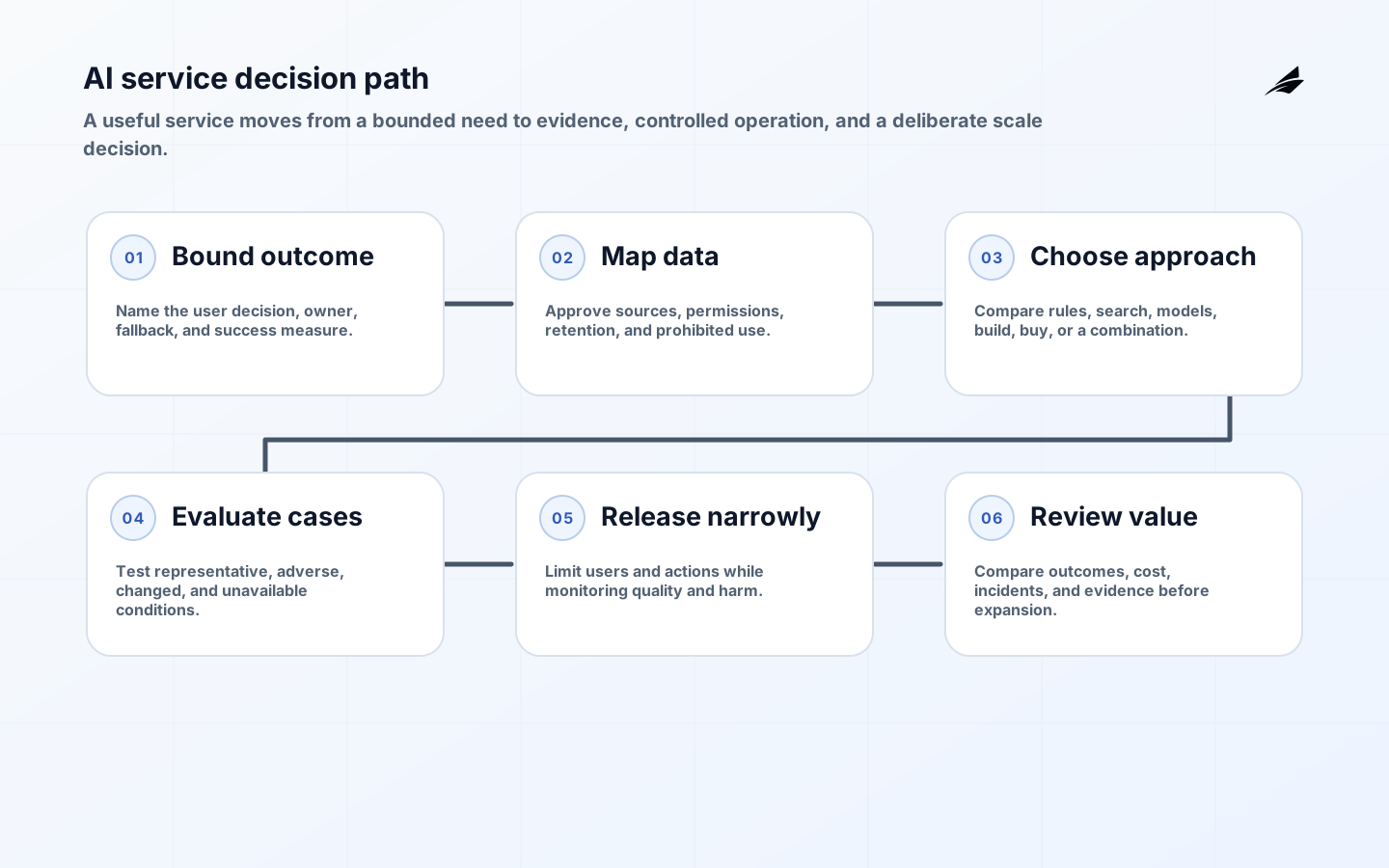
This AI services and solutions FAQ is for teams that have moved past general curiosity and need decisions they can act on. AI services can include document extraction, search, drafting, classification, forecasting, and workflow assistance, but the label does not determine value. The useful question is whether a service can improve a defined business decision while preserving privacy, security, and a route for people to correct it. Answers below are deliberately conditional: a sensible control for a marketing draft may be inadequate for a customer eligibility decision.
What should we ask first?
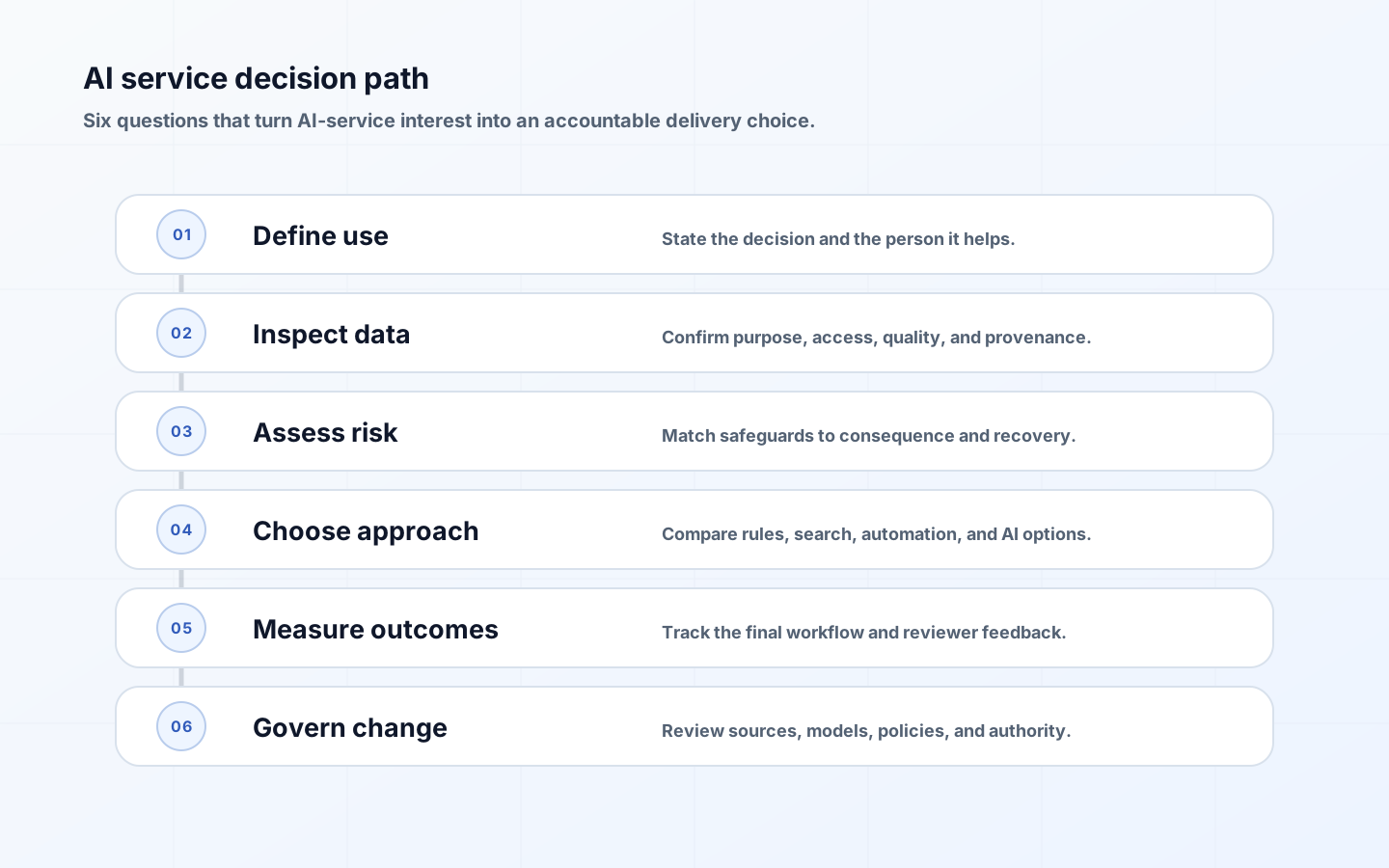
Ask what a person will decide or do differently once the service produces an output. Describe the current workflow, the delay or error it creates, and the acceptable fallback when the service cannot help. That statement prevents a platform search from becoming the project. NIST's AI Risk Management Framework is a helpful starting point for organizing conversations about validity, safety, security, accountability, transparency, and explainability. It is not a promise that a system is safe; it is a structure for making trade-offs explicit.

| Question | Short answer | What to examine next |
|---|---|---|
| Is this a good AI use case? | Usually when input patterns are meaningful, the output can be reviewed, and success has a business definition. | Current examples, exceptions, and the cost of an incorrect result. |
| Must we use generative AI? | No. Rules, search, analytics, or conventional automation may be more predictable for the task. | The smallest approach that solves the stated decision. |
| Who owns the result? | A named business owner remains accountable even when technology teams run the service. | Authority to change policy, accept risk, and handle complaints. |
| Can we start with a pilot? | Yes, if it has a narrow scope, a manual fallback, and criteria for continuation or stop. | What evidence the pilot must produce. |
What data can an AI service use?
Use only records that have a clear purpose, an approved access path, and enough context to support the task. Data that is available to a system is not automatically appropriate for a service to retrieve, summarize, or send to a third party. Establish field-level restrictions for sensitive material, respect source-system permissions, and define retention and deletion behavior. When a service retrieves internal knowledge, show users the source and date where practical so they can judge whether the answer fits the case. Uncertain, stale, or incomplete records should remain visible as such rather than being polished into a confident response.
- Which systems are authoritative for the facts the service will use?
- Which users may request each category of information?
- What confidential, regulated, or personal fields are excluded?
- How will the service respond when a needed source is unavailable?
- What record of retrieval, output, and reviewer action is proportionate to the risk?
- Who can approve a new connector or change the permitted purpose?
What risks deserve early attention?
The risk profile comes from the task and deployment design, not solely from the model. A flawed answer may be recoverable in an internal draft but unacceptable in a safety, employment, financial, or legal workflow. The NIST Generative AI Profile identifies risks that organizations can adapt to their own context, including confabulation, data privacy, information integrity, and harmful bias. Keep a register of assumptions and a named owner for each important risk; that makes review a working practice rather than a slide at approval time.
| Risk pattern | Practical safeguard | Evidence of operation |
|---|---|---|
| Plausible but wrong output | Require citations, validation rules, or human review before consequential use. | Sampled cases with acceptance and correction reasons. |
| Unauthorized disclosure | Apply permissions before retrieval and minimize content in logs. | Access tests, configuration review, and incident process. |
| Unexpected tool action | Limit authority, confirm consequential steps, and make actions reversible where possible. | Tool allowlist and transaction audit trail. |
| Quality drift | Re-evaluate after material changes in data, policy, prompts, or model version. | Version record and recurring task evaluation. |
Should we buy, build, or combine?
Buy when a product meets the task, integration, control, and support requirements with acceptable contractual terms. Build or extend when the differentiating value lies in a specific workflow, proprietary data context, or control surface that a packaged product cannot provide. Many teams combine a managed model with their own orchestration, permissions, and review experience. Compare options using the work required to operate them, not headline features alone. Ask for export paths, audit support, change notices, security evidence, and a realistic account of what remains your team’s responsibility.
- Where are prompts, files, outputs, and operational logs processed and retained?
- How are model, policy, and service changes communicated and controlled?
- Which identity, access, and audit integrations are supported?
- What limits, failure modes, and support commitments apply in production?
- Can the service provide citations, structured output, and usable diagnostics for this workflow?
- How can data and configuration be exported if the product is replaced?
How do we measure whether it helps?
Measure the decision path, not a vanity count of requests. Depending on the workflow, track time to a final outcome, reviewer acceptance and correction, backlog age, rework, user confidence, and incidents. Segment results by source, team, document type, or exception class so a good average does not hide a harmful pocket of performance. OWASP's LLM application guidance is also useful during measurement because security failures often emerge through ordinary inputs and connected tools, not only through model benchmarks.
How should we evaluate cost, providers, and operating responsibility?
Compare providers on the complete service boundary, not a model benchmark or a low introductory token price. The commercial model should expose model and hosting charges, retrieval and storage, integration, evaluation, human review, observability, security testing, support, and change work. Ask which components are portable, who owns prompts and evaluation sets, how provider updates are introduced, and whether the organization can export its data and evidence. ISO/IEC 42001 treats AI as a management system that must be established, maintained, and continually improved; that is a more useful buying lens than a one-time proof of concept.
Responsibility cannot be outsourced with the API call. The business owner defines the permitted purpose and accepts residual risk; product and engineering teams implement the workflow and release controls; security and privacy specialists test exposure; operators monitor service behavior; and the supplier documents platform capabilities, limits, incidents, and changes. A contract should state data-use terms, retention, subprocessors, regional processing, service levels, incident notification, intellectual-property treatment, exit assistance, and the evidence available for audit. Pair the buying decision with Edilec’s AI services implementation checklist and generative AI delivery plan.
| Commercial question | Evidence to request | Decision consequence |
|---|---|---|
| What drives recurring cost? | Representative workload estimate including review and observability | Budget against useful completed cases, not raw requests |
| Can the service change underneath us? | Version policy, release notice, regression evidence, and rollback terms | Define a controlled upgrade path |
| Who may use submitted data? | Contractual data-use, retention, deletion, and subprocessor terms | Exclude or minimize data that lacks an approved purpose |
| How do we leave? | Export formats, portable artifacts, transition support, and deletion proof | Avoid dependence that cannot be unwound safely |
Frequently asked questions
- Do we need an AI policy before a pilot? You need at least clear ownership, permitted data, review expectations, and escalation paths; broader policy can mature alongside evidence.
- Can employees use public tools for work? Follow the organization’s approved-data and security rules; public availability does not make a tool suitable for internal records.
- Does human review eliminate risk? No. Review must be feasible, informed, and able to challenge the output; otherwise it becomes a rubber stamp.
- How often should we re-evaluate? After material changes and on a regular cadence that matches the consequence and volatility of the task.
Key takeaways
- Define the decision before selecting technology.
- Apply source permissions and purpose limits to data use.
- Match safeguards to the consequence of error.
- Assess providers as operating partners, not just feature lists.
- Keep evidence of quality, corrections, and changes.
Conclusion
The best answers about AI services are grounded in the work people must complete and the harm they must avoid. Treat every early answer as a hypothesis to test with users, records, and operating evidence. For next steps, see the practical guides to LLM evaluation and bounded agent permissions.