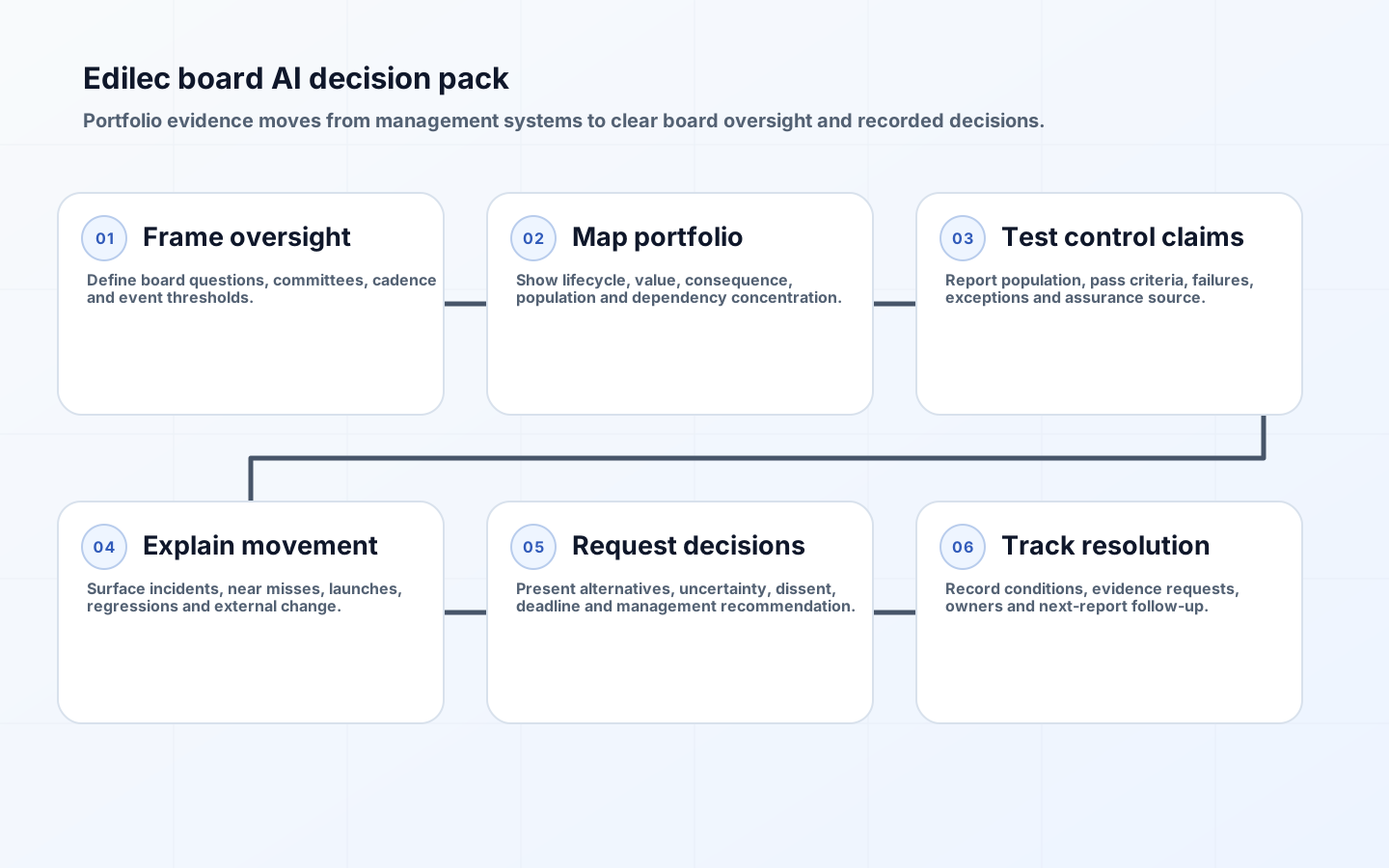
AI governance board reporting should help directors oversee strategy and material exposure, not make them operate model controls. Counts of pilots, training completion, or policy pages can create motion without insight. A useful pack shows where AI creates value, where consequence and dependency concentrate, whether critical controls work, what changed, which incidents or near misses matter, and what management needs the board to decide. It also preserves trend and challenge so optimistic narratives can be tested over time.
Build the pack from the management system, not as a quarterly presentation exercise. Edilec's AI governance operating model establishes roles, the AI automation ROI guide disciplines value claims, and the source-of-truth dashboard guide helps maintain metric ownership and decision lineage.
Start with the board's oversight questions
Agree which matters belong to the full board and which to risk, audit, technology, or other committees. Typical questions are: Is AI strategy aligned with enterprise objectives? Which deployments could materially affect people, safety, law, reputation, resilience, or capital? Does management have capable ownership and resources? Are controls and independent assurance credible? What external dependencies could remove options? What decisions or risk acceptances require board authority? The OECD corporate-governance resources provide broader context for accountability, disclosure, and board responsibilities.

Write a reporting charter defining audience, frequency, thresholds, owners, data sources, committee routing, confidentiality, and minutes. Provide a stable quarterly core plus immediate escalation for threshold events. Keep a concise main pack with appendices for definitions, inventories, evaluations, and legal detail. Directors need enough system context to challenge management, but architecture diagrams and control catalogs should appear only when they explain a material decision.
| Board question | Decision-useful measure | Poor proxy to avoid | Expected action |
|---|---|---|---|
| Where is value material? | Realized benefit against baseline with adoption and quality | Number of pilots | Continue, redirect or stop investment |
| Where is risk concentrated? | High-impact uses by consequence, scale and dependency | Total model count | Change appetite, controls or portfolio |
| Do controls work? | Critical-control pass rate, exceptions and independent findings | Policies approved | Fund remediation or accept residual risk |
| Are events changing exposure? | Material incidents, near misses, recurrence and time to contain | Raw ticket volume | Escalate response and accountability |
| Are options narrowing? | Provider concentration, exit test, skills and data portability | Vendor satisfaction | Diversify, renegotiate or retain dependency |
Show portfolio value beside exposure and optionality
Segment the portfolio by lifecycle, business outcome, risk tier, affected population, autonomy, geography, and model or platform dependency. For material systems show expected and realized value, baseline, adoption, quality, cost to operate, and accountable owner. Place exposure on the same page: possible consequence, control status, unresolved uncertainty, and exit readiness. This prevents a valuable system from being treated as automatically acceptable, or a well-controlled system from surviving when it delivers no benefit.
Aggregate carefully. A single red high-impact deployment can disappear inside an average green score. Show concentrations: one provider supporting several critical processes, one dataset reused across rights-sensitive decisions, or one small governance team approving rapid growth. Include stopped and rejected proposals because they demonstrate appetite in operation. Explain changes since the prior report and distinguish genuine portfolio movement from better inventory discovery.
Report control effectiveness, not control existence
The NIST AI RMF frames AI risk work through Govern, Map, Measure, and Manage. A board view can map those functions to ownership, context coverage, evaluation evidence, and treatment outcomes without turning them into a superficial maturity score. Select a small set of critical controls: complete inventory, impact assessment, representative evaluation, access and authority, human intervention, monitoring, incident readiness, supplier evidence, and change control.
For each critical control report population, pass definition, tested coverage, failure count, severity, trend, overdue remediation, and assurance source. Separate management self-assessment from second-line challenge and internal or external audit. Show accepted exceptions and expiry. The NIST AI RMF Playbook offers suggested actions useful for management design, but the board needs whether the organization's chosen controls operate and whether remaining risk fits appetite.
Explain incidents, near misses, and material change
Report significant events by consequence and learning: what happened, affected people or operations, duration, containment, control failures, recurrence potential, external reporting, corrective actions, and executive accountability. Include near misses that reveal a material weakness. Avoid identifying sensitive individuals or exposing exploit detail in broad packs. Trend by failure pattern, not only count; better detection may increase reports while reducing actual harm.
Material-change reporting should cover new high-impact uses, expanded autonomy, major provider or model substitutions, new jurisdictions, risk-appetite exceptions, significant evaluation regression, regulatory change, acquisitions, and retirement of critical systems. ISO describes ISO/IEC 42001 as a continually improving management system; the pack should show whether governance adapts when strategy, technology, evidence, and external obligations change.
Put explicit decision requests and escalation thresholds first
Every request should state the decision, sponsor, deadline, alternatives, financial and nonfinancial effects, affected stakeholders, evidence, uncertainty, management recommendation, dissent, and consequence of delay. Distinguish information, advice, approval, and risk acceptance. Record the resolution, conditions, and follow-up owner in minutes and the next pack. A dashboard without a decision pathway asks directors to admire risk rather than govern it.
| Threshold event | Immediate recipient | Board or committee question | Evidence in escalation |
|---|---|---|---|
| Severe actual or plausible harm | Chair and designated committee leads | Is crisis governance and disclosure adequate? | Timeline, containment, affected parties and uncertainty |
| Critical control failure across portfolio | Risk or audit committee | Should exposure be limited pending remediation? | Population, interim safeguards and retest date |
| New high-impact autonomous use | Relevant committee before launch | Does residual risk fit appetite and strategy? | Impact assessment, evaluations and accountable owner |
| Material provider concentration | Technology and risk committees | Is dependency accepted and exit funded? | Concentration map, contract rights and migration test |
| Repeated missed value or rising cost | Full board or strategy committee | Should investment continue or change? | Baseline, realized outcomes and alternatives |
Design the pack for challenge, traceability, and continuity
Use a one-page executive view, portfolio movement, critical risks and controls, incidents and changes, investment outcomes, decisions, and appendices. Label dates, definitions, thresholds, data owners, and known limitations. Use consistent scales and show prior periods. Avoid decorative heat maps where unrelated dimensions are multiplied into false precision. Provide short case narratives when a metric cannot convey the human or operational consequence.
Schedule periodic deep dives into one material system, one shared platform, and one external dependency. Give directors access to relevant expertise and independent challenge. Track unanswered questions and whether management delivered promised evidence. Review the pack itself annually: which measures led to decisions, which were misunderstood, what remained invisible, and where incentives distorted reporting. Board AI literacy should include limits of evaluation and aggregation, not product demonstrations alone.
Protect metric definitions from reporting incentives
Give every board measure a definition, population, calculation, data owner, control owner, refresh date, threshold rationale, and known limitation. Reconcile totals to the AI inventory and explain restatements. Independent risk or audit functions should challenge measures that management compensation or launch commitments could influence. Teams may label pilots nonproduction, redefine a severe incident, close an action without retest, or count estimated hours saved as realized value. Preserve prior values and definitions so trend remains meaningful. Periodically sample from each measure back to source records and from source populations into the report. This two-way trace is essential when a green headline depends on missing systems or excluded failures.
Include a forward view rather than reporting only what already happened. Management should identify the next two reporting periods' planned high-impact launches, provider retirements, regulatory milestones, major contract renewals, audit work, talent constraints, and decisions likely to exceed delegated appetite. Give early indicators and trigger dates. Scenario analysis can show how a provider outage, severe harmful event, loss of a critical dataset, or new legal restriction would affect operations and strategic options. The board can then ask whether contingency funding, alternative suppliers, manual capacity, insurance, or communications preparation is adequate before a threshold event forces a rushed decision.
Board minutes should capture material questions, management answers, dissent, conditions, recusals, requested evidence, and due dates without attempting a transcript. Link each follow-up to the reporting system and show overdue items in the next pack. When a decision changes after new evidence, preserve both resolutions and explain the change. This continuity allows directors, auditors, and future management to understand why exposure was accepted and whether promised safeguards became real.
Key takeaways for AI governance board reporting
- Organize the pack around oversight questions, material changes, and explicit decisions.
- Put realized value beside consequence, control status, dependency, and exit readiness.
- Report tested control populations, failures, exceptions, assurance source, and remediation trend.
- Escalate threshold events promptly rather than waiting for the quarterly cycle.
- Preserve dissent, uncertainty, conditions, and follow-up so governance remains traceable.
- Show forward commitments and trigger dates so directors can preserve strategic options before a dependency or incident becomes urgent.
FAQ about board-level AI reporting
How many metrics should the main pack contain? Only enough to answer stable oversight questions; move diagnostic detail to appendices. Should the board approve every AI use? No. Management should operate within delegated appetite, with board attention on strategy, material exposures, exceptions, and severe events. Is a maturity score useful? It may summarize direction, but it can hide critical failures; always show underlying evidence and concentration. How often should reporting occur? Use a regular cadence plus event-driven escalation defined in the charter.
Conclusion: report for decisions, not reassurance
Directors do not need every model metric, but they do need a faithful view of value, consequence, control effectiveness, incidents, dependency, and change. A stable evidence-backed pack gives them continuity, while clear thresholds ensure serious matters arrive in time. When each page connects to an owner and a decision, board reporting becomes part of the AI management system rather than a polished layer above it.