ISO 42001 vs NIST AI RMF is not a choice between good and bad governance. ISO/IEC 42001 specifies requirements for an organizational AI management system. NIST AI RMF offers voluntary, flexible outcomes and practices for managing AI risk across systems and contexts. One can provide a certifiable management-system backbone; the other can provide a rich risk vocabulary and implementation guidance. The right answer depends on assurance commitments, customer expectations, organizational maturity, and how much structure already exists.
The public ISO/IEC 42001 overview says the standard addresses establishing, implementing, maintaining, and continually improving an AI management system for organizations providing or using AI. NIST describes the AI RMF as voluntary, non-sector-specific, and use-case agnostic. Neither resource replaces applicable law, technical evaluation, or domain judgment.
Compare their primary purposes before their clauses
A management-system standard asks whether the organization has a coherent way to set policy and objectives, assign responsibilities, operate processes, evaluate performance, correct problems, and improve. A risk framework asks whether relevant AI risks are governed, mapped, measured, and managed. These questions overlap, but they operate at different levels. ISO/IEC 42001 is the organizational container; NIST AI RMF can deepen how teams reason about a system, its impacts, and risk responses.
Do not infer that an ISO/IEC 42001 certificate proves a particular model is accurate, fair, secure, lawful, or suitable for a customer's use. It can provide evidence that a defined management system meets assessed requirements within its scope. Likewise, an organization can implement NIST AI RMF rigorously without receiving an official NIST certificate. Assurance claims must name the scope, criteria, assessor, date, and limitations.
ISO 42001 vs NIST AI RMF decision matrix
| Dimension | ISO/IEC 42001 | NIST AI RMF | Decision implication |
|---|---|---|---|
| Form | Requirements for an AI management system | Voluntary risk-management framework | Choose based on assurance and operating need |
| Primary level | Organization and scoped management system | Organization and AI system lifecycle outcomes | Use RMF to enrich system practice |
| Assessment | Can support third-party management-system certification | No NIST certification scheme | Phrase claims precisely |
| Method | Policy, objectives, processes, performance, improvement | Govern, Map, Measure, Manage | Cross-map rather than duplicate |
| Access | Full standard is licensed | Framework and Playbook are public | Plan access and training costs |
| Tailoring | Scope and context within requirements | Profiles and context-driven selection | Document exclusions and priorities |
ISO clarifies on its certification page that independent bodies, not ISO itself, issue certification, and that accreditation concerns recognition of a certification body's competence. Procurement teams should request the certificate, scope statement, issuing body, accreditation details, surveillance status, and relevant exclusions. A logo or vendor statement is not enough.
Choose ISO/IEC 42001 when external assurance matters
ISO/IEC 42001 is attractive when customers, boards, regulators, or procurement processes expect an independently assessed management system; when the organization already operates ISO-style systems; or when leaders need one accountable program spanning AI provider and user activities. It encourages repeatable governance beyond a few flagship models. Certification can also create discipline around scope, internal audit, corrective action, and management review.
The tradeoff is implementation and audit overhead. A narrow scope may be easier to certify but less meaningful to customers. A broad scope may expose immature practices and require sustained resources. Decide whether the scope covers the whole organization, an AI product unit, development and deployment activities, internal use, or a named service family. Ensure the statement matches the systems and geographies customers assume it covers.
Choose NIST AI RMF when flexible risk practice is the immediate need
NIST AI RMF is useful when teams need a common language across product, engineering, legal, security, and social-impact disciplines; want to tailor profiles by use case; or need practical risk outcomes before committing to certification. The NIST Playbook offers voluntary suggested actions aligned to subcategories and explicitly says it is not a checklist to implement in full.
The framework's flexibility is also its governance challenge. Teams can claim alignment while selecting only easy outcomes. Prevent that by defining a profile, mapping each outcome to a local control, naming evidence and owners, documenting omissions, and commissioning independent review. NIST notes that AI RMF 1.0 is under revision, so version the profile and avoid encoding current labels as permanent database fields.
Build one integrated governance backbone
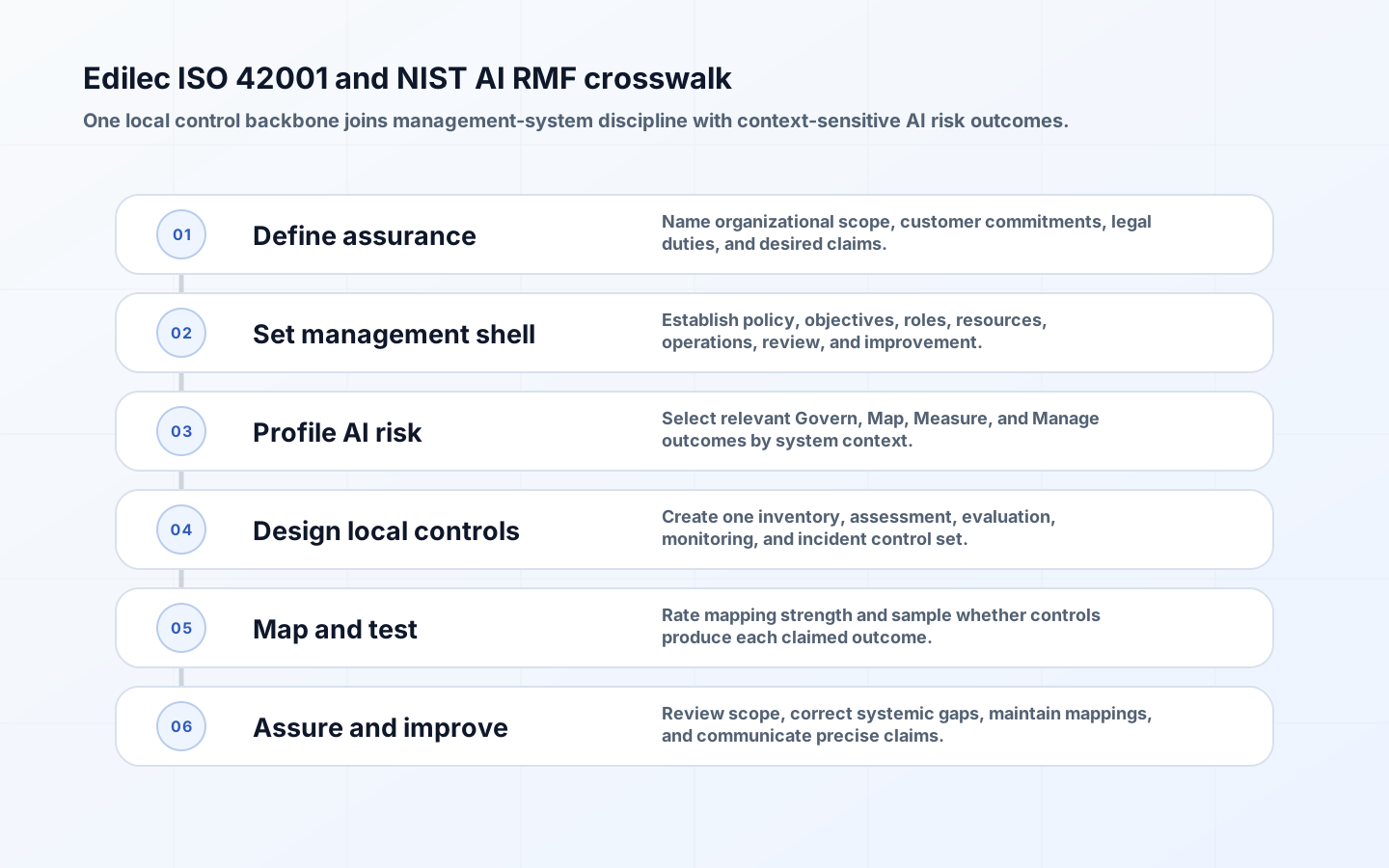
Use ISO/IEC 42001 to define the management-system shell: context, scope, leadership, policy, objectives, support, operational processes, evaluation, corrective action, and improvement. Use NIST AI RMF to structure risk outcomes within that shell. A local control such as system inventory, impact assessment, evaluation governance, incident response, or monitoring can satisfy multiple mapped needs while retaining one owner, workflow, and evidence source.

Create a crosswalk with columns for source requirement or outcome, local objective, control, owner, system scope, evidence, test procedure, reviewer, frequency, and known gaps. Do not force one-to-one mappings. Several RMF outcomes may support one management-system process, while one RMF outcome may depend on several controls. The NIST Generative AI Profile can add technology-specific priorities without becoming a second program.
| Shared process | Management-system evidence | RMF enrichment | Operational owner |
|---|---|---|---|
| AI inventory | Scope, ownership, lifecycle procedure | Govern inventory and retirement outcomes | AI governance operations |
| Impact and risk assessment | Method, competence, records, approvals | Map context, impacts, tolerances | Product and risk |
| Evaluation | Planned controls and performance review | Measure validity, reliability, and trustworthiness | Evaluation lead |
| Risk treatment | Operational planning and control | Manage prioritization and response | Business owner |
| Monitoring and incidents | Performance evaluation and corrective action | Continuous mapping and measurement | Service and incident owners |
Sequence implementation around business commitments
Start with scope and stakeholders. Inventory AI activities, contractual commitments, legal duties, customer expectations, existing management systems, and current risk practices. Build a local control model and map both sources. Pilot the controls on representative provider and deployer use cases. Run an internal readiness review that tests outcomes, not document presence. Correct systemic gaps before selecting a certification body or publishing broad alignment claims.
Reuse existing information security, privacy, quality, procurement, and software delivery processes where ownership and evidence are sound. Add AI-specific context instead of creating duplicate committees. Edilec's governance guide and compliance-ready delivery guide show how policy and release evidence can meet in ordinary operations.
Verify supplier claims without confusing frameworks
When a supplier claims ISO/IEC 42001 certification, inspect scope and validity. When it claims NIST AI RMF alignment, request its profile, control mapping, evidence sample, assessment method, exceptions, and last review. Ask which systems, models, services, subcontractors, and internal uses are included. Neither claim should substitute for product-specific evaluation, data terms, security evidence, incident obligations, or legal role analysis.
Require a current audit trail for risk acceptance and corrective action. A certificate can coexist with weak product evidence; a sophisticated risk profile can coexist with weak management discipline. Procurement should evaluate both organizational capability and the exact service being acquired.
Avoid common integration failure modes
The first failure is a clause-to-document exercise that never examines a real system. The second is an RMF workshop producing dozens of aspirational practices without owners. The third is duplicate evidence: one risk register for certification, another for product, and a third for customers. The fourth is scope ambiguity, where public claims sound enterprise-wide but audited processes cover one team. Design controls around operating decisions, then map them honestly.
A crosswalk should not claim equivalence where sources ask different questions. Record mapping strength and rationale: direct, partial, supporting, or gap. A policy may directly satisfy a management-system need while only supporting an RMF outcome that also requires system evidence. Independent reviewers should challenge optimistic mappings and sample whether local controls produce the claimed outcome.
Budget for maintenance after certification or first implementation. Model releases, new uses, organizational changes, incidents, audit findings, revised NIST material, and evolving customer expectations all change mappings. Assign a standards owner and local control owners, review crosswalk changes through governance, and communicate only the assurance statements the evidence can support at that date.
Use customer and regulator requests as inputs, not as the control architecture. Collect recurring questionnaires, assurance clauses, and evidence asks; map them to canonical controls and artifacts; then answer from controlled records. This reduces inconsistent claims and reveals where external expectations exceed current scope. Sales and procurement teams should have approved language describing what certification, alignment, or assessment actually covers and a route for requests that need qualified review.
Key takeaways
- ISO/IEC 42001 specifies an AI management system; NIST AI RMF structures voluntary AI risk outcomes.
- Certification is performed by independent certification bodies, not ISO, and its scope matters.
- NIST does not certify AI RMF implementations; alignment claims need a profile, mapping, evidence, and review method.
- Use one local control library and cross-map both sources instead of operating duplicate programs.
- Evaluate organizational assurance and product-specific evidence separately.
Frequently asked questions
Can an organization use both from the start?
Yes. Define the management-system scope and use RMF outcomes to design risk processes. Sequence controls by actual risk and commitments rather than waiting for every document to be complete.
Is ISO/IEC 42001 certification mandatory?
Generally it is a voluntary assurance choice, though a contract, procurement rule, or sector arrangement could require it. Certification does not by itself establish compliance with every applicable law.
Which is better for a smaller company?
A focused NIST profile may be the faster route to useful risk practice, while ISO/IEC 42001 may be justified by customer demand or an existing management-system culture. Size matters less than assurance need, scope, and ability to sustain processes.
Conclusion
The strongest ISO 42001 vs NIST AI RMF decision starts with the assurance problem. Use ISO/IEC 42001 when a structured, auditable management system and possible certification are central. Use NIST AI RMF to deepen context-sensitive risk work. For many organizations, an integrated backbone is the durable answer: one set of controls, one evidence system, and transparent mappings to both sources.