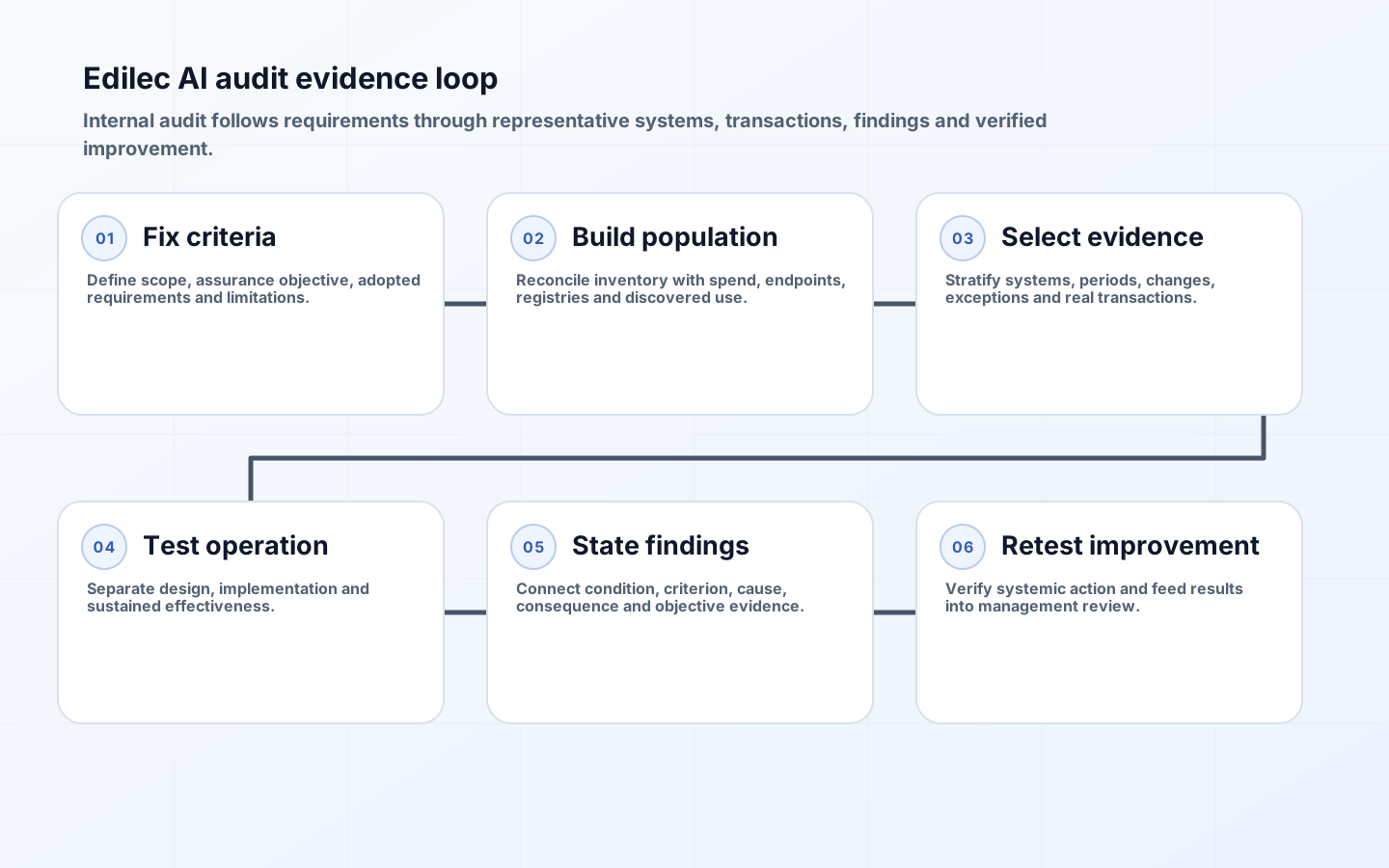
An AI management system audit asks whether governance operates across real decisions, not whether a policy library exists. The auditor traces objectives, risk assessments, approvals, data and model controls, monitoring, incidents, and corrective actions through a representative set of AI systems. A policy can be beautifully written while owners bypass intake, inventories omit embedded models, evaluation evidence is stale, or management accepts risk without understanding affected people. Internal audit should expose those breaks early enough to improve the system.
This guide assumes an established audit charter and adapts risk-based assurance to AI. It complements Edilec's AI governance operating model, LLM evaluation framework, and audit-log design guide. Certification readiness may be a benefit, but the internal objective is reliable governance and evidence.
Set audit objectives, scope, and criteria precisely
State what the engagement will conclude: design adequacy, operating effectiveness, conformity to selected requirements, or readiness for management review. Define organizational units, products, lifecycle stages, suppliers, and dates. The ISO page for ISO/IEC 42001 describes requirements for establishing, implementing, maintaining, and continually improving an AI management system. Obtain the licensed standard when auditing conformity; do not treat a public summary or this guide as a substitute for normative requirements.
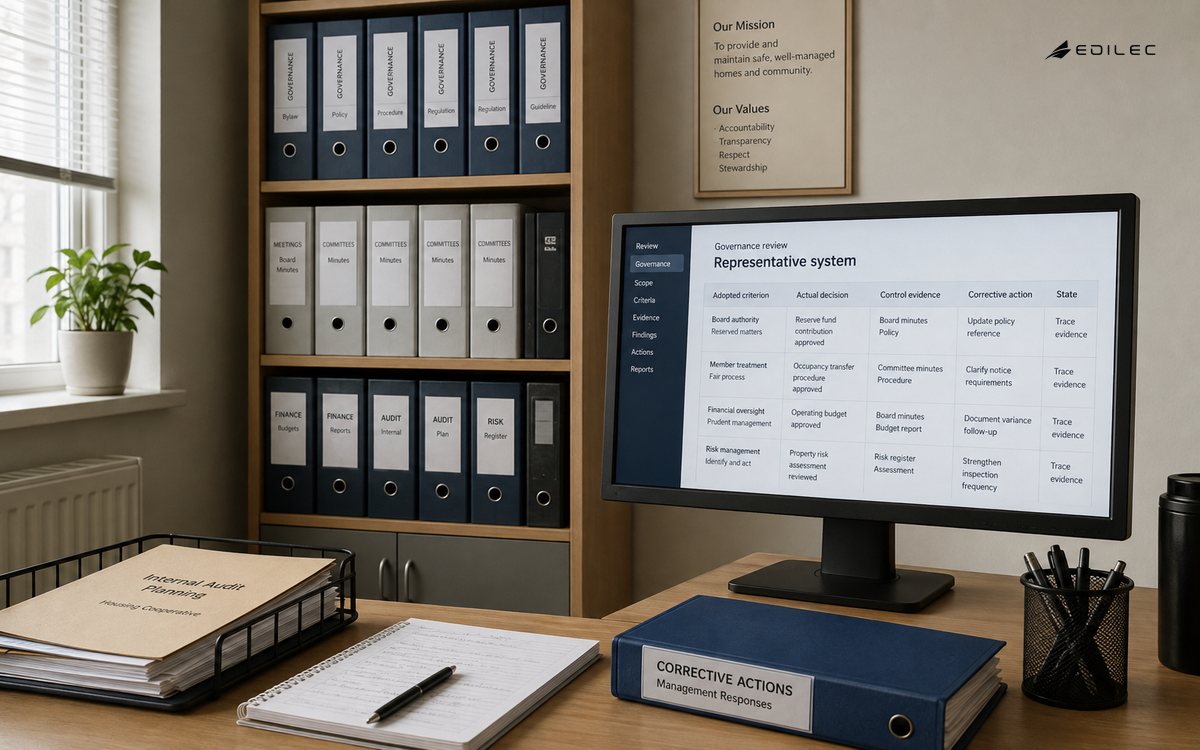
Build criteria from the organization's commitments: approved AIMS scope, policies and objectives, legal register, risk method, control plan, contractual duties, and relevant framework mappings. The NIST AI RMF organizes work through Govern, Map, Measure, and Manage. It can help test completeness, but findings should cite the actual criterion the organization adopted. Resolve conflicts and exclusions before fieldwork so teams are not judged against unstated expectations.
| Audit domain | Design question | Operating-effectiveness evidence |
|---|---|---|
| Inventory and ownership | Are inclusion rules and accountable owners defined? | Reconcile deployed services, procurement, code and expense samples |
| Impact and risk | Does the method cover people, context, misuse and uncertainty? | Trace selected assessments to decisions and updates |
| Development and change | Are release gates proportional to risk? | Inspect evaluations, approvals, versions and rollbacks |
| Operations | Do monitoring and escalation have thresholds and owners? | Sample alerts, incidents, overrides and response times |
| Improvement | Are causes corrected and effectiveness checked? | Retest closed actions and recurring findings |
Build the population before selecting AI audit samples
Request the AI inventory, but do not assume it is complete. Reconcile it with vendor spend, cloud model calls, browser extensions, data-platform workloads, model registries, production endpoints, privacy assessments, and departmental surveys. Identify embedded AI in purchased applications and spreadsheets used for consequential decisions. Record population limitations as audit evidence. Inventory completeness is often a control objective in its own right because an unlisted system cannot reliably inherit policy, monitoring, or incident response.
Use stratified, judgmental sampling rather than a convenient handful of famous projects. Include high-impact and low-impact tiers, in-house and vendor systems, approved and retired services, different geographies, systems with incidents, and a recently changed deployment. Add a discovery sample from outside the inventory. For transactions, sample approvals, exceptions, human overrides, monitoring alerts, and changes across the period. Explain why the sample can answer the audit objective and where it cannot support extrapolation.
Walk one decision end to end, then test controls independently
Begin each selected system with a walkthrough from business purpose to a real output and downstream action. Ask the owner to show, rather than describe, intake, impact assessment, data lineage, evaluation, approval, deployment, monitoring, user disclosure, override, and retirement. Compare the demonstrated path with documented procedure. A walkthrough finds missing handoffs and identifies the authoritative systems from which the auditor should obtain samples without relying solely on management-curated screenshots.
Test design by asking whether a control, if performed, could prevent or detect the stated risk. Test implementation with one current example. Test operating effectiveness across the audit period with independent samples. Reperform calculations or approvals where feasible; inspect timestamps and version links; confirm segregation of duties and exception handling. For automated controls, assess configuration, change access, failure behavior, and the completeness of inputs. For human review, test information quality, authority, workload, and evidence of meaningful intervention.
Challenge impact assessments, evaluations, and monitoring as one chain
The public summary for ISO/IEC 42005 emphasizes effects on individuals, groups, and society across the lifecycle. Sample whether assessments identify affected parties, foreseeable use and misuse, distributional effects, severity, likelihood, reversibility, and consultation. Then trace material impacts to requirements, evaluation cases, human controls, monitoring indicators, and incident criteria. A generic fairness paragraph that changes no control is documentation, not effective risk treatment.
Evaluation testing should inspect dataset relevance, provenance, subgroup coverage, contamination controls, metric rationale, baseline, thresholds, reviewer competence, and version identity. Production monitoring should detect changes that matter to the use case rather than report only latency and token consumption. The NIST AI RMF Playbook offers suggested actions across framework functions; use these as challenge prompts to locate missing practices, while retaining the organization's risk decisions as the primary audit trail.
Write findings that distinguish nonconformity, risk, and improvement
A defensible finding states condition, criterion, cause, consequence, and evidence. Call something a nonconformity only when objective evidence shows a requirement was not fulfilled. A risk observation may identify an exposure where no explicit requirement exists; an opportunity for improvement can strengthen an adequate process. Do not dilute repeated control failure into a suggestion, and do not inflate a documentation preference into a major nonconformity. Calibrate severity by impact and systemic reach, not by the seniority of the owner.
| Finding signal | Likely classification | Management response expected | Closure evidence |
|---|---|---|---|
| Required assessment absent for one high-impact system | Nonconformity | Contain exposure, complete assessment, examine population | Approved assessment and population review |
| Same approval bypass across several units | Systemic nonconformity | Correct workflow and governance cause | Control redesign plus sustained sample |
| Metric weak but accepted risk still within policy | Risk observation | Reassess rationale and alternatives | Documented decision and monitoring |
| Procedure works but evidence retrieval is slow | Improvement opportunity | Simplify evidence architecture | Optional implementation evidence |
| Corrective action marked done without retest | Open nonconformity | Perform effectiveness review | Independent retest with passing sample |
Drive corrective action into management review
Management should correct immediate instances, analyze causes, determine whether similar failures exist, implement systemic action, and verify effectiveness. The auditor should challenge vague actions such as retrain staff when workflow design, incentives, staffing, or tooling caused the failure. Every action needs an owner, due date, affected population, interim risk treatment, and evidence requirement. Closure testing should use fresh samples and confirm that the correction did not merely move the gap to another lifecycle stage.
Report themes to management review: scope suitability, objectives, risk trends, supplier dependencies, incidents, evaluation performance, resource constraints, overdue actions, and changes that could affect the AIMS. Preserve management decisions and risk acceptance. Internal audit should remain independent of designing the controls it later evaluates, while it can explain criteria and risk. Plan follow-up based on severity and change velocity rather than waiting automatically for the next annual cycle.
Assemble the right audit competence and use analytics carefully
The engagement team may need internal-audit method, AI engineering, cybersecurity, privacy, legal, human-factors, data, and domain expertise. Record competence gaps and use specialists without delegating the audit conclusion to system owners. Analytics can reconcile inventories, identify missing approvals, detect version mismatches, stratify exceptions, and select unusual transactions, but validate source completeness and transformation logic before relying on a dashboard. When auditors use generative AI to review evidence, apply the organization's own data rules, verify every conclusion against original records, and preserve reproducible workpapers. An opaque summarizer should not become the sole basis for a nonconformity or for clearing one.
Plan evidence retention so another auditor can understand selection, procedures, results, professional judgment, review, and conclusion without relying on memory. Reference authoritative records rather than duplicating sensitive prompts or personal data into workpapers. Restrict access and define retention with legal, privacy, and audit requirements. When management disputes a finding, document the evidence and both interpretations, then use the audit escalation process; do not negotiate away objective condition or exaggerate certainty. Quality review should challenge whether criteria were applied consistently across vendor and internally built systems and whether scope limitations changed the assurance conclusion.
Coordinate the audit plan with privacy, security, quality, model-risk, and financial assurance teams to reuse reliable evidence and avoid exhausting the same owners. Preserve each function's mandate and conclusion; a security test does not answer fairness, and a model evaluation does not prove management-system operation. Map overlap, gaps, reliance criteria, and timing. Where another function's work is used, assess its competence, objectivity, scope, methods, and results rather than accepting a report title as sufficient evidence.
Key takeaways for an AI management system audit
- Define the assurance conclusion and adopted criteria before collecting evidence.
- Reconcile the AI inventory independently and include a discovery sample outside it.
- Trace impacts into requirements, evaluations, monitoring, incidents, and real decisions.
- Separate design, implementation, and operating effectiveness in both testing and findings.
- Close corrective actions only after fresh evidence demonstrates that the cause was addressed.
FAQ about AI management system internal audits
Does an internal audit certify ISO 42001 conformity? No. It can evaluate conformity and readiness, but certification is a separate external process. Must auditors understand machine learning code? Not for every test, though the team needs enough technical competence to challenge data, evaluation, automation, and evidence. Can the AI governance team audit itself? It can monitor controls, but an internal audit conclusion requires appropriate independence and objectivity. How large should the sample be? Large enough to address risk and population variability; document judgment instead of applying a universal number.
Conclusion: audit the operating system, not the policy shelf
A useful AI management system audit follows evidence across organizational boundaries and lifecycle stages until it reaches actual outcomes. It discovers the real population, tests whether controls work repeatedly, distinguishes requirements from recommendations, and forces corrective actions to prove effectiveness. That discipline gives management more than a conformity score: it reveals whether the organization can notice changing AI risk, make accountable decisions, and improve before customers, regulators, or affected people discover the gap first.