AI Services and Solutions Delivery Plan
AI services and solutions should be commissioned as changes to a business service, not as a model installation. The delivery plan must connect a measurable user outcome to data rights, workflow integration, evaluation, human responsibility, security, support, cost and retirement. It should also compare AI with simpler process, rules, search and software options. The NIST AI Risk Management Framework provides a useful lifecycle vocabulary: govern the work, map its context, measure relevant behavior and manage risk over time. A credible plan translates those ideas into release evidence and named owners. It does not promise a universal timeline or return before the team has observed the workflow and tested the assumptions that drive cost and consequence.
Start with the work
Begin by observing a real workflow and selecting one specific problem. It may be difficult to find a reliable policy answer, slow to prepare a case, prone to duplicate data entry, or hard to route an exception. Describe the trigger, user, inputs, current steps, output, next action, and exception route. Ask what a wrong, late, or unavailable result would mean for the people involved. This prevents a delivery plan from being organized around an abstract capability. It may also show that the best first solution is a clearer process, search improvement, data repair, or integration. The plan should welcome that finding: it is cheaper to solve the right problem with a simple method than to make a complex AI service compensate for an unclear workflow.

| Planning question | Why it matters | Early artifact |
|---|---|---|
| Who benefits? | Value must be tied to a user and job. | User outcome statement. |
| What changes? | Authority and workflow may change together. | Current and proposed process map. |
| What is excluded? | Boundaries reduce accidental expansion. | Non-goals and escalation cases. |
| What fails safely? | Recovery affects feasibility. | Manual fallback description. |
Separate solution options
Compare options that solve the same user problem, not only AI products against each other. A rule may be more transparent and robust when the decision logic is stable. A retrieval experience may be preferable when users need trustworthy source material. A generative assistant may help when language transformation is genuinely useful and review is available. A predictive or ranking service may help prioritize a queue, provided priority is not mistaken for a final judgment. Record the capability, assumptions, data needs, explanation needs, operating burden, and failure mode of each option. This comparison guards against the common pattern of making a use case fit the tool already selected.
- Include a non-AI process or data improvement option in the comparison.
- Check whether the necessary data exists and has an accountable owner.
- Ask whether a reviewer can understand and challenge the result.
- Estimate integration and support work, not only model or license cost.
- Reject options that cannot meet the safety or privacy boundary.
Plan cost with assumptions
Costs arise across the lifecycle. Discovery requires process mapping, data assessment, and stakeholder decisions. Delivery can require interface design, integration, evaluation, access management, user training, and release preparation. Operations includes provider or infrastructure charges, monitoring, support, incident response, source upkeep, and review of changes. Costs can also move with volume, latency targets, retention, availability, expert review, and compliance obligations. Rather than use a generic figure, state the workload and service assumptions behind each estimate and nominate the owner who will test them. This makes it possible to see whether a lower build cost shifts burden into manual review, vendor dependence, or later remediation.
| Cost area | Often overlooked element | Question for the plan |
|---|---|---|
| Discovery | Time from process and domain owners. | What decisions must be made before build? |
| Integration | Identity, source quality, and error handling. | Which dependencies need live testing? |
| Evaluation | Reviewer time and difficult cases. | What evidence is needed to release? |
| Operations | Support and change review. | Who responds when behavior shifts? |
Design for risk
Identify risks in relation to the proposed action. Consider not only inaccurate output, but also privacy exposure, security misuse, inaccessible interaction, overreliance, source staleness, unequal error effects, outages, and changes that alter behavior. The NIST Generative AI Profile is useful for generative use cases, including concerns about confabulation and information integrity. Convert each material concern into a scenario: what happens, who is affected, how is it detected, who responds, and what control could reduce it? Controls may include narrower scope, approved sources, user training, role-based access, review, logging, abstention, and manual fallback. Some scenarios may reveal that the planned authority is too high for the available evidence.
Prove the proposed service
Plan evaluation before implementation choices become fixed. Gather cases that represent normal work, ambiguity, incomplete information, adversarial or misleading input where relevant, and situations where the solution should refuse or escalate. Ask subject-matter reviewers to use a rubric that measures what matters to the workflow: factual support, usefulness, timeliness, fairness considerations, safety, and clarity. Compare the new process with the existing baseline, including corrections and downstream effects. Keep evidence of source versions, configuration, test results, reviewer findings, and residual-risk acceptance. The NIST Privacy Framework also prompts necessary questions about whether test and operational data are handled consistently with the intended purpose.
Roll out as an operating change
A rollout should give the organization a controlled way to learn. Limit the first audience or case type, provide support, communicate the service boundary, and maintain a fallback route. Monitor workflow outcomes, corrections, escalations, data quality, access events, availability, and reports from users. Review individual cases behind significant signals. Decide in advance who may expand scope, introduce a new source, or change from recommendation to automatic action. ISO/IEC 42001 offers management-system ideas that help turn objectives, roles, monitoring, and improvement into ongoing practice. The local plan should remain understandable to the people who run the work every day.
Operate and exit responsibly
After release, maintain an inventory of the service, its owners, dependencies, data sources, authority, and material changes. Re-evaluate when a model, provider, policy, data source, user population, or incident changes the original assumptions. Give people a route to report a concern and a route to get essential work done during a pause. Retirement deserves planning too: decide what happens to data, records, access, integrations, and user communication when a service is replaced or no longer justified. An exit plan makes a team more willing to pilot carefully because it does not turn every experiment into an irreversible dependency.
Fund delivery through evidence-based stage gates
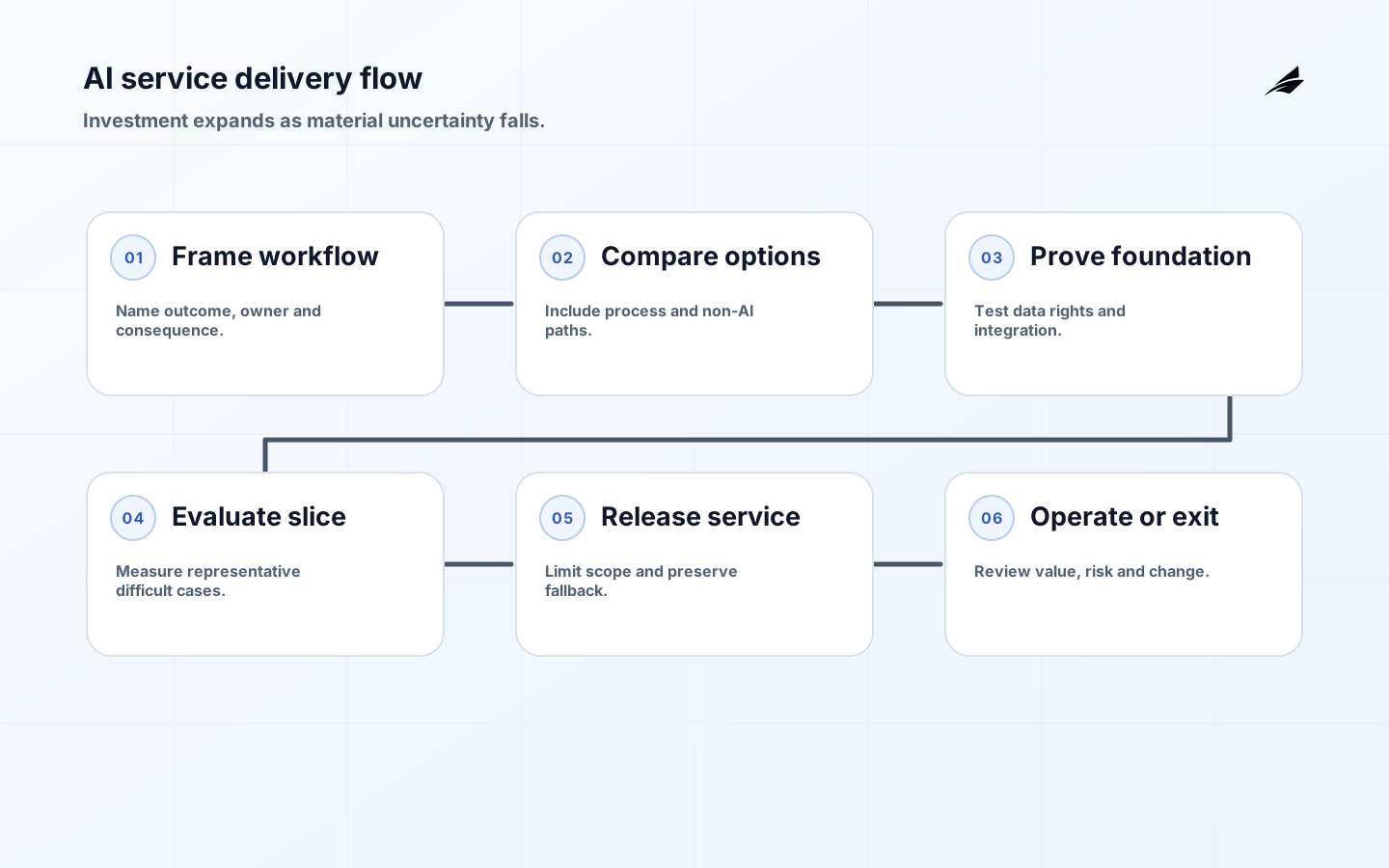
Use six decisions: frame the workflow, compare solution options, prove data and integration, evaluate a production-shaped slice, release to a bounded population, then operate or exit. Each gate needs an owner and artifact. The AI services scope guide provides adjacent planning detail, the AI services implementation checklist supports acceptance, and the AI services FAQ helps stakeholders challenge assumptions. Funding should expand only when evidence reduces an important uncertainty.
Consider a contract-review assistant. Discovery maps document types, reviewer roles, clauses, source templates, confidentiality and current cycle time. A proof tests extraction and retrieval on representative agreements, including scans, amendments and missing schedules. The pilot drafts issues with citations but leaves legal judgment to qualified reviewers. Costs include document preparation, evaluation, secure storage, integration, review time, provider use, support and model-change retesting. The NIST Generative AI Profile helps identify risks such as confabulation and information integrity. Expansion depends on supported findings, missed material issues, reviewer effort, cycle time, access incidents and total cost per reviewed agreement.
| Delivery gate | Evidence required | Decision |
|---|---|---|
| Workflow framed | Baseline, owner, scope and consequence | Explore options |
| Option selected | AI and non-AI comparison | Fund proof |
| Feasibility proven | Data rights, integration and difficult cases | Build pilot |
| Pilot accepted | Evaluation, controls, fallback and support | Bounded release |
| Live service reviewed | Outcomes, incidents, drift and unit cost | Expand, change or pause |
| Exit triggered | Migration, retention and communication plan | Retire responsibly |
Key takeaways
- Plan around a real workflow and compare more than one solution path.
- Make cost assumptions visible across discovery, delivery, and operations.
- Translate risks into cases, owners, controls, and recovery actions.
- Use representative evaluation to decide whether the service is ready.
- Treat rollout, ongoing review, and retirement as parts of delivery.
Frequently asked questions
How do we know whether AI is the right solution? Compare it with simpler process, rule, search, or data approaches against the same user outcome and control needs. What makes a cost estimate useful? It states the relevant volumes, service targets, dependencies, review workload, and uncertainty instead of implying precision that is not yet supported. Can a pilot use different controls from production? A pilot may limit exposure, but it should not bypass essential handling, access, or accountability decisions. Who decides to expand? The accountable owner should make that decision from evidence, with input from the roles affected by the change.
- What is an exit criterion? A condition under which value, risk, cost, or support burden no longer justifies continuing.
- Should every output be logged? Retain what is needed for operations and investigation while respecting data-minimization and retention duties.
- What is the first planning milestone? Agreement on the user outcome, boundary, owners, data questions, and evidence required to proceed.
Make trade-offs explicit
Every delivery plan makes trade-offs between speed, breadth, control, cost, and user effort. Put them on the table. A broader source set may improve coverage while increasing access and freshness work. A faster automated route may reduce queue time while requiring stronger review for errors. A highly tailored experience may improve usability while adding support complexity. State which outcome is being optimized, who accepts the trade-off, what evidence supports it, and what signal would cause reconsideration. This is especially valuable when suppliers or sponsors present different success measures. A shared trade-off record allows the team to discuss the actual decision rather than argue from generic positions for or against AI. It also makes a later redesign less political because the original assumptions are visible.
Conclusion
A sound AI services and solutions plan makes uncertainty visible and progressively cheaper to resolve. Start from work, compare options, count lifecycle cost and require representative evidence before authority or audience expands. Governance is part of design, while monitoring, support and exit are part of delivery. This approach gives sponsors a defensible basis to proceed, reshape or stop, and gives operators a service they can understand when behavior, providers and business conditions change.