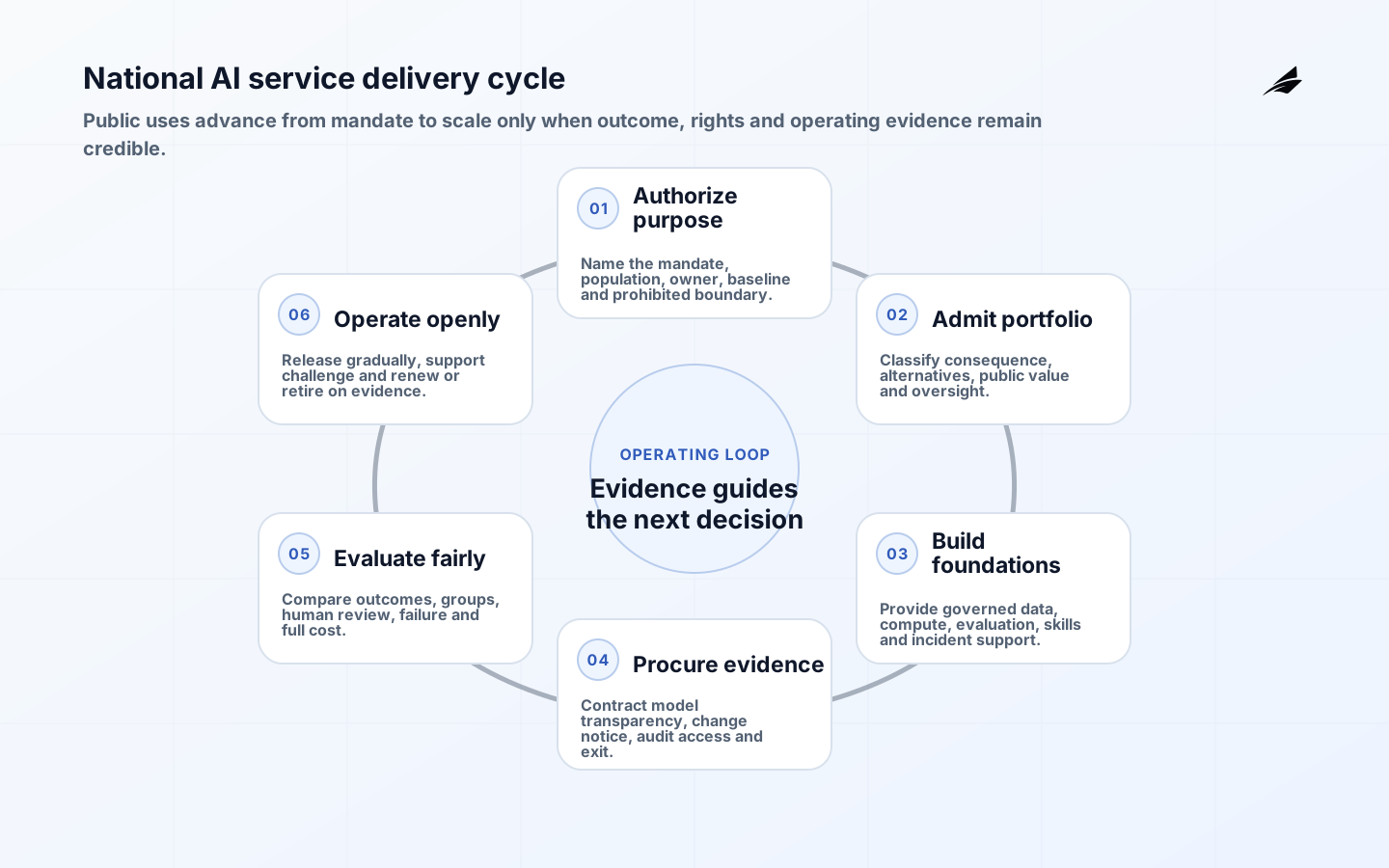
National AI services are shared capabilities, delivery teams and governance mechanisms that help public institutions use artificial intelligence for defined public outcomes. They may include compute access, approved models, data services, evaluation facilities, procurement frameworks, reusable components and specialist support. They are not a single national model or a license to automate every decision. A sound program connects each service to legal authority, an accountable institution, affected people and measurable public value.
This national AI services implementation checklist complements the national AI scope, cost and risk plan and national AI services FAQ. Teams implementing individual processes can also use the AI workflow automation checklist. The sequence below is deliberately evidence-led: a country can build shared foundations while preserving sector accountability and stopping uses that do not withstand evaluation.
1. Establish the mandate and public-value portfolio
Start with public problems, not technology availability. For each candidate, document the service failure or opportunity, population affected, current baseline, responsible authority, legal basis, non-AI alternatives and distribution of expected benefits and harms. A translation assistant for public information has a different risk boundary from eligibility scoring, biometric identification or clinical prioritization. Grouping them under one innovation program obscures who may authorize, evaluate and suspend each use.
Create a portfolio board with policy, service, technical, security, privacy, procurement and affected-community representation. The board should set prohibited or restricted uses, define escalation thresholds and publish decision criteria. The OECD AI Principles, updated in 2024, join innovation with human rights, transparency, robustness and accountability. Treat those principles as lifecycle governance rather than a one-time review: translate them into named decisions and evidence while applying the laws of each jurisdiction directly.
| Portfolio gate | Evidence required | Decision owner |
|---|---|---|
| Problem admission | Baseline, affected population, mandate and alternatives | Public service owner |
| Risk classification | Rights, safety, privacy, security and systemic impact assessment | Accountable authority |
| Pilot approval | Evaluation design, data authority, controls and exit route | Portfolio board |
| Scale approval | Independent results, operating cost and unresolved harms | Funding and service authorities |
| Continuation | Live performance, appeals, incidents and public feedback | Operational service owner |
2. Build shared foundations without centralizing every decision
Inventory the enabling capabilities that many agencies need: secure development environments, approved compute, identity, data access controls, model and dataset records, evaluation tools, logging, incident coordination and contract templates. Fund reusable foundations when they lower duplicated cost or strengthen assurance. Keep domain-specific data interpretation, service design and final accountability with the institution that understands the law and operating context. A central platform should make good practice easier, not become an unreviewable decision maker.
Treat data access as a governed service. Record provenance, collection purpose, permitted reuse, quality limitations, retention, localization and the authority for linking records. Establish controlled research environments for sensitive analysis and separate experimentation from production entitlements. Compute plans should model demand, energy, geographic resilience, supply concentration and exit options. The UK's AI Opportunities Action Plan illustrates how compute, data, skills and adoption form connected national policy questions; local implementation still requires explicit affordability and accountability.
3. Procure systems, evidence and exit rights
Write outcome-based requirements that also make assurance testable. Require suppliers to identify models, material data dependencies, subcontractors, hosting locations, evaluation methods, known limitations, security practices, human-oversight needs and change-notification rules. Contract for access to logs and evidence needed by auditors and service operators. Avoid asking for disclosure that vendors cannot lawfully provide; instead specify the behavior, documentation and independent testing needed for the risk level.
Commercial terms should address usage units, minimum commitments, model updates, performance degradation, incident cooperation, data return or deletion, continuity and transition assistance. Retain a practical route to another provider or a non-AI process. Concentration risk is not solved by naming two vendors if both depend on the same model or cloud layer. Test portability with a representative workflow before signing a long commitment, and price the staff, evaluation, integration and oversight around the service rather than comparing inference rates alone.
4. Run controlled pilots with credible evaluation
Pre-register the pilot question, baseline, comparison, success thresholds and stop conditions. Select cases that represent languages, regions, accessibility needs and difficult exceptions, not merely clean demonstrations. Measure task outcomes and public experience alongside technical accuracy. Where an AI output informs a consequential decision, define who reviews it, what information that person sees, how automation bias is reduced and how an affected person can obtain explanation and correction.
Use the NIST AI Risk Management Framework functions of Govern, Map, Measure and Manage to structure evidence, not as a compliance badge. Evaluate foreseeable misuse, privacy leakage, security attacks, unequal error patterns, model drift and failure of dependent services. An independent evaluator should be able to reproduce material results. Pilot data must include the operational burden: review time, false-positive investigation, support, appeals and compute. A faster model that creates more corrections may reduce rather than increase public capacity.
5. Authorize and operate each service progressively
Move from sandbox to limited production only after the service owner accepts residual risk and operating teams rehearse expected failures. Release by bounded population, region or transaction class. Publish the system purpose, responsible body, material role of AI, data categories, human-review route and contact for challenge in language people can understand. Transparency must not reveal security-sensitive controls, but it must be sufficient for meaningful accountability.

Create live monitoring for outcome quality, subgroup effects, overrides, complaints, security events, model or data changes and upstream outages. Version prompts, policies, models and evaluation sets so an incident can be tied to the deployed configuration. Define authority to restrict, roll back or suspend. Regulatory obligations vary: for example, the European Commission's AI Act overview describes phased rules and risk categories in the EU. Maintain a jurisdiction-specific obligations register rather than treating any international principle as legal advice.
- Confirm the public-service owner, legal authority and affected population.
- Classify the use and approve data, security, rights and procurement controls.
- Evaluate a representative pilot against a non-AI baseline and predefined thresholds.
- Rehearse human review, appeal, outage, incident and supplier-change scenarios.
- Authorize a bounded rollout with versioned evidence and public information.
- Review live outcomes and cost; scale, change, suspend or retire on evidence.
6. Measure public value, capability and distribution
A national dashboard should not reduce progress to the number of pilots or models deployed. Track service outcomes, access, distribution, safety, public challenge, capability growth and full operating cost. Separate ecosystem measures such as research capacity or workforce skills from the performance of a particular public service. Publish definitions, measurement windows and known gaps so figures can be interpreted. Independent scrutiny is especially important when the sponsoring institution also reports success.
| Measure | Useful interpretation | Misleading proxy |
|---|---|---|
| Service outcome | Change versus baseline for the intended population | AI transactions processed |
| Distribution | Outcome and error differences across relevant groups | National average alone |
| Contestability | Time and success rate for review or correction | Presence of an appeal page |
| Reliability | Failures, drift and recovery by deployed version | Laboratory benchmark only |
| Economic value | Net benefit after people, compute, assurance and transition | Model API price |
| Capability | Reusable public skills, data quality and evaluation capacity | Training attendance |
7. Maintain a national assurance and capability record
Create a durable record for every production use: mandate, owner, suppliers, model and data versions, risk classification, evaluations, approvals, operating indicators, incidents, complaints, audits and retirement decision. Standardize the minimum fields nationally while allowing sector evidence to differ. Publish an appropriate subset in a public register so citizens, oversight bodies and other agencies can discover where AI materially contributes to a service. Protect security-sensitive and personal details, but record the rationale for any withheld field.
Link each service record to workforce capability. Identify which roles can commission evaluation, interpret subgroup results, administer platforms, investigate incidents, review outputs and communicate with affected people. Training completion alone is not competence: use exercises and supervised decisions. Maintain independent evaluation and civil-society engagement capacity rather than relying entirely on suppliers. For shared services, publish reusable test methods, contract clauses and incident lessons so one agency's learning improves the national system.
At least annually, reassess whether the original need, legal basis, data, provider, alternatives and public expectations have changed. Trigger an earlier review after material model updates, scope expansion, serious incidents or new law. Renewal should be an affirmative decision. If benefits no longer outweigh complete costs and risks, support an orderly exit: notify users, preserve required records, revoke access, return or delete data, terminate commitments and verify that the non-AI service can continue.
Key takeaways
- Authorize national AI services as a portfolio of bounded public uses, not a blanket technology program.
- Share compute, evaluation, contracts and controls while retaining domain accountability.
- Procure operational evidence, change notice and exit capability along with model access.
- Compare pilots with credible alternatives and include human, appeal and support costs.
- Scale only when public outcomes, rights protection and affordability remain observable in production.
Frequently asked questions
Does a national AI service require a sovereign national model?
No. A country may invest in domestic models for language, security, research or industrial-policy reasons, but shared national services can also govern access to multiple public, commercial and open models. The decision should follow the use case, total cost, strategic dependencies, evaluation evidence and legal requirements.
How long should a public-sector AI pilot run?
Long enough to observe representative demand, difficult cases, staff behavior and at least one change or failure scenario. Calendar duration is secondary to evidence coverage. A narrow transactional service may produce evidence in weeks; a seasonal or high-consequence service may require a much longer controlled period.
Who should own an AI system used across agencies?
A central team can own the common platform, but each public use needs a domain service owner with authority over purpose, deployment and suspension. Shared ownership without a final accountable decision maker leaves incidents, appeals and risk acceptance unresolved.
Conclusion
National AI services create durable value when strategy becomes a sequence of accountable service decisions. Define public purpose, build reusable foundations, procure evidence and exit rights, evaluate representative pilots, authorize progressively and keep outcomes open to challenge. The result is not the fastest possible deployment count; it is a national capability that can adopt useful AI, detect harm and stop or change systems when the public evidence requires it.