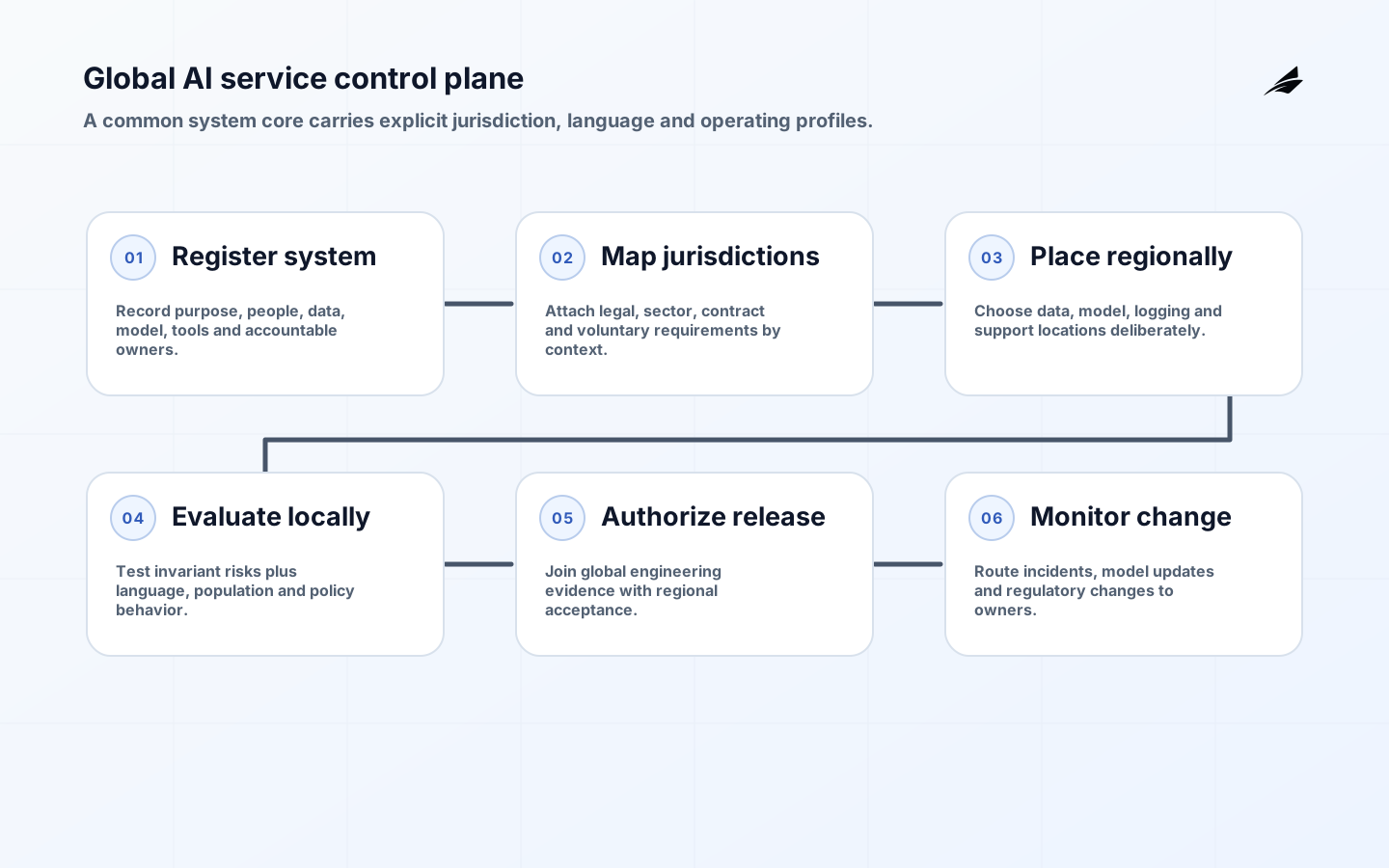
Global AI services need a common engineering and governance core that can adapt to jurisdiction, language, customer and sector. Copying one pilot into every region creates hidden differences in lawful purpose, data movement, model behavior, disclosure, human review and incident reporting. Building an independent system for each country duplicates cost and makes assurance incomparable. The practical design is a central control plane with local profiles, evidence and accountable operators.
This plan is for organizations selecting or delivering AI across several markets. Pair it with the global AI implementation checklist and global AI services FAQ. Teams still defining the basic engagement can compare the AI services scope and risk plan before committing to regional rollout.
Define one service and its local contexts
Register the business owner, intended purpose, affected people, inputs, outputs, model, tools, decisions, human authority and prohibited uses. Then attach deployment contexts: country, customer type, language, channel, sector and user role. Risk depends on context. The same summarization model may be low consequence for internal meeting notes and high consequence when its output influences employment, credit or access to a public service.
| Registry field | Why it matters globally | Owner |
|---|---|---|
| Intended and prohibited use | Prevents local teams from repurposing a general tool silently | Business owner |
| Affected people and geography | Drives rights, language and impact analysis | Regional product and legal |
| Data categories and movement | Supports privacy, residency and supplier decisions | Data owner |
| Model and dependency versions | Makes tests and incidents reproducible | Engineering |
| Human authority and appeal | Clarifies who can override or correct an outcome | Operations owner |
| Applicable control profile | Connects obligations to evidence | Governance owner |
Use a stable internal identifier for the AI system across contracts, model versions and regions. Avoid inventories that list only externally purchased models; the application, retrieval data, rules, tools and workflow create the delivered behavior. Register experiments too, with lighter controls and expiry, because pilots often become internal production through continued use rather than a formal launch.
Map requirements without pretending they are identical
Maintain a jurisdiction and sector matrix reviewed by qualified counsel and control owners. Separate binding law, regulator guidance, standards, contracts and voluntary commitments. The OECD AI Principles, updated in 2024, provide an international reference for innovative and trustworthy AI that respects human rights and democratic values. NIST's voluntary AI RMF organizes risk activity around Govern, Map, Measure and Manage. ISO/IEC 42001 specifies an AI management system. These can support a shared operating vocabulary, but none automatically proves compliance with local law.
As of July 14, 2026, the European Commission states that the EU AI Act entered into force on August 1, 2024; prohibited-practice and AI-literacy provisions applied from February 2, 2025; and governance and general-purpose AI obligations applied from August 2, 2025. The Commission's current implementation page describes further dates and agreed timeline changes for transparency and high-risk rules. Verify the live official text and applicable role before each release rather than copying dates from an old roadmap.
| Control domain | Common core | Local profile example |
|---|---|---|
| Classification | Intended use, impacts and system role | Local risk category and sector trigger |
| Transparency | User notice and system documentation | Language, channel and required disclosure |
| Human oversight | Named authority, escalation and intervention | Qualification, labor or sector requirement |
| Data | Purpose, lineage, quality and access | Residency, transfer and retention basis |
| Assurance | Versioned tests and limitations | Required assessment, registration or conformity evidence |
| Incident | Detection, severity and response | Authority, customer and deadline routing |
Create a control crosswalk at the requirement level, with accountable interpretation and evidence. Reuse is legitimate when the evidence actually meets several requirements; a generic policy statement should not be counted repeatedly. Give every local deviation an owner, rationale, effective date and review trigger. Regulatory change monitoring must feed backlog and release governance, not remain a legal newsletter.
Choose a regional architecture deliberately
Decide where prompts, source records, embeddings, logs, feedback and model processing occur. Data residency is not solved by hosting the application locally if telemetry, support or model calls cross borders. Build a data-flow map through subprocessors and support paths. Classify data before model selection, minimize content, and use regional routing only from verified attributes. Where a global model endpoint is unsuitable, compare regional deployment, local model hosting, de-identification or a narrower non-AI workflow.
| Architecture option | Advantage | Trade-off to test |
|---|---|---|
| Central service | Consistent operation and efficient scale | Transfers, latency and regional outage concentration |
| Regional service | Residency and local performance | Configuration drift and duplicated operation |
| Customer-hosted component | Customer control of data and keys | Support visibility and upgrade consistency |
| Local model | Offline or sensitive processing | Hardware, update, evaluation and model limits |
| Hybrid routing | Task-specific control and economics | Policy accuracy and cross-route comparability |
Keep authorization, prohibited outcomes and consequential business rules in deterministic services rather than translating each jurisdiction into prompts. Models can classify or draft within a profile, but policy code should decide what data is accessible and what action is allowed. Design supplier exit: preserve evaluation sets, prompts, schemas, model abstraction where practical, data export and a controlled way to disable a model or region.
Evaluate by language, population and context
Translation of an English benchmark is not enough. Build cases from local workflows, policy, language varieties, names, formats and harm scenarios with appropriate consent and privacy. Include code switching, transliteration, dialect, ambiguous requests and local prohibited use. Qualified reviewers should define acceptable outcomes and escalation, then examine disparities across relevant groups without inferring sensitive attributes casually.
- Create a global invariant set for safety, security, privacy and core product behavior.
- Add regional suites for language, law, policy, integrations and cultural context.
- Run every model, prompt, retrieval and tool change against affected suites before promotion.
- Test prompt injection, data leakage, unsupported claims, excessive tool authority and failure recovery.
- Calibrate human review and refusal by consequence rather than applying one threshold worldwide.
- Monitor production drift and sample real outcomes with approved data-handling procedures.
Singapore's IMDA describes AI Verify as a governance testing framework and toolkit aligned with international principles, supporting process checks and technical testing for traditional and generative AI. Such tools can add repeatability, but test results need interpretation in the actual deployment. Publish a model and system limitations record for operators, and state what the evaluation did not cover.
Build global governance with local authority
A central AI council can own standards, registry, approved suppliers, evaluation infrastructure and enterprise reporting. Regional owners should approve local fit, language, operations and obligations. Product teams own the system behavior and fixes; legal and risk functions advise and challenge; they should not become the only people accountable for a technical product. Define escalation when global consistency conflicts with local requirement.

| Decision | Global owner | Regional owner |
|---|---|---|
| Model supplier approval | Due diligence and baseline contract | Local transfer and sector suitability |
| Use-case release | Core safety and engineering gate | Local law, language and operating acceptance |
| Evaluation | Methods, tooling and invariant tests | Representative cases and qualified review |
| Incident | Severity, coordination and supplier action | Affected-person, customer and authority response |
| Change | Shared component and control update | Local regression and rollout decision |
Train people for their role. General AI literacy is different from model engineering, reviewer qualification, incident response or risk acceptance. Operators need to recognize uncertainty and escalation. Engineers need secure design and evaluation. Executives need to understand residual risk and evidence. Record completion and refresh training when systems or obligations materially change.
Plan delivery stages and total cost
Cost includes model use or hosting, data preparation, regional infrastructure, integration, evaluation, human review, translation, assurance, security, support, legal analysis and incident readiness. Compare cost per successful outcome by region, not token price alone. A local model may reduce transfer risk but increase hardware and evaluation work. A central service may lower run cost while creating unacceptable legal or resilience concentration.
| Stage | Exit evidence | Scale decision |
|---|---|---|
| Global frame | Registry, owner, intended use and invariant controls | Is the use case eligible? |
| Reference build | Bounded workflow and baseline evaluation | Does the design work safely? |
| First region | Local profile, data flow and operator acceptance | Does context meet thresholds? |
| Second-region proof | Reusable core and documented variation | Is the operating model repeatable? |
| Portfolio rollout | Regional waves, support and monitoring | Do value and assurance justify expansion? |
| Sustain | Change, incident, audit and retirement evidence | Should each deployment continue? |
Key takeaways
- Register the complete AI system and every material deployment context.
- Use international frameworks for shared discipline while mapping local law separately.
- Trace data through models, logs, support and subprocessors before choosing regional placement.
- Evaluate local language, population, policy and failure scenarios with qualified reviewers.
- Give global governance reusable controls and regional owners real release and incident authority.
Frequently asked questions
Can one governance framework cover every country?
One internal framework can provide inventory, roles, risk methods and evidence standards. It still needs jurisdiction and sector profiles. A framework is an operating system for compliance and risk work, not a substitute for applicable requirements.
Does regional hosting guarantee data residency?
No. Review model endpoints, logs, support, backups, analytics, subprocessors and administrative access. Residency and transfer obligations depend on the complete data flow and legal context.
Should every region use the same model?
Only when it meets local quality, language, availability, data and commercial needs. Different models may be justified, but outputs and controls must remain comparable through common contracts and context-specific tests.
What should a worldwide AI provider contract include?
Include regions, data use, subprocessors, model changes, security, evaluation support, incident notification, audit evidence, service levels, intellectual property, exit and deletion. Allocate system-level duties beyond the base model.
Conclusion
A global AI service should be consistent enough to govern and local enough to be valid. One system registry, requirement crosswalk, regional architecture, layered evaluation and distributed accountability provide that balance. Expand market by market when evidence travels honestly and local differences remain visible.