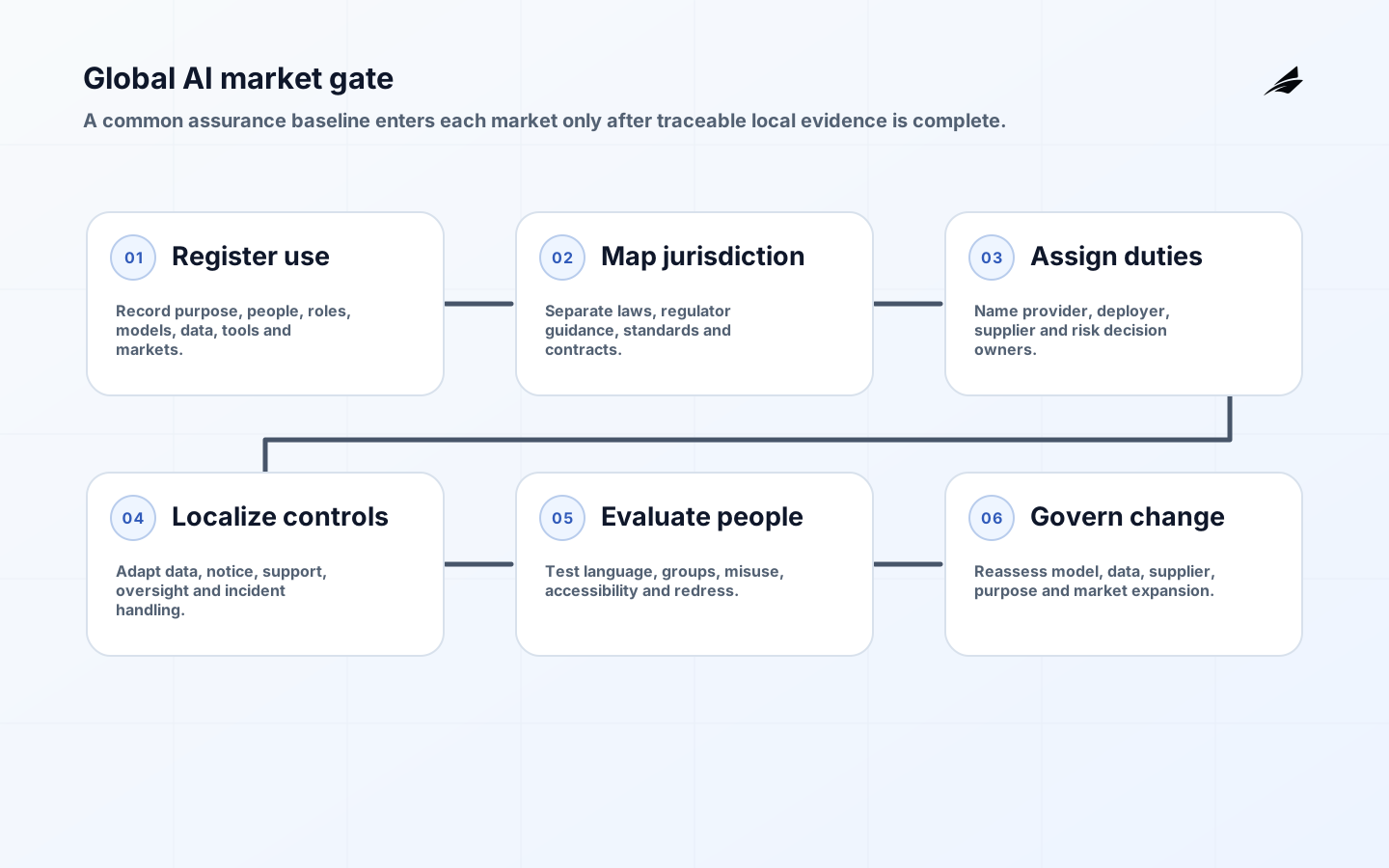
A worldwide AI services implementation checklist must do two things at once: preserve a coherent engineering and governance baseline, and respect the laws, cultures, languages and service conditions of each market. A single global policy is not a substitute for jurisdiction analysis. Conversely, treating every country as a completely separate product creates inconsistent controls and duplicated evidence. The practical answer is a common assurance core with documented local overlays and explicit market launch gates.
The OECD AI Principles provide an international reference around inclusive growth, human rights and democratic values, transparency, robustness and accountability. NIST offers a voluntary risk-management structure; Singapore publishes practical model governance guidance; Canada has binding duties for covered federal automated decisions; and the EU AI Act assigns obligations by role and risk. These instruments are not interchangeable. Use the worldwide AI services plan to frame scope and the worldwide AI FAQ for leadership decisions.
1. Inventory systems, uses, roles and markets
Create an AI system register that describes intended purpose, users, affected people, decision or content pathway, model, data, tools, integrations, owner, supplier and lifecycle state. Track where the service is offered and where affected people are located; provider headquarters alone does not determine every applicable rule. Distinguish development, provision, import, distribution and deployment roles because obligations can attach differently. Record whether a general-purpose model is being provided or used inside a downstream system.
Decompose broad products into use cases. A translation feature, employment-ranking workflow, customer-support assistant and fraud model may have different legal classifications and harms even when they share a model endpoint. Identify prohibited or excluded uses in each market. Keep research and production separate, but do not assume a pilot is outside the law simply because exposure is small. Obtain qualified local legal advice for binding interpretation and maintain citations to current official sources.
| Register field | Why it matters | Evidence owner |
|---|---|---|
| Intended purpose and affected decision | Defines scope and foreseeable misuse | Product and domain owner |
| Legal role by market | Determines provider, deployer or public-body duties | Legal and compliance owner |
| Models, data and tools | Exposes supply-chain and cross-border dependencies | Technical owner |
| Affected groups and languages | Shapes representative testing and redress | Service and localization owner |
| Lifecycle and material changes | Triggers review, notification or reassessment | AI governance owner |
2. Build a jurisdiction and obligation matrix
For every launch market, map AI-specific rules, privacy and data protection, consumer protection, employment, equality, intellectual property, cybersecurity, product safety, sector regulation, accessibility and records. Record effective dates, regulator guidance, contractual duties and pending changes separately. The European Commission’s official AI Act page, for example, publishes a phased application timeline and role-specific requirements; teams should verify the current legal text and guidance at each release gate rather than freezing a summary in a slide.
Translate each obligation into a control, artifact, owner and trigger. A transparency duty might become in-product disclosure plus a test and approved localized wording. An impact assessment might require a public artifact for a covered government use, as Canada’s federal directive does. Distinguish mandatory controls from voluntary framework practices and customer-requested evidence. This prevents a useful standard from being represented as law and a legal duty from disappearing into general best practice.
3. Assign accountable governance and supplier duties
Name an executive accountable for the program and a product owner for each system. Define who can approve use, risk acceptance, market launch, model change and suspension. Include legal, security, privacy, domain, accessibility and affected-community perspectives in proportion to risk, but do not make a committee the incident owner. Publish escalation routes and preserve decision records, dissent, conditions and expiry dates.
Contract with model, data, labeling, hosting and evaluation suppliers for intended use, service changes, incident notification, security, data use, retention, subprocessors, audit evidence, intellectual-property allocation, regulatory cooperation, export, deletion and termination. Require enough information to fulfill downstream duties without claiming access a supplier cannot provide. Track model versions and dependencies. A vendor assurance report does not assess the downstream workflow, local language or organization-specific human oversight.
| Risk area | Global baseline | Local overlay example |
|---|---|---|
| Transparency | Disclose AI involvement and system purpose where appropriate | Regulator-prescribed notice, language or content marking |
| Human oversight | Named authority, competence and intervention path | Sector-specific reviewer qualification or appeal right |
| Data governance | Provenance, quality, access, retention and lawful handling | Localization, transfer mechanism or sensitive-data rule |
| Evaluation | Validity, safety, security and group analysis | Local language, population, threshold or regulator test |
| Incident response | Detect, contain, investigate and preserve evidence | Market-specific reporting recipient and deadline |
4. Govern data and cross-border processing
Trace training, fine-tuning, retrieval, prompt, output, feedback and telemetry data. Record source, rights, purpose, geography, sensitivity, quality, retention and recipients. Separate personal data, confidential information, copyrighted material and regulated records. Determine transfer and localization requirements with counsel. Data residency settings need verification across backups, support access, logs and subprocessors; a regional inference endpoint does not necessarily constrain the whole lifecycle.
Create data-quality criteria linked to the use case and affected groups. Test missingness, historical bias, label consistency, temporal validity and language coverage. Provide correction and deletion workflows where applicable, including downstream indexes and evaluation stores. Limit production feedback capture by default and document whether it changes the model. Protect retrieval sources against unauthorized content and prompt injection. Preserve provenance without retaining excessive personal or sensitive data.
5. Evaluate representative behavior and control evidence
Define acceptance thresholds before testing. Evaluate task validity, reliability, safety, security, privacy, robustness, explainability or transparency, accessibility and harmful bias as relevant. NIST frames risk work as Govern, Map, Measure and Manage, with continuous lifecycle attention. Use independent domain review for consequential uses. Test foreseeable misuse, tool abuse, data extraction, prompt injection, automation bias and failure of the human handoff.
A translated benchmark is not automatically a localized evaluation. Use representative language varieties, names, formats, cultural contexts, policy sources and service conditions. Engage qualified local reviewers and affected groups where appropriate, compensate participation and protect test data. Report uncertainty and subgroup sample limitations. When no defensible test or mitigation exists for a high-consequence scenario, narrow the use or do not launch.
6. Localize operation, redress and incident response
Provide disclosures and instructions in the languages and channels people use. Make a human alternative and appeal or correction route meaningful, with authority to change the outcome. Train operators on system limits, local duties and escalation. Do not present a nominal reviewer who lacks time, information or power as human oversight. Track handoff completion and redress outcomes, not only response generation.
Create a global incident taxonomy and local reporting matrix. Monitor model behavior, data and concept drift, security events, complaints, supplier changes and unexpected impacts. Preserve relevant versions, prompts, retrieved sources, tool calls and decisions with privacy safeguards. Run market-specific exercises. Authority to disable a feature globally or in one region must be technically available and organizationally clear.
Run a six-stage market launch procedure
- Register the specific AI use, affected decision, roles, models, data, tools, owner and target markets.
- Map current official obligations by jurisdiction and sector; distinguish law, guidance, standard and contract.
- Implement the global assurance baseline and assign each local overlay to a control, artifact and accountable owner.
- Evaluate representative languages, groups, misuse, security, human oversight and redress against pre-set thresholds.
- Approve a bounded market release with localized notices, support, monitoring, incident contacts and suspension authority.
- Continuously monitor and reassess model, data, supplier, purpose, market and regulatory changes; update public and internal evidence.

Control material change and portfolio expansion
Define material-change triggers: new model family, autonomous tool, decision purpose, affected group, data source, language, region, supplier, threshold or user disclosure. Route each trigger to technical regression testing and obligation reassessment. A provider’s silent model alias update can change behavior without a code deployment, so pin versions when available and monitor provider notices. Keep rollback and prior evaluation artifacts usable.
Review the portfolio for duplicated systems and correlated dependency. Repeated reliance on one model or provider can create common-mode risk across countries and products. Test provider failure and model withdrawal, maintain export and replacement plans, and avoid unsupported fallback models for consequential services. Report performance, incidents, complaints, redress, cost and environmental or compute indicators in a bounded way that stakeholders can interpret.
Key takeaways
- Maintain one system and use-case inventory with legal roles and market exposure.
- Build a reusable assurance baseline, then attach traceable jurisdiction and sector overlays.
- Localize evaluation, disclosure, support and redress rather than translating UI text alone.
- Contract for supplier change evidence and preserve downstream accountability.
- Treat model, data, purpose and market expansion as controlled changes that can trigger reassessment.
Frequently asked questions
Can one global responsible AI policy cover every country?
It can establish the minimum organizational baseline, but it cannot replace current local legal and sector analysis. Attach local overlays, owners and effective dates. Where standards conflict, decide the market design with qualified counsel and record the reasoning rather than quietly choosing the least demanding rule.
Does the EU AI Act apply only to companies based in Europe?
No. Its territorial scope can reach providers and deployers outside the EU in defined circumstances. The role, system, placement or use and output context matter. Confirm the current official text and guidance for the specific service; do not infer applicability from company headquarters alone.
Does compliance with NIST or OECD principles prove legal compliance?
No. They are valuable risk and policy references, but legal duties arise from applicable law and regulation. Map framework controls to obligations where they genuinely support them, and keep the different status visible in evidence and public claims.
Conclusion
Worldwide AI services become governable when every market launch joins reusable technical evidence to current local duties and lived service conditions. A transparent inventory, representative evaluation, meaningful human routes and controlled change keep global scale from erasing accountability. For workflow-level execution, use the AI automation implementation checklist and AI workflow FAQ.