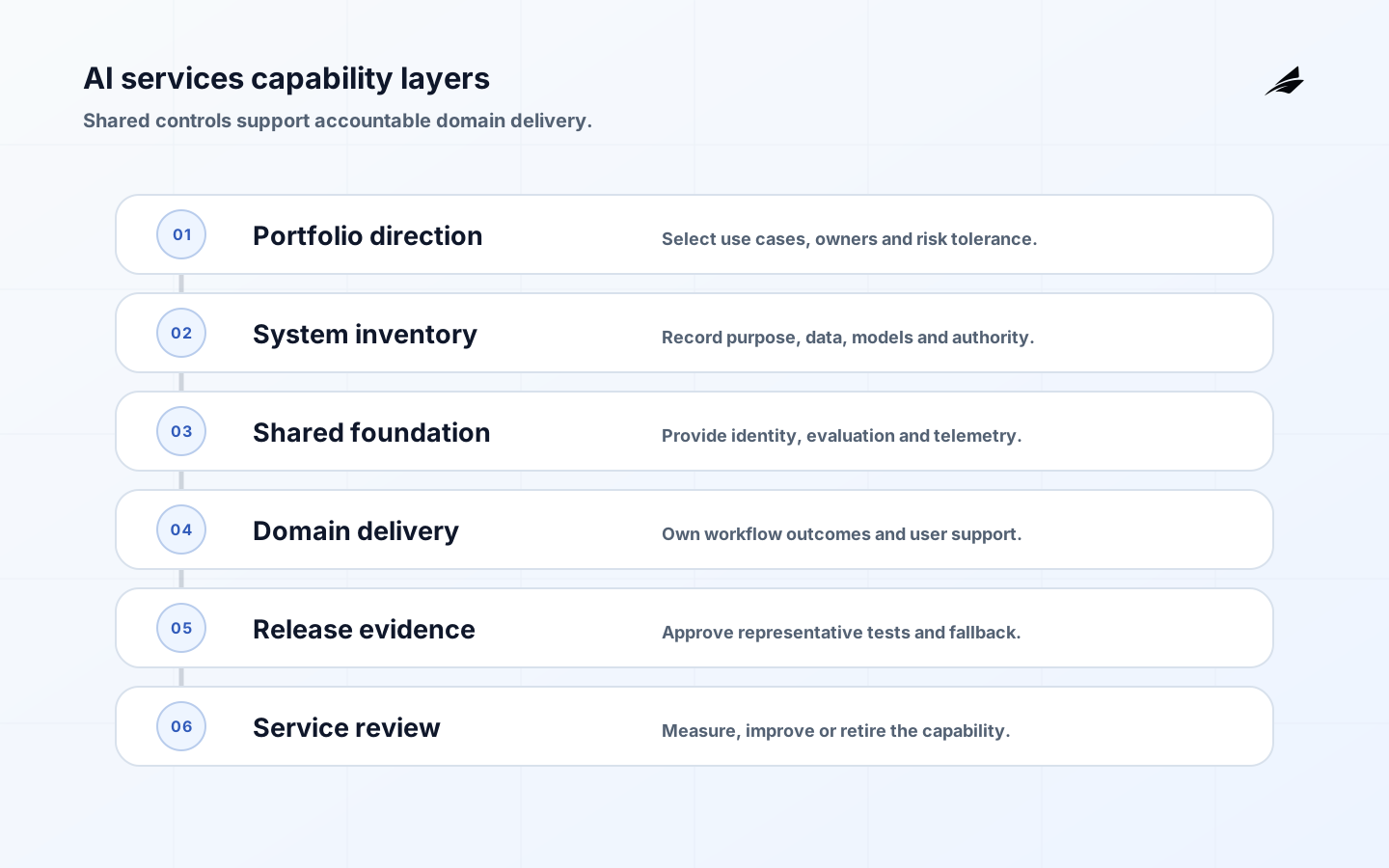
An AI services capability is the organizational ability to select, build, release and operate AI-enabled services repeatedly without rediscovering ownership and safety controls for every project. It is broader than a model platform and more concrete than an innovation committee. A useful capability joins business sponsorship, product management, data stewardship, engineering, security, evaluation, service operations and procurement around one lifecycle. The NIST AI RMF Core is a practical anchor because it treats governance as continuous and connects it to mapping context, measuring behavior and managing risk. The implementation goal is not to apply every control equally. It is to make the control level proportional to the use case and keep evidence that an accountable person can inspect.
Define the capability boundary
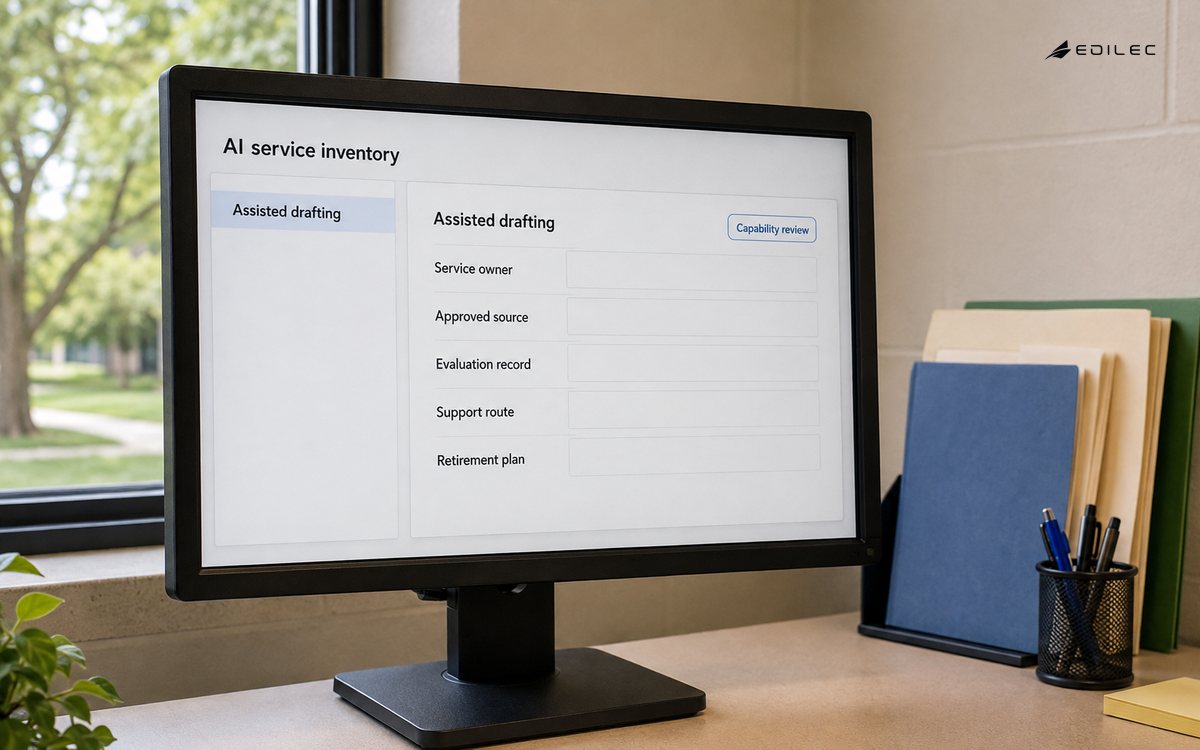
Start with the decisions the capability must support: whether a use case proceeds, which data it may use, what authority it receives, what evidence permits release and who can pause it. Maintain an inventory of AI systems, including third-party features embedded in ordinary SaaS products. For each entry, record purpose, owner, affected users, data classes, model and provider, tools, deployment boundary, evaluation status and review date. The inventory should include retirement because the NIST AI RMF Core explicitly includes safe decommissioning. Use the AI governance operating model to separate portfolio decisions from the engineering controls inside one service.
| Capability decision | Named owner | Evidence required |
|---|---|---|
| Admit a use case | Business sponsor and AI product lead | Problem statement, alternatives and impact screen |
| Approve data | Data owner and privacy lead | Purpose, rights, minimization and retention |
| Release a version | Service owner and risk approver | Evaluation report, control tests and fallback |
| Expand authority | Business process owner | Observed quality, exceptions and user outcomes |
| Retire a service | Service owner | Exit plan, access removal and retained records |
Build a federated operating model
A small central team should own shared policy, approved patterns, vendor due diligence, evaluation tooling and the system inventory. Domain teams should remain responsible for the business outcome, subject-matter review and daily service. This avoids two common failures: a central group that becomes a queue for every experiment, and isolated teams that repeat security and evaluation mistakes. ISO describes ISO/IEC 42001 as a management system for establishing policies, objectives and processes, then continually improving them. Translate that into a monthly portfolio review, a release gate for material changes and an incident route that names who can disable a prompt, model, tool or integration.
Standardize the engineering foundation
Provide a supported path for identity, secrets, data access, model routing, prompt and configuration versioning, structured outputs, tool authorization, telemetry and evaluation. The path should make the safe choice easier, not force every team onto one model. Separate experimentation from production accounts; restrict production writes through application services rather than giving a model broad credentials. OWASP’s LLM application risks show why untrusted content, output handling and excessive agency must be addressed in system design. Teams building retrieval or agent workflows should also use the internal-tool evaluation guide before release.
| Foundation component | Minimum standard | Failure it prevents |
|---|---|---|
| Identity and tools | Per-user authorization and allowlisted actions | A model acting beyond the requester’s authority |
| Context and data | Approved sources, provenance and retention | Untraceable or overbroad data use |
| Evaluation | Versioned cases, rubrics and thresholds | Releasing from an impressive demo |
| Observability | Run IDs, latency, cost, refusals and tool results | An incident with no reconstructable path |
| Fallback | Manual route and tested disable control | Users trapped in an unsafe automation |
Create evaluation evidence before authority
Evaluation must represent the actual task and consequence. Build datasets from consented, appropriately handled examples; include routine cases, rare but costly cases, ambiguous inputs and adversarial attempts. Define what must be exact, what can be judged with a rubric and what always needs a human. NIST’s Generative AI Profile emphasizes testing across deployment and use rather than treating evaluation as a one-time benchmark. Store the service version, dataset version, metric definitions, reviewer instructions, failures and approval decision together. For regulated internal work, the release checklist provides a more detailed evidence pattern.
- Define an acceptance threshold and a separate stop threshold.
- Test permission boundaries and tool failures, not only answer quality.
- Record reviewer disagreement instead of hiding it in an average score.
- Re-run critical cases when models, prompts, retrieval sources or policies change.
- Sample live outcomes and feed confirmed failures back into the evaluation set.
Operate AI as a service
Give every live capability a service owner, support route, severity model, change record and review cadence. Monitor business outcomes alongside technical signals: accepted suggestions, corrections, unresolved exceptions, latency, spend per completed task and incidents intercepted by reviewers. Provider changes can alter behavior without a code deployment, so record model identifiers and retest before material upgrades. Keep a kill switch close to the workflow, but also test what users do after it is used. The manual route must preserve queued work, source records and accountability. The capability is mature when teams can explain a run, correct it, communicate an incident and retire it without specialist improvisation.
Implement in six deliberate increments
Begin with two or three bounded use cases that expose different needs, such as document extraction, assisted drafting and a read-only retrieval assistant. Establish the inventory and decision rights before building shared platform features. Then add reusable access, evaluation and telemetry based on observed repetition. Pilot the complete operating path, not only model output. During the first quarter, review exceptions weekly and ask whether controls are reducing meaningful risk or merely adding delay. Expand when domain teams can own outcomes using the common path. This evidence-led sequence prevents a platform program from becoming detached from work and gives leadership a defensible basis for investment.
Create a proportionate intake and classification route
A capability needs a fast way to distinguish a harmless experiment from a service that requires independent review. Ask about intended users, decision consequence, personal or confidential data, external content, tool access, customer disclosure, legal obligations and what happens when the result is wrong. Use those answers to assign a tier with defined evidence and approvers. A read-only drafting aid used by five trained employees should not wait for the same forum as an autonomous customer eligibility action, but neither should it escape inventory and ownership. Publish examples at each tier and allow teams to challenge classification. Review the tier when audience, data, provider or authority changes; risk is a property of use in context, not the model name alone.
Control suppliers and model change
Procurement should capture service location, data-use terms, retention, sub-processors, security reporting, model-change notice, availability, export, deletion and termination assistance. Engineering should verify claims through the deployed configuration because a contractual option does not prove it is enabled. Maintain an approved-provider record, but evaluate the complete workflow rather than assuming a listed model makes every application safe. For material provider updates, run the critical evaluation set, compare behavior and cost, review changed limitations and stage exposure. Keep a tested alternative for business-critical services: that may be a manual route, a smaller local model or a different provider, depending on recovery time and data constraints.
Train people for their actual decisions
General AI awareness is not enough for service ownership. Product leads need to classify use cases and explain limitations; engineers need secure integration and evaluation skills; reviewers need rubrics, escalation and fatigue controls; support teams need incident and challenge routes; procurement needs model-service questions; executives need to interpret portfolio evidence. Create role-based training from real workflows and assess it through decisions, not attendance. Independent assurance should sample inventory accuracy, evaluation reproducibility, access enforcement, incident readiness and retirement. Findings should feed the same improvement backlog as production incidents. This is how a management system becomes observable in daily work rather than a policy that only appears during an audit.
Use a capability roadmap with explicit outcomes
Plan capability work in quarterly outcomes rather than a long platform feature list. A first outcome might be that every live AI service has an owner, inventory record, evaluation and disable route. A second might make high-risk tool calls use one authorization and audit pattern. A third could reduce the time domain teams need to create a representative evaluation. For each outcome, name the current friction, affected teams, expected evidence and decision date. Sequence platform work behind proven demand; do not build a universal prompt registry, vector platform or model broker because it sounds foundational. Review adoption and remove patterns that teams bypass for legitimate reasons.
Leadership should fund the operating work that success creates. More services mean more evaluations, incidents, supplier reviews, reviewer capacity and retirement obligations. Forecast those loads alongside delivery demand and set a maximum unsupported portfolio. Where a shared team becomes a bottleneck, clarify decision rights or automate evidence collection before simply adding headcount. Capability health is visible when domain teams can deliver within guardrails, independent reviewers can reproduce important evidence and executives can see which services deserve expansion. It is not visible from the number of models connected or people trained.
Key takeaways
- Treat AI services capability as a lifecycle operating system, not a model gateway.
- Keep portfolio governance central while business outcomes remain with domain owners.
- Require representative evaluation before expanding audience or authority.
- Build identity, provenance, observability and fallback into the supported engineering path.
- Review live outcomes, provider changes and retirement with the same discipline as release.
Frequently asked questions
How large should the central AI capability team be?
Size it to the shared work, not the number of experiments. A compact team can own policy, platform patterns, inventory, evaluation support and vendor controls while domain teams supply product, data and operational ownership. Add central capacity only where repeated demand or independence requires it.
Does ISO/IEC 42001 certification need to come first?
No. Organizations can use its management-system logic without pursuing certification. Establish scope, leadership accountability, risk treatment, documented operation and continual improvement first; decide separately whether external certification creates business or assurance value.
Which metric best shows capability maturity?
No single count is sufficient. Track the share of live systems with named owners and current evaluations, time to resolve exceptions, percentage of changes retested, business outcome trends and how often weak services are redesigned or retired.
Conclusion
A sustainable AI services capability turns scattered pilots into accountable services. Clear decisions, reusable controls, representative evidence and practiced operations let teams move faster because the boundaries are visible and recovery is designed before a failure.