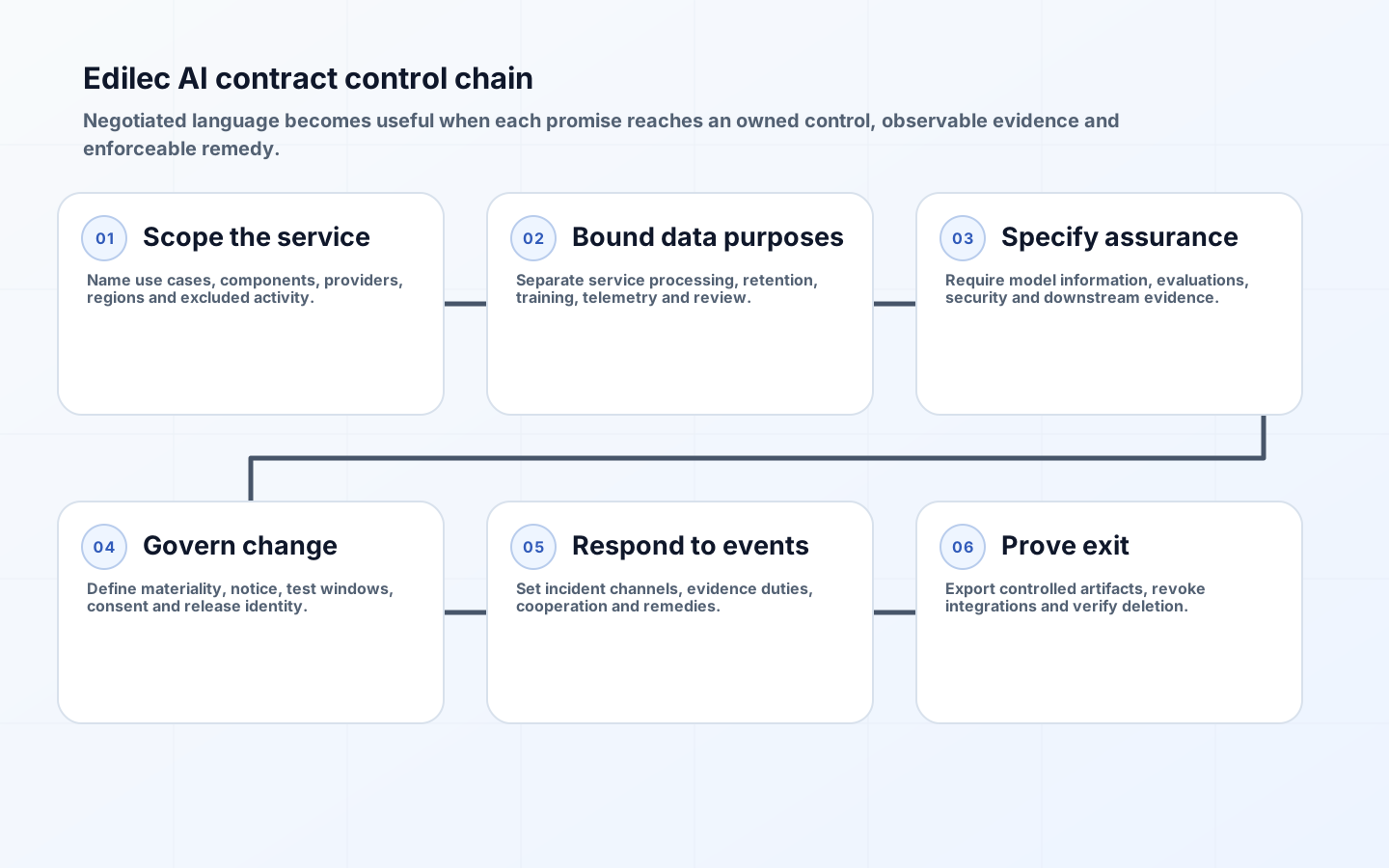
AI contract clauses should convert a provider's promises into controls that a customer can operate. A conventional software agreement may define availability, confidentiality, support, and liability while saying almost nothing about whether customer prompts train a model, which subcontracted model actually answers, how a silent model update is tested, or what evidence arrives after an AI safety event. Those omissions matter because an AI service is a changing chain of models, retrieval sources, policies, evaluators, and human decisions rather than a fixed executable.
The negotiation should start from the intended use and consequence, not a generic AI addendum. A drafting assistant that cannot send documents needs different obligations from a system that ranks applicants or operates industrial equipment. Use Edilec's AI governance operating model to assign internal owners, then connect this agreement to the production model monitoring guide so contract rights produce observable action.
Define the AI system and its value chain before drafting clauses
Define covered services by function, deployment, model family, data stores, connected tools, regions, and approved use cases. Distinguish the provider of the application from model providers, hosting providers, evaluators, data suppliers, and support subprocessors. The European Commission's GPAI questions and answers emphasizes information flow along the AI value chain so downstream providers can integrate models and meet their own obligations. A customer therefore needs both a stable service description and visibility into material dependencies.
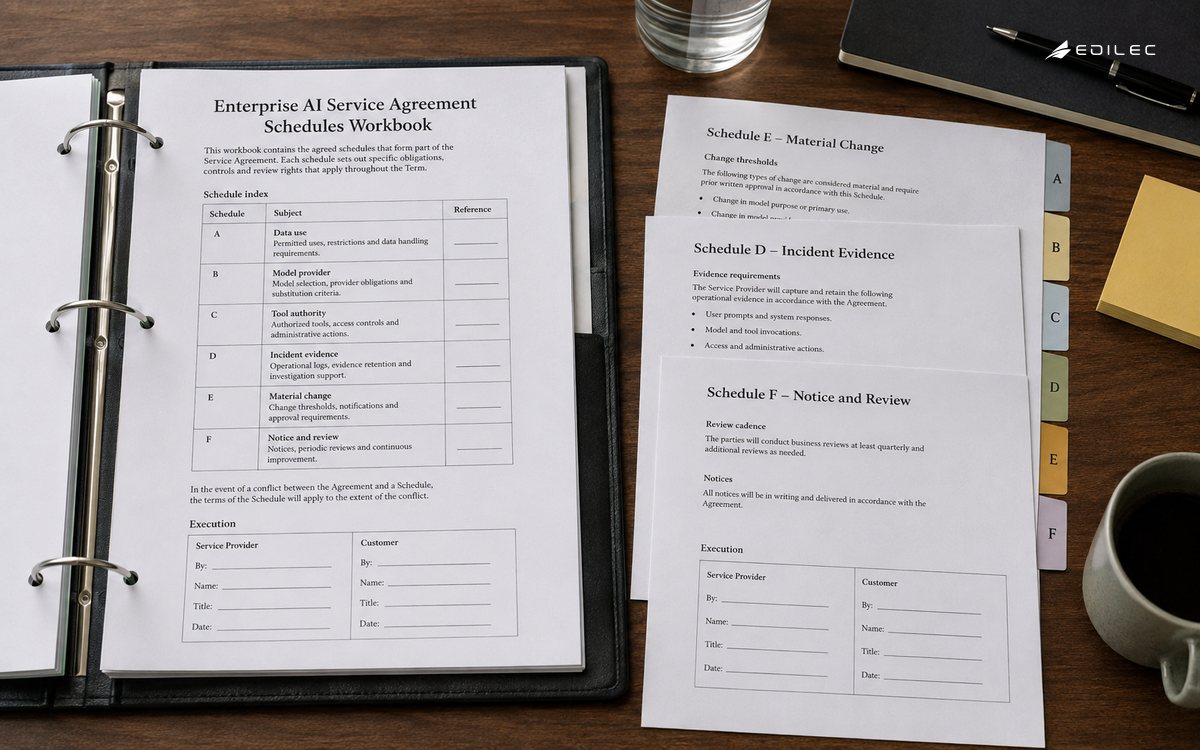
Attach a system schedule that names current components and identifies which substitutions require notice or consent. Avoid freezing every low-level library version; that makes routine security maintenance impractical. Instead define materiality by impact: a new model provider, a changed data-use purpose, reduced evaluation performance, new tool authority, movement to another jurisdiction, or removal of a safety control. The schedule becomes the baseline against which notice, testing, and termination rights can operate.
| Clause area | Minimum customer position | Evidence to request |
|---|---|---|
| System scope | Named use cases, model roles, tools, regions and excluded uses | Architecture and dependency schedule |
| Input and output data | No training or unrelated improvement without explicit election | Data-flow map and retention settings |
| Model changes | Advance notice for changes meeting agreed materiality | Release notes and comparative evaluation |
| Incidents | Rapid operational notice plus regulated-reporting cooperation | Timeline, affected versions and corrective actions |
| Exit | Export, deletion, transition help and credential revocation | Deletion certificate and portability test |
Separate service processing, training, telemetry, and human review
The data clause should enumerate purposes rather than rely on a broad license to operate or improve services. Treat prompts, uploaded files, retrieval records, feedback, embeddings, outputs, traces, and support tickets separately. For each class specify whether it is processed transiently, retained, viewed by people, used to tune customer-specific behavior, or used to improve a shared model. A prohibition on training is incomplete if the provider can still retain traces indefinitely for undefined product improvement.
Specify controller and processor roles where applicable, approved locations, encryption, access logging, deletion intervals, legal-hold handling, and the treatment of derived artifacts. Require the provider to flow restrictions to subprocessors and model providers. Address customer responsibility too: lawful collection, permitted instructions, notices to users, and prohibition of data categories the service is not designed to protect. Balanced allocation is more enforceable than language pretending one party controls the whole lifecycle.
Contract for model information and evaluation evidence
Require enough model documentation to assess the use case: model identity or class, known limitations, supported languages, evaluation methods, safety controls, and conditions that can degrade results. The Commission states that GPAI providers must make technical documentation available to downstream providers, while providers with systemic-risk models have additional evaluation and risk obligations. The voluntary GPAI Code of Practice gives a current reference point for transparency, copyright, safety, and security commitments, but the agreement should state the provider's actual deliverables.
Output language should avoid two extremes: treating every output as warranted truth, or disclaiming all responsibility while selling an enterprise decision system. Allocate validation according to control. The customer usually owns final business decisions and domain review; the provider should own conformance to documented functionality, safeguards, and agreed evaluations. Define acceptance thresholds for critical tasks, the representative test set, prohibited regressions, and remedies when the service falls below them. Edilec's LLM evaluation framework helps turn those obligations into a repeatable test program.
Write AI-specific security and incident obligations
Security clauses should cover model and pipeline threats in addition to conventional cloud controls. Ask how the provider protects training and evaluation data, artifacts, prompts, retrieval indexes, model endpoints, secrets, and tool integrations. NIST SP 800-218A extends secure development practices to generative AI and dual-use foundation models; use it as a control vocabulary for provenance, tampering resistance, testing, release integrity, and vulnerability response rather than merely requiring an unspecified industry-standard program.
Define an AI incident broadly enough to capture harmful or materially incorrect behavior, unauthorized tool use, data disclosure, model compromise, evaluation evasion, and regulatory serious incidents. Notice should begin when a responsible provider team confirms a credible event affecting the service, not only after root cause is complete. Specify an urgent channel, initial facts, preservation of model and prompt evidence, update cadence, cooperation with customer assessments, and a final corrective-action report. Keep legal notification decisions with qualified counsel in the relevant jurisdiction.
Make change, audit, and remedy rights operational
A change clause needs classification and consequences. Low-impact patches can follow ordinary release notices. Material changes should trigger advance notice, relevant evaluation evidence, a customer test window, and a right to reject or terminate when the provider cannot preserve essential requirements. Emergency security changes may occur first, but should produce prompt notice and retrospective evidence. Require stable version identifiers in logs so the customer can reconstruct which configuration generated an outcome.
| Negotiation issue | Acceptable fallback | Unacceptable ambiguity |
|---|---|---|
| Audit access | Independent report plus targeted evidence and regulator cooperation | Provider may refuse all control evidence |
| Model substitution | Notice, comparison results and exit for adverse material change | Any model may change without notice |
| Incident timing | Tiered initial notice followed by verified updates | Notice only after final investigation |
| IP claims | Provider defense for supplied model/service; customer owns supplied materials | All model-related claims shifted to customer |
| Service failure | Credits plus remediation, suspension or exit for critical failure | Service credit as exclusive remedy for every harm |
Audit rights can be proportionate without becoming ceremonial. Start with current independent reports, control mappings, penetration-test summaries, evaluation results, and evidence for identified gaps. Preserve targeted inspection for material incidents, credible nonconformity, and regulator requests, with confidentiality and reasonable frequency protections. Remedies should follow consequence: correction and retesting for a failed control, suspension for unsafe functionality, indemnity allocation for defined third-party claims, and termination plus transition where trust cannot be restored.
Plan exit, portability, and the negotiation sequence
Exit terms should cover more than downloading prompts. Identify export formats for configuration, approved prompts, retrieval content, logs, evaluations, fine-tuning artifacts, and customer-specific taxonomies. State which items are provider intellectual property and what substitutes the customer receives. Require assistance to rotate integrations, revoke tokens, redirect workflows, and validate deletion across primary systems and backups under an agreed schedule. If switching is technically impossible, the commercial decision should reflect that dependency before signature.
Negotiate in risk order. First agree use-case boundaries and prohibited data. Next settle data purposes, system dependencies, and security. Then address evaluation, change, incident cooperation, and exit. Finally align liability, indemnities, insurance, pricing, and service levels with the residual exposure. A clause matrix should record owner, proposed text, fallback, unresolved fact, and operational evidence. This prevents legal language from outrunning the provider's actual architecture or the customer's capacity to use the rights it buys.
Govern the contract after signature
Create an obligation register that translates each negotiated promise into a control owner, evidence source, frequency, escalation path, and renewal question. Procurement can track certificates, subprocessors, and notices; engineering can verify model identifiers and evaluations; security can test incident channels; legal can maintain the regulatory position; the business owner can decide whether value still justifies dependence. Review the register before renewal and after incidents or architecture changes. Exercise at least one difficult right, such as retrieving evaluation evidence or exporting configuration, while the relationship is healthy. A contractual right that has never been routed, tested, or evidenced may fail precisely when the customer needs it most.
Key takeaways for AI contract clauses
- Draft from the intended use, consequence, and AI value chain, then define material change against that baseline.
- Separate every data purpose and artifact; a simple no-training promise does not resolve retention, telemetry, or human review.
- Tie model documentation, evaluation thresholds, incident notices, and audit rights to evidence the customer can consume.
- Use risk-based remedies and preserve a technically tested exit route before the service becomes embedded.
FAQ about enterprise AI agreements
Should every AI vendor accept the same addendum? No. A common schedule improves consistency, but the obligations should scale with data sensitivity, autonomy, affected people, regulatory context, and substitutability. Is a no-training clause enough? No; define retention, support access, telemetry, embeddings, feedback, subprocessors, and deletion. Should customers demand approval for every model update? Usually not. Reserve approval or exit for changes that meet objective materiality criteria, while requiring traceability and notice for other production releases.
Conclusion: turn negotiated rights into operating controls
A strong AI agreement does not predict every model failure. It establishes a clear baseline, preserves information across the value chain, assigns validation and response duties, and gives both parties a disciplined way to handle change. The best test is operational: procurement, engineering, security, legal, and the business owner should each know which evidence they receive and what decision follows. If a clause cannot be mapped to an owner, artifact, trigger, and remedy, it is probably reassurance rather than control.