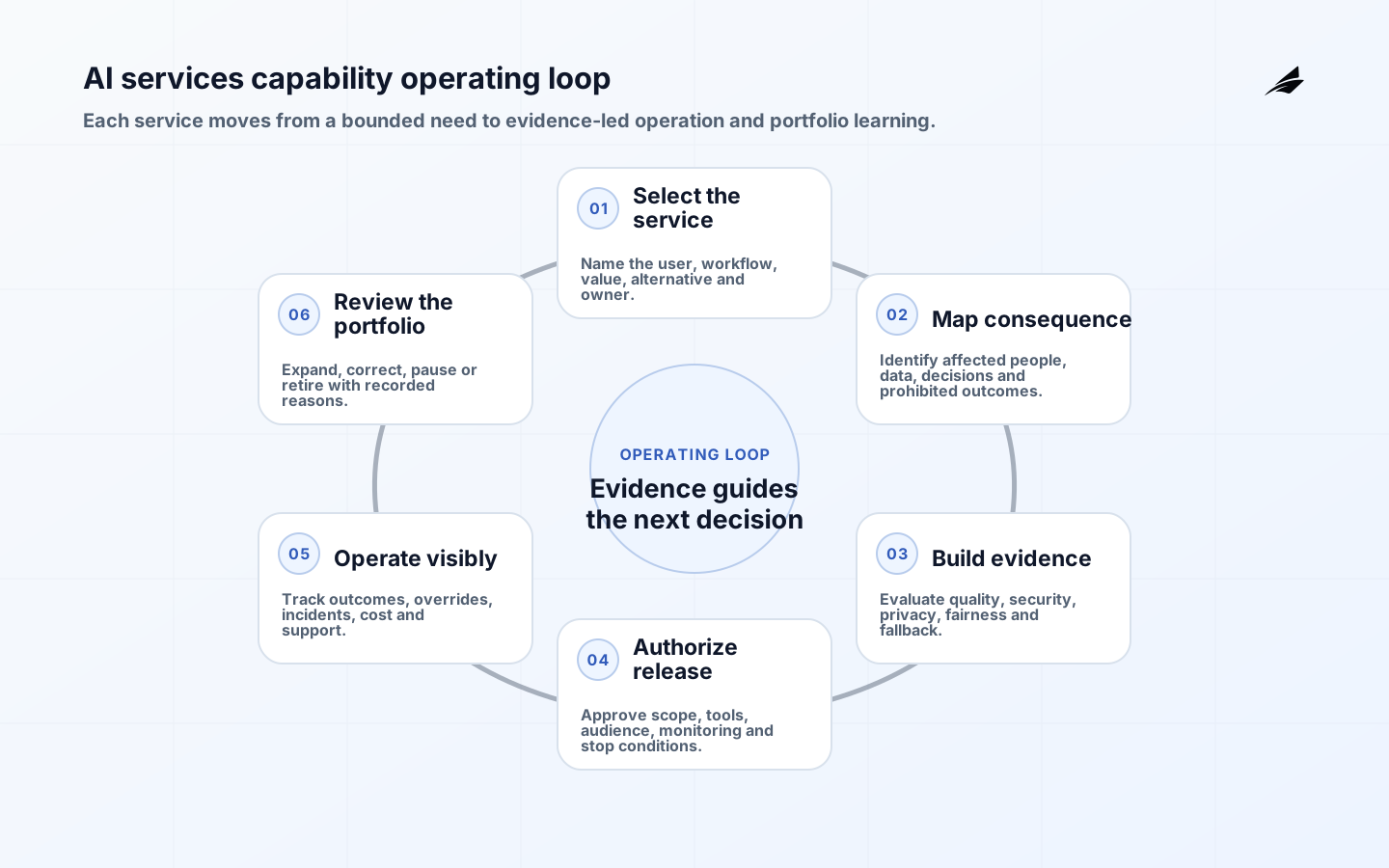
An AI services capability is the organizational ability to select, build, operate, and improve AI-enabled services repeatedly. It is not measured by the number of prototypes or model subscriptions. A capable team can explain why a workflow should use AI, what evidence supports release, which data and actions are permitted, who owns the customer outcome, and how the service fails safely. This FAQ answers the practical questions leadership teams face when moving from scattered experiments to a dependable operating model. The emphasis is deliberately on decisions, records, controls, and learning because those are the elements that remain important when models, vendors, and regulations change.
For deeper implementation detail, pair this FAQ with Edilec’s AI governance operating model, model evaluation guide, and safe employee assistant guide. Together they connect portfolio governance, release evidence, and day-to-day service controls.
What does AI services capability mean?
It means having the roles, methods, technical foundations, and decision rights to operate AI services responsibly over time. A team with capability can answer basic operational questions: which services exist, which data they use, who owns them, how they are evaluated, and how users report a problem. The NIST AI Risk Management Framework provides a useful vocabulary for this work, including governing, mapping, measuring, and managing risks. Use the vocabulary to prompt evidence, not to declare a capability complete.
| Capability question | Healthy sign | Warning sign |
|---|---|---|
| Can teams start responsibly? | They use a short intake and have access to approved patterns. | Every project negotiates access and controls from scratch. |
| Can leaders see the portfolio? | Services, owners, purpose, and status are recorded in one workable view. | No one can tell which pilots reached real users. |
| Can users challenge outputs? | Feedback reaches an owner and changes evaluations or design. | Reported problems disappear into a generic support queue. |
| Can the organization stop safely? | Actions can be paused and a manual process is understood. | A failure requires an emergency effort to discover dependencies. |
Where should we start?
Start with one recurring workflow where people already have examples, a measurable pain point, and enough authority to test an improvement. Choose a task with a bounded user group and a credible manual fallback. Build the basic intake, data-access, evaluation, and incident practices around that work instead of attempting to publish a perfect enterprise policy first. A narrow launch creates artifacts that later teams can reuse: an owner statement, test set, review procedure, model-change note, and support runbook. Those artifacts are the beginning of a capability.
- Inventory active experiments and name an owner for each one.
- Select one workflow where outcome quality can be reviewed by domain experts.
- Document approved and prohibited data paths for the initial service.
- Create a release checklist and a simple route for users to report issues.
- Measure corrections and exceptions before proposing broad automation.
- Hold a regular review where business, technical, and risk roles examine evidence together.
How much governance is enough?
Enough governance makes responsibility visible and gives people a way to act when conditions change. It should define risk tiers, required evidence, approvals for data and authority, and oversight for consequential services. It should not demand the same paperwork from a low-impact drafting aid and a system that may influence a customer outcome. ISO/IEC 42001 describes requirements for an AI management system and can inform a proportionate approach. The real test is whether a team can use the process during a fast-moving delivery, not whether the policy is long.
| Service tier | Typical treatment | Escalation trigger |
|---|---|---|
| Assistive | User remains the author and decision-maker; evaluate usefulness and access controls. | Sensitive inputs or repeated misleading output. |
| Recommendation | A reviewer accepts, changes, or rejects an output before action. | Low acceptance, unclear review, or material policy change. |
| Bounded automation | The service performs a reversible action within defined rules. | Authority expansion, failed validation, or unusual volume. |
| High consequence | Specialized assessment, oversight, and recovery requirements are needed. | Potential impact on rights, safety, or a critical obligation. |
What technology should be shared?
Share technology where it removes repeated risk or effort: identity integration, secrets management, permission-aware retrieval, evaluation tooling, logging patterns, and an exception queue. Avoid forcing a single model or framework merely for uniformity. Architecture should make appropriate choices easier while preserving the ability to change vendors, models, or deployment patterns. Review connected-tool permissions carefully. The OWASP LLM Top 10 highlights why excessive agency and unsafe input handling can turn an apparently simple assistant into a broader operational risk.
- Does the platform apply existing employee and source-system permissions?
- Can a service identify the version of its model, prompt, source, and tools?
- Can teams evaluate and roll back a change independently?
- Are logging and retention choices appropriate for the content handled?
- Can users see enough provenance to challenge an answer?
- Does the platform make a constrained default easier than unrestricted tool access?
How do we know the capability is improving?
Look for a reduction in avoidable reinvention and a rise in usable operating evidence. Good signs include clearer service ownership, faster but still credible review, more representative evaluations, and exceptions that lead to concrete design changes. Do not use request volume or model count as proof of maturity. A capability may be improving when it stops a poorly framed project early, because it has protected users and delivery capacity. Review trends in incidents, corrections, support load, data-access decisions, and time from change request to safely released service.
Frequently asked questions
- Do we need a central AI team? A small coordinating function can be useful, but business teams must retain ownership of their decisions and outcomes.
- Can capability be outsourced? Providers can supply tools and expertise, but accountability for data, use, and operational decisions remains internal.
- How do we handle shadow AI? Offer an approved route that is usable, learn why people bypass it, and address unsafe use without assuming all experimentation is malicious.
- What is the first success metric? A credible improvement in a defined workflow, supported by review evidence and a workable support model.
How should we manage a portfolio of AI services?
Use one lightweight service register rather than a separate governance ceremony for every team. Record the service owner, affected users, supported decision, model and provider, data classes, connected tools, risk tier, evaluation set, release state, incident route, and next review date. The NIST AI Risk Management Framework organizes risk work around Govern, Map, Measure, and Manage; a service register makes those activities visible at portfolio level. The NIST Generative AI Profile adds actions for risks that are especially relevant to generative systems, including confabulation, information integrity, privacy, security, and third-party dependencies.
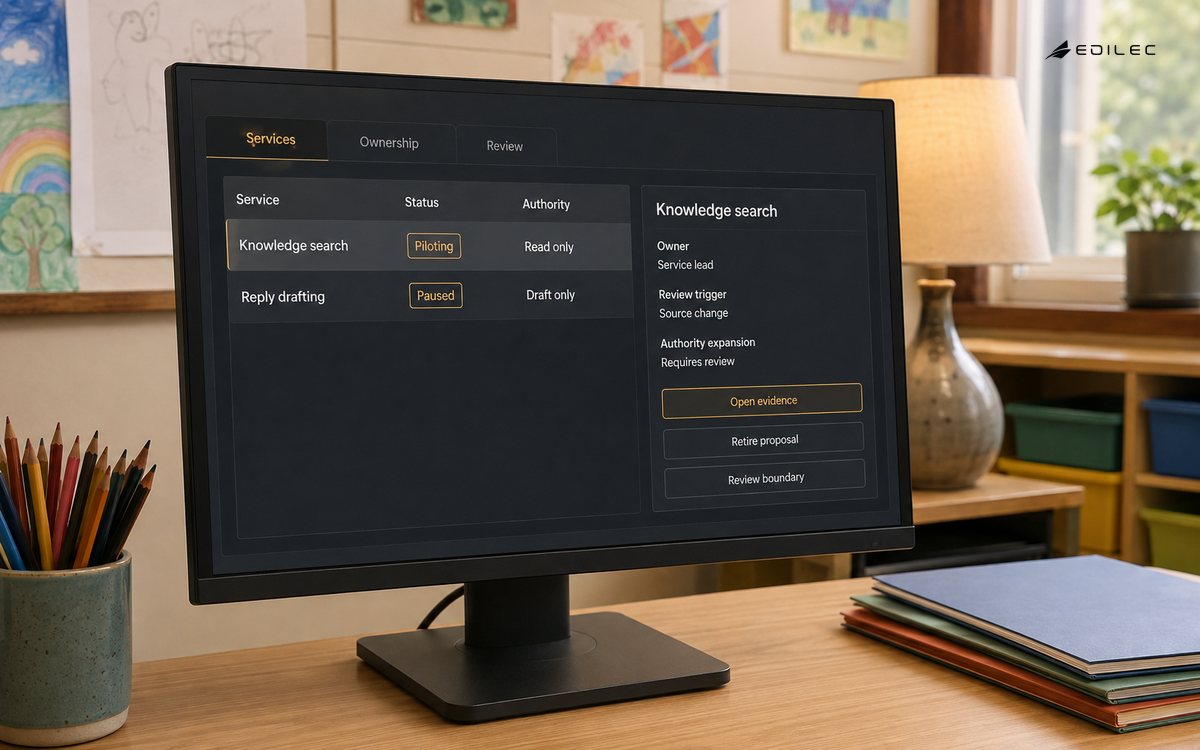
| Portfolio question | Evidence to retain | Decision owner |
|---|---|---|
| Should this service exist? | Workflow need, alternatives, affected people, expected value | Business service owner |
| Can it enter production? | Evaluation results, control tests, operating readiness | Product and risk owners |
| Can authority expand? | Pilot outcomes, incident history, revised failure analysis | Named approval authority |
| Should it be changed or retired? | Usage, benefit, cost, complaints, unresolved risks | Portfolio sponsor |
How should regulation influence capability design?
Start with applicable obligations, not a universal compliance label. The European Commission’s AI regulatory framework uses a risk-based structure and establishes different duties for different actors and uses. A company may be a provider in one workflow and a deployer in another. Legal counsel should determine applicability, while the delivery capability supplies reliable inventories, technical documentation, data records, human-oversight controls, incident evidence, and change history. Building those records into normal delivery is more durable than assembling them only for an audit.
What security work is specific to AI services?
Apply normal application and cloud security first, then test the ways untrusted language can influence the system. The OWASP Top 10 for LLM Applications is useful for threat modelling prompt injection, sensitive-information disclosure, supply-chain weaknesses, excessive agency, and other model-enabled failure modes. Treat retrieved documents and tool output as untrusted data, keep authorization in deterministic services, restrict tool scopes, validate resulting state, and preserve an emergency stop. A model instruction is never a substitute for an access-control decision.
Key takeaways
- Capability is an operating practice, not a model purchase.
- Begin with one reviewable workflow and reusable artifacts.
- Scale governance to authority and consequence.
- Share control patterns, not unnecessary uniformity.
- Treat safe refusal or closure as a valid outcome.
Conclusion
A durable AI services capability combines disciplined selection, accountable ownership, trustworthy technical foundations, and evidence from real use. Begin with one bounded workflow, make the service legible from proposal through retirement, and expand authority only when outcomes justify it. That is how an organization gains speed without losing control.