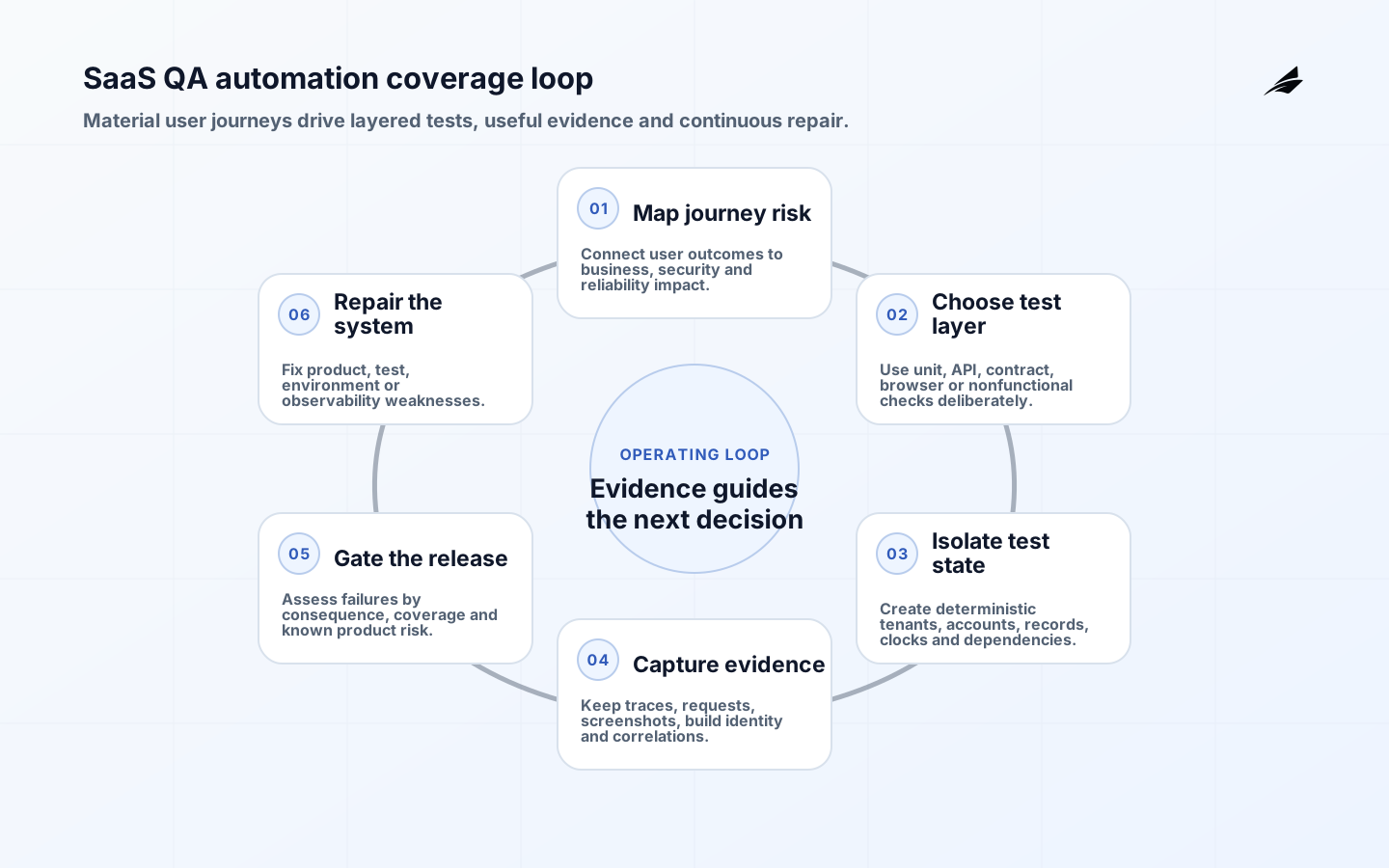
QA automation for SaaS consulting should improve release confidence and diagnostic speed, not merely increase the count of scripted tests. The best engagement starts by identifying revenue-critical and trust-critical user journeys, the defects that currently escape, and the evidence a team needs when a build fails. It then places the right checks at the right layer: fast component and API tests for broad feedback, a deliberately small browser suite for complete user outcomes, contract tests for integrations, and focused nonfunctional tests for security, accessibility, performance and recovery. The questions below help a SaaS leader evaluate scope, tools, environments, cost and operating ownership before commissioning the work.
Key takeaways
- Automate stable, consequential user outcomes before chasing raw test counts.
- Keep most feedback below the browser layer; reserve end-to-end tests for journeys that genuinely cross the product.
- Design deterministic accounts, tenants, clocks and data so failures can be reproduced.
- Treat test artifacts, quarantine, ownership and repair time as part of the automation product.
- Measure escaped defects, diagnostic time, coverage of material risk and release decisions—not only pass rate.
When does a SaaS company need QA automation consulting?
External help is valuable when growth has exposed a structural gap: releases depend on lengthy manual regression, recurring production defects cross several services, test environments cannot be trusted, or a suite exists but nobody believes a red build. Consulting can also help before a platform migration, multi-tenant redesign, mobile launch or regulated-customer commitment. It is less useful when product behavior changes daily without stable acceptance decisions or when the team has no capacity to own the resulting suite. In those cases, begin with workflow clarification, observability and testability. The broader QA automation scope and delivery plan can help define the engagement boundary.
What should be automated first?
Map complete journeys to business consequence. For a B2B SaaS product, the first set may include sign-in with the supported identity provider, tenant creation, invitation and role assignment, a core record lifecycle, billing or entitlement enforcement, export, and account closure. Select flows that are repeated, stable enough to assert and costly to get wrong. Avoid starting with whichever screen is easiest to record. The Playwright best-practices guidance recommends testing user-visible behavior and using resilient locators that reflect how users perceive the interface. That principle keeps tests meaningful when implementation details change.
| Test layer | Best use | Typical release role |
|---|---|---|
| Unit or component | Rules, transformations and UI states in isolation | Fast feedback on every change |
| API or service | Authorization, validation, state transitions and error contracts | Broad business behavior in CI |
| Contract | Provider and consumer compatibility across team boundaries | Prevent incompatible independent releases |
| Browser or mobile | A small set of complete user journeys | Confidence that integrated behavior works |
| Nonfunctional | Accessibility, security, load, resilience and recovery | Risk-based release or scheduled gates |
How should the first automated journeys be designed?
Specify each journey as an observable outcome, not a click sequence. The test should create or select an isolated tenant, perform work through supported interfaces, verify authoritative state and clean up safely. Prefer API setup for data that is not itself under test, but do not bypass the behavior being validated. Make time, identifiers and external dependencies controllable. A test for subscription downgrade should verify entitlement behavior, retained data and billing state, not just a confirmation message. Place assertions near the business consequence so a failure explains what changed.
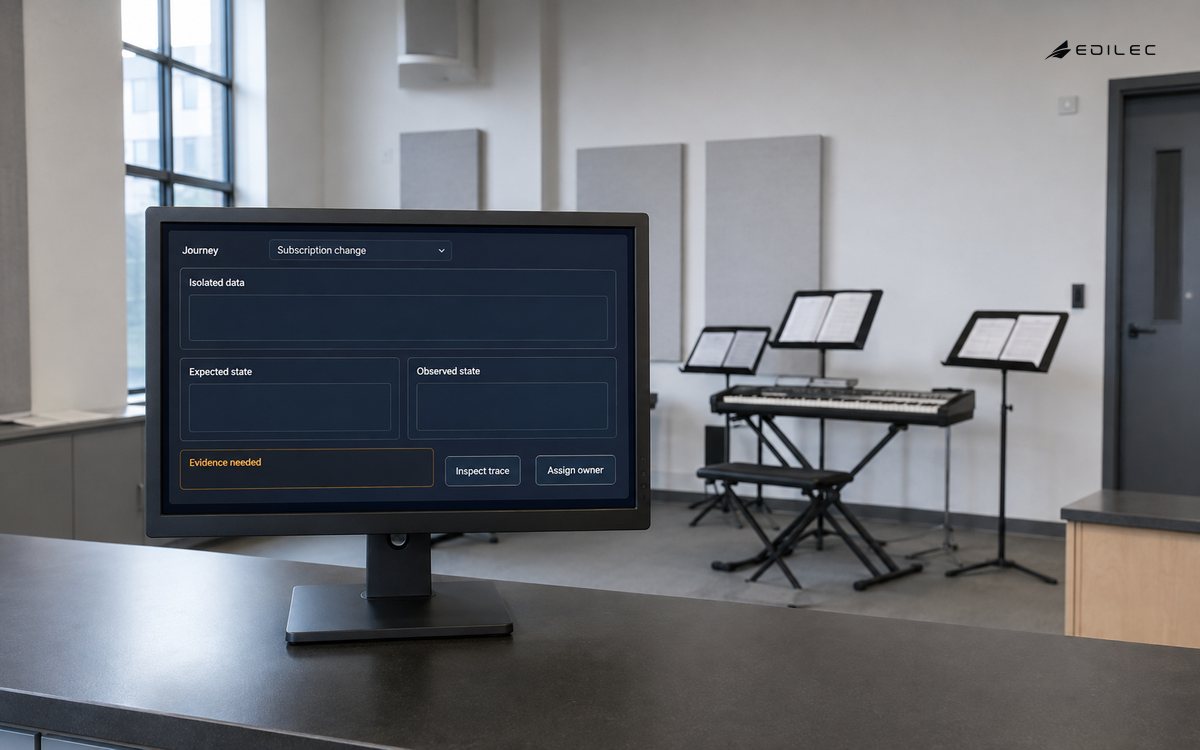
Isolation is crucial in a multi-tenant service. Playwright browser contexts provide clean storage and cookie state for each browser test, but application data also needs isolation. Generate unique tenant and record identifiers, avoid shared mutable accounts, and expose safe reset or fixture APIs in nonproduction environments. If tests depend on a common inbox, payment sandbox or asynchronous queue, give each run a correlation key and a deterministic way to wait for the business event. Those choices reduce false failures and make parallel execution possible.
How do we prevent and manage flaky tests?
Flakiness is a reliability defect in the test system. Remove arbitrary sleeps, wait for observable conditions, isolate state and capture the information needed to explain a failure. Auto-waiting can handle interface actionability, but it cannot repair nondeterministic data, an overloaded environment or an event with no correlation. Retry can distinguish a transient symptom from a consistent failure, yet a passing retry does not make the original result healthy. The official Playwright retry model classifies tests that pass after retry as flaky; use that signal to assign an owner and repair deadline rather than quietly accepting instability.
| Failure class | Evidence to capture | Correct response |
|---|---|---|
| Product regression | Trace, screenshot, request IDs and changed build | Block or assess release by consequence |
| Test defect | Locator or assertion mismatch with intended behavior | Repair test with product-owner confirmation |
| Environment fault | Capacity, dependency or fixture failure | Restore environment and rerun affected scope |
| Known intermittent product issue | Linked defect and occurrence evidence | Risk owner decides quarantine and release |
| Unknown | Complete artifact bundle and reproducible seed | Triage before adding retries |
Do we need a production-like test environment?
You need an environment that reproduces the contracts and risks under test, not necessarily a full production clone. Match identity flows, network policy, database engine and relevant configuration for high-risk journeys. Use provider sandboxes or controlled simulators for payments, email and messaging, and run a small set of read-only or synthetic checks in production where appropriate. Mask or generate personal data instead of copying production records casually. Maintain environment configuration as code and publish health signals so a failing suite can distinguish an application defect from a broken dependency.
Can functional automation cover security and accessibility?
Functional tests can verify important controls—tenant denial, role boundaries, session expiry, secure file handling and audit events—but they do not replace threat modeling, code review or specialized security testing. Use the OWASP Application Security Verification Standard to define verifiable security requirements appropriate to the product. Similarly, automated accessibility checks catch only part of the problem. Combine them with keyboard journeys, focus review, screen-reader checks and human evaluation against WCAG 2.2. Put these checks into the ordinary release path so they do not become a late certification exercise.
What does QA automation consulting cost, and how is value measured?
Cost depends on product surface, testability, environments, integrations, device matrix and expected service level. A bounded engagement should price discovery, framework and CI setup, fixture design, initial journeys, documentation, training and a stabilization period. It should state assumptions about access and product change. Ongoing cost includes suite maintenance, infrastructure, third-party test services and ownership of failures. Value is visible when manual regression time falls, escaped defects in covered journeys decline, diagnosis becomes faster and teams can release smaller changes with evidence. The implementation checklist provides concrete acceptance items.
Who owns the suite after the consultants leave?
The product engineering team should own behavior and repair; a quality specialist or platform group can own shared tooling, patterns and coaching. Every test needs a business or service area, code owner and expected execution tier. Make suite changes part of feature work, and review slow, flaky, duplicated and low-value tests on a schedule. Consultants should pair with maintainers, document architecture and failure diagnosis, and leave an operating dashboard. A handoff that delivers hundreds of tests without skills, ownership or a deletion policy is unfinished work.
Practical review checklist
- Confirm the top journeys with product, support and engineering, then record the user-visible outcome, data preconditions, relevant roles and failure consequence for each. This prevents a technically convenient test list from becoming the automation roadmap.
- Require every CI failure to preserve a trace, screenshot, console output, network evidence, build identity and business correlation key. Evidence should be available without rerunning a failed test against a changed environment.
- Set an explicit quarantine rule with owner, linked defect, expiry and release consequence. A quarantined check remains visible in reporting and must not silently become permanent background noise.
- Test tenant isolation and authorization with negative cases at API and browser layers. Create users in distinct tenants and prove that identifiers, exports, search, caches and asynchronous work never cross the boundary.
- Review the suite monthly for execution time, flakiness, duplicated coverage, obsolete product behavior and escaped defects. Delete low-value checks and invest in testability where manual diagnosis still dominates.
Frequently asked questions
What percentage of tests should be automated?
There is no useful universal percentage. Automate repeatable checks where speed, frequency and consistency create value; retain exploratory, usability and judgment-heavy work for people. Report coverage by material journey and risk instead of dividing automated cases by a changing inventory of manual cases.
Is Playwright always the right tool?
No. Playwright is strong for modern web journeys and cross-browser automation, but API, component, mobile-native, performance and security tests need appropriate tools. Select a small interoperable toolset that fits the product stack, team skills and diagnostic requirements. The SaaS implementation readiness checklist helps test that choice against operating constraints.
Conclusion
QA automation for SaaS consulting is successful when it leaves a team with faster, more trustworthy release decisions. Start from critical user outcomes, build deterministic test data and environments, keep browser coverage focused, treat flakiness as work, and transfer clear ownership. The resulting suite should explain risk and failure—not merely produce a larger number of green checks.