Automation testing services should deliver a maintainable quality system, not a pile of scripts. A useful engagement identifies product risks, chooses the cheapest reliable test layer for each risk, integrates checks into delivery, makes failures diagnosable and transfers ownership to the team that will live with the suite. Buyers should evaluate scope, environments, data, observability, security and maintenance together because initial script count says little about release confidence.
What buyers are really deciding
A team searching for automation testing services is usually facing slow regression, repeated production incidents, a growing product surface or a release process that depends on a few people's memory. The procurement question is not simply which tool a provider uses. It is which risks will be covered, at which levels, in which environments, with what evidence, and who will repair the suite when the product changes. ISO/IEC/IEEE 29119 frames testing as a set of concepts, processes, documentation and design techniques; that process view is more durable than a tool-first proposal.
Automation is strongest for repeatable checks with clear expected results. Human testing remains important for exploration, usability, ambiguous requirements and issues that automated oracles do not perceive. Accessibility is a clear example: WCAG 2.2 contains testable criteria but explicitly recognizes a combination of automated testing and human evaluation. Security also needs multiple techniques; NIST's SSDF integrates security practices into development, and OWASP's Web Security Testing Guide covers review and active testing beyond a scanner run.
Scope by product risk and test layer
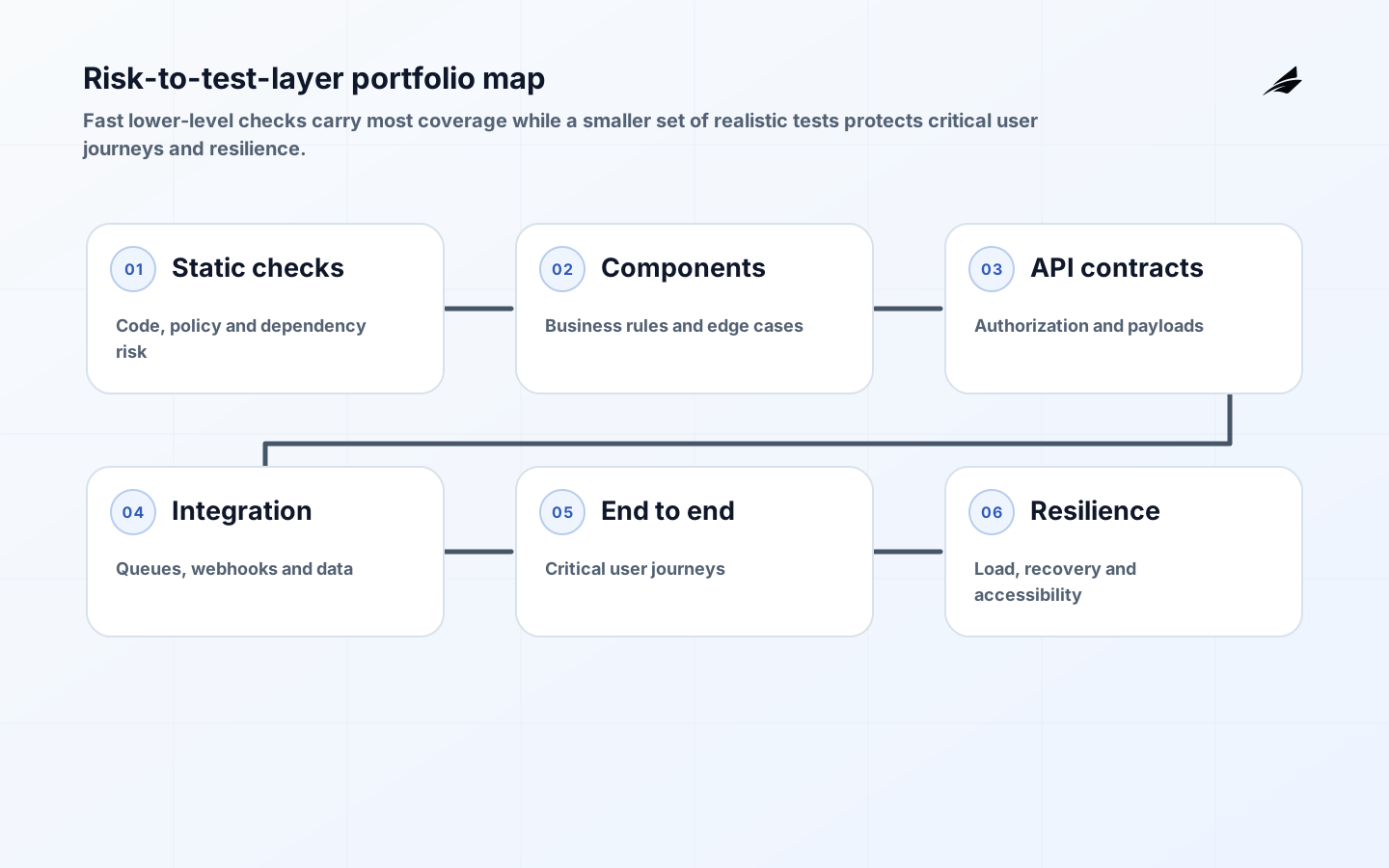
Begin with a product-risk workshop. Map critical journeys, business rules, data boundaries, integrations, permissions, supported browsers and devices, service objectives and recent defect patterns. Rank failures by likelihood and impact, then assign controls. A pricing error may be best covered with fast component tests over many input combinations. A broken payment handoff needs contract and integration tests. A small number of browser tests should confirm that a real user can complete the journey. The portfolio should avoid duplicating the same assertion at every layer without a reason.
| Test layer | Best use | Common scope mistake |
|---|---|---|
| Static checks | Types, linting, dependency policy, secret and code analysis | Treating scanner output as proof that runtime behavior is secure |
| Unit or component | Business logic, edge cases and fast developer feedback | Testing implementation details so closely that refactoring breaks harmless tests |
| API and contract | Schemas, authorization, error behavior and service compatibility | Ignoring consumer expectations and third-party failure modes |
| Integration | Database, queue, identity, payment and external-system behavior | Using unrealistic mocks for the highest-risk dependencies |
| Browser or mobile journey | Critical user-visible workflows across supported configurations | Automating every UI variation and creating a slow, brittle suite |
| Performance and resilience | Latency, capacity, recovery and degraded dependencies | Running load without a production model or actionable telemetry |
| Accessibility and security | Standards-based checks plus expert evaluation | Claiming conformance or penetration coverage from automation alone |
What a complete service scope should contain
- Discovery: product architecture, risks, defect history, current suite, release flow and target outcomes.
- Strategy: in-scope test levels, environments, browsers or devices, data approach, quality gates and exclusions.
- Foundation: framework conventions, repository structure, reporting, secrets, parallelism and CI integration.
- Implementation: prioritized automated checks with traceability to risks and acceptance criteria.
- Stabilization: flaky-test triage, runtime reduction, failure diagnostics and baseline measurement.
- Enablement: reviews, pairing, runbooks, ownership boundaries and training for maintainers.
- Operations: suite health review, dependency upgrades, incident-driven additions and periodic portfolio pruning.
Define deliverables in operational terms. A framework is not complete until it runs predictably in a clean environment, publishes artifacts, distinguishes product failures from infrastructure failures and documents local reproduction. Test cases should use stable contracts. Playwright's official guidance recommends testing user-visible behavior, isolating tests and preferring resilient user-facing locators over DOM structure. Equivalent principles apply in other frameworks: tests should observe supported behavior, control their own data and minimize hidden dependencies.
Estimate cost from the work, not a script count
Responsible estimates begin after a short assessment. Fixed prices per automated case hide large differences: a pure calculation test, a tenant-isolated billing flow and a cross-platform mobile journey are not comparable units. Estimate discovery and foundation separately from scenario implementation, then include stabilization, CI capacity, test data, environment work, reporting, handover and ongoing maintenance. Report assumptions and ranges rather than presenting false precision. The most useful commercial model ties milestones to working capabilities and quality gates.
| Cost driver | Why it changes effort | Evidence to request |
|---|---|---|
| Architecture and integrations | Distributed systems require controllable dependencies and cross-service diagnostics | System map, contracts and failure-mode inventory |
| Environment readiness | Unstable builds, unavailable services and configuration drift consume test time | Environment owner, uptime and provisioning path |
| Test data | Privacy, tenant isolation and repeatability may require factories or synthetic datasets | Data lifecycle and reset design |
| Platform matrix | Browsers, devices, locales and feature flags multiply meaningful combinations | Supported-market matrix based on product policy |
| Legacy testability | Missing APIs, selectors and observability create engineering work before useful tests | Testability backlog with product-team commitments |
| Quality requirements | Performance, security, accessibility and regulated evidence need specialist methods | Named standard, target and reporting expectation |
| Maintenance model | Product change and dependency updates create recurring ownership | Capacity, response times and definition of suite health |
Practical example: a SaaS billing release
Consider a SaaS product adding annual plans and prorated upgrades. Component tests cover price calculations, tax inputs, rounding and boundary dates. API tests verify plan changes, authorization and idempotency. Contract tests protect the payment-provider payload and webhook schema. Integration tests run success, decline, duplicate webhook and delayed webhook paths in a controlled sandbox. A small browser suite confirms that an administrator can upgrade, see the correct total and receive an updated entitlement. Security tests check role boundaries; accessibility checks cover forms, errors and keyboard flow, with human evaluation for criteria automation cannot establish. Post-deployment smoke tests verify the live critical path without creating real charges.
Put the right checks at the right release gate
Fast, deterministic checks should run on every change. Broader integration and browser suites can run on pull requests, merge queues or deployment candidates according to runtime and risk. Scheduled suites are useful for larger compatibility matrices and longer resilience tests but should not become a parking place for failures nobody owns. GitHub's CI documentation illustrates the basic feedback loop: build and test shared changes, report results in the pull request and use the result during review. The same pattern applies across CI platforms.
| Gate | Typical checks | Failure policy |
|---|---|---|
| Developer feedback | Unit, component, static and focused contract checks | Block the change; provide local reproduction |
| Pull request | Affected integration tests, critical UI journeys and policy checks | Block on confirmed product failure; quarantine only with owner and expiry |
| Pre-release | Full regression, migrations, platform matrix and targeted performance | Release decision based on risk and documented exceptions |
| Post-deployment | Read-only or reversible smoke tests and synthetic critical journeys | Rollback or incident path for material failure |
| Scheduled | Extended compatibility, resilience, security and accessibility review | Triage within an agreed service level; feed findings into backlog |
Manage the risks of automation itself
Flaky tests are not harmless noise. They train teams to rerun failures, weaken gates and hide real regressions. Track first-run pass rate, rerun outcomes and failure cause. Quarantine should require an owner, issue and expiry, not a permanent skip list. Other risks include shared test data, production-like secrets in logs, destructive tests against the wrong environment, excessive UI coverage, unreviewed generated tests and a suite whose only maintainer is the provider. Build controls into repository permissions, environment allowlists, code review and runbooks.
| Risk | Control | Metric |
|---|---|---|
| Flaky suite | Isolation, deterministic data, diagnostics and time-boxed quarantine | First-run reliability and quarantined-test age |
| Slow feedback | Layer tests, select affected scope and parallelize with capacity limits | Median and tail feedback time |
| False confidence | Risk traceability, exploratory testing and incident gap analysis | Escaped defects by uncovered risk |
| Environment damage | Explicit target allowlist, least privilege and reversible fixtures | Unauthorized or destructive execution attempts |
| Vendor lock-in | Client-owned repository, documented conventions and paired handover | Changes completed by internal maintainers |
| Security or privacy leakage | Synthetic data, secret masking and restricted artifact retention | Sensitive-data findings in logs and artifacts |
A practical delivery plan
- Week zero assessment: inspect architecture, pipelines, environments, defect history and current tests; agree outcomes and constraints.
- Risk and portfolio design: map critical risks to test levels, define exclusions, select the first vertical slice and write acceptance evidence.
- Foundation: establish conventions, data factories, environment configuration, reporting, artifacts and CI execution using a representative scenario.
- Incremental coverage: automate high-value risks in product slices, review code with maintainers and demonstrate failures, not only passing runs.
- Stabilization: measure runtime and reliability, remove redundant tests, improve diagnostics and rehearse recovery from environment failures.
- Handover and operation: complete runbooks, ownership, training, backlog and service levels; review suite health and escaped defects on a cadence.
Use exit criteria for each phase. The foundation exits when a clean runner can execute, report and reproduce a deliberately failed test. A product slice exits when tests cover agreed risks, data can be reset, failures identify the affected layer and the product team accepts maintenance. The engagement exits when named owners can add, debug and retire tests without provider dependency. These criteria keep delivery focused on capability rather than activity.
Questions to ask an automation testing provider
- How do you turn product risks and production incidents into a test portfolio?
- Which checks will stay manual, and why?
- How will you create isolated, privacy-safe and repeatable test data?
- What is the flaky-test policy, and which metrics expose hidden reruns?
- How are security, accessibility, performance and resilience included or explicitly excluded?
- Who owns repositories, credentials, environments and test artifacts?
- What handover evidence proves our team can maintain the suite?
- How will scope and price change when testability gaps are discovered?
Key takeaways
- Buy a risk-based quality capability, not a promised number of scripts.
- Place each check at the fastest reliable layer and reserve end-to-end tests for critical journeys.
- Include environments, data, diagnostics, CI and maintenance in the cost model.
- Treat flakiness, runtime and ownership as product health concerns.
- Require security, accessibility and exploratory methods where automation alone cannot establish quality.
Frequently asked questions
What should be automated first?
Start with a critical, repeatable journey that currently consumes regression effort and has controllable data. Automate its business logic and contracts before adding a small end-to-end proof. This vertical slice tests the framework and delivery process while producing useful coverage.
How much do automation testing services cost?
Cost depends on architecture, environment readiness, data, platform matrix, quality requirements and maintenance. Request a paid or time-boxed assessment, explicit assumptions and milestone ranges. A per-script quote is rarely comparable across systems and can exclude the engineering that makes tests reliable.
Can automation replace manual testing?
No. It can replace repeated execution of well-defined checks and free people for exploratory, usability and risk-focused work. Human evaluation remains necessary where expected results are ambiguous or standards require judgment.
How should success be measured?
Use feedback time, first-run reliability, high-risk coverage, escaped defects, mean time to diagnose, quarantine age, release exceptions and internal maintenance capability. Script count and raw pass rate are activity measures, not sufficient outcomes.
Conclusion
The strongest automation testing service leaves behind more than regression coverage. It creates a layered test portfolio, dependable CI feedback, controlled data, actionable diagnostics and a team capable of evolving the system. Scope from risk, estimate the full operating cost and make maintainability an acceptance criterion from the first scenario.