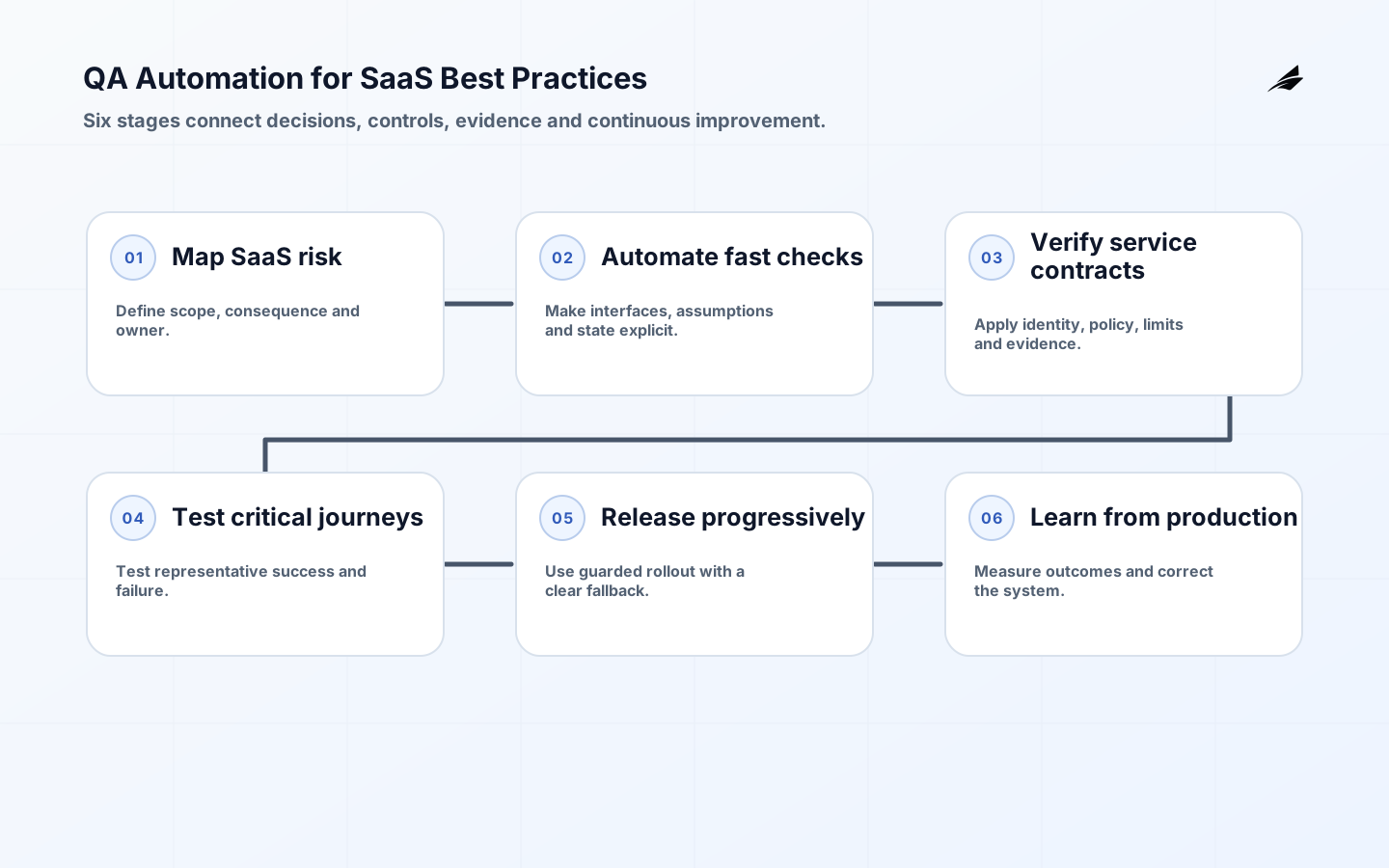
QA automation for SaaS best practices begins with product risk, not a target percentage of automated tests. A SaaS release can fail through business logic, tenant isolation, permissions, API compatibility, browser behavior, data migration, performance, configuration or third-party dependency. Teams need fast checks close to code, focused integration and journey tests, safe deployment and production evidence.
Use this FAQ with the SaaS QA practical guide, best-practices checklist, QA automation consulting plan and consulting checklist. Keep suites small enough to diagnose and broad enough to protect real user outcomes.
Build a risk-based SaaS test strategy
Map critical journeys, roles, tenants, data and integrations to failure consequence and change frequency. Put deterministic logic in unit and component tests; verify service contracts at boundaries; use integration tests for infrastructure behavior; reserve browser journeys for user-visible cross-component risk. Manual exploratory testing remains valuable for new behavior, usability and unexpected interactions.
NIST’s Secure Software Development Framework includes defining security requirements and criteria for checks, reviewing design and testing software. Use one quality plan that covers functional, security, accessibility, performance, resilience and operability requirements. Ownership belongs with the team producing and operating the service, supported by quality specialists.
Control test data, tenants and environments
Create isolated tenants and identities per test worker where practical. Generate minimal data through supported APIs and clean it deterministically. Do not depend on test order or a shared mutable account. Mask production-derived data and enforce retention. Verify tenant boundaries at service and data layers, not only through UI navigation.
Playwright’s test best practices emphasize user-visible behavior, test isolation, resilient locators and control of third-party dependencies. Prefer roles and labels over CSS structure, and web-first assertions over fixed sleeps. Pin browser and environment versions for visual comparisons while still testing supported current browsers.
| Test layer | Best use | Avoid |
|---|---|---|
| Unit/component | Rules, transformations and edge cases | Recreating every external system |
| Contract | Consumer-provider message compatibility | Claiming full integration coverage |
| Integration | Database, queue, identity and infrastructure behavior | One giant shared environment |
| Browser journey | Critical user-visible cross-component outcomes | Duplicating all lower-level cases |
Test APIs and events as contracts
Define schemas, status behavior, authentication, idempotency, pagination, rate limits and compatibility. Consumer-driven contracts can provide fast feedback between independently delivered services. Pact documentation explains contracts as a shared understanding of integration messages and distinguishes them from broad end-to-end tests.

Test the actual consumer client and provider behavior, not hand-written examples disconnected from code. Include error and compatibility scenarios. Contract tests do not prove networking, deployment, data or full journey behavior, so retain a small number of integration checks. Track contract versions and verify providers against currently deployed consumers before release.
Automate security requirements, not only vulnerability scans
Use OWASP ASVS 5.0 as a source of verifiable web application security requirements. Translate applicable controls into design reviews, unit tests, API authorization tests, configuration policy, dependency checks and targeted dynamic tests. Include tenant isolation, role changes, session handling, input validation and audit behavior.
Scanners need tuned scope, versioned rules and owners. Block deterministic high-risk violations; route ambiguous findings for review. Test abuse such as cross-tenant identifiers, mass assignment, expired invitations, replay and privilege downgrade. Protect test credentials and evidence. Security regression belongs throughout delivery and does not eliminate expert threat modeling or penetration testing.
Keep CI results reliable and diagnosable
Run fast changed-code checks first and parallelize independent suites. Record code, configuration, data seed, dependency, browser and test version. Quarantine does not mean forget: assign flaky tests, expiry and repair priority. Separate infrastructure failures from product failures. Preserve traces, screenshots, logs and correlation IDs for failed journeys without leaking customer data.
Use retries only to gather evidence, not convert an initial failure into green. Track time to signal, flake rate, failure concentration and suite duration. Remove redundant tests and repair poor boundaries. A long suite that runs after merge provides less prevention than a focused check developers trust before integration.
| Release evidence | Question | Example threshold |
|---|---|---|
| Regression | Did affected behavior pass reliable checks? | All required risk-mapped suites valid |
| Migration | Can data change and recovery succeed? | Rehearsal reconciles representative volume |
| Progressive health | Is limited exposure behaving normally? | Error, latency and outcome within guardrail |
| Exception | Who accepted missing evidence and until when? | Named owner and dated remediation |
Verify migrations and deploy progressively
Database and configuration changes need forward and backward compatibility, representative volume, backup and recovery tests. Expand-and-contract schema changes avoid requiring every service to switch simultaneously. Test feature controls, defaults, permission migration and rollback. Rehearse production-like topology where behavior depends on queues, caches or regional services.
The joint CISA safe software deployment guidance recommends phased deployment supported by testing and measurement. Use canaries or progressive exposure with health and business criteria. Know when rollback is unsafe after data writes and prepare roll-forward repair.
Use production signals as quality evidence
Synthetic checks verify critical paths; real-user and service telemetry reveal latency, errors and behavior at actual scale. Correlate release, tenant, route and trace without exposing sensitive data. Monitor queue lag, background jobs, integration failures and support contacts. Production monitoring catches risks test environments cannot reproduce, but it should not become permission to skip pre-release checks.
Feed incidents and escaped defects into the cheapest reliable regression layer. Review release outcomes using current DORA software delivery metrics, including throughput and instability measures, alongside customer impact and escaped severity. Avoid measuring QA by test count, automation percentage or bugs found; those metrics can reward duplication and late discovery.
Make release decisions from explicit evidence
Define required evidence by service criticality and change type: checks, contracts, security, migration, performance, accessibility, operational readiness and approvals. The release owner should see missing or stale evidence, exceptions and progressive rollout state. Emergency paths need authority, minimum checks and retrospective review.
Review suite value quarterly. Map critical risks to at least one reliable check and identify gaps. Retire tests that do not protect behavior. Measure failed deployment recovery, rework, escaped defect consequence, flake and lead time together. Quality is the team’s ability to change the service safely, not the size of the automation repository.
Example: protect a multi-tenant role change
A new custom-role feature changes API authorization, administration UI and cached permissions. Model invariants by tenant, role, resource ownership and lifecycle. Test policy logic at service level, consumer contracts for changed responses, database migration, and a small browser set for creation, assignment, revocation and cross-tenant denial.
- Generate isolated tenants and users for each test worker.
- Assert deny cases as carefully as allowed cases.
- Test cache invalidation after role removal and session refresh.
- Verify old clients tolerate additive response fields.
- Run migration against representative role volume and rollback conditions.
- Canary by tenant and monitor authorization denials and support contacts.
The release gate includes deterministic authorization tests, contract verification, migration reconciliation and a canary health window. A failed cross-tenant test blocks release; a flaky visual assertion is owned and repaired without hiding authorization evidence. Production audit samples confirm actor, action, resource, policy and outcome.
Review evidence before expanding scope
Before expanding QA automation for SaaS best practices, the accountable owner should review representative outcomes, exceptions, access, changes, operating cost, user feedback and recovery evidence. Confirm that metrics still reflect the intended business result, that known limitations are visible to users and that suppliers have not changed material behavior without evaluation. Exercise one realistic failure and reconcile the resulting records. Record the decision to scale, narrow, correct or retire the capability, including assumptions and a review date. This review keeps implementation evidence connected to authority and prevents a successful pilot from becoming an unmanaged dependency.
Build a coverage review around product topology and customer commitments. For each critical capability, map supported browsers, clients, tenant plans, regions, integrations, feature controls, data lifecycle and service objectives to test and production evidence. Include accessibility, localization, billing, entitlement, backup restore and account deletion where applicable. Sample the matrix after major architecture or pricing changes; old tests may still pass while no longer representing supported behavior. Give customer-reported defects a correlation ID and route them into risk review, then add a regression only at the layer that can reliably detect recurrence. Quarterly, remove redundant cases, repair unreliable fixtures and review whether test environments still match material production configuration. This keeps automation aligned with the service customers actually buy. Record gaps with an owner, consequence and review date.
Key takeaways
- Map SaaS risks to the cheapest reliable unit, contract, integration, journey or production check.
- Isolate tenants, identities and data so tests remain reproducible.
- Automate explicit security, migration and compatibility requirements.
- Treat flake, test infrastructure and diagnostic evidence as product quality concerns.
- Release progressively and feed escaped defects back into focused regression.
Frequently asked questions
What percentage of SaaS tests should be automated?
There is no universal target. Automate stable, repeated checks where speed and consistency create value. Keep exploratory, usability and novel-risk work human-led. Measure risk coverage, feedback time, reliability and escaped outcomes rather than automation percentage.
How many end-to-end tests are enough?
Use enough to protect critical cross-component user outcomes and deployment wiring, while moving detailed rules and combinations to faster layers. A small, stable journey suite is usually more useful than hundreds of brittle browser scripts. Review each test against the risk it detects.
Should tests run against production?
Run safe synthetic and observational checks designed for production, with isolated data and no destructive action. Do not replay broad test suites against customer systems. Progressive rollout and monitoring complement pre-release evidence; they do not replace it.
Conclusion
QA automation for SaaS best practices is a release evidence system. Place checks according to risk, keep data and tenants isolated, verify contracts and security, and make deployment observable and reversible. Teams gain speed when feedback is trusted and focused, not when every scenario is forced through the browser.