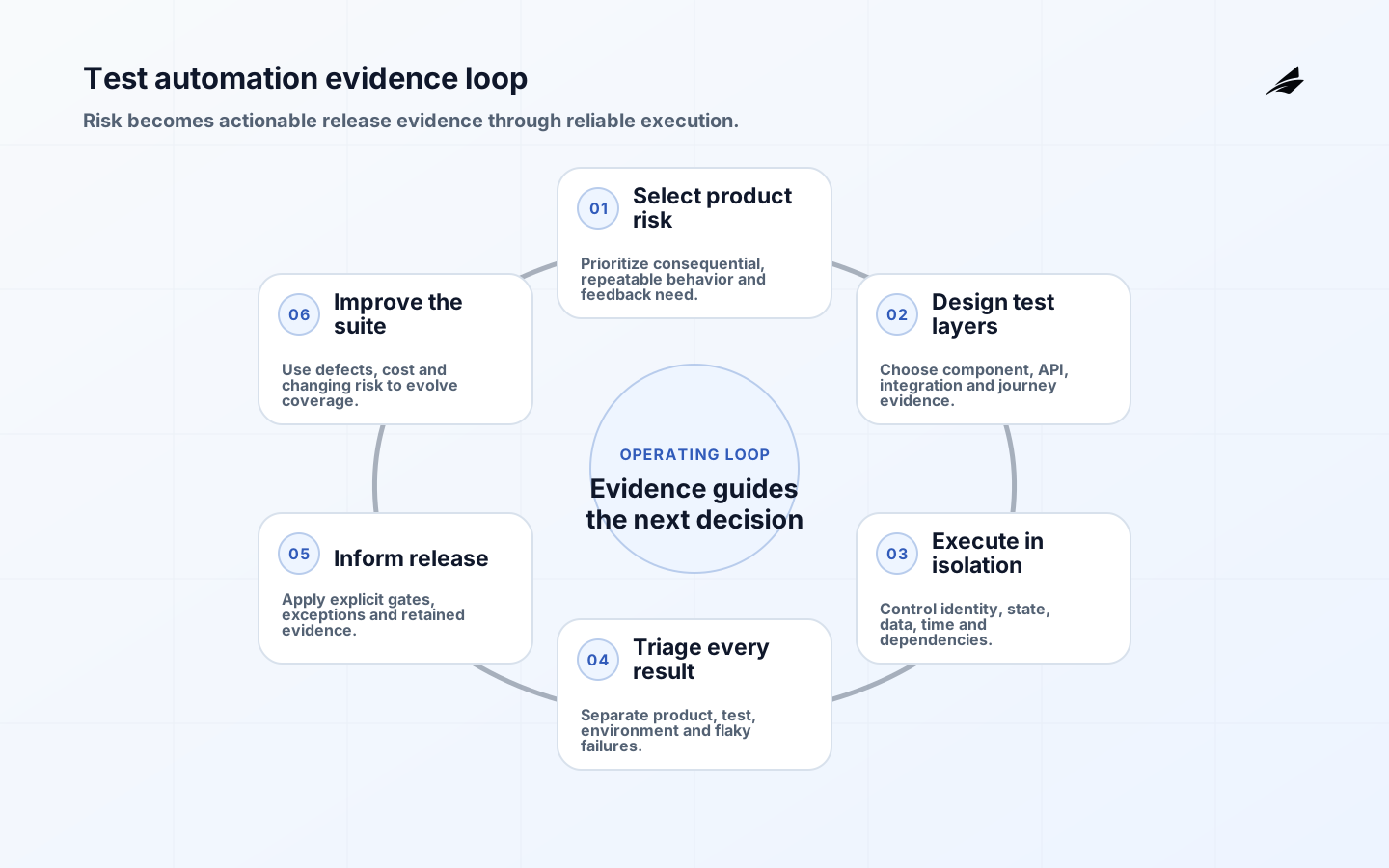
Automation testing services design, build and operate executable checks that provide fast evidence about software change. The service may include strategy, framework engineering, API and UI tests, mobile or data checks, CI/CD integration, environments, reporting and maintenance. It should not promise to automate all testing or replace skilled exploration. This automation testing services FAQ helps buyers define a useful scope and evaluate whether a provider improves release decisions.
For procurement and rollout, use the automation testing delivery plan, automation implementation checklist and performance testing checklist. The central test is simple: does the suite detect important regressions with enough speed, repeatability and diagnostic evidence for a team to act? Test counts and pass percentages do not answer that alone.
What do automation testing services include?
A mature engagement begins with product risk, architecture and release flow. It selects test layers, establishes data and environment controls, implements maintainable test components, connects execution to delivery pipelines, and creates ownership for failures and updates. Providers may also assess an inherited suite, migrate tools, stabilize unreliable checks, train product teams and supply managed execution. Scope should state applications, platforms, browsers, interfaces, environments, nonfunctional qualities and support hours.
The 2024 ISTQB Test Automation Engineering syllabus treats tool selection, modular design, pilot deployment, CI/CD integration, infrastructure verification, reporting and continuous improvement as connected capabilities. That is a better buying model than purchasing script volume. Source code, configuration, fixtures, pipeline definitions, runbooks and results should remain accessible to the customer.
| Service component | Typical deliverable | Acceptance question |
|---|---|---|
| Strategy | Risk model, layer selection, candidate backlog and target measures | Does scope follow release risk and feedback need? |
| Framework | Repository, standards, reusable fixtures and local execution | Can customer engineers understand and extend it? |
| Test implementation | Versioned API, UI, component, data or mobile checks | Do checks assert meaningful behavior and failure paths? |
| CI/CD integration | Trigger, parallelism, reports, gates and quarantine policy | Does evidence arrive in time for the decision? |
| Operations | Triage, maintenance, environment and service targets | Is every failure owned and diagnosable? |
| Improvement | Coverage review, defect learning and retirement | Does the suite evolve with product risk? |
What should and should not be automated?
Automate stable, repeatable and consequential checks that need frequent execution or broad data variation. Good candidates include API contracts, calculations, permissions, critical user journeys, migration reconciliation, configuration policies and known regression patterns. Prefer lower test layers when they can prove the behavior because they are usually faster and easier to diagnose. Keep a smaller end-to-end set to prove that deployed components work together.
Manual exploration remains valuable for new behavior, ambiguous requirements, usability, visual nuance and unexpected interaction. Security and accessibility require mixed techniques. The OWASP Web Security Testing Guide includes reviews, threat modeling, source analysis and active testing across the lifecycle, while WCAG 2.2 provides testable accessibility criteria but many checks still require human judgment. Automation expands observation; it does not eliminate reasoning.
How should an automation framework be designed?

Design for isolation, readable intent and controlled dependencies. Each test should establish or obtain its own state, use deterministic identifiers, avoid relying on execution order, and clean up safely. Centralize interaction helpers only when they express stable product concepts; giant generic wrappers hide useful tool behavior. Keep assertions near the behavior and include enough context in failures to reconstruct request, response, data, version and environment.
Playwright’s test-isolation guidance uses clean browser contexts so storage and cookies do not leak between tests. The principle applies beyond browsers: isolate database records, queues, accounts and clocks where practical. Use service virtualization carefully and retain contract tests against real dependencies. A fully mocked suite can pass while production integration fails; an all-live suite can become slow and uncontrollable.
How should flaky tests be handled?
A flaky result changes without a relevant product change. Common causes include shared state, asynchronous timing, unstable selectors, uncontrolled data, network dependencies and resource contention. Measure first-run failure and retry outcome separately, assign an owner, preserve traces, and quarantine only under a time-bounded policy. A quarantined test should remain visible and should not silently contribute a green status. Repeatedly increasing timeouts treats the symptom and lengthens feedback.
The Playwright retries documentation classifies tests that pass only after retry as flaky rather than simply passed. Use retries to gather diagnostic evidence or absorb a narrowly understood external condition, not to redefine success. Set an error budget for flaky outcomes, investigate correlated failures and delete checks whose value no longer exceeds their maintenance cost.
How do automated tests fit into CI/CD?
Create a feedback ladder. Fast static, component and API checks run on a change; broader integration and selected browser journeys run before merge or deployment; resilience, performance and expansive compatibility suites run at appropriate scheduled or release gates. Gates should reflect risk and confidence, not historical habit. Define whether infrastructure, environment or product failure blocks release and who can authorize an exception with a recorded rationale.
- Version tests with product code where ownership and release timing align.
- Use immutable build artifacts across stages so later tests evaluate what will be released.
- Protect pipeline credentials, runners, dependencies and test data under the NIST SSDF practices.
- Publish machine-readable and human-readable results with artifact, commit, environment and test version.
- Rerun failed checks in a clean state and preserve the first failure’s logs, screenshots, traces and responses.
- Review skipped, quarantined and never-executed tests as explicit coverage debt.
What determines cost and ROI?
Cost depends on product testability, architecture, platform matrix, environment reliability, data setup, existing suite quality, release frequency and maintenance demand. A fixed price per script rewards superficial output. Ask providers to estimate discovery, framework work, candidate implementation, pipeline integration, stabilization, documentation, training and managed operation separately. Include licenses, devices, runners, cloud consumption and engineering time spent investigating false alarms.
Evaluate return through feedback and escaped-risk outcomes: regression detection before production, time to trustworthy result, manual effort removed, investigation time, release frequency, escaped defects and suite maintenance. Attribution is imperfect, so compare trends and incidents with context. Automation can be valuable even when it does not reduce headcount; faster controlled releases and reproducible evidence may be the important benefit.
| Measure | Definition | Why it matters |
|---|---|---|
| Risk coverage | Priority behaviors and failure modes with reliable checks | Connects automation to product consequence |
| Time to signal | Change to actionable result at each test layer | Shows whether evidence can affect release |
| First-run reliability | Checks passing or failing deterministically without retry | Protects confidence in the suite |
| Diagnostic time | Failure to owned defect, environment issue or test issue | Measures operational usability |
| Escaped regression | Production defect a defined automated check should have found | Exposes missing or ineffective coverage |
| Maintenance load | Engineering effort to update and stabilize tests | Makes total cost visible |
Key takeaways
Practical example: an ecommerce team asks a provider to automate checkout. The provider first separates pricing and inventory rules into component and API checks, then keeps three browser journeys for guest, registered and declined-payment behavior. Each browser test creates its own account and basket, controls provider responses and captures a trace on first failure. A duplicate-callback scenario proves that one authorization creates one order. The pipeline runs rule tests on every change and browser journeys before deployment. When a browser check passes only after retry, the result remains flaky and assigned for repair. The team measures time to diagnosis and escaped checkout regressions, not merely the growing number of scripts.
- Buy a risk-based testing capability, not a promised number of scripts.
- Automate repeatable consequential behavior at the lowest effective layer.
- Preserve manual exploration for ambiguity, usability and techniques that require judgment.
- Design isolated tests and treat retry-passing results as reliability work, not clean success.
- Create pipeline gates with explicit ownership, evidence and exception authority.
- Measure trusted feedback, escaped regressions and maintenance cost over raw execution totals.
Frequently asked questions
Can automation reach 100% test coverage?
A team can define a metric that reaches 100%, but it will not mean all product risk is covered. Code coverage does not prove assertions, integrations, user experience or unknown failure modes. Use several views: critical journey, requirement, interface, risk, configuration and code coverage, each with stated limitations.
Who should own automated tests after handover?
Product engineering should own the meaning and release response, while a quality engineering or platform group may own shared infrastructure and standards. The provider must transfer source, access, documentation and skills. Tests without a team authorized to fix the product or the check quickly become ignored.
Should AI-generated tests be accepted without review?
No. Generated code can accelerate candidate creation, but engineers must verify intent, assertions, data handling, dependencies and maintainability. Run it through the same code review and pipeline controls as other test software. A test that executes successfully may still assert the wrong behavior or expose sensitive data.
Conclusion
A useful provider acceptance gate includes a clean installation from documented dependencies, local execution by a customer engineer, pipeline execution on the release artifact, deliberate triggering of representative failures, and successful diagnosis from retained evidence. The customer should also be able to add one check, rotate credentials, update a fixture and retire a test without provider intervention. Review licenses, repositories, environments, service accounts, dashboards and ownership queues. These steps expose frameworks that work only on a consultant’s machine and confirm that the service has delivered maintainable testing capability rather than an opaque collection of automated actions.
Automation testing services are effective when they deliver dependable evidence at the moment a release decision is made. Scope from risk, choose appropriate layers, engineer isolation, control flaky results, integrate transparent gates and measure outcomes. That makes the suite a maintainable part of software delivery rather than a growing inventory of scripts.
Review the service quarterly against product change, escaped defects, suite reliability and maintenance demand. Retire redundant checks, move slow evidence to a better layer, and fund testability improvements where repeated workarounds obscure risk.