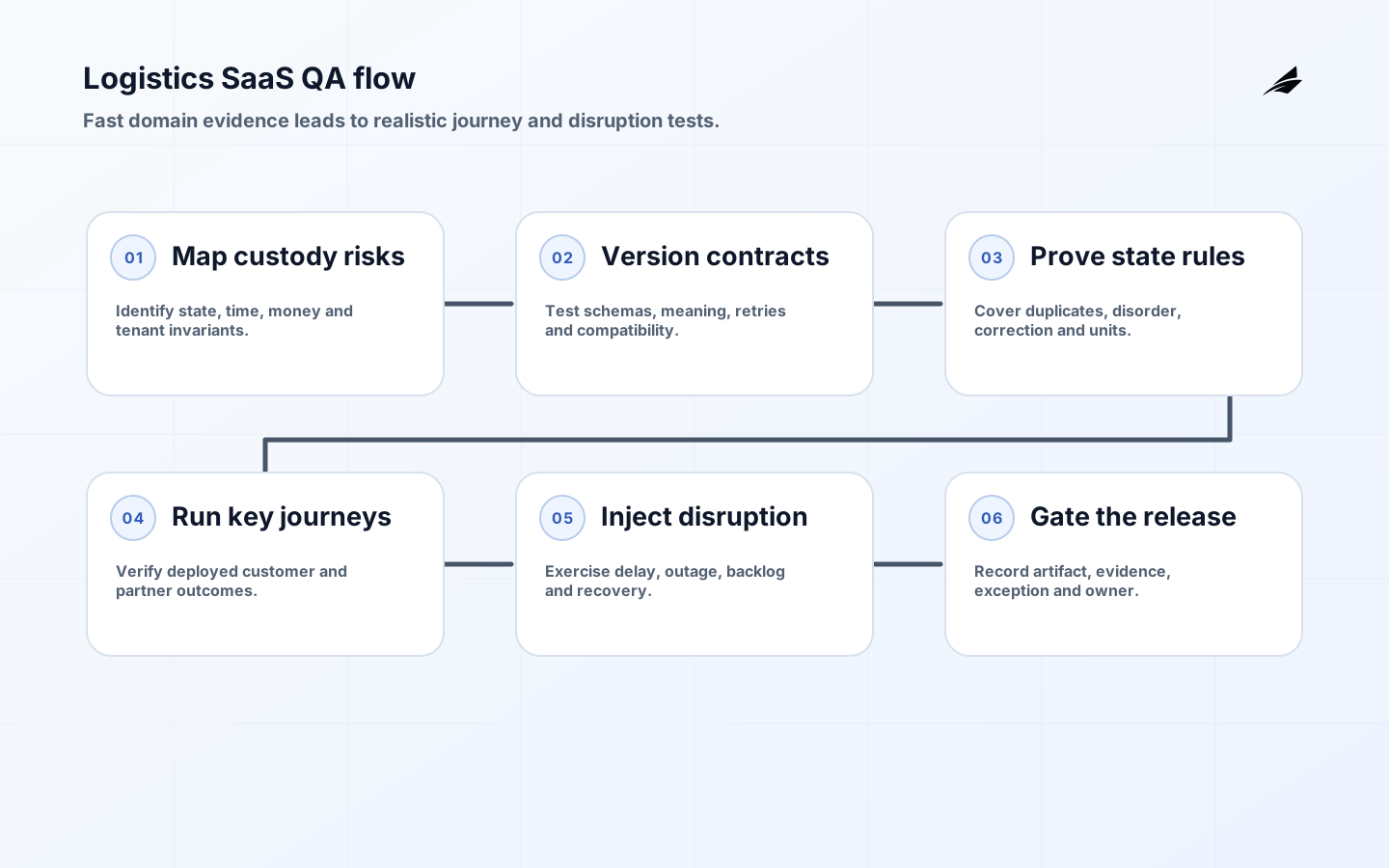
QA automation for SaaS logistics must prove more than screens and endpoints. Logistics software represents physical events that arrive late, repeat, conflict or disappear; it exchanges data with carriers, warehouses, customers and devices; and one tenant's workload or data must not affect another. A useful automation strategy therefore follows business invariants across time and boundaries. It gives a release team fast evidence about ordinary changes while preserving focused tests for the costly failures that only appear under concurrency, partner disruption or recovery.
Use this FAQ with Edilec's practical logistics SaaS test strategy and implementation checklist. Teams comparing broader delivery options can also review the SaaS QA scope and risk guide. The central rule is simple: automate evidence for release decisions, not activity for a test-count dashboard.
What makes logistics SaaS testing different?
Map the workflow as a stateful event chain: quote, book, label, pick, pack, dispatch, handoff, arrival, delivery, exception, return and settlement. Each transition has preconditions, identifiers, time meaning, authority and downstream effects. GS1's EPCIS standard provides a common language for what happened, when, where, why and how. Even when a product does not implement EPCIS, those dimensions are an excellent basis for test data and assertions.
Test the invariants that matter to operations: a package cannot be delivered before it is dispatched; a repeated scan must not double inventory or billing; an event-time correction must not corrupt current state; a tenant must never query another tenant's shipment; and a partner retry must be idempotent. Include time zones, daylight-saving changes, units, partial quantities, split shipments, merged consignments and offline mobile capture. Happy-path browser automation alone cannot expose these failures.
| Risk surface | Representative failure | Best automation layer | Release evidence |
|---|---|---|---|
| Domain state | Impossible or skipped shipment transition | Model and service tests | Invariant suite passes |
| Partner API | Duplicate, delayed or changed payload | Contract and replay tests | Compatibility report |
| Tenant boundary | Cross-tenant read or cache leak | Authorization and isolation tests | Denied-access proof |
| Mobile edge | Offline scan reorders events | Device and synchronization tests | Reconciliation result |
| Operations | Queue backlog hides customer delay | Synthetic flow and alert test | Objective and routing result |
How should the automated test portfolio be divided?
Keep most tests close to deterministic code and service boundaries. Unit and property tests cover calculations, parsers and transition rules. Component tests run a service with real persistence and controlled dependencies. Contract tests verify provider and consumer expectations. A smaller set of end-to-end journeys proves deployed assembly. W3C WebDriver defines a standard browser-control interface, but a browser test should exist only where browser behavior or a complete user journey is the risk.
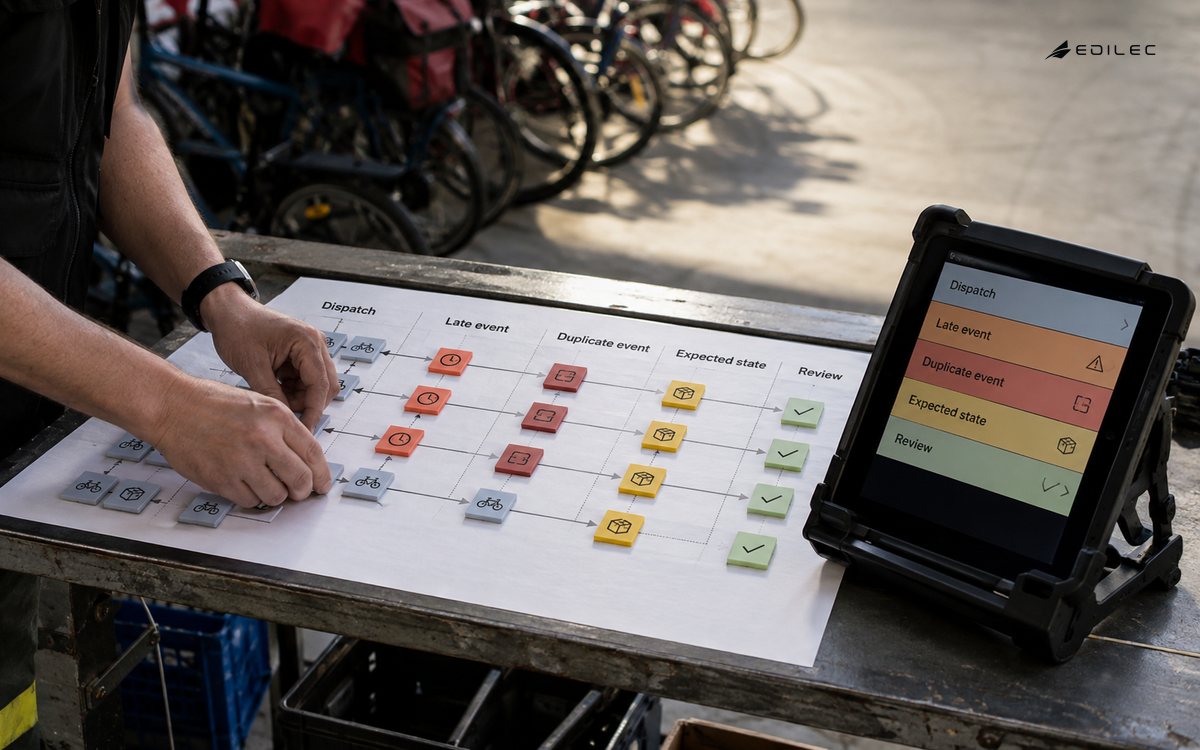
Choose tests by failure detection value, speed and diagnostic quality. A hundred slow UI cases that all fail after an authentication outage provide less confidence than focused authentication, API and journey checks. Tag the minimum release gate, scheduled regression, partner certification, performance and resilience suites. Record owner and expected action for every gate. Quarantine only with a defect, impact assessment and expiry; an indefinite quarantine quietly removes coverage.
How should contracts and test data be managed?
Describe HTTP interfaces with a versioned contract. The OpenAPI Specification gives humans and tools a language-neutral description of API capabilities. Validate schema, required fields, formats, status codes and compatibility, then add semantic rules schemas cannot express. For asynchronous messages, version the event envelope and domain payload separately. Test unknown optional fields, old consumers, retries, out-of-order delivery and dead-letter replay.
Build synthetic data factories around valid business states, then mutate them to create edge cases. Keep identifiers, clocks and randomness controllable so failures reproduce. Use production-derived distributions only after minimization and de-identification; never make a copied customer database the default test fixture. Maintain golden scenarios for partner formats and update them through reviewed contract change. A test environment needs enough production shape to expose behavior, not production secrets or unbounded scale.
| Data set | Purpose | Required controls | Refresh trigger |
|---|---|---|---|
| Minimal fixtures | Fast deterministic component tests | Generated IDs and fixed clock | Domain rule change |
| Partner examples | Contract and mapping compatibility | Provenance, license and redaction | Partner version notice |
| State sequences | Ordering, duplication and correction | Expected state ledger | Workflow change |
| Volume profile | Capacity and noisy-neighbor behavior | Synthetic distribution and limits | Traffic profile change |
| Failure corpus | Regression for escaped defects | Root cause and safe payload | Every material incident |
How are security and tenant isolation tested?
Treat tenant identity as an input propagated across API, queue, cache, search, storage, export and telemetry boundaries. Generate two or more tenants with intentionally similar identifiers and attempt horizontal and vertical access. Test background jobs, support tooling, bulk imports and signed download links, not only interactive requests. Verify that rate limits and resource quotas prevent one tenant from exhausting shared capacity. Confirm logs and traces do not disclose shipment or customer data across support boundaries.
Use the OWASP Application Security Verification Standard to define testable web-control requirements at an appropriate assurance level. Combine automated static, dependency, secret and dynamic checks with threat-led manual testing for high-impact changes. Security findings need exploitability, affected scope, owner and release disposition. A scanner pass is not evidence that business authorization or tenant isolation is correct.
How should performance and resilience be automated?
Model demand by workflow, tenant and event shape. Measure end-to-end completion, tail latency, queue age, error rate, database contention and cost at steady state and bursts. Test a large tenant beside small tenants to expose noisy-neighbor effects. Include carrier cutoff periods, warehouse shift changes and bulk tracking updates. Capacity tests should identify a limit and a controlled response, not simply produce a maximum requests-per-second number.
Inject bounded failures: partner timeout, duplicate message, unavailable identity provider, delayed database replica, exhausted quota and failed deployment. Verify retry budgets, circuit behavior, idempotency, degraded mode, alert routing and reconciliation. Google SRE's monitoring guidance emphasizes user-relevant latency, traffic, errors and saturation. A resilience test is complete only when the team observes impact, contains it and proves the business state is correct afterward.
What belongs in the delivery pipeline?
On every change, run formatting, static checks, unit tests, component tests and affected contracts. Build an immutable artifact once, scan it and promote the same artifact. Run a compact deployed smoke suite in each environment. Schedule broader journey, browser, compatibility, performance and resilience suites according to change risk and execution cost. Use changed-code and dependency information to select additional tests, but retain a periodic complete run to detect gaps in selection logic.
A release dashboard should show required suites, artifact revision, environment, test-data revision, failures, accepted exceptions and approver. Measure escaped defects by failure class, flaky-test rate, median gate time, detection stage and time to diagnosis. Do not reward more tests. Retire redundant checks and move escaped failures to the cheapest reliable layer. The SaaS QA implementation checklist provides a broader acceptance sequence.
How should test environments and dependencies be controlled?
Define an environment contract covering deployed revisions, configuration, feature flags, clocks, queues, partner simulators, data factory, credentials and observability. Build it from versioned infrastructure and seed data so a failed run can be reproduced. Give every shared environment an owner and change calendar. Prevent one suite from consuming another suite's messages or mutating its tenant. Short-lived environments are useful for isolated component and journey tests, while a stable integration environment may still be needed for certified partner endpoints and device labs.
Use simulators to create timeouts, malformed payloads, rate limits and rare carrier responses deterministically, but run a smaller scheduled suite against real sandbox or certification endpoints. Record whether a failure came from the product, fixture, environment or external dependency. Monitor environment drift, queue backlog and test-data age. A rerun should not be the default resolution for an unexplained failure; require enough retained request, event and state evidence to diagnose it. Track flaky behavior as production-quality debt because the same races and isolation gaps can exist in customer workflows.
Assign ownership for the automation platform itself: runner capacity, browser and device versions, secret rotation, dependency upgrades, result retention and incident response. Keep test code under the same review and security controls as product code. Limit write access to production-like partner accounts and ensure synthetic identifiers cannot be mistaken for real consignments. Periodically restore the test-result store and rebuild a runner from source so release evidence does not depend on one administrator's workstation or undocumented service configuration.
QA automation for SaaS logistics FAQ
What percentage of tests should be automated?
There is no useful universal percentage. Automate repeatable checks that protect important behavior and can produce deterministic evidence. Keep exploratory, usability and novel-risk investigation human-led, then automate stable regressions at the lowest effective layer.
How many end-to-end tests are enough?
Cover the small set of revenue, custody, compliance and recovery journeys that must work in the assembled system. Push permutations into service and model tests. End-to-end tests should prove wiring and critical outcomes, not duplicate every field rule.
Should AI generate the test suite?
AI can propose cases, data and assertions, but domain owners must verify invariants, expected results and data safety. Generated volume can increase maintenance without increasing coverage. Evaluate AI-assisted tests by defects found, stability and review effort.
Key takeaways
- Model logistics as event chains with explicit business invariants.
- Keep most automation at deterministic domain, component and contract layers.
- Test duplication, disorder, tenancy, partner failure and reconciliation deliberately.
- Use synthetic, versioned test data with controllable time and identifiers.
- Gate releases on evidence and owned exceptions, not raw test counts.
Conclusion: automate the evidence a release needs
QA automation for SaaS logistics is effective when it protects custody, timing, money, tenant boundaries and recoverability across a changing partner network. Build fast checks around domain rules and contracts, preserve a few realistic journeys, exercise disruption and reconcile state. That portfolio gives teams confidence to release without pretending that a green browser suite describes the whole supply chain.