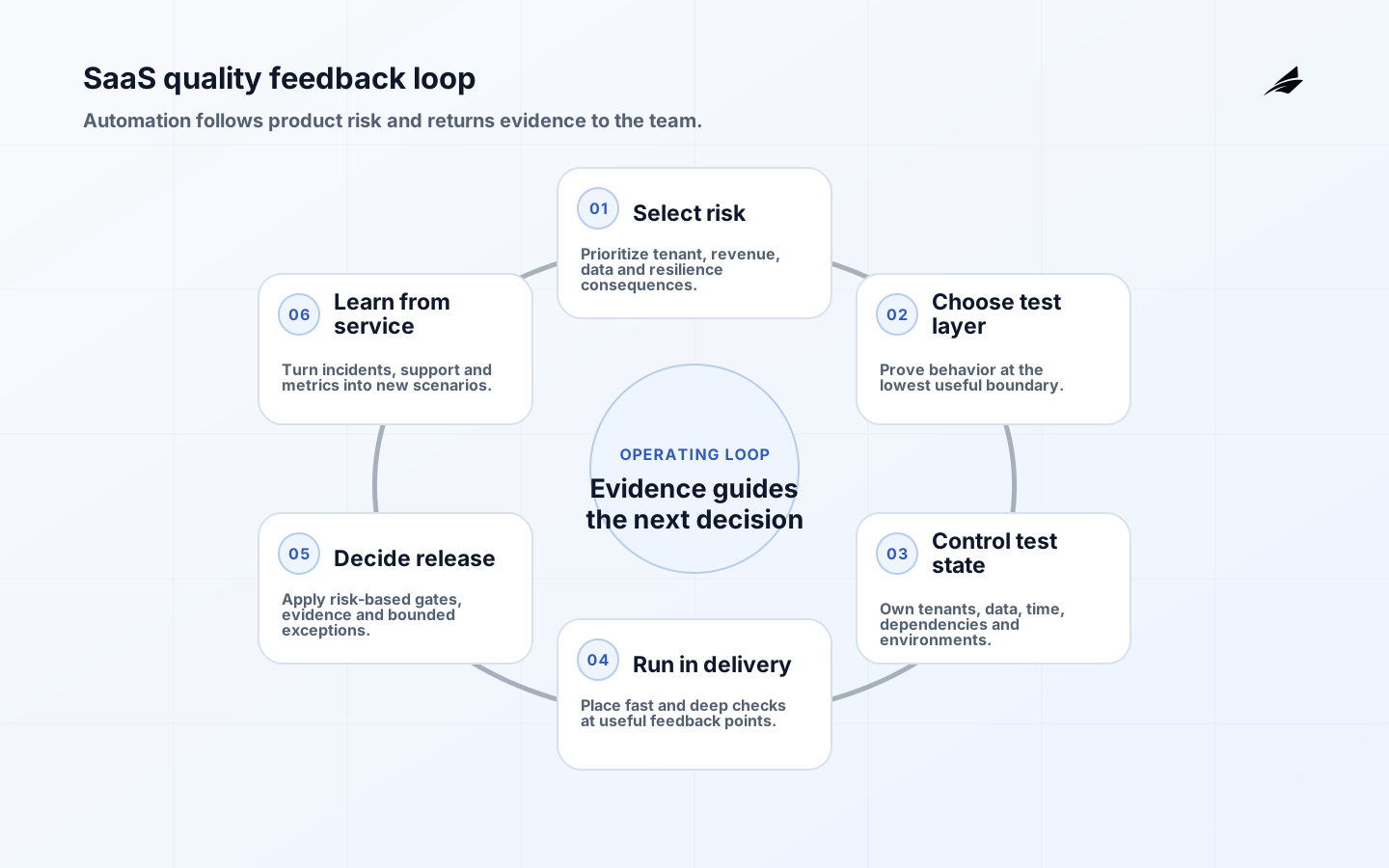
QA automation for SaaS startups should shorten trustworthy feedback on the risks that could lose customers, corrupt tenant data or block revenue. It should not maximize the number of scripted checks. A small team needs a layered test strategy, stable data and environments, clear release decisions and ownership for failures. This guide shows business and engineering leaders how to build that capability without creating a brittle suite that costs more than it protects.
Use the SaaS QA automation checklist when implementing the plan and the SaaS QA automation FAQ for common tradeoffs. Teams buying specialist help can compare scope with the QA automation consulting plan and its implementation checklist.
Start with SaaS risk and release outcomes
List the journeys that sustain the business: account creation, authentication, trial conversion, subscription change, payment, core product work, data export, support recovery and tenant administration. For each, identify financial, security, privacy, availability and trust consequences of failure. Add platform risks such as background jobs, third-party APIs, migration, feature flags, browser support and noisy-neighbor behavior. This risk map determines what must be automated first.
Define a baseline before expanding tools: production defects by journey, escaped severity, rollback frequency, manual regression time, flaky failure rate, time to diagnose and release delay. The Government Digital Service guidance on testing a service regularly emphasizes testing throughout development, using realistic environments and combining methods. Adopt that lifecycle view; quality is evidence produced by the whole team, not a final phase owned by one tester.
| SaaS risk | Best first automation layer | Representative assertion | Business guardrail |
|---|---|---|---|
| Tenant data leakage | Authorization integration and API tests | Tenant A cannot read or mutate Tenant B records | Zero cross-tenant disclosure |
| Billing error | Contract and scenario tests | Plan, tax, credit and proration totals reconcile | Invoice correction stays below threshold |
| Broken onboarding | Focused browser journey | New user reaches first value with verified email | Conversion and accessibility do not regress |
| Migration corruption | Schema and reconciliation tests | Counts, keys and sampled records match | Rollback remains possible |
| Dependency outage | Resilience and fallback tests | Timeout, retry and degraded state follow policy | No duplicate charges or silent loss |
| Feature flag collision | Configuration matrix tests | Supported flag combinations preserve invariant | Emergency disable works |
Build a layered automation architecture
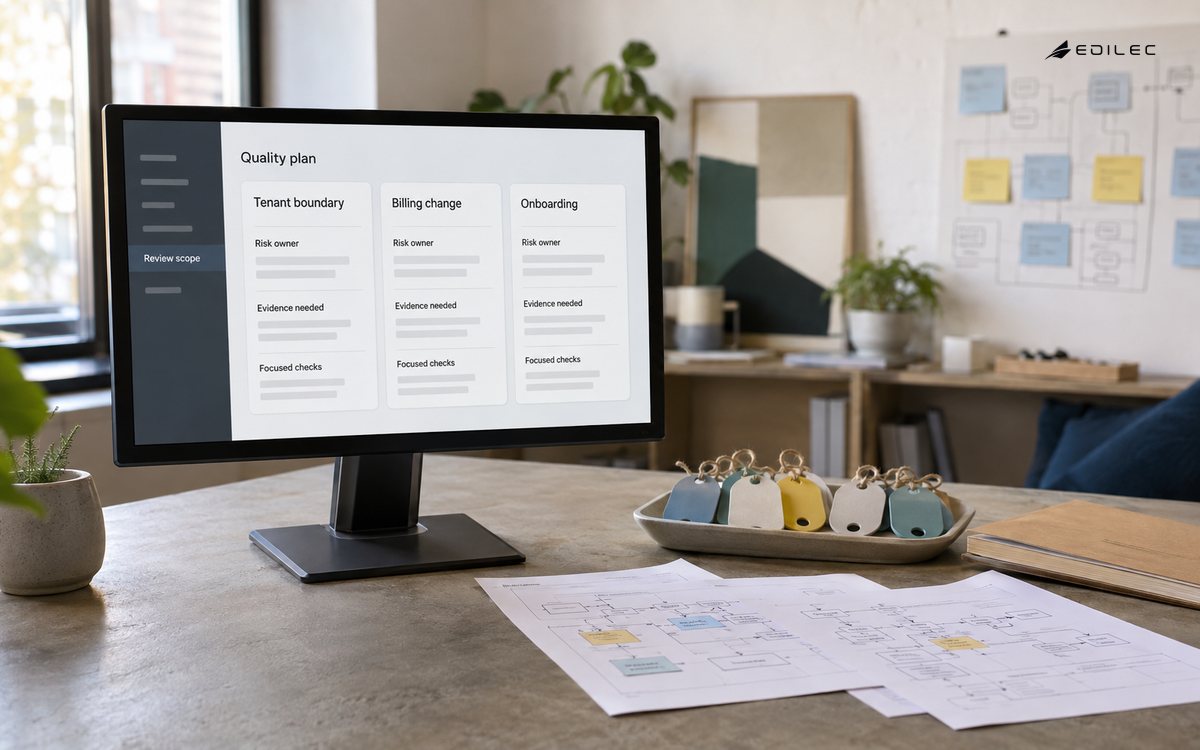
Put most deterministic business rules in fast unit or component tests. Use API and integration tests for service contracts, persistence, permissions and dependency behavior. Reserve browser tests for a small set of critical user journeys and browser-specific behavior. Add contract tests where teams or suppliers change interfaces independently. Performance, security, accessibility, migration and recovery tests address different qualities and need explicit scenarios rather than being folded into a generic regression count.
Automate at the lowest layer that can prove the risk. A price calculation belongs below the browser; one checkout journey proves wiring and user behavior. Playwright’s best practices recommend testing user-visible behavior, isolating tests and using resilient locators rather than implementation details. Those habits reduce false failures, but tool defaults cannot choose business coverage. Maintain a trace from each critical risk to its test layer, owner and release policy.
Design test data for tenants, states and time
Create builders or approved fixtures for tenants, roles, plans, entitlements, usage, invoices and lifecycle states. Every test should own or uniquely address its data so parallel execution cannot collide. Avoid copying production records unless a governed masking and approval process makes that necessary. Synthetic data is safer but must cover realistic boundaries: Unicode names, time zones, large accounts, expired trials, suspended users, negative balances and partial configuration.
Control time and external behavior. Subscription renewal, token expiry and scheduled jobs become slow or flaky when tests wait on the real clock. Inject a clock where feasible or provide supported test controls. Stub third-party failures at unit and integration layers, then run a smaller set against provider sandboxes to validate the contract. Record sandbox limitations. Test idempotency with duplicate webhooks and retries, because network delivery is not a single happy request.
Make environments reproducible and observable
Create environments from versioned infrastructure and configuration. Record application revision, database migration, flags, dependencies and seed data for each run. Ephemeral environments can improve isolation, but only if startup, identity, data and teardown are dependable. A shared staging environment may still be useful for integrated journeys; schedule ownership and prevent teams from silently changing it. Protect test credentials and keep their permissions representative but bounded.
Capture logs, traces, screenshots and network or console errors with a run identifier, while excluding secrets and personal payloads. On failure, show the first meaningful cause and affected test, not thousands of unrelated lines. Retain artifacts long enough to diagnose intermittent problems. Monitor runner capacity, queue time and environment provisioning beside test duration. A fast test suite waiting twenty minutes for an unavailable environment does not provide fast feedback.
Integrate checks into a risk-based CI path
Run formatting, static analysis, unit tests and selected integration tests on each change. Trigger broader browser, migration, compatibility and nonfunctional suites according to affected components, release branch or schedule. Keep an auditable mapping of change to selection; a clever impact algorithm that silently omits a critical test creates false confidence. Build once, test that artifact and promote it. Fail closed for critical checks, and define who can grant a time-bounded exception with compensating evidence.
Classify failures as product defect, test defect, environment defect or infrastructure defect. Quarantine only with an owner, issue, risk assessment and expiry. Do not automatically rerun until green and discard the original failure. Track first-run pass rate and flaky-test recurrence. A healthy suite gives an engineer a clear action within minutes for common changes and a bounded deeper path for release candidates.
Include security, privacy and accessibility in quality
Automate authorization boundaries, input handling, secret detection, dependency review and secure configuration, but combine scanners with threat-based tests. The OWASP Application Security Verification Standard offers requirements that teams can tailor by application context. NIST’s Secure Software Development Framework connects organizational preparation, protection, secure production and vulnerability response. Assign finding owners and verify fixes against the released artifact.
Accessibility is also a product quality requirement. Use semantic components and automated checks for detectable problems, then test critical journeys with keyboard and assistive technologies. WCAG 2.2 provides the normative success criteria; automation cannot judge every criterion or the usability of a complete workflow. Include authentication, errors, upgrade dialogs and support recovery, not only marketing pages. Keep accessibility failures in the same prioritized product backlog.
Implement coverage in business-sized increments
Consider a startup launching seat-based billing. The first slice tests entitlement calculation as a pure function, subscription and invoice transitions through service APIs, provider webhook signatures and duplicates, and one browser journey from upgrade to visible entitlement. Add reconciliation between internal ledger and provider invoice. The release gate blocks mismatched totals, cross-tenant access and unhandled duplicate events; cosmetic receipt differences may follow a separate policy.
For a collaborative editor, focus first on tenant isolation, permission transitions, save conflict and export integrity. Use component tests for editing rules, API tests for permissions and version conflicts, a small multi-session browser scenario for collaboration, and load tests for representative document sizes. Inject connection loss and reconnect. The implementation succeeds when the suite identifies the broken invariant quickly and operators can connect a production symptom to the same scenario.
| Metric | Definition | Decision use | Anti-pattern |
|---|---|---|---|
| Critical risk coverage | Approved high-impact risks with current automated and manual evidence | Choose next automation investment | Counting test cases without risk weight |
| First-run pass rate | Runs passing without retry | Find flaky tests and unstable environments | Reporting only eventual green |
| Feedback time | Change submitted to actionable result | Tune suite placement and capacity | Optimizing test runtime while queue grows |
| Escaped defect rate | Production defects by journey and severity | Find missing scenarios and weak gates | Blaming individuals instead of learning |
| Diagnosis time | Failure to identified owner and cause | Improve artifacts and observability | Using mean that hides long tail |
| Maintenance effort | Engineering time spent repairing tests | Refactor brittle layers | Treating maintenance as free |
Create a sustainable quality operating model
Product and engineering leaders own risk and release policy. Developers own tests near their components; quality specialists coach strategy, exploratory testing and complex automation; platform teams own runner and environment capability; security and accessibility specialists provide independent depth. Keep one named owner for every critical journey. Review production incidents and support themes monthly, add missing scenarios and remove tests that no longer protect an active risk.
Budget maintenance. Refactor shared fixtures, page objects and data builders when product concepts change. Review suite duration, quarantine, duplicate coverage and old feature flags. A vendor engagement should leave repositories, documentation, test data methods and trained owners with the startup. Judge progress by faster reliable decisions and fewer serious escapes, not by scripts delivered. As the product grows, evolve the test portfolio with architecture and customer segments.
Key takeaways
- Prioritize automation from SaaS business, tenant and revenue risks.
- Test each behavior at the lowest layer that proves it.
- Own test data, time and dependency behavior for deterministic execution.
- Build reproducible environments and actionable failure evidence.
- Put security, privacy, accessibility, migration and resilience into the portfolio.
- Measure first-run feedback, escapes, diagnosis and maintenance rather than script count.
QA automation for SaaS startups FAQ
What should a startup automate first?
Automate stable, high-consequence rules and one or two revenue or customer-critical journeys. Tenant isolation, authentication, billing and data integrity usually outrank broad visual regression, but the exact order should follow the product risk map.
What percentage of tests should be automated?
There is no useful universal percentage. Automate checks that are repeatable, decision-relevant and economical; keep exploratory, usability and judgment-heavy work human-led. Track critical risk coverage and feedback quality instead of an automation ratio.
Does a startup need a dedicated QA team?
Not necessarily. Quality remains a product and engineering responsibility. A specialist can improve strategy, exploratory testing and tooling, but developers and service owners must still maintain tests and act on production evidence.
Conclusion
Effective QA automation for a SaaS startup is a feedback system around business risk. Select critical journeys, use the right test layer, control data and environments, and make failures actionable in continuous delivery. Combine automation with human exploration and production learning. The result is not a giant suite; it is a team that can release quickly while knowing which customer, tenant, revenue and resilience claims have current evidence.