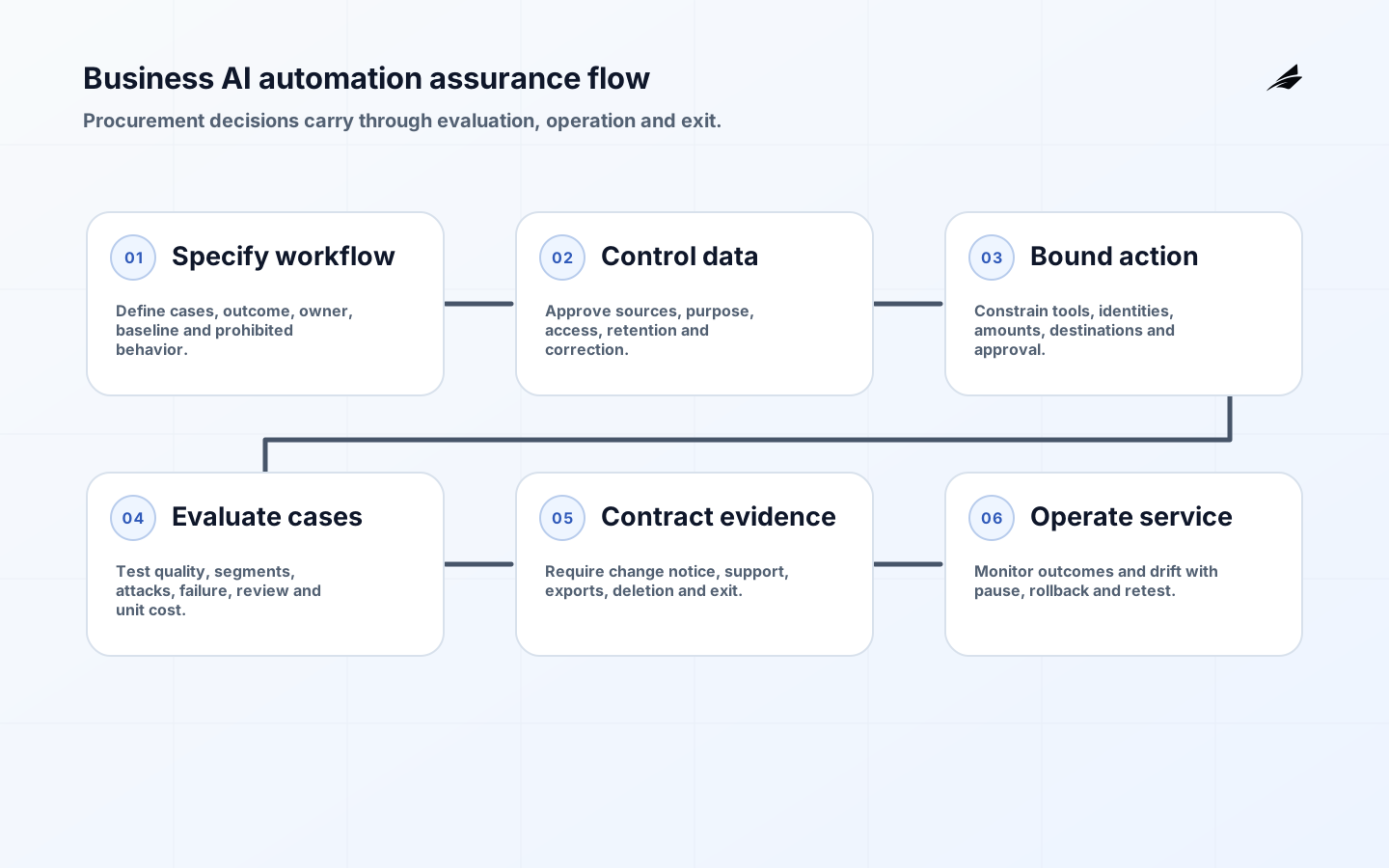
AI automation services for business workflows should be purchased as an accountable operating change, not as access to a model. The service may classify, extract, summarize, draft, recommend or coordinate steps, but the buyer still owns the business policy, data purpose, authority and consequences. A sound implementation defines which work enters, what evidence the system uses, which actions it may take, when a person intervenes, how errors are corrected and what outcomes justify continued use. This checklist moves from workflow selection through provider exit with acceptance evidence at every stage.
Use the scope, cost and delivery guide before procurement, the business workflow FAQ for common design questions, and the general workflow checklist for adjacent controls. NIST's AI RMF is voluntary and use-case-neutral; its Govern, Map, Measure and Manage functions are a practical way to keep organizational decisions connected to system evidence.
1. Select a bounded workflow and accountable owner
Document trigger, eligible cases, current roles, systems, inputs, decisions, outputs, downstream actions, exceptions and completion. Identify where judgment is required and where deterministic workflow is enough. Do not automate a broken process merely to move defects faster. Remove duplicate approvals, repair authoritative records and clarify ownership first. Favor a workflow with enough volume and feedback to evaluate, while avoiding irreversible or high-consequence action in the first release.
Name one business owner with authority over policy and stop decisions, plus data, technology, security, privacy and operational owners. Baseline cycle time, queue age, handling effort, error, rework, abandonment and outcome. Define expected value and risk limits in the same document. A provider demonstration should use representative anonymized cases and show exceptions, not a curated happy path.
2. Write service requirements and prohibited behavior
Specify task quality by segment, response time, availability, throughput, review rate, data locations, retention, provider training use, model-change notification, logging, security response, portability and support. List prohibited inputs, outputs, decisions, destinations and tool actions. State when the system must abstain. Require an accessible manual route and no retaliation or hidden penalty for human disagreement. Translate regulatory and contractual duties into testable workflow behavior with qualified advice.
Use the NIST AI RMF Playbook as a source of suggested actions, selecting those material to the context. Require the provider to explain its role, model suppliers, subprocessors, data flow, evaluation and incident process. Generic responsible-AI principles are not evidence that the configured service meets the buyer's requirement.
| Requirement area | Buyer must define | Provider must evidence | Acceptance gate |
|---|---|---|---|
| Outcome | Action and baseline | Workflow design and expected effect | Representative task improves |
| Quality | Metric, segments and error cost | Evaluation results and limitations | Threshold met by critical segment |
| Data | Purpose, sensitivity and retention | Flow, controls and deletion | No unapproved processing |
| Authority | Allowed actions and approval | Identity and tool restrictions | Consequential action stays bounded |
| Operation | Objectives and escalation | Telemetry, support and rollback | Incident exercise succeeds |
| Exit | Assets and transition period | Exports, deletion and assistance | Alternative path is viable |
3. Control data, knowledge and records
Inventory input records, documents, knowledge bases, examples, evaluation cases, feedback and output logs. Record owner, source, quality, sensitivity, permitted use, retention, access and correction. Minimize fields and retrieve only the material context for the case. The NIST Privacy Framework helps connect data processing to possible adverse effects. Review new inferred attributes and combinations, not only obvious identifiers.
Define authoritative sources and effective dates. Ground responses in approved content where factual company policy matters and surface references to reviewers. Treat user documents, web content and retrieved text as untrusted data that may contain instructions. Separate evaluation data from prompt examples and tuning. Establish how a person corrects the source record versus the generated output so the system does not repeatedly compensate for upstream defects.
4. Design the control boundary
Use deterministic code for authorization, financial calculation, required checks, policy thresholds and final write validation. Constrain model output to schemas and allowed values. Limit service identities, tools, record scope, amount, destination and execution count. Require confirmation for material external communication, account change, payment, eligibility or deletion. Protect secrets and never allow model text to select credentials. Rate-limit actions and prevent duplicate effects with idempotency keys.
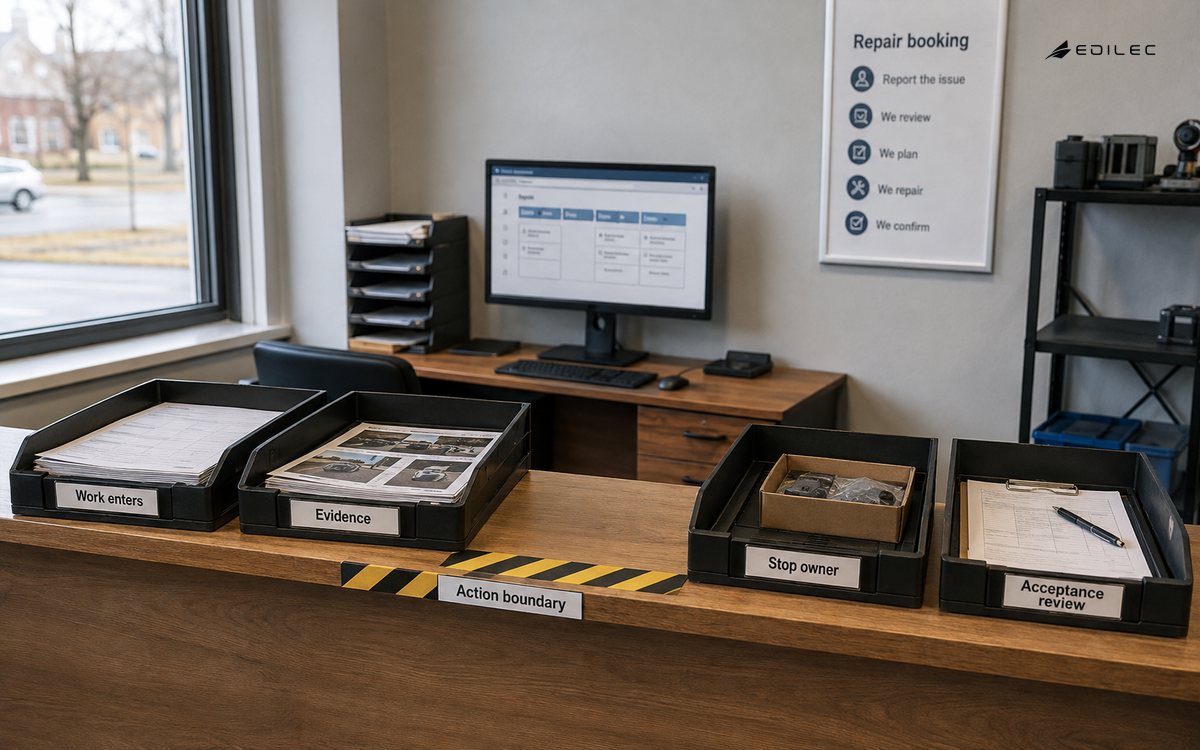
The NIST Generative AI Profile describes risks specific to or amplified by generative AI. Convert relevant risks into threat scenarios and tests. Maintain a visible escalation path when the system encounters conflicting instructions, insufficient evidence, unsafe requests, suspected manipulation or repeated failure. Human review must have context, time and authority; a rubber-stamp step does not reduce risk.
5. Build a representative evaluation and pilot
Create cases from real variation and edge conditions. Define a scoring rubric before comparing providers. Measure field-level accuracy, class precision and recall, factual support, policy adherence, completeness, unsafe behavior and abstention as appropriate. Weight errors by consequence and report segments rather than one average. Review disagreement among expert labelers; some apparent model errors reveal ambiguous business policy.
Run offline evaluation, integration testing, shadow mode and a limited cohort. Test malformed input, conflicting records, prompt injection, unavailable knowledge, tool denial, timeouts, duplicate delivery, provider outage and rollback. Measure reviewer burden and correction latency. Preserve versions of model, prompt, policy, retrieval, tools and evaluation so a result can be reproduced. NIST SP 800-218A supports integrating AI-specific concerns into secure software development.
| Pilot signal | Evidence | Decision question | Possible response |
|---|---|---|---|
| Task quality | Scores by case type and consequence | Is performance acceptable where it matters? | Limit or redesign failing segment |
| Workflow time | End-to-end queue and review duration | Did the bottleneck actually move? | Fix integration or staffing |
| Human override | Rate and coded reason | Is review catching systematic defects? | Correct source, policy or model |
| Unsafe action | Blocked and attempted tool calls | Are authority limits effective? | Tighten identity and validation |
| Unit cost | Provider, platform and labor per accepted case | Is value durable at expected volume? | Change route or service tier |
| Incident readiness | Detection, containment and reconstruction drill | Can operations manage failure? | Delay release and repair runbook |
6. Contract for change, evidence and exit
Tie milestones to accepted workflow evidence rather than model access or prompt count. State model and subprocessor notification, security obligations, data-use restrictions, service objectives, evaluation rights, incident support, intellectual property, export and deletion. Retain buyer access to workflow configuration, prompts or policies where contractually possible, evaluation cases, logs, integration code and decision records. Do not accept a provider score that cannot be reproduced on buyer cases.
Price discovery, integration, security, evaluation, run support and change separately enough to expose assumptions. Model cost per accepted outcome, including human review, correction and vendor management. Require rate limits and budget alerts. Avoid long commitments before representative volume and quality are known. Define transition assistance and a fallback process that can continue essential work without the provider.
7. Release and operate as a service
Train users on purpose, limits, evidence, escalation and correction. Release by case type, region or business unit through controlled cohorts. Use feature flags and preserve the last accepted configuration. Monitor input drift, output quality samples, abstention, overrides, tool denial, latency, cost, incidents and downstream outcomes. Establish alert owners and response windows. A quality dashboard without a pause mechanism is observation, not control.
Review after provider, model, prompt, policy, source, integration or population changes. Investigate incidents and near misses without assuming the model is the only cause; workflow, data and human incentives often contribute. Retest material corrections. Retire temporary fallback, stale prompts, unused access and unneeded logs. Reapprove scope before adding tools or new decision authority.
Use a change taxonomy once the service is live. A copy edit to a reviewer instruction, a new knowledge source, a model replacement and permission for a new tool should not follow the same approval path. Classify changes by possible effect on data, behavior and authority, then tie each class to evaluation depth, approvers, rollout cohort and rollback evidence. Emergency provider changes need retrospective review. This prevents routine maintenance from becoming painfully slow while ensuring that a seemingly simple configuration change cannot quietly expand who is affected or what the automation can do.
Maintain a benefit ledger alongside the risk register. Record baseline volume, eligible volume, accepted outcomes, released capacity, avoided delay, operating spend and material incidents using agreed definitions. Review benefits net of review and correction work. If value depends on staff accepting weak output or omitting difficult cases from measurement, the business case is not credible. A transparent ledger helps leaders improve or stop the workflow without defending a sunk technology purchase.
Key takeaways
- Buy an accountable workflow outcome, not model access.
- Define prohibited behavior, abstention and human authority before build.
- Minimize and govern data across inputs, retrieval, feedback and logs.
- Keep authorization and irreversible actions outside probabilistic output.
- Evaluate representative segments, complete workflow effects and cost per accepted case.
- Contract for model change, evidence access, operational support and exit.
AI automation services for business workflows FAQ
Should one provider automate many workflows at once? Begin with a representative bounded workflow. Shared controls can later support others, but each use needs its own outcome, data, evaluation and authority.
Is a human-in-the-loop always sufficient? No. The reviewer may lack context, time or independence. Measure review quality and workload, and reduce the system's authority where meaningful review is not practical.
Who owns an automated error? The contract allocates tasks, but the business deploying the workflow retains accountability for its use. Define provider duties and internal decision authority explicitly.
When can the pilot scale? When outcome, quality, risk, operational readiness and unit-cost gates are met over representative volume, not merely when users like the demonstration.
Conclusion
AI automation services for business workflows become dependable when purpose, evidence and authority remain connected from procurement through operation. Select a bounded task, control data and action, evaluate the complete workflow, contract for change and exit, and scale by accepted cohorts. That creates useful automation without outsourcing accountability to a model or supplier.