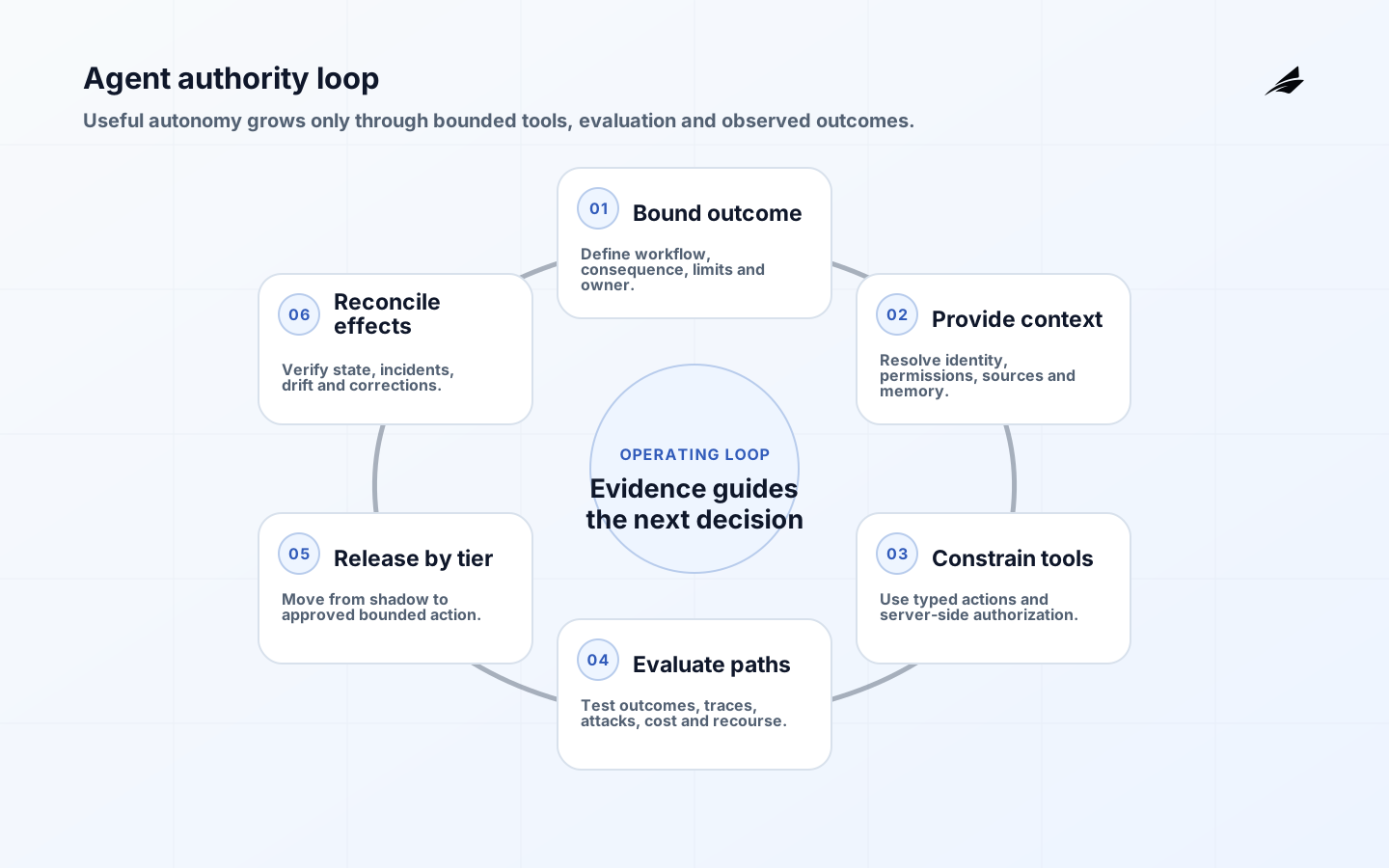
An AI solutions agent is a system that interprets a goal, uses context, plans steps and invokes tools to produce or change business state. Its value comes from completing a bounded workflow, not from appearing autonomous. Its risk also differs from an ordinary chatbot: a wrong answer may be visible, while a wrong tool call can send a message, alter a record, disclose data or spend money. This AI solutions agent implementation checklist connects workflow scope, authority, context, evaluation, security, release and operations.
Use it with Edilec's AI agent delivery plan, business workflow agent guide and production agent checklist. Start with one valuable workflow whose outcome can be verified. Do not begin by exposing broad enterprise tools and asking the model what to automate. Business owners remain accountable for decisions and consequences even when the agent performs intermediate work.
1. Bound the outcome and authority
Define the initiating event, intended outcome, authorized user, affected records, maximum duration and completion evidence. Map normal, ambiguous, prohibited and exception paths. Separate read, recommend, draft, request approval and execute authority. A research agent may read approved sources and draft a brief; a service agent may classify a case but require approval before issuing credit. Set value, frequency, data, customer and time limits outside the model. A model statement that an action is safe must never grant permission.
Apply the NIST AI Risk Management Framework at the system level: govern ownership, map context and impact, measure behavior, and manage risk throughout operation. Create an impact assessment covering affected people, data, financial or safety consequences, legal duties, failure reversibility and recourse. Name the product owner, tool owners, model owner, security owner, reviewers and incident authority. Record residual risk and the person empowered to accept it.
| Authority tier | Permitted behavior | Control |
|---|---|---|
| Observe | Read approved context | Tenant, role and purpose filters |
| Recommend | Return ranked options | Evidence and uncertainty shown |
| Draft | Prepare reversible content or change | Human edits before release |
| Act with approval | Invoke a bounded tool after review | Fresh authorization and exact preview |
| Act automatically | Execute low-consequence reversible step | Hard limits, sampling and stop control |
2. Engineer context, memory and tools
Provide the minimum context needed for the step. Resolve identity, tenant, role, purpose and current workflow state before retrieval. Apply source permissions before content enters the prompt, not after generation. Preserve citations or record references so users can verify claims. Separate durable business state from conversational memory. Memory should have a schema, owner, retention rule, correction path and explicit scope; an unbounded transcript is not a reliable customer record.
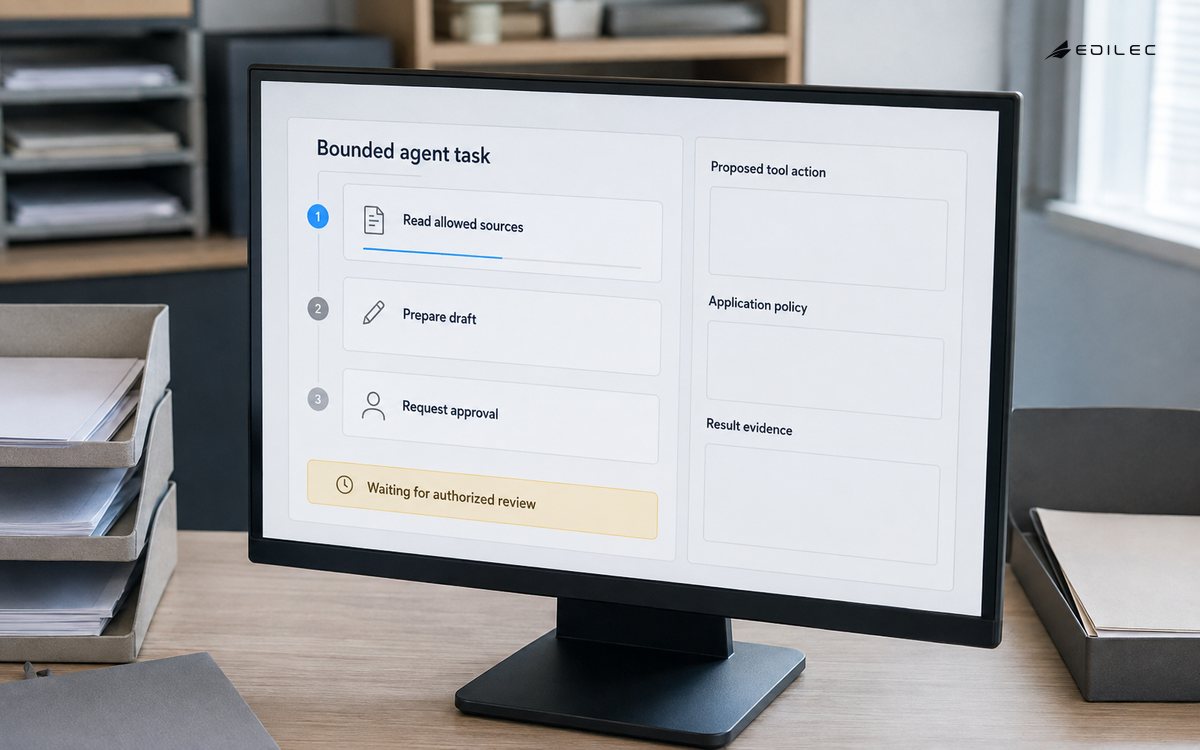
Design tools as narrow, typed operations with descriptive names, strict schemas and server-side authorization. Return useful errors and current state. Make financial and record-changing calls idempotent, and require the agent to present an exact preview before approval. The Model Context Protocol specification standardizes connections to resources and tools and includes authorization requirements, but protocol compliance does not make a tool trustworthy. Validate server provenance, scopes, token audience and every tool result.
3. Build deterministic workflow controls
Place an orchestrator around the model. It enforces allowed states, tool sequences, budgets, timeouts, retries, approvals and terminal conditions. Use code for policy, arithmetic, eligibility and irreversible transitions. Let the model handle interpretation and constrained planning where variability adds value. Limit step count, token use, tool calls and recursive delegation. Detect repeated plans and fail closed into a useful queue. Persist checkpoints so long-running work can resume without replaying completed actions.
Human approval must bind to a specific proposed action and fresh state. Show the source evidence, fields to change, downstream effect and uncertainty. Expire approvals when inputs change. A generic approval to let the agent finish defeats oversight. Give reviewers reject, edit, narrow and escalate options. Route high-consequence or out-of-distribution cases to qualified reviewers and measure queue health. A fallback that no team can staff is not a control.
4. Threat-model the agent as an execution system
Treat retrieved pages, documents, emails, tool descriptions and user content as untrusted. They can contain instructions intended to redirect the agent. The OWASP securing agentic applications guide provides concrete design and deployment controls. Separate data from instructions, constrain tools by policy, sanitize rendered content, avoid secrets in prompts and validate outputs before use. Do not rely on a system prompt as the primary security boundary.
Use MITRE ATLAS to structure adversarial scenarios across reconnaissance, execution, persistence, credential access, collection, exfiltration and impact, including agent-specific techniques. Test prompt injection, tool-output manipulation, confused-deputy behavior, credential theft, memory poisoning, excessive agency, denial of wallet and cross-tenant leakage. Log model, prompt template, retrieval references, tool request, authorization decision, result and final outcome while minimizing sensitive content. Provide a kill switch that revokes tool authority, not merely hides the interface.
5. Evaluate end-to-end behavior
Build an evaluation set from real workflow categories, rare exceptions, adversarial cases and historical failures. Keep protected test data governed and separate from training or prompt tuning. Score outcome correctness, evidence use, policy compliance, tool choice, argument accuracy, unnecessary actions, escalation, latency and cost. A final answer can be correct despite an unsafe path, so inspect traces. Use deterministic assertions for required fields and state transitions, expert review for nuanced quality and security tests for abuse resistance.
The NIST Generative AI Profile calls for proportionate testing, validation, red teaming, defined human-AI roles and feedback. Establish release thresholds by risk class and compare with the current human or rules baseline. Run repeated trials because model behavior varies. Test model, prompt, retrieval, tool and policy changes independently where possible. Maintain a regression set that cannot be quietly removed to improve aggregate scores.
| Evaluation dimension | Evidence | Production signal |
|---|---|---|
| Outcome | Task-specific correctness and reconciliation | Verified completion and correction rate |
| Grounding | Claims linked to permitted records | Unsupported-claim and citation failure rate |
| Authority | No action beyond policy and approval | Denied calls and unauthorized attempts |
| Efficiency | Steps, latency, tokens and tool cost | Cost per successful workflow |
| Recourse | Escalation and correction succeed | Appeal resolution and repeat failure |
| Security | Adversarial scenarios remain contained | Injection alerts and privilege anomalies |
6. Release progressively and operate the agent
Begin in offline replay, then shadow mode, reviewer assistance and bounded execution. Use cohorts and authority tiers rather than one launch switch. Define entry, pause and rollback thresholds for quality, security, cost, queue impact and customer harm. Version model, prompts, policies, retrieval indexes and tools so an outcome is reproducible enough to investigate. Test rollback and provider outage behavior. Preserve a non-agent path for critical work until evidence supports dependence.
Monitor validated outcomes rather than self-reported completion. Reconcile tool effects with systems of record, sample low-risk automated cases and review escalations, corrections, drift, latency, cost and denied actions. Establish incident response for prompt injection, leakage, harmful action and provider change. Review model and tool release notes before upgrades. Feed user feedback into triage with provenance; do not train directly on unreviewed feedback that an attacker or mistaken user can manipulate.
Manage model and provider dependency. Record approved models, regions, data-use terms, retention, safety settings, limits, pricing and fallback. Test a model change against the full evaluation set before promotion; a newer model may improve average quality while changing tool behavior or refusal in critical cases. Set spend and rate limits at the service boundary. Design for provider throttling and outage with queued, degraded or human processing. Ensure logs contain enough version information to investigate behavior after a vendor update.
Design the user experience to calibrate trust. State what the agent can do, which sources it used, when an action is pending and how to correct or stop it. Do not use human-like confidence language to conceal uncertainty. Preserve user edits and clearly distinguish agent-generated content in records where provenance matters. Notifications should describe completed effects, not merely agent intent. Users need one reliable place to see active tasks, approvals, failures and history.
Prepare the workforce and service desk. Train reviewers on policy and common agent failure modes, and train support teams to collect trace identifiers without exposing prompts or sensitive context. Define who can inspect, rerun, cancel or compensate a task. Track whether automation shifts work into exception queues rather than removing it. Include reviewer effort, customer correction and incident response in the business case; token cost alone is not the cost of an agent-enabled service.
Document compensation and correction for failed actions. Some workflows can reverse a draft or record update; others need a credit, customer contact, downstream reconciliation or formal incident. Map these steps before granting execution authority and test them with realistic partial failures. An agent is not operationally complete if it can initiate a transaction that no owned process can unwind or explain.
Key takeaways
- Define one verifiable workflow and separate recommendation from execution authority.
- Enforce identity, policy, budgets and state transitions outside the model.
- Treat context and tool outputs as untrusted and tools as privileged interfaces.
- Evaluate the path, tool effects and recourse, not only the final text.
- Expand authority through progressive release and observed production evidence.
Frequently asked questions
Does an agent need multiple models? No; use the simplest architecture that meets the workflow. Should agents have long-term memory? Only governed, minimal memory with purpose, scope and correction. Can a human approval make any action safe? No; reviewers need evidence, authority and time, while hard policy still applies. How is success measured? Verified business completion, correction, safety, latency and cost. When should deployment stop? When harmful action, leakage, unexplained drift, failed reconciliation or review overload exceeds the approved threshold.
Conclusion
A production AI agent is a controlled participant in a business service. Bound its outcome, give it narrow tools, keep policy and authorization deterministic, test adversarial paths and reconcile every material effect. Teams that earn autonomy through evidence can automate useful work without making model confidence a substitute for accountable authority.