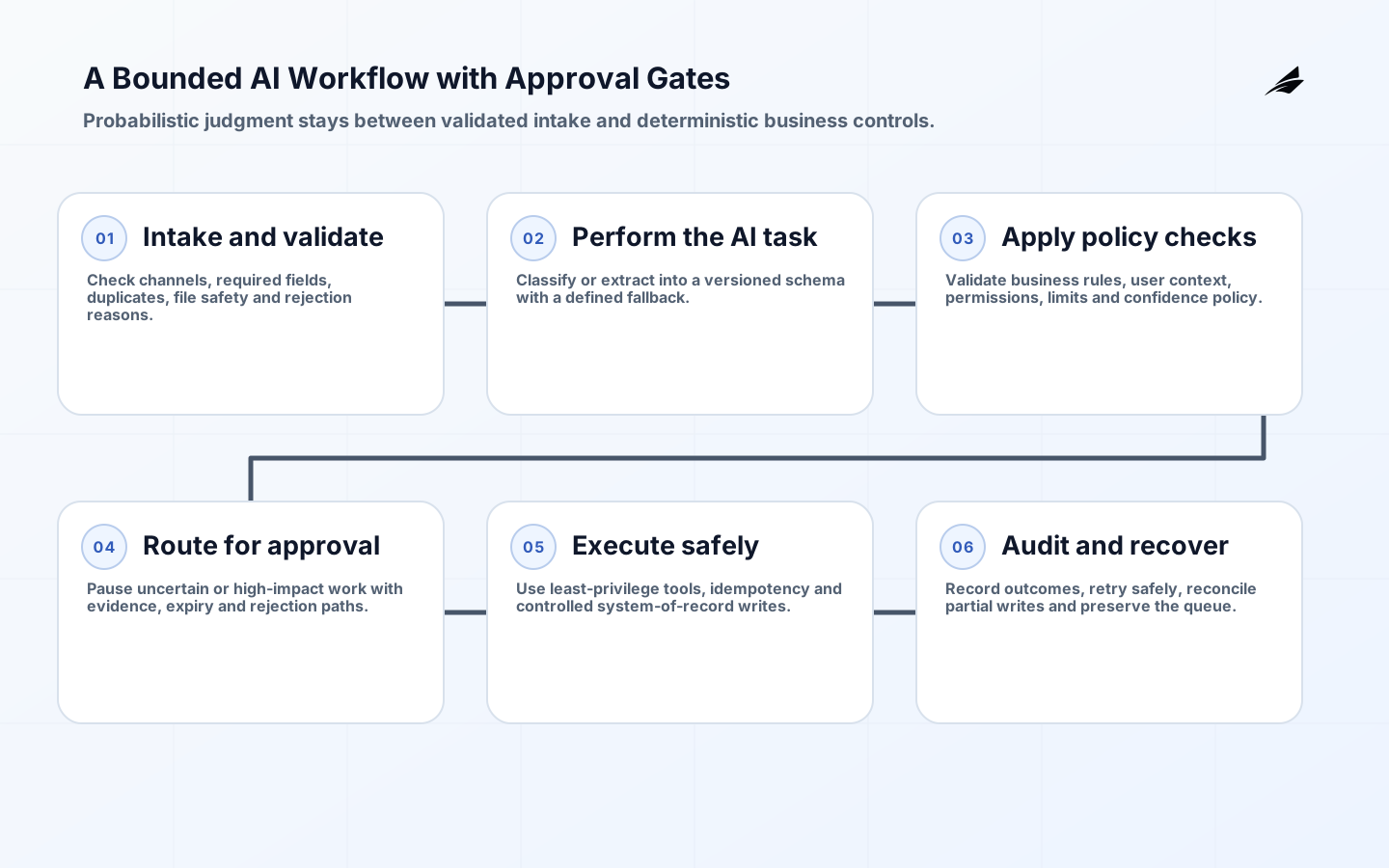
AI workflow automation services combine language or vision models with deterministic business logic, integrations and human decisions. The goal is not to let a model run a process by itself. It is to use probabilistic capabilities where they are useful, such as classifying an email, extracting fields or drafting a response, while software controls identity, validation, state, approvals and writes to systems of record. Teams searching for a provider usually need to know which workflow is suitable, what the first release includes, what drives cost and how to prevent an uncertain model output from becoming an irreversible business action.
What an AI workflow automation engagement should decide
A useful engagement begins with one operational outcome, not a catalogue of AI features. Examples include reducing the time to triage support requests, checking incoming supplier documents, preparing a case summary for an approver or drafting an account update from approved records. The workflow must have an identifiable owner, a stable input, a defined completion state and enough historical examples to test. If nobody can describe the current exception path, adding AI will hide rather than remove process ambiguity.
| Use-case signal | Good first candidate | Needs redesign or tighter controls |
|---|---|---|
| Input and outcome | Recurring documents, messages or records with a clear target state | Open-ended strategic work with no agreed definition of done |
| Decision consequence | Recommendation or draft that a person can review | Payments, deletions, legal commitments or access changes executed without approval |
| Process evidence | Past cases include normal examples, edge cases and corrections | Rules live only in individual memory and exceptions are not recorded |
| Integration surface | Documented APIs and named systems of record | Shared credentials, direct database writes or unclear record ownership |
| Value measurement | Baseline cycle time, rework, backlog or quality can be measured | Success is described only as adoption or number of prompts |
Scope the service around a bounded operating flow
The scope should follow a case from entry to closure. Discovery maps actors, handoffs, systems, data classifications, exception categories and service-level expectations. The build scope then defines each state, which component is allowed to make each decision and what evidence is recorded. This is closely related to the control patterns in How AI agents work in business workflows and the operating model behind Edilec AI automation services.
| Layer | Required design decision | Acceptance evidence |
|---|---|---|
| Intake | Accepted channels, file types, required fields, malware checks and duplicate handling | Representative inputs enter once and rejected inputs receive a reason |
| AI task | Prompt, model, response schema, confidence policy and fallback | Versioned test set shows task-level quality by important category |
| Orchestration | States, retries, idempotency keys, timeouts and dead-letter path | A failed step can retry or resume without duplicating an action |
| Authorization | User context, service identity, least-privilege tool permissions and secret storage | Every read and write is permitted independently of model output |
| Human review | Approval threshold, reviewer role, evidence presented and expiry rule | High-impact actions pause, can be rejected and retain the decision record |
| Operations | Logs, alerts, cost allocation, runbooks, model change control and rollback | Owners can diagnose a case and disable automation without losing the queue |
The model should receive the minimum context required for its task. Tool calls should expose narrow operations such as create_draft_case_note rather than an open-ended database or shell interface. The application should validate tool arguments, re-check authorization in the destination system and attach an idempotency key to mutation requests. OWASP describes excessive agency as a combination of too much functionality, permission or autonomy; a well-scoped workflow deliberately limits all three.
Example: automate supplier invoice intake without automating payment
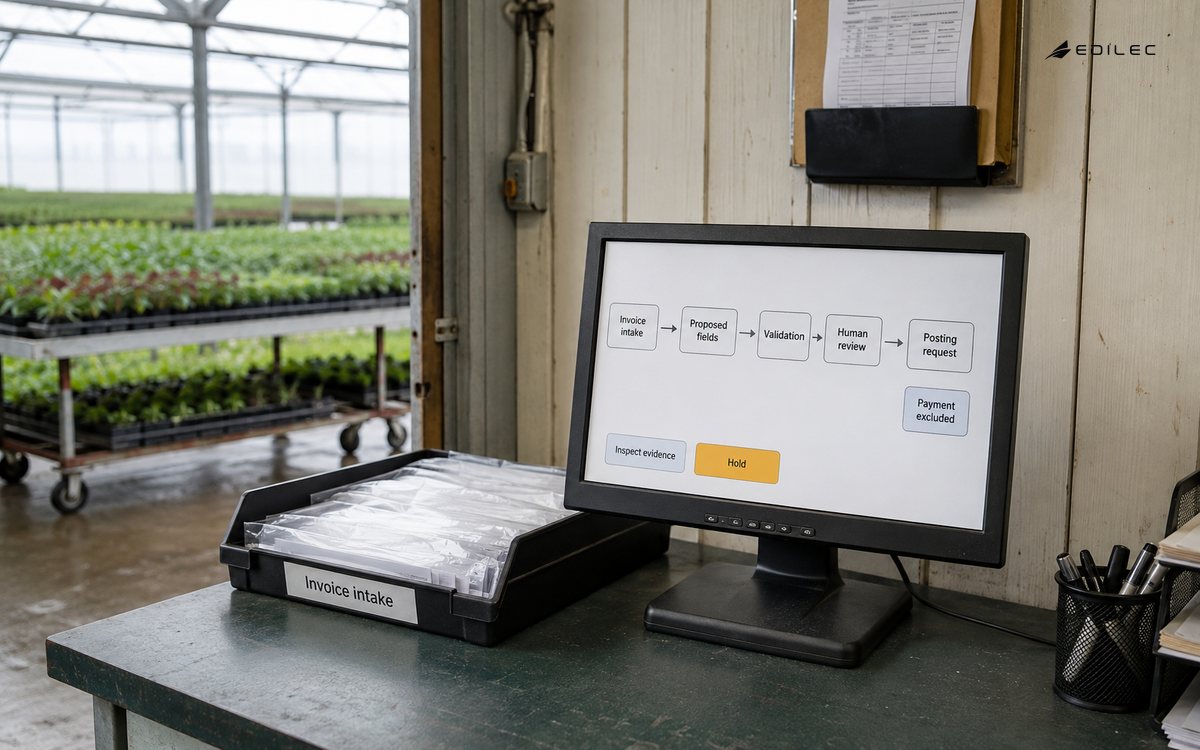
Consider a finance team that receives invoices by email. An intake service stores the original file, scans it and assigns a case ID. A document model extracts supplier, invoice number, date, currency, purchase-order reference and line items into a schema. Deterministic checks compare totals, detect duplicates and look up the supplier and purchase order through read-only APIs. Clean matches become draft payable records; mismatches enter an exception queue with the source page and failed rule highlighted.
The model never approves payment. A finance user reviews the draft in the existing approval system, where role and amount thresholds already apply. The workflow records extraction version, validation results, reviewer decision and final record identifier. This design can still remove repetitive keying and routing, but it preserves the financial control boundary and creates evidence for investigating an error. The same pattern applies to support triage, onboarding packets and contract metadata: automate preparation and low-risk routing first, then expand only after measured evidence supports it.
Estimate total cost by stage and unit of work
A credible estimate separates one-time delivery from recurring operation. Delivery includes process discovery, integration work, test-data preparation, security review, interface design, evaluation and rollout support. Run cost includes model input and output, document processing, storage, orchestration executions, network transfer, observability, human review and ongoing support. Vendor token rates alone are not a total-cost estimate. A cheaper model can be more expensive if weak outputs create more retries or reviewer effort.
- Calculate volume by business event: cases per month, pages per case, model calls per case and average input/output size.
- Add non-model services: extraction, queues, databases, workflow state, audit storage, monitoring and integration API charges.
- Measure review effort: percentage escalated multiplied by median handling time and loaded staff cost.
- Allocate shared platform cost to a workflow or business unit using tags and execution metadata.
- Budget for evaluation and change: model, prompt, policy and source-system updates all require regression testing.
- Track cost per successfully completed case, not cost per call, so failures and retries remain visible.
Timeline depends more on integration readiness, policy decisions and test evidence than on prompt creation. A bounded pilot can move quickly when APIs, owners and historical cases are available. A production workflow takes longer when identity must be redesigned, documents are inconsistent, approval rules conflict or downstream systems have no supported interface. Estimate discovery and remediation explicitly instead of hiding them inside an optimistic build date.
Design controls for the failure modes that matter
| Risk | Control | Production signal |
|---|---|---|
| Incorrect classification or extraction | Schema validation, business rules, confidence-based review and representative regression tests | Correction rate by field, category and source channel |
| Prompt injection through a document or message | Treat external content as data, isolate instructions, restrict tools and require approval for consequential actions | Blocked inputs, anomalous tool requests and policy-test failures |
| Unauthorized action | Per-tool service identities, user-context authorization and least-privilege destination permissions | Denied calls, permission changes and access exceptions |
| Duplicate or partial writes | Idempotency keys, transactional boundaries, compensating steps and reconciliation | Duplicate records, stuck states and reconciliation differences |
| Silent model or prompt drift | Version pinning, change approval, shadow evaluation and gradual exposure | Quality delta between versions and rollback frequency |
| Runaway consumption | Input limits, call budgets, retry caps, quotas and per-workflow cost alerts | Calls and cost per completed case |
Roll out in evidence-producing stages
- Baseline the current process. Record volume, cycle time, touch time, backlog, error categories and escalation rate before automation.
- Build an offline evaluation set. Include normal cases, rare formats, policy boundaries, adversarial content and examples that require abstention.
- Run in shadow mode. Produce recommendations without changing the process, then compare them with actual human decisions.
- Launch assistive mode. Let users review drafts and capture corrections with reason codes; do not learn automatically from unverified corrections.
- Enable bounded automation. Auto-route only the low-risk segment that has passed agreed quality and security gates.
- Expand gradually. Review weekly quality, cost, incidents and reviewer feedback; promote one category or action at a time.
- Operationalize ownership. Publish runbooks, on-call contacts, kill switches, version history, data retention and incident response steps.
NIST's AI RMF Playbook organizes risk work around Govern, Map, Measure and Manage. That is a useful operating rhythm: assign accountability, map the workflow and affected people, measure performance under realistic conditions, then manage residual risk and changes in production. Testing is not a one-time gate because inputs, models, prompts, connected tools and business rules all evolve.
Measure the business result and the control system
A dashboard should connect operating value with quality, risk and cost. Track median and tail cycle time, straight-through completion, human correction, reopen or rework rate, exception age, policy violations, incidents, availability and cost per completed case. Segment quality by language, document source, customer group or workflow category where those differences can expose poor coverage. Adoption alone is not proof of benefit, and an average accuracy score can conceal an unsafe failure mode.
- Choose one workflow with a named owner and measurable baseline.
- Keep deterministic rules and authorization outside the model.
- Place human approval at consequential or uncertain decisions, not at every step by default.
- Price the complete case, including review, retries, integrations and operations.
- Treat evaluation, logs, rollback and incident response as product features.
- Use human-in-the-loop automation guidance when defining review roles and escalation policy.
Frequently asked questions
What should be included in AI workflow automation services? A production scope should include process discovery, data and integration mapping, workflow orchestration, model-task design, evaluation, security controls, user experience, observability, deployment and an operating handover. A demo that only generates an answer is not the complete service.
Should an AI agent control the entire workflow? Usually no. Use an orchestrator or state machine to hold durable state, retries, timeouts and approval branches. Give the model narrow tasks and tools. This makes the process inspectable and lets the team resume or roll back a case without asking a model to reconstruct state.
How much human review is necessary? Review should follow consequence and uncertainty. High-impact writes, unusual cases and weak-confidence outputs need approval. Low-risk, well-tested cases can move automatically after the team has evidence. Monitor the automated segment because its input mix can change.
How is AI automation ROI calculated? Compare the fully loaded current process with the new process at the same output quality. Include avoided manual touch time, faster completion and reduced rework, then subtract delivery amortization, platform consumption, review, support and governance. Use cost per successful case and a quality guardrail rather than claiming value from model usage.
Can a pilot use production data? Only under approved data handling, access, retention and vendor terms. Minimize fields, use a separated environment and prefer representative de-identified cases where possible. A pilot does not justify bypassing security or privacy controls.
Conclusion
The strongest AI workflow is deliberately unglamorous around the model: clear states, narrow permissions, validated data, visible exceptions and accountable people. That structure lets the flexible AI step create value without becoming the control plane. A good services engagement leaves the client with more than a working integration. It leaves an evaluation set, operating metrics, runbooks, cost ownership and a safe path for expanding automation when the evidence supports it.