AI business process automation implementation succeeds when a team improves one real workflow without handing uncontrolled authority to a model. The useful question is not whether AI can draft, classify or recommend. It is whether the complete process can accept evidence, preserve permissions, handle uncertainty, perform an authorized action, recover from failure and leave a record that an operator can explain. That standard applies to document intake, support routing, sales operations, finance review and internal knowledge work alike.
This FAQ is for business owners, operations leaders, product managers and engineers moving from an experiment to production. Start with the scope, cost and risk guide, use the readiness checklist before approving a pilot, and apply risk tiers across models and use cases when one platform supports several workflows. The answers below focus on decisions that remain important regardless of model vendor.
Which processes are good candidates for AI automation?
Choose a process with a stable goal, observable inputs, enough examples to evaluate, and an owner who can define a correct or acceptable result. Strong first candidates include classifying inbound requests, extracting fields for review, finding relevant policy passages, preparing a draft response, detecting missing documents and prioritizing a queue. These tasks tolerate a proposal-and-review pattern. They also produce evidence that can be compared with the present process before any autonomous action is allowed.
Avoid beginning with a process whose rules are disputed, data is inaccessible, failures can cause immediate material harm, or nobody owns exceptions. A model cannot repair an unclear operating policy. First map the current path from trigger to completed outcome, including rework, approvals, systems of record and manual workarounds. Then isolate the step where probabilistic inference adds value. Keep deterministic calculations, authorization, monetary limits and final record updates in conventional code or qualified human control.
| Candidate task | Appropriate AI role | Keep outside the model |
|---|---|---|
| Document intake | Classify and extract fields with evidence locations | File acceptance, retention and authoritative posting |
| Support triage | Suggest category, urgency and relevant knowledge | Entitlement checks, refunds and account changes |
| Policy research | Retrieve and summarize approved sources | Policy approval and legal interpretation |
| Operations review | Flag anomalies and prepare a case packet | Investigation outcome and disciplinary action |
How should the first implementation be scoped?
Define one bounded use case with a named user, entry condition, output contract and stop condition. Establish a baseline for cycle time, error or rework, backlog age and operator effort. The pilot should process representative cases in shadow mode before it changes production state. Shadow results reveal where source documents are ambiguous, labels disagree and integrations fail without exposing customers to an untested decision. Sample routine, rare, multilingual, adversarial and incomplete inputs rather than evaluating only clean examples.
Write acceptance thresholds before comparing models. Include task quality, evidence support, abstention behavior, latency, cost and downstream correctness. A high average classification score can hide unacceptable mistakes in a small but consequential class. Segment results by case type and affected group. Decide which result blocks release, which sends a case to review and which merely triggers investigation. The implementation backlog should include workflow controls, telemetry, support and rollback, not just prompts and API calls.
- Document the present workflow, baseline and accountable owner.
- Define the model task, typed output and prohibited actions.
- Assemble representative evaluation cases with expected outcomes.
- Run shadow processing and inspect errors by risk-relevant segment.
- Pilot with bounded users, explicit review and immediate rollback.
- Expand only after production evidence meets declared thresholds.
What architecture keeps AI workflow automation controlled?
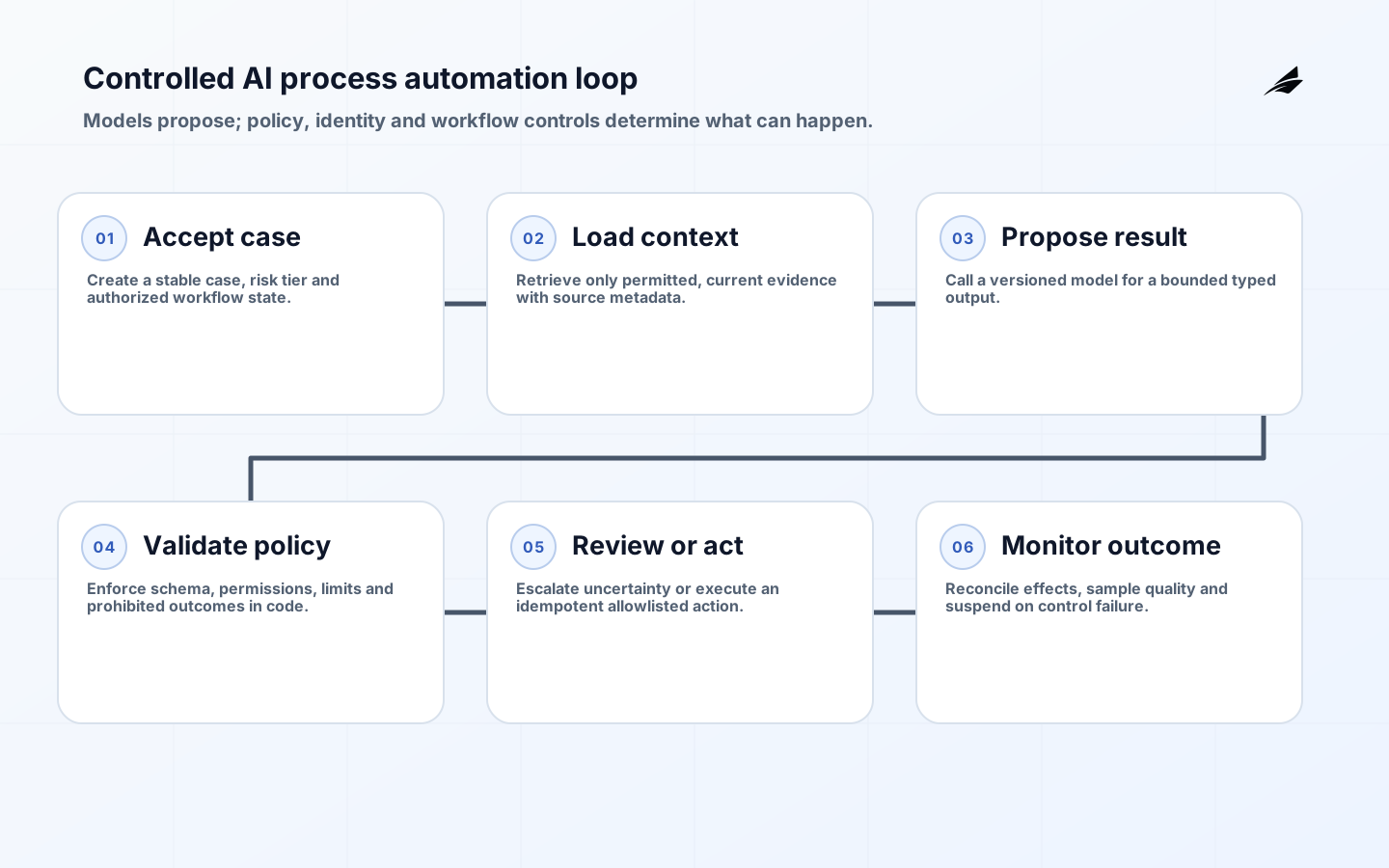
Place the model inside an ordinary workflow service rather than letting a chat interface become the system of record. The service loads the authorized case, retrieves permitted context, calls a versioned model configuration, validates the returned schema and applies policy in code. A separate tool adapter exposes only named operations with narrow parameters. Every write uses the current user or service identity, an idempotency key and a business rule that remains enforceable even if the model output is malicious or malformed.
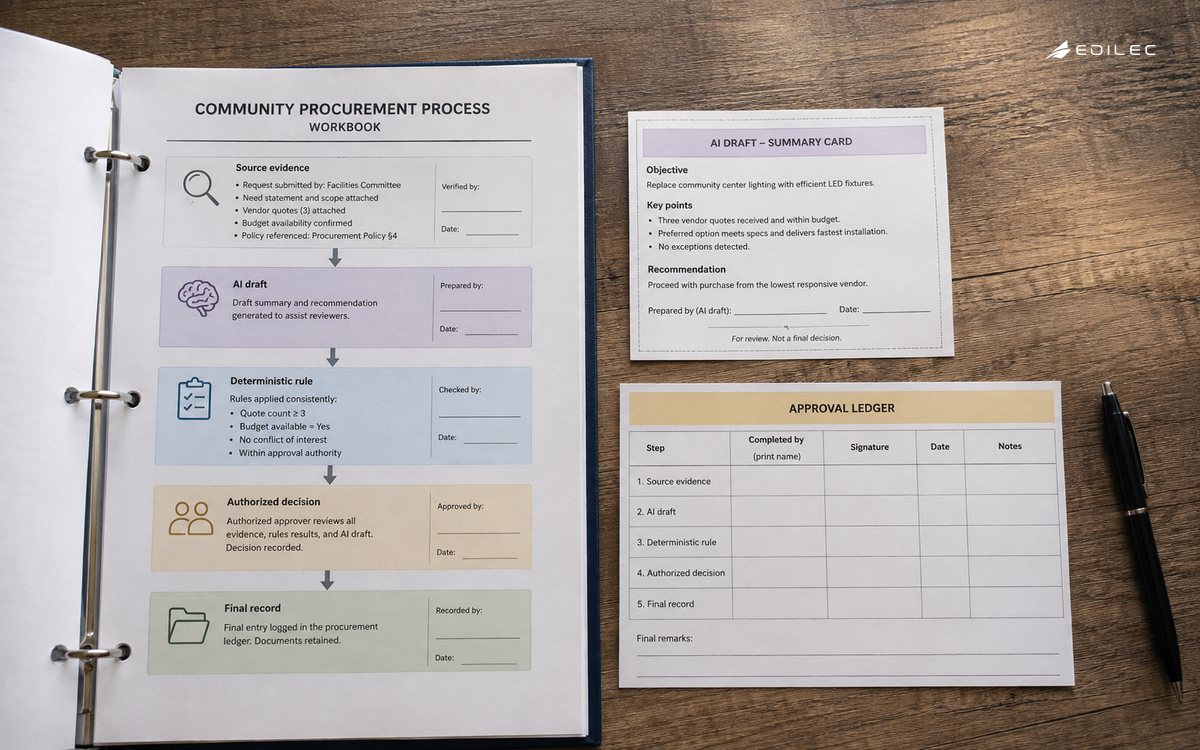
Treat retrieved text, attachments and tool responses as untrusted data. They may contain instructions that conflict with the application policy. Separate instructions from content, restrict destinations server-side and never let the model choose arbitrary URLs, database statements or recipient addresses. Store correlation identifiers, source references, model and prompt versions, validation outcomes and tool results. Do not log sensitive prompts by default; retain only what has an approved purpose and access policy.
When is human review necessary and how should it work?
Human review is required when uncertainty, impact, policy or law makes automated action inappropriate. Examples include adverse decisions, unusual refunds, employment matters, safety incidents, material financial changes and cases with conflicting evidence. Review must be effective: the reviewer needs the source material, the model proposal, relevant policy, time to inspect it and authority to reject or escalate. A decorative approval button after an opaque recommendation does not create meaningful oversight.
Route based on observable conditions such as missing evidence, out-of-scope requests, low agreement between checks, protected classes, unusually large amounts or novel tool calls. Avoid presenting a confidence number as if it were a calibrated probability unless calibration has been demonstrated for that exact setting. Capture reviewer changes and reasons without using disagreement as automatic evidence that the model should imitate the reviewer; policy disputes and reviewer error need separate investigation.
| Control point | Automated check | Human responsibility |
|---|---|---|
| Before inference | Access, source freshness and data minimization | Approve purpose and risk tier |
| After inference | Schema, citations, prohibited content and limits | Resolve ambiguity or high-impact cases |
| Before action | Current permission, state and idempotency | Authorize exceptions and irreversible effects |
| After action | Result reconciliation and alerting | Investigate incidents and approve remediation |
How should privacy, security and suppliers be handled?
Classify the data before selecting a service. Record what personal, confidential, regulated or customer-controlled information enters prompts, retrieval stores, logs and evaluations. Minimize fields, isolate tenants, encrypt transport and storage, use workload identities and rotate credentials. Contract terms should address data use, retention, model training, subprocessors, incident notice, region, deletion, audit evidence and service changes. Confirm obligations with qualified privacy or legal counsel for the relevant jurisdictions.
Apply secure software practices to the surrounding application: protected repositories, reviewed dependencies, secret scanning, threat modeling, authorization tests and a vulnerability response process. Test prompt injection, data exfiltration, cross-tenant retrieval, unsafe tool arguments, excessive output and denial-of-service paths. Supplier safety features do not replace application controls. Maintain a fallback that queues work or returns to the previous manual process when the model, retrieval service or integration is unavailable.
What should be measured after launch?
Measure the complete business outcome, not tokens consumed or demonstrations completed. Pair cycle time and operator effort with correctness, rework, customer impact and control performance. Track abstentions, escalations, overrides, unsupported claims, duplicate actions, access denials, integration failures and unresolved queue age. Segment by workflow path and risk class so an easy majority does not hide deterioration in rare cases. Compare against the baseline and a valid control period where seasonality matters.
Production monitoring should distinguish model drift, data changes, policy changes and workflow defects. Re-run the approved evaluation set when the model, prompt, retrieval corpus, tool contract or business rule changes. Sample live outcomes under an approved privacy process and provide a report channel for users and affected people. Define suspension thresholds before incidents occur. An operations owner must be able to disable a model-assisted path without disabling the underlying business service.
What evidence should approve wider deployment?
Prepare a release packet that identifies the use case owner, risk tier, model and prompt versions, data sources, evaluation population, results by material segment, open limitations, human-review design, security tests, rollback procedure and monitoring thresholds. The approver should be able to trace each claimed benefit to production evidence and each material risk to an owned control. Record the decision, conditions and expiry rather than treating a successful demonstration as indefinite authorization.
Key takeaways
- Start with one stable workflow and one bounded inference task.
- Keep authorization, limits and authoritative state transitions outside the model.
- Evaluate representative cases by risk-relevant segment before production action.
- Give human reviewers evidence, time, authority and a genuine escalation path.
- Measure business outcomes and control failures throughout the operating lifecycle.
Frequently asked questions
Do we need an AI agent for process automation?
Usually not for the first release. A deterministic workflow with one or two bounded model calls is easier to test, secure and operate. Add planning or multi-tool behavior only when the task genuinely requires it and each extra capability has an enforceable boundary.
Can the system learn automatically from reviewer corrections?
Reviewer changes are useful evaluation data, but they should be curated. A correction may reflect preference, a policy update or reviewer error. Validate provenance, consent and representativeness before using it for prompts, retrieval or model training.
How long should a pilot run?
Run it until the team has representative volume across normal and difficult cases, not for an arbitrary number of weeks. Predefine the evidence required for a decision, including quality, safety, operating effort, cost and recovery tests.
What is the safest failure mode?
Preserve the request, prevent duplicate side effects, explain that automation is unavailable, and route the case to a recoverable queue or manual process. Silent loss and repeated tool calls are not acceptable fallback behavior.
Conclusion
AI business process automation implementation is an operating-system change, not a prompt exercise. A dependable design bounds the model task, preserves deterministic authority, exposes evidence to reviewers and measures the whole workflow. When the team can stop automation safely, reconstruct every consequential action and prove that outcomes improved without shifting risk elsewhere, the use case is ready to scale.