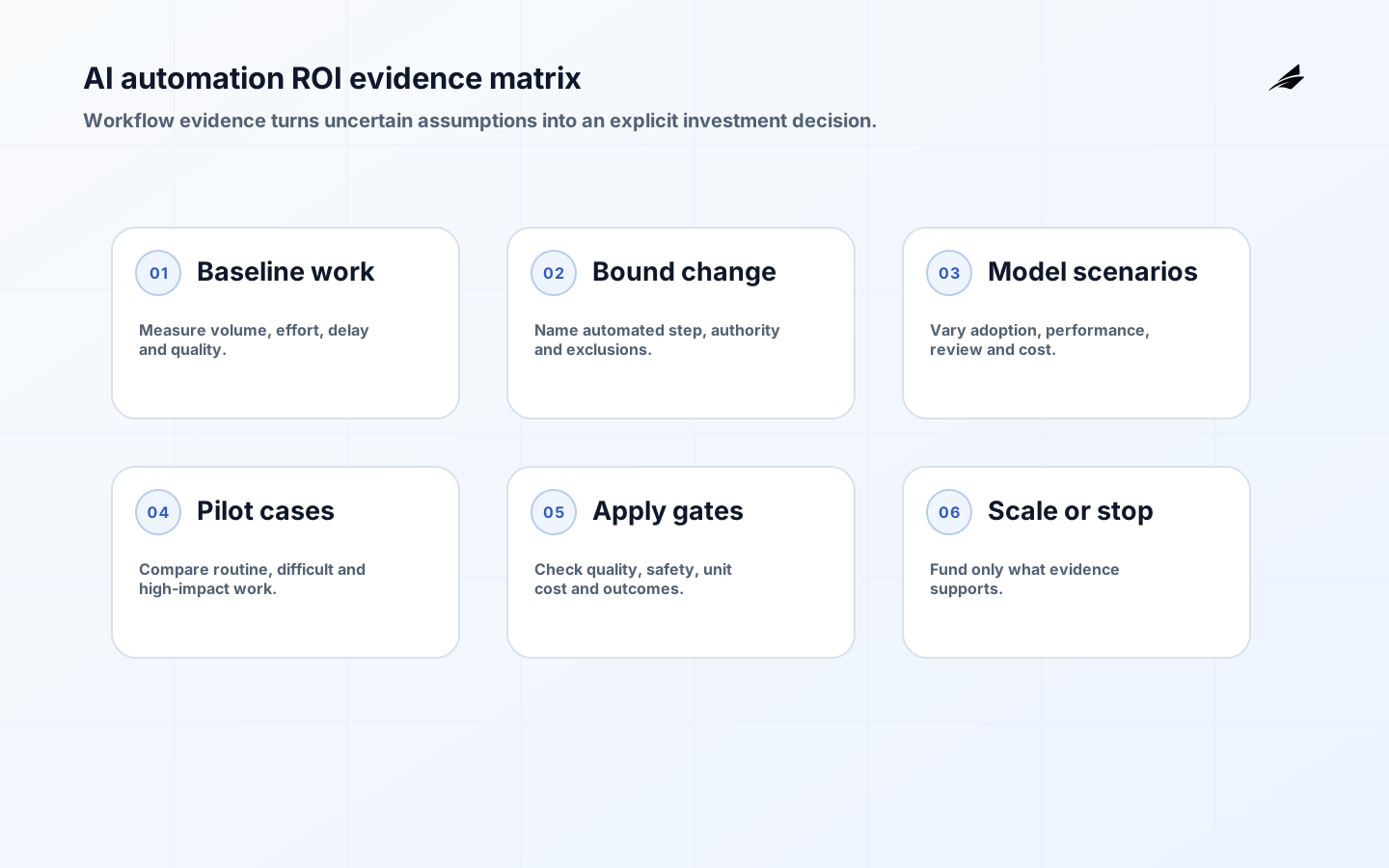
AI automation ROI planning FAQ is most useful when it helps a team improve a real operating decision rather than demonstrate a feature. Name the person affected, the incoming trigger, the source information, the decision, and the cost of being wrong. The apparent task is often several tasks: collecting facts, checking permission, applying policy, asking for missing evidence, and recording an accountable outcome. A careful plan makes those boundaries visible before a vendor, model, or integration choice narrows the options. It also keeps the eventual user close to the work instead of treating them as a final acceptance test.
Edilec’s AI automation ROI guide frames the investment, common ROI mistakes tests assumptions, and workflow escalation rules addresses hidden human work.
Establish the operating baseline
Should released time count as cash savings?
Only when capacity is removed, avoided, or productively redeployed. Report capacity, service, and cash effects separately.
When should a pilot stop?
Stop when quality or safety gates fail, exceptions overwhelm operations, data cannot be governed, economics remain poor, or the need disappears.
Measure the present workflow before assigning value to automation. Use several representative weeks to count eligible arrivals, seasonal peaks, waiting time, active handling time, transfers, corrections, reopened cases, abandoned work, and outcomes that matter to the recipient. Segment easy and complex cases rather than relying on an average. Observe operators handling exceptions and note every spreadsheet, message, policy check, and system lookup required to finish. Separate measured facts from forecast assumptions: historical volume can be verified, while future adoption and minutes saved remain hypotheses. Record current staffing, service commitments, error consequences, and cost allocation. This baseline is the denominator for the business case and prevents a pilot with a friendlier case mix from appearing more valuable than the operation it would replace.
| What to inspect | Evidence to collect | Decision it informs |
|---|---|---|
| Eligible demand | How many cases match the proposed boundary, by source, period, and complexity | Realistic adoption ceiling and representative pilot sampling |
| Current effort | Active minutes, waiting, transfers, lookups, rework, and exception handling | Where time could actually be released and which burden may move |
| Outcome quality | Accuracy, completeness, service delay, complaints, and consequence of error | Acceptance gates that prevent savings from hiding worse results |
| Economic baseline | Loaded labor, vendor, infrastructure, support, and existing change costs | Comparable unit cost and credible cash, capacity, or service benefit |
| Operational constraint | Data authority, permissions, policy judgment, deadlines, and fallback capacity | Feasibility, risk cost, and the human work that remains |
Set a bounded first scope
Choose a unit of work that is frequent enough to evaluate and narrow enough to price. Define its entry criteria, eligible cohort, source record, permitted AI contribution, output destination, reviewer, and conventional completion path. Classification or evidence retrieval is often a better first boundary than autonomous approval because the team can compare results without granting irreversible authority. Exclude cases whose data, policy, or consequence differs materially and count those exclusions in the economics. The AI automation ROI guide for IT managers covers adjacent implementation choices. For the business case, ensure every handoff states why a person is needed, what evidence they receive, and how their time enters unit cost.
- Write an eligibility rule that operators and finance can apply to both baseline and pilot populations.
- Limit the initial AI step to a named draft, retrieval, classification, or routing outcome with a responsible reviewer.
- Carry case identity and cited source evidence into review so corrections and downstream effects can be reconciled.
- Define exclusions, missing-data treatment, policy triggers, and the owner of every non-standard case.
- Sample across normal volume, peak periods, complexity bands, channels, and affected user groups.
- Keep the existing completion route available and estimate the capacity it needs during pause or exit.
Design controls into the workflow
Include the cost and behavior of controls in the proposed service, not as a later compliance adjustment. Identity and purpose checks determine which cases and sources the assistant may see. Evidence requirements shape review time. Policy thresholds and consequence determine whether work can be sampled, must be approved, or must bypass AI entirely. The NIST AI Risk Management Framework supplies a useful structure for governing, mapping, measuring, and managing these risks. Apply stricter authority and recovery where an output can affect money, employment, safety, access, or legal standing. Test the controls at peak demand and count their operating effort; an economically attractive forecast that assumes reviewers will skip necessary safeguards is not a credible plan.
| Control | Practical implementation | What to review |
|---|---|---|
| Case and source authorization | Verify requester, task purpose, and permitted records before processing | Denied requests, excess retrieval, permission drift, and investigation effort |
| Reviewable evidence | Present source references, proposed output, uncertainty, and policy trigger together | Reviewer time, corrections, unresolved evidence, and audit retrieval cost |
| Exception capacity | Send ambiguous, conflicting, or consequential work to an empowered queue | Referral share, wait time, specialist workload, abandonment, and recurring causes |
| Release assurance | Version models, prompts, rules, data connectors, and evaluation sets | Regression effort, approval time, changed outcomes, and maintenance cadence |
| Service continuity | Support selective pause, correction, reconciliation, and manual completion | Fallback staffing, backlog clearance, restoration test, and downstream repair |
Run a pilot that tests the claim
Design the pilot as a test of the investment thesis. Draw cases from the same eligibility rule and complexity distribution used in the baseline, retain a comparable manual path, and set quality, safety, service, review-load, and cost gates before seeing outcomes. Track attempted and completed eligible work, correction severity, false routing, exception age, total handling time, reviewer minutes, source and tool expense, user behavior, and downstream defects. Inspect individual records from every important segment, especially rare high-consequence cases that averages dilute. Log model, prompt, source, rule, and process changes during the period. The result should show whether the service produces durable net value under ordinary operational pressure, not whether a curated demonstration can succeed.
- Stratify the sample by volume driver, complexity, consequence, channel, and missing or conflicting information.
- Record operator acceptance, edit, rejection, and referral reasons rather than counting human touch as one undifferentiated step.
- Price review, specialist escalation, user support, quality sampling, governance, and correction into every completed unit.
- Test access denial, source outage, duplicate submission, stale evidence, integration timeout, and changed policy.
- Pause the AI route, complete queued work manually, reconcile downstream records, and measure recovery effort.
- Have operations, finance, risk, and technology owners decide against predefined scale, redesign, hold, or exit gates.
Price the full service
Construct total cost in categories finance can trace. One-time investment includes discovery, process redesign, data and policy preparation, integrations, security and privacy review, evaluation, rollout, training, and change management. Recurring cost includes model and infrastructure use, software licenses, human review, specialist exceptions, monitoring, support, quality sampling, incident response, source maintenance, reevaluation, and vendor management. Allocate shared platform cost consistently and model volume sensitivity. Describe benefits separately as avoidable cash, redeployable capacity, faster service, lower error consequence, or additional demand served. Capacity becomes economic value only when the organization has a realistic plan to remove, avoid, or use it. Show low, expected, and high scenarios with explicit assumptions rather than disguising uncertainty in one precise ROI percentage.
Operate, learn, and change deliberately
Reforecast value from production evidence on a fixed cadence. Compare eligible demand, actual adoption, automation completion, review share, corrections, service time, exception backlog, affected-user outcomes, unit cost, and benefit realization with the approved scenario. Explain changes in mix, policy, source systems, staffing, or reporting before attributing movement to AI. Sample cases even when aggregate quality is stable, and check whether work has migrated into support or specialist queues. Use recurring causes to improve source data, process design, instructions, or training, then evaluate the change. The NIST Cybersecurity Framework complements this economic review by keeping governance, protection, detection, response, and recovery responsibilities visible as the service and its risks evolve.
Build the business case from one queue
Example: invoice exception triage

A team receives 8,000 invoice exceptions monthly. Sample by type, supplier, complexity, handling time, rework, escalation, and consequence. The first use may classify an exception and retrieve a purchase order, not approve payment. Estimate eligible volume, adoption, time change, review, error correction, integration, model use, evaluation, security, support, and change costs. Keep low, expected, and high scenarios rather than forcing one precise forecast.
Compare equivalent pilot cases with the baseline. Track correct routing, handling time, reviewer corrections, aged items, duplicate work, unsupported suggestions, and downstream errors. Segment results because easy cases can flatter the average. Set expansion gates before testing: minimum quality, no rise in material error, bounded review time, and acceptable unit cost. Include shutdown and exit costs. If the gate fails, improve source data, redesign the process, or stop.
Key takeaways
- Baseline eligible volume, total effort, outcome quality, delay, variation, and current cost before forecasting benefit.
- Separate avoidable cash, usable capacity, faster service, avoided harm, and growth value instead of combining them.
- Choose a narrow AI contribution with explicit exclusions, evidence, review ownership, and manual continuity.
- Pilot against predefined quality, safety, service, exception-load, and unit-cost gates using representative cases.
- Include data, integration, governance, human review, support, reevaluation, recovery, and exit in lifetime cost.
- Reforecast from live cohorts and stop, redesign, or scale according to measured net value rather than sunk effort.
Frequently asked questions
What is the smallest sensible starting point?
The smallest credible scope is one eligibility rule applied to one recurring case family, with a maintained source record, observable output, authorized reviewer, and conventional fallback. It must occur often enough to expose variation but remain recoverable when the assistant is wrong. A team might classify one invoice-exception type into an existing queue or retrieve evidence for one policy check while leaving approval unchanged. Measure the full path, including exclusions and referrals. That design generates economic and operational evidence without forcing the business case to assume every neighboring task behaves the same way.
How should success be measured?
Match measures to the stated benefit. A capacity claim needs eligible units, active minutes released, review and rework, and evidence that the capacity was avoided or productively reassigned. A speed claim needs comparable end-to-end elapsed time and service outcomes. A quality claim needs error severity, corrections, complaints, and downstream consequence. Always include adoption, exclusions, exception age, unit operating cost, and cohort mix. Review sampled records with operators and affected users, assign interpretation to an owner, and predefine variance that triggers investigation or a refreshed forecast.
When should a team stop or redesign the work?
Pause or redesign when a material safety or access gate fails, representative quality remains below acceptance, referrals exceed available specialist capacity, the process cannot retain adequate evidence, or total unit cost no longer supports a realistic benefit scenario. Stop when the underlying need has changed or remediation would cost more than credible value. An exit decision protects capital; it is not a failed pilot. Preserve the baseline, cohort definition, observed failure modes, cost data, operator feedback, and recovery result so future work begins from evidence rather than repeating optimistic assumptions.
Conclusion
A defensible AI automation ROI case is modest about prediction and rigorous about evidence. Measure the current queue, bound automation, include the full operating model, express uncertainty as scenarios, and let representative pilot results control scale.