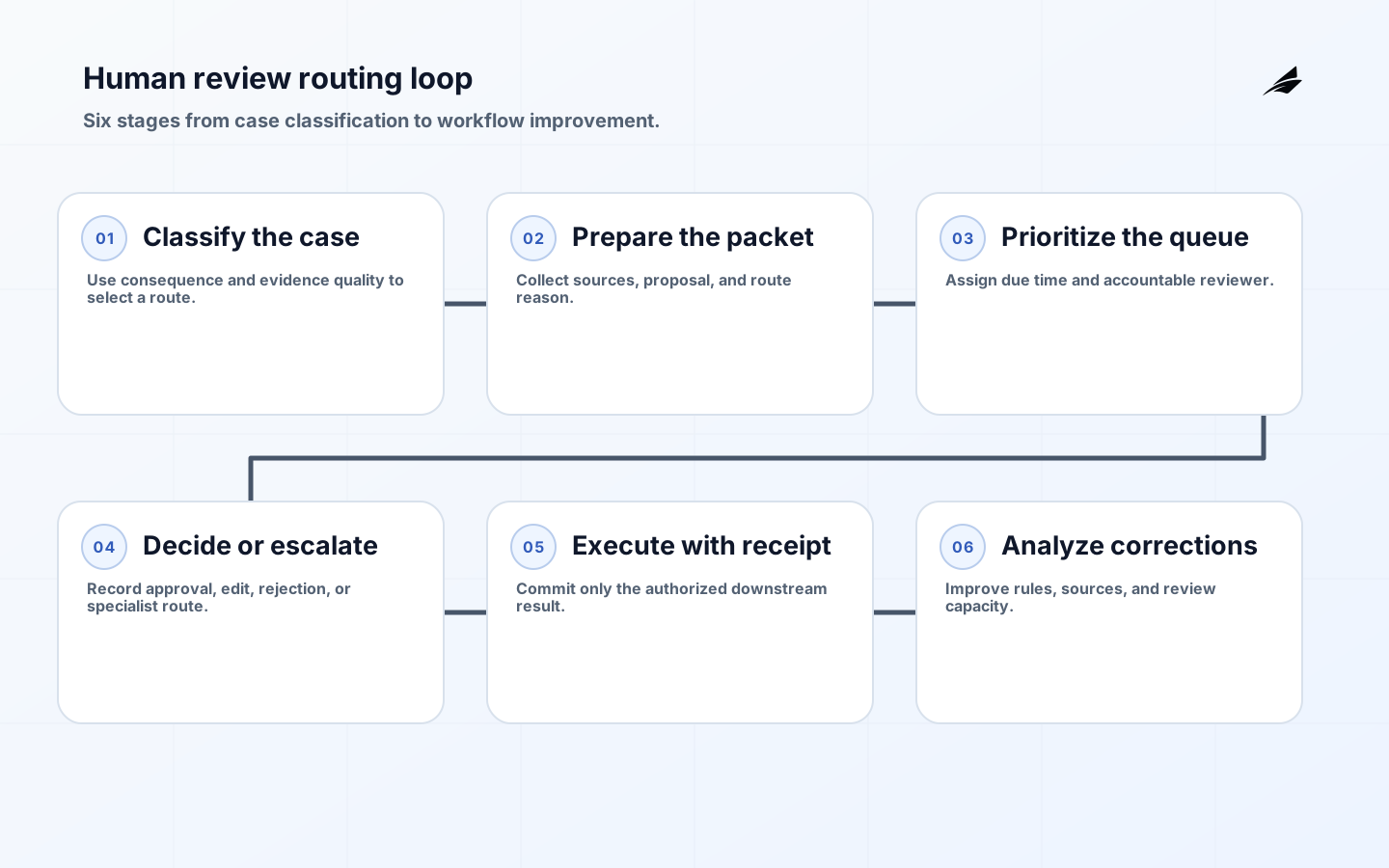
Human-in-the-loop automation is not achieved by placing an approve button beneath a model response. It is a work system in which automation prepares or routes a case, a person has enough evidence and authority to make the material decision, and the outcome improves the next version of the service. IT managers should decide first which cases require judgment, why they require it, and what a reviewer needs to complete the task without recreating all of the automation manually. The difficult design problem is capacity. If every uncertain case lands in an unprioritized queue, an apparent safety measure becomes a delay mechanism and users will seek workarounds. Review must be selective, accountable, and observable.
Separate advice, approval, and execution
Map the workflow into distinct steps: collecting inputs, generating a proposal, verifying evidence, deciding, executing, and recording the result. The same person need not own every step, but the handoff and authority at each one must be explicit. A system may draft a reimbursement explanation, for example, while a designated employee decides whether the evidence satisfies policy and a separate system commits the approved payment. Define when the system should proceed without review, when it must request a decision, and when it must stop. Use consequence, uncertainty, data quality, and policy sensitivity as routing signals. Avoid pretending that a single confidence score carries all of that context.
| Case characteristic | Recommended route | Reviewer needs |
|---|---|---|
| Low consequence and deterministic rule | Automate with periodic sampling. | Trace, rule version, and exception count. |
| Incomplete or conflicting evidence | Hold for review. | Source records, missing-data reason, and due time. |
| Material customer or financial effect | Require explicit approval. | Recommendation, policy basis, and action preview. |
| Potential security or safety impact | Escalate to specialist path. | Full context, containment option, and incident owner. |

Design the review experience as real work
A reviewer should see the case objective, the relevant source facts, the automation's proposal, the uncertainty or policy rule that triggered review, and the available decisions. Present source links and timestamps rather than an unexplained summary. Provide a short reason for each route so reviewers can spot systematic misclassification. Give them authority to approve, edit, reject, defer, or escalate, and record which option was used. Queue design matters too: prioritize by deadline and consequence, prevent a few difficult cases from blocking straightforward ones, and define coverage for absences. The review surface is a product interface; measure whether it helps people make sound decisions efficiently, not merely whether it receives clicks.
Plan review capacity before expansion
Estimate arrivals by case type, the expected review time, the available reviewers, and the service target for each queue. Then test the design against peak demand, staff absence, a downstream dependency failure, and a model change that increases escalation volume. A pilot with low traffic can conceal a system that becomes unsafe or unusable at normal load. Use sampling for stable, low-consequence automation, but make the sample design explicit: which outcomes, users, and source conditions are represented? Review correction patterns to identify whether the problem is poor retrieval, an ambiguous policy, missing input, or a misleading interface. AI guardrails should reduce inappropriate routing rather than impose an opaque barrier.
| Measure | Why it matters | Interpret with |
|---|---|---|
| Queue age by priority | Shows whether a decision is waiting too long. | Case consequence and staffing changes. |
| Reviewer edit rate | Reveals proposal quality and interface fit. | Reason codes, not only percentage. |
| Escalation rate | Shows policy ambiguity or uncertainty. | Source quality and workflow slice. |
| Reversal after execution | Finds decisions that need stronger controls. | Impact, root cause, and recovery time. |
Preserve auditability without surveillance excess
Keep a case record that joins the input references, model and configuration version, retrieved evidence, proposed result, reviewer decision, any downstream action, and later correction. Retain the minimum information needed for accountability and service improvement; do not turn monitoring into indiscriminate collection of employee behavior. Access to sensitive cases should follow the same role and purpose restrictions as the underlying systems. When an incident occurs, the team should be able to identify affected cases, pause the route, and use the retained trace to determine whether a correction, notification, or rollback is necessary. That trace also makes evaluations more realistic because it preserves examples of accepted, edited, rejected, and escalated work.
Turn decisions into durable improvements
Classify reviewer changes in a way that engineers and process owners can act on: wrong source, stale record, missing context, policy interpretation, output format, incorrect route, or user correction. Prioritize fixes that remove repeated reviewer effort without broadening authority. Re-run changed behavior against retained cases before release, including cases where the old behavior was appropriately cautious. This is where RAG systems and workflow design meet: better evidence may eliminate a review, while a high-impact decision may always deserve one. Do not use approval rate as a target; an unusually high rate can signal rubber-stamping as readily as quality.
Implementation checks
| Operating check | Concrete practice | Why it matters |
|---|---|---|
| Case taxonomy | Define low-impact, review-required, and specialist-escalation case classes. | Routing can be tested against a stable business rule. |
| Reviewer packet | Show objective, source facts, proposal, route reason, and available decisions. | A reviewer avoids reconstructing the case from other systems. |
| Queue policy | Set priority, service target, reassignment, and coverage rules. | Urgent cases do not wait behind routine work. |
| Decision record | Capture who decided, what evidence they used, and what changed. | Later corrections have an accountable trace. |
| Capacity forecast | Model normal volume, peak volume, staffing absence, and error spikes. | Expansion does not overwhelm the review path. |
| Sampling plan | Specify which automated cases are sampled and how findings are classified. | Low-risk automation remains observable without blanket review. |
| Correction analysis | Separate source, policy, interface, and model defects. | The team removes recurring work at the right layer. |
| Recovery drill | Practice stopping a route and reconciling in-flight decisions. | Oversight remains useful during a real service failure. |
Review quality depends on the organization around the screen. Train reviewers on the decision rule, the evidence hierarchy, and the exact point at which escalation is expected. Calibrate regularly by having qualified reviewers independently assess a small set of representative cases, then discussing disagreements in the rule or evidence rather than treating one person as inherently correct. This reveals policies that sound clear in a document but fail under real variation. It also gives managers a defensible way to distinguish normal professional judgment from a systematic automation defect.
Avoid measuring people only by queue speed. A reviewer who resolves cases quickly by accepting every proposal can make a dashboard look healthy while weakening the control. Balance timeliness with evidence completeness, correction quality, escalations that prevented harm, and feedback from the downstream owner. Use the findings to adjust staffing and workflow thresholds, not to create a hidden performance score. The point of a human loop is to bring accountable context into a decision; capacity measures should protect that role rather than erode it.
The handoff from automation to a reviewer should preserve time as well as content. Show when each source was retrieved, when the proposal was made, and whether the underlying record changed while the case waited. If a decision depends on a time-sensitive value, re-check it before execution rather than assuming the review packet remains current. This protects reviewers from approving a technically correct but already obsolete recommendation. It also creates a useful operational signal: frequent stale handoffs may indicate an overloaded queue, a poor routing threshold, or a workflow that needs a shorter approval path.
Key takeaways
- Route cases using consequence, evidence quality, policy sensitivity, and uncertainty together.
- Give reviewers the source facts, reason for review, authority, and recovery options.
- Size queues for peak demand and changed model behavior, not a quiet pilot.
- Record decisions and corrections in a case trace that supports investigation.
- Use reviewer edits to improve sources, rules, interfaces, and evaluation sets.
- Keep material execution separate from a model’s unreviewed proposal.
Frequently asked questions
Does every AI output need a reviewer? No. Review should be proportional to consequence and the reliability of a bounded task; low-impact, deterministic paths may be sampled. Can confidence determine routing? It can be one signal, but it does not substitute for policy, data quality, or impact. Who owns a correction? The process owner owns the business decision, while technical and data owners should own the defect paths that caused an incorrect proposal or route.
Set service levels for human review
Human review needs a service model, not an unlimited queue. Define the arrival rate, peak pattern, consequence classes, reviewer skills, target decision time, abandonment rule, and fallback when capacity is exhausted. A system that routes every uncertain case to the same group can create an invisible outage while the model appears healthy. Separate urgent safety or financial cases from routine quality sampling, and let the interface explain why each item was routed. NIST AI RMF calls for clearly differentiated human roles and oversight procedures; operationally, that means the reviewer must have both authority and enough context to act. Measure not only queue age but also overturn rate, requests for more evidence, repeat corrections, and cases completed outside the approved path.
| Review measure | What it reveals | Possible response |
|---|---|---|
| Queue age by consequence | Whether capacity matches risk | Reserve skilled capacity or narrow automation |
| Overturn rate | How often proposals fail human judgment | Improve source, model, rule, or scope |
| Evidence-request rate | Whether reviewers receive usable context | Change the case packet and provenance |
| Reviewer disagreement | Whether policy or rubric is ambiguous | Calibrate examples and assign policy owner |
| Bypass and abandonment | Where people route around oversight | Repair latency, authority, or recovery |
Human review is one control within a larger AI operating design. The AI guardrails guide helps determine which constraints belong in software, the RAG systems guide covers evidence presented to reviewers, and the production approval guide addresses authority, queue behavior, and traceability after rollout.
Conclusion
Human-in-the-loop automation is useful when the human role has real authority, practical evidence, and sustainable capacity. Design routing and review as a service, record the result, and improve the upstream causes of repeated edits. That makes oversight an operational capability instead of a ceremonial click.