QA automation for SaaS consulting should create faster, safer release decisions, not a larger pile of scripts. The useful scope begins with the customer journeys and business rules whose failure would cause loss, confusion, security exposure or support work. It then assigns the right test level, data, environment and owner to each risk. DORA’s continuous delivery guidance describes reliable automated tests, continuous testing and comprehensive observability as capabilities that support low-risk delivery. A consulting engagement should leave those capabilities inside the client team: tests developers can diagnose, release evidence product owners can understand and a maintenance model that survives the first redesign.
Scope quality outcomes before tools
Map the SaaS service from sign-up through the valuable customer outcome, including billing, permissions, integrations, notifications, support and cancellation. For each path, state the risk, expected behavior, authoritative data and observable result. Separate release-blocking checks from exploratory testing and monitoring. A checkout test that merely finds a button is weaker than one that proves the user received the right entitlement and the financial record was created once. Playwright recommends testing user-visible behavior and keeping tests isolated; both principles reduce coupling to implementation details. The QA implementation checklist can turn this map into delivery tasks.

| Risk area | Automated evidence | Human or operational check |
|---|---|---|
| Authentication | Session, recovery and role-boundary scenarios | Abuse review and support recovery |
| Core workflow | Outcome and state-transition assertions | Exploratory review of unfamiliar paths |
| Billing | Idempotency, totals and entitlement reconciliation | Finance exception sampling |
| Accessibility | Automated rules plus keyboard smoke paths | Screen-reader and cognitive usability review |
| Integrations | Contract tests, retries and duplicate handling | Partner sandbox and outage exercise |
Design a layered testing portfolio
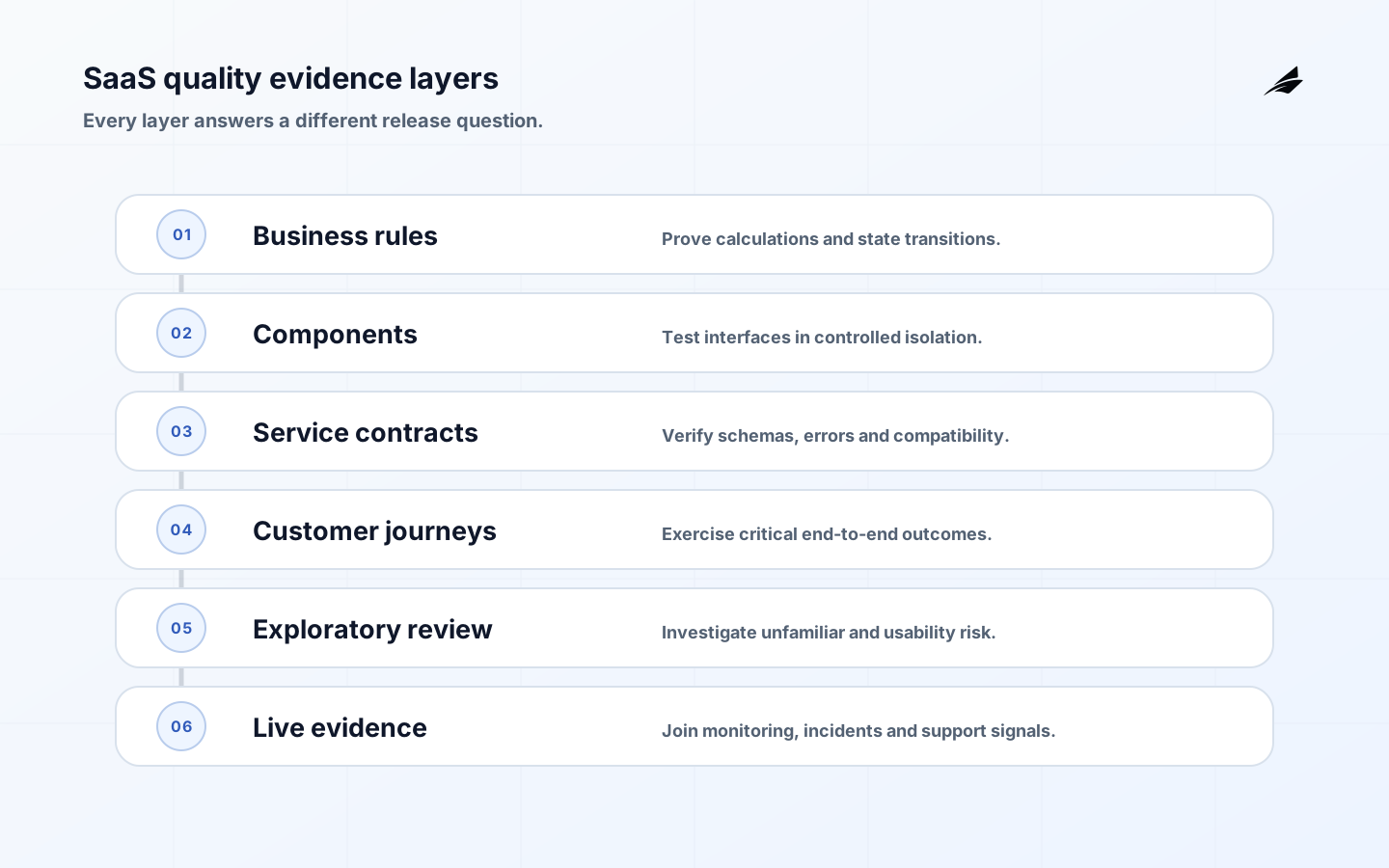
Use fast unit and component tests for business rules, contract tests for service boundaries and a small set of end-to-end tests for critical journeys. End-to-end suites are expensive when they reproduce every field combination through the browser. Place each assertion at the lowest level that can prove the behavior, then keep browser tests for integration and user experience. Playwright’s auto-retrying assertions wait for observable states and are more robust than arbitrary sleeps. Include API checks for setup and verification, but do not let them replace visible user outcomes. The goal is a portfolio that gives a useful signal within minutes and a broader regression result within the release window.
Control test data and environments
Flaky automation often exposes unmanaged data or environment dependencies. Create deterministic tenants, users, plans and feature states; allocate unique records per parallel worker; and clean up through supported APIs. Never copy production personal data into a test system without an approved transformation and purpose. Virtualize third-party failures that cannot be controlled, while retaining a smaller set of scheduled tests against real sandboxes. Document environment differences such as identity provider, queue, region, payment mode and feature flag. If a test passes only after rerunning, treat it as a defect in the test or system, not a successful release signal.
| Cost line | Planning question | Control metric |
|---|---|---|
| Initial design | Which journeys and risks need automation first? | Coverage of release-critical outcomes |
| Framework | What fixtures, reporting and parallelism are reusable? | Time to add a stable scenario |
| Execution | Which browsers, devices and environments are required? | Duration and infrastructure cost per run |
| Maintenance | Who fixes tests after product change? | Failure triage time and flaky-test rate |
| Operations | How will synthetic checks and incidents feed the suite? | Escaped defect converted into prevention evidence |
Make security and accessibility part of acceptance
Security checks belong in normal delivery. The NIST Secure Software Development Framework recommends integrating secure practices across the development lifecycle instead of leaving them to a final review. Automate authorization boundaries, unsafe input handling, dependency checks and security headers where they produce reliable evidence. Accessibility also needs a mixed method: automated engines find only some failures, while keyboard navigation, focus behavior, error recovery and assistive-technology use require human judgment. Use WCAG 2.2 as the shared requirement set and record which success criteria each scenario supports.
Run the engagement as a transfer of capability
Deliver in thin slices. In discovery, agree risk priorities, release process and current failure data. In foundation, create repository conventions, fixtures, CI execution and reporting. In the first workflow slice, automate one revenue or trust-critical journey across supported environments. Pair client engineers on every test review and make failure triage part of normal stand-up work. Expand only after the first slice remains stable across product changes. The SaaS QA delivery plan is useful when estimating roles, dependencies and rollout gates.
- Define an owner for every release-blocking suite.
- Quarantine only with a defect, deadline and accountable resolver.
- Capture trace, screenshot, network and application context on failure.
- Review duplicated and low-value tests each quarter.
- Use the normal deployment path for emergency fixes so recovery is practiced.
Measure the quality system, not test volume
Test count is easy to inflate and hard to interpret. Track signal time, failure reproducibility, escaped defects by risk, change failure rate, time to restore, maintenance effort and the percentage of critical journeys with current evidence. Review whether a failing test prevented customer impact or simply delayed a release for an obsolete assertion. Combine automation data with incidents, support contacts and product analytics. The CI/CD guide for SaaS teams shows how these signals fit into a wider release system. A mature suite gets smaller when redundant checks no longer justify their cost.
Modernize an existing test estate deliberately
Most consulting work starts with tests that already exist. Inventory them by customer risk, level, duration, ownership, last useful failure and maintenance burden. Preserve stable checks that prove current behavior; rewrite tests coupled to CSS or sequencing; retire duplicated cases; and move rule assertions below the browser where possible. Do not pause all releases for a framework rewrite. Build the new conventions around one critical journey, run both paths for a short comparison and migrate by product area. Keep historical failure data so the team can tell whether reliability actually improves. A successful modernization reduces triage time and escaped risk even if the raw test count falls.
Cover performance, resilience and privacy behavior
Functional correctness is only one SaaS quality dimension. Establish load profiles from realistic tenant and data shapes, then test latency, concurrency, queue growth and graceful degradation. Exercise expired credentials, provider throttling, delayed events and partial outages. Verify that retries do not duplicate billing or messages. Add privacy checks for data export, deletion, retention and log minimization, and confirm that one tenant’s high demand cannot expose or starve another. These scenarios may run less often than the pull-request suite, but their owners and release cadence should be explicit. Tie results to capacity and recovery decisions rather than publishing a performance chart with no threshold.
Plan the consulting exit from day one
The client should own repositories, credentials, environments, dashboards and decision records throughout the engagement. Pair on framework choices, test reviews and failure triage instead of delivering a black-box suite at the end. Document local setup, CI behavior, fixtures, test-data lifecycle, quarantined cases and the route for adding coverage. Agree who maintains shared libraries and how product teams request changes. In the final acceptance, have client engineers diagnose a deliberately failing scenario, add a new test and run the release evidence without consultant access. Reserve follow-up time for observed gaps, but make independent operation the completion criterion.
Create a release evidence package
For each material release, assemble the commit and artifact, environment, test suite versions, critical results, known failures, accessibility and security checks, approval and deployment outcome. Keep the package generated from pipeline data where possible so it does not become paperwork. A concise report should answer what changed, which risks were tested, what was not tested, who accepted residual risk and how the team will recognize trouble in production. Link failure details rather than pasting large logs. This record helps incident responders compare the release decision with actual behavior and helps consultants demonstrate that the client now owns a repeatable quality process.
Define severity and release rules with product and operations before the suite starts failing. A cosmetic defect, a lost financial record and a cross-tenant disclosure should not enter the same count. State which results block automatically, which require named review and which are advisory. Allow exceptions only with reason, scope, mitigation and expiry. Review rules after escaped defects and false blocks. When the team can explain why a release proceeded despite a known failure, governance becomes practical; when every red result is treated equally, automation creates delay and encourages people to ignore the pipeline.
Key takeaways
- Start with customer and business risk, then select the test level.
- Keep end-to-end coverage small, meaningful and isolated.
- Treat test data, environments and observability as first-class design work.
- Integrate security and accessibility evidence into normal delivery.
- Measure useful signal and escaped risk rather than raw test count.
Frequently asked questions
What percentage of tests should be automated?
There is no useful universal percentage. Automate repeatable checks whose result changes a release or operating decision. Preserve exploratory, usability and risk work where human observation provides more value than a brittle script.
Should a flaky test block a release?
An unexplained flaky result is not trustworthy evidence. Either fix the cause quickly, remove it from the blocking path with a dated defect and owner, or replace it with a more deterministic check. Silent retries should not turn uncertainty into green status.
What drives consulting cost most?
The largest drivers are usually application testability, data setup, environment stability, supported browser and tenant combinations, integration dependencies and the client team’s maintenance capacity. A focused risk portfolio often costs less over time than broad UI coverage.
Conclusion
Professional QA automation for SaaS gives teams a dependable answer to “is this release safe enough?” A risk-led portfolio, controlled data and durable ownership produce that answer faster than a large suite built around screens alone.