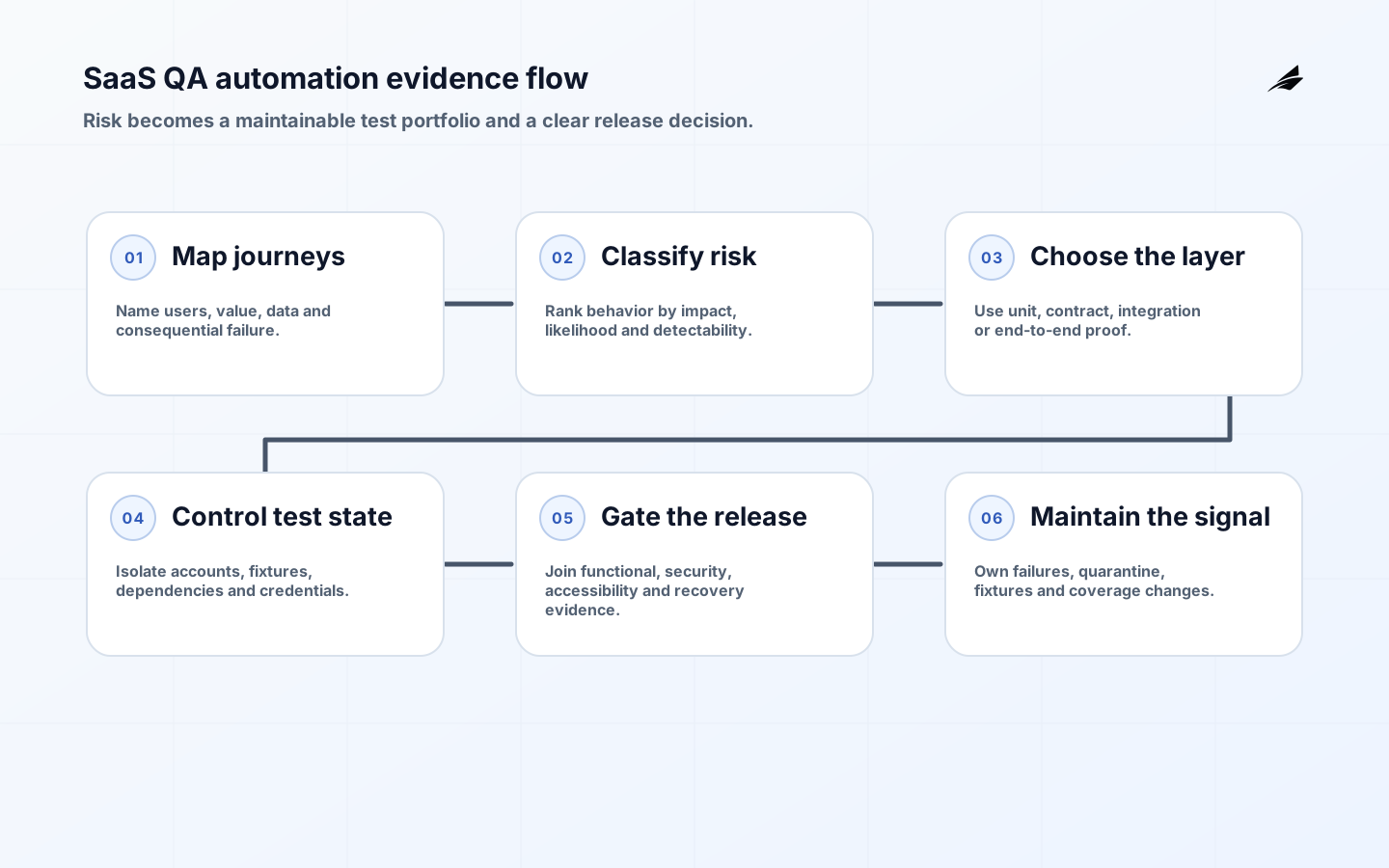
QA automation for SaaS consulting should give a client faster, more credible information about release risk. It should not merely produce a large suite that passes in a demonstration and becomes expensive to maintain. A useful engagement begins with customer journeys, failure consequences, production architecture, and the decisions a team must make before release. The implementation checklist in this guide helps consultants establish that evidence while leaving the client with understandable tests, stable ownership, and a practical maintenance model.
Use this checklist alongside Edilec’s custom-software test strategy, deployment rollback guide, and application monitoring guide. Automation is most useful when test evidence, release recovery, and production signals describe the same customer path.
Define the outcome before selecting tooling
Begin with one decision or task that a real person already performs. Describe the starting signal, the information that is allowed to influence the result, the accountable role, the action or response, and the evidence that proves completion. For QA automation for SaaS consulting implementation checklist, this gives every technical choice a business test: does it make a shared, testable definition of a useful engagement before work begins more reliable, faster, or easier to review? The NIST AI Risk Management Framework is a useful discipline here because it frames risk management as an ongoing activity, not a one-time compliance review. Write down unacceptable outcomes as clearly as desired outcomes, including an incorrect result, an unavailable service, an unauthorized disclosure, and an unresolvable dispute.
| Question | Working answer | Evidence to request |
|---|---|---|
| What is in scope? | One consulting test program path with a named user, decision, and owner. | A current journey map and a plain-language success condition. |
| What may change? | Only the records, routes, or release decision explicitly approved for the first use case. | A boundary statement and a list of excluded actions. |
| Who can intervene? | A business owner, a technical owner, and a support route with escalation authority. | Named roles, response expectations, and access review. |
| How is value judged? | By the quality and timeliness of the resulting work, not by activity volume. | A baseline and a scheduled review of outcome measures. |
Map the operating model and its boundaries
A sound design starts with the information lifecycle. Identify the source of each important field, the person or system allowed to change it, the rule for freshness, and the conditions under which it should not be used. Keep the presentation layer separate from the authoritative record; otherwise a convenient display can quietly become a decision source. For readiness, handover, and evidence of progress, this distinction is practical. It lets a reviewer trace a result back to a record, an event, or a test run instead of relying on a summary that may already be stale. It also surfaces the unglamorous requirements that determine whether a pilot can become a service: identity, permissions, environment ownership, retention, and incident handling.
For a consulting checklist, turn readiness questions into artifacts a delivery team can inspect. A list of test cases is not enough: request access constraints, an environment map, a data-reset method, release cadence, monitoring contacts, and examples of known customer-impacting defects. Then choose one journey where the team can state the expected behavior, the unacceptable behavior, and the evidence a release owner will read. The NIST Secure Software Development Framework reinforces the value of explicit verification practices. The checklist should also identify what the consultant will not own, such as product acceptance, production access approval, or permanent incident response, so the service does not hide an accountability gap.
Design controls that help people make decisions
Controls should make the intended workflow easier, not merely add a separate audit ritual. Apply least privilege to the people and services involved; use a stable identifier for each request, run, answer, or decision; and record material inputs, policy version, result, and intervention. Match the review threshold to consequence. A low-impact consulting test program may proceed after routine checks, while an ambiguous or high-impact case should pause for a qualified human. Do not disguise uncertainty as confidence. A useful interface says what it knows, what source or test supports it, and what the user should do next when it cannot proceed safely.
| Risk or failure | Control to include | Signal to review |
|---|---|---|
| Input is incomplete, stale, or contradictory | Validate essential fields, preserve source time, and send unresolved cases to an exception queue. | Exception reason, age, and resolution outcome. |
| A permission or policy changes | Evaluate access at the action boundary and version the governing rule. | Denied action, policy version, and override history. |
| A dependency becomes unreliable | Use timeouts, bounded retries, and a manual continuation path. | Failure rate, retry age, and user impact. |
| A result is challenged | Keep a traceable record of inputs, result, reviewer action, and correction. | Challenge volume, reversal cause, and recurrence. |
Pilot a real path and rehearse the difficult cases
Choose a pilot that is narrow enough to understand end to end but meaningful enough that a user will notice the difference. The first release should exercise the same identities, data handling, integrations, and approval or release practices expected in production. Avoid treating a sandbox success as proof of service readiness. Before widening access, run deliberate scenarios: a bad input, a changed rule, a revoked account, a delayed dependency, and a disagreement about the result. Capture the evidence a support colleague would actually need. In QA automation for SaaS consulting implementation checklist, the rehearsal is where the team discovers whether the operating model can survive an ordinary inconvenient Tuesday.
- State the pilot population, consulting test program boundary, and exit criteria in language a business owner can challenge.
- Run an expected path, a rejected path, a delayed dependency path, and a recovery path with the production-like controls enabled.
- Give every finding an owner, a due date, and a decision: correct now, accept temporarily, or exclude from the first release.
- Use the related planning guide and the companion checklist to keep planning, readiness, and delivery decisions aligned.
Measure the result, not just the system
Use the completed checklist as a readiness gate, not a score to optimise. Review whether the selected journey has stable identifiers, safely provisioned accounts, observable outcomes, and a person who can resolve a disputed failure. During the first iteration, measure setup time, feedback delay, failed test classification, and the fraction of results that lead to a clear release action. The NIST AI RMF Playbook provides a useful cadence for turning observations into managed change. A missing test-data owner or an unrepeatable environment should pause expansion until the team has a practical remedy, even if a demonstration can still pass.
Build a risk-shaped test portfolio
Automate at the lowest layer that can prove the requirement, then retain a small set of end-to-end journeys for integration and customer confidence. Contract tests can detect a changed payload faster than a browser test, while a browser test is appropriate for a critical sign-up, billing, permission, or recovery path. Playwright’s best-practices guidance recommends testing user-visible behavior rather than implementation details. Its isolation model gives each test independent browser state, reducing order dependence and making failures easier to reproduce.
| Test layer | Best use | Consulting deliverable |
|---|---|---|
| Unit and component | Business rules, transformations, UI states | Fast suite owned with the code |
| Contract | API schemas, events, provider assumptions | Versioned consumer and provider checks |
| Integration | Database, queue, identity, payment, email | Controlled dependencies and failure cases |
| End to end | Few revenue or service-critical journeys | Trace, screenshots, and reproducible evidence |
| Production check | Availability and safe synthetic paths | Alert-linked runbook with no customer mutation |
Include accessibility and security in normal evidence
Functional correctness does not establish that a SaaS workflow is usable or adequately protected. Map application-security checks to the OWASP Application Security Verification Standard at a rigor appropriate to the system. Include keyboard navigation, focus order, names, instructions, error handling, and contrast against WCAG 2.2. Automated scanners find only a portion of accessibility and security defects, so combine them with manual review and targeted penetration or assistive-technology testing where consequence warrants it.
Leave an operable suite, not consultant dependency
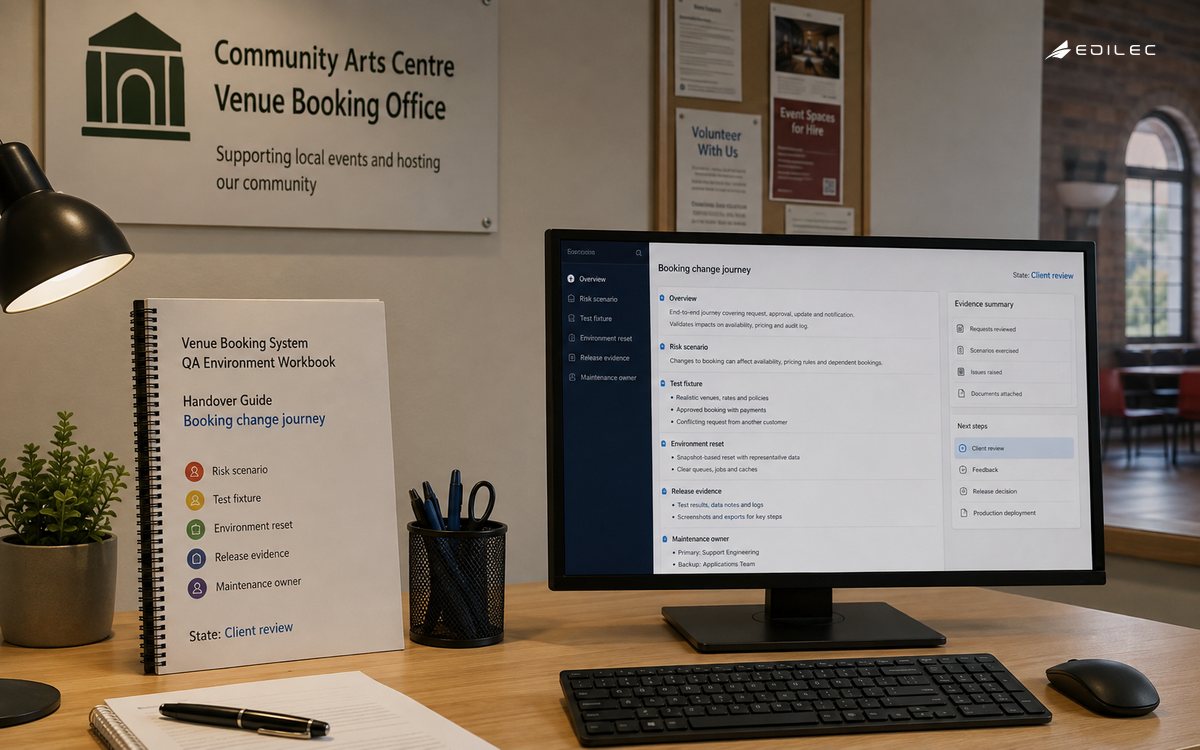
Define ownership for every test group, fixture, synthetic account, test data set, environment dependency, and quarantine decision. Store release evidence with the exact commit and artifact. Use protected deployment environments so production credentials are unavailable until gates pass; GitHub’s environment controls illustrate branch restrictions, required reviewers, and environment-scoped secrets. Before handoff, observe the client diagnose a deliberate failure, update a brittle fixture, and decide whether a failed check should block release. Documentation is successful only when the receiving team can operate without the consultant.
Key takeaways
- QA automation for SaaS consulting implementation checklist earns trust through a bounded decision and named ownership, not through a broad technology promise.
- Make readiness, handover, and evidence of progress visible in the working flow so people can intervene before a small defect becomes a business problem.
- Use rehearsal evidence to decide whether to expand; counts of completed tasks or test runs are not enough by themselves.
- Connect this work with a connected implementation article so the broader operating model remains consistent.
Frequently asked questions
- What should a first consulting test program release include? Include one valuable path, explicit boundaries, a named owner, reliable evidence, and a recovery route. Broader scope can wait until this path has survived change and exception handling.
- How should a team estimate effort? Estimate discovery, access and data preparation, design, build, verification, rehearsal, documentation, and handover separately. The unknowns are usually in dependencies and operating ownership, not in the first screen or rule.
- When is human review required? Use it where consequence, uncertainty, policy sensitivity, or incomplete evidence makes an unattended result unsafe. Define who reviews, what they see, and what they may override.
- Can automation or retrieval replace accountability? No. It can organize evidence and accelerate a bounded task, but an accountable business role still owns policy, exceptions, and the decision to expand or stop the service.
Conclusion
A strong SaaS QA automation engagement produces decision evidence that survives handoff. Anchor the suite in consequential journeys, use the right layer for each claim, exercise realistic environments and failures, and make maintenance ownership explicit. The result is not just faster testing; it is a client team that can release and recover with greater confidence.