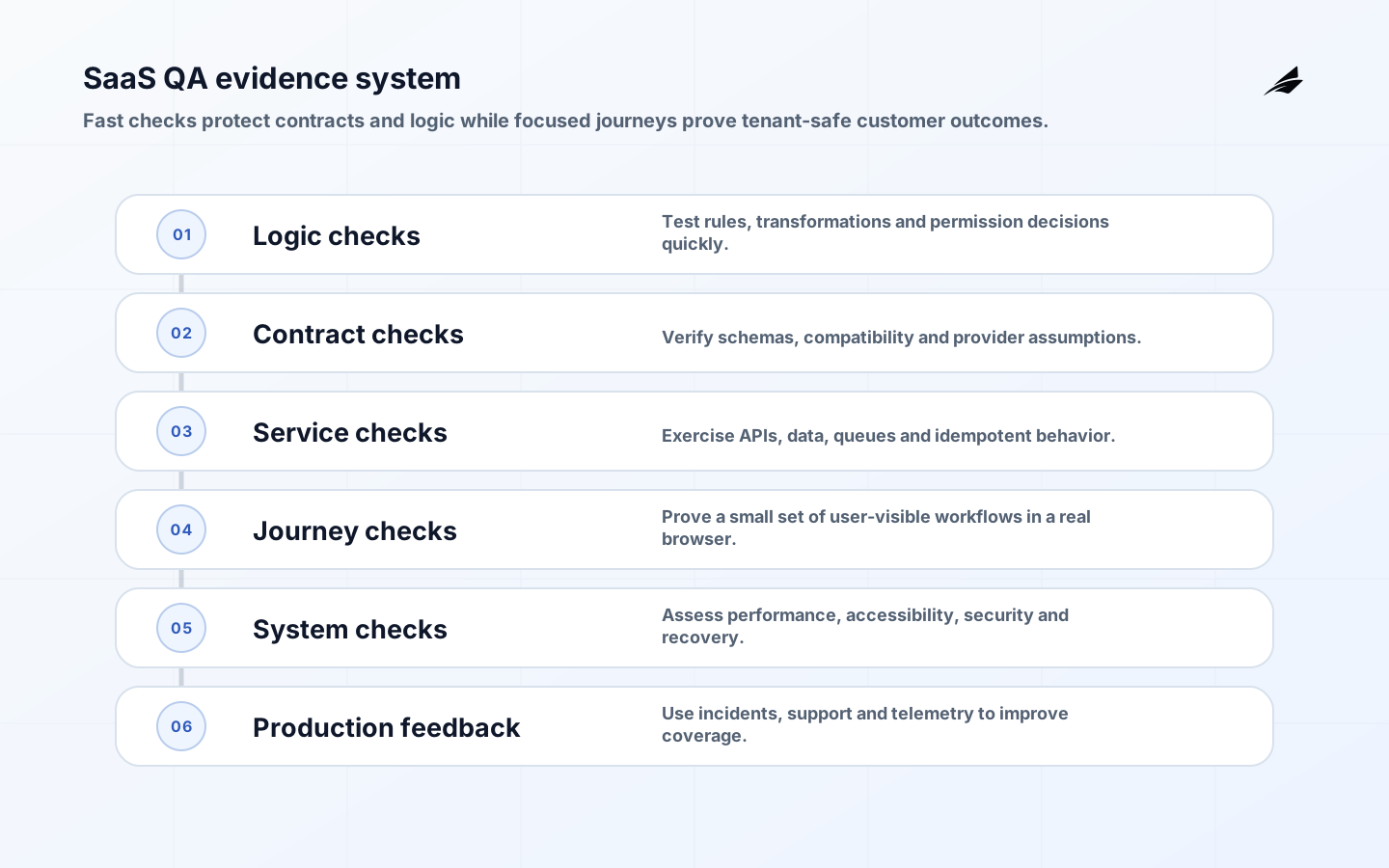
QA automation for SaaS should reduce release risk and shorten diagnosis, not maximize the number of scripted test cases. A SaaS product combines user interfaces, APIs, asynchronous jobs, data migrations, integrations, permissions, billing and multiple tenant configurations. The automation portfolio must show that important outcomes remain correct across those boundaries and that one tenant cannot affect another. Fast checks belong close to the code; a focused set of end-to-end journeys verifies real assembly. When every scenario is pushed through a browser, feedback slows and failures become difficult to explain.
This guide presents a risk-based approach for product, engineering and business teams. It covers test layers, stable selectors, controlled data, tenant isolation, API and event contracts, failure scenarios, CI execution and production feedback. The release standard should be explicit: which risks were tested, in what environment, against which version and data, with what result and accepted exceptions. Automation supports judgment by producing repeatable evidence; it does not replace exploratory testing, usability review or accountable release decisions.
Start with product risk and customer journeys
Inventory the outcomes customers depend on: account creation, sign-in, subscription change, data import, core transaction, approval, report, integration and support recovery. For each, identify failure consequence, frequency, change rate, tenant variation and detectability. Rank authorization and data isolation highly even when a path is not frequently changed, because failure can expose another customer. Include administrative and operator journeys; many severe SaaS failures occur in bulk actions, migrations or support tooling rather than the polished customer interface.
Translate risks into assertions at the cheapest reliable layer. A pricing calculation belongs in unit tests; an API schema and backward compatibility belong in contract tests; idempotent webhook processing belongs in a service test; a small browser test proves that a user can complete the flow. Record what is intentionally tested elsewhere so coverage is understandable. Avoid duplicating the same rule across every layer. Duplication increases maintenance without necessarily increasing confidence and can make one defect produce dozens of noisy failures.
| Risk | Best primary layer | Representative assertion |
|---|---|---|
| Business rule | Unit or component | Boundary values and decision table |
| API compatibility | Consumer/provider contract | Required fields, enum and error compatibility |
| Tenant isolation | Service and authorization | Tenant A cannot read or mutate tenant B |
| Critical journey | Browser end to end | User-visible result and durable state |
| Resilience | System or fault test | Retry, recovery and no duplicate side effect |
Build a deliberate test-layer portfolio
Keep the base fast and deterministic. Unit tests cover calculations, transformations and permission predicates. Component tests cover UI state and service logic with controlled boundaries. Contract tests verify API, event and third-party assumptions. Service integration tests run databases, queues and authentication together. Browser tests cover only critical journeys and high-risk rendering behavior. Add separate suites for accessibility, performance, security, migration and disaster recovery because they use different environments and acceptance measures.
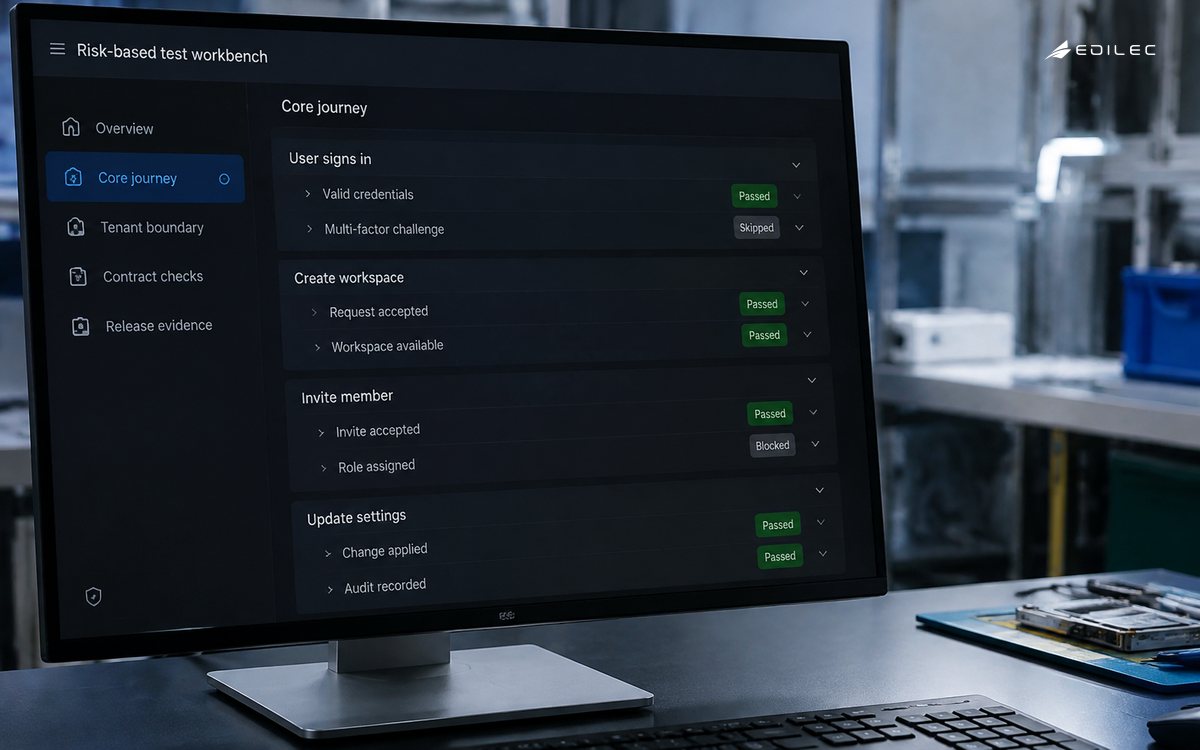
Review the portfolio by detection value, execution time, flakiness and maintenance cost. A slow test that catches unique high-consequence regressions can be worthwhile; a flaky duplicate should be removed or moved down a layer. Tag tests by capability and risk rather than organizational team. Maintain a trace from incident or requirement to evidence without forcing a bureaucratic one-test-per-requirement model. Product teams should understand which risks lack automation and choose exploratory review or explicit acceptance.
Write browser tests around user-visible behavior
Playwright recommends user-facing locators, test isolation and web-first assertions. Select elements by role, accessible name or stable testing contract rather than CSS structure. Let the framework wait for actionability and expected state instead of sleeping for fixed durations. Each test should create or receive its own isolated state and clean up through supported APIs. Shared ordered tests create cascading failure and prevent safe parallel execution. Use page objects only where they clarify a domain interaction; enormous abstraction layers can hide the behavior being verified.
Assert the outcome, not every intermediate implementation detail. After submitting an order, verify the confirmation and durable record or API state. Capture traces, screenshots, network and console evidence on failure, but protect secrets and personal data. Control third-party dependencies in routine CI; run a smaller scheduled contract suite against real sandboxes. Pin browser and environment versions for visual comparisons. Treat animation, eventual consistency and background jobs explicitly rather than increasing global timeouts until tests appear stable.
| Flaky symptom | Likely cause | Durable correction |
|---|---|---|
| Intermittent missing element | Implementation selector or fixed sleep | User-facing locator and state-based assertion |
| Passes only in suite order | Shared account or data | Independent fixture and unique records |
| Random API failure | Uncontrolled third party | Contract stub plus bounded sandbox test |
| Parallel collision | Static tenant or identifier | Per-worker namespace and cleanup |
| Timeout after release | Unmodeled async completion | Poll owned job state with a business deadline |
Test tenant isolation as a continuous property
Create at least two tenants in the same test and attempt cross-tenant access through API identifiers, search, exports, caches, jobs and administrative paths. Test authorization at the data access boundary, not only hidden navigation. Include users with overlapping names and records with identical local identifiers to reveal missing tenant keys. Verify background events carry tenant context and that retries do not change it. Test support impersonation and role changes with audit evidence. A positive “Tenant A can view its record” test does not prove isolation.
Exercise shared-resource pressure as well as access. One tenant’s import, report or webhook storm should not starve ordinary work for others beyond defined policy. Verify rate limits, queue fairness, cache keys, database predicates and storage paths. Where tenants receive dedicated resources, test routing and lifecycle. Preserve synthetic test data so failures are reproducible, but rotate credentials and avoid production customer information. Isolation tests should run on every material data-access or authorization change and in periodic system exercises.
Automate API, event and integration contracts
Version request, response and event schemas. Test required fields, optional additions, enum evolution, pagination, errors, idempotency, authorization and rate limits. Consumer-driven contracts are useful when managed carefully, but providers still need a coherent compatibility policy. For webhooks and queues, test duplicate, delayed, out-of-order and malformed events. Verify signature and replay protections and confirm that retries cannot duplicate billing, notifications or state transitions. Store representative payloads with sensitive values removed.
Third-party integrations require two levels: deterministic local simulations and bounded verification against provider sandboxes. Simulations should reproduce documented rate limits, errors and latency, not only happy responses. Sandbox tests validate credentials, endpoint changes and real serialization. Monitor deprecation notices and assign ownership. OWASP’s API guidance emphasizes authorization, resource consumption, inventory and unsafe consumption of external APIs; those risks should appear in automated abuse cases, not only a yearly penetration test.
Control test data, time and environments
Define factories for valid domain objects and named fixtures for important edge cases. Generate unique identifiers per test or worker and freeze or control time for expiration, billing and scheduling scenarios. Seed large tenants for query and migration behavior. Make setup observable and fail fast when prerequisites are missing. Cleanup should be safe and scoped; deleting by a broad prefix in a shared environment can destroy another run. Where a test uses a transaction rollback, remember that asynchronous workers may use different connections and still need explicit cleanup.
Track environment configuration, feature flags, database migrations, service versions and external stubs with the run. A passing result in an unknown environment is weak evidence. Keep staging sufficiently representative for the question without pretending it is identical to production. Test infrastructure is product infrastructure: patch it, monitor capacity and review access. If the suite itself is unhealthy, stop releases based on it until reliability is restored or use documented alternate evidence.
Integrate automation into delivery without blocking blindly
Run fast logic and contract checks on every change. Use impacted service and journey suites before merge or deployment, then run broader regression and nonfunctional suites on scheduled or release triggers. Shard independent tests and keep failure artifacts. Quarantine only with an owner, reason and expiry; a permanent quarantine is deleted coverage. Distinguish product failure, test defect, environment failure and infrastructure outage in reporting. Retry can gather evidence but should not turn an initial failure into an unqualified green result.
The release record should list version, suites, environment, result, known failures, waivers and accountable approver. Measure time to signal, unique defects found, escaped defects, flaky rate and maintenance effort. Do not reward raw test count. Review production incidents and support cases monthly to add or reposition coverage. Remove tests for retired behavior. Automation stays valuable when it evolves with architecture and customer risk rather than preserving every historical script.
Key takeaways
- Map automation to product and tenant risk, not test volume.
- Place assertions at the fastest layer that can prove the behavior.
- Use isolated state, user-facing locators and condition-based waits.
- Continuously test authorization, tenant context and noisy-neighbor behavior.
- Treat CI results as versioned release evidence with owned exceptions.
Frequently asked questions
How many end-to-end tests should a SaaS product have?
Enough to cover critical assembled journeys and unique browser risks, but not every rule. Move detailed variations into faster layers. Review suite duration, diagnostic value and flakiness rather than using a universal number.
Should failed tests be retried?
A limited retry can capture evidence of nondeterminism, but the run should report the initial failure. Repeatedly retrying until green hides risk. Fix the product, test or environment cause and track flaky behavior.
Can AI generate the test suite?
AI can assist with candidate cases and code, but engineers must verify assertions, data, security and maintenance. Generated volume without a risk model often duplicates coverage and encodes incorrect assumptions.
Conclusion
Reliable SaaS QA automation is a layered evidence system. It proves important rules quickly, validates contracts and tenant boundaries, exercises a small set of complete journeys and records the exact release conditions. Combine automation with exploratory judgment and production feedback. When failures are reproducible and each test protects a named risk, the suite supports faster delivery without trading away customer trust.