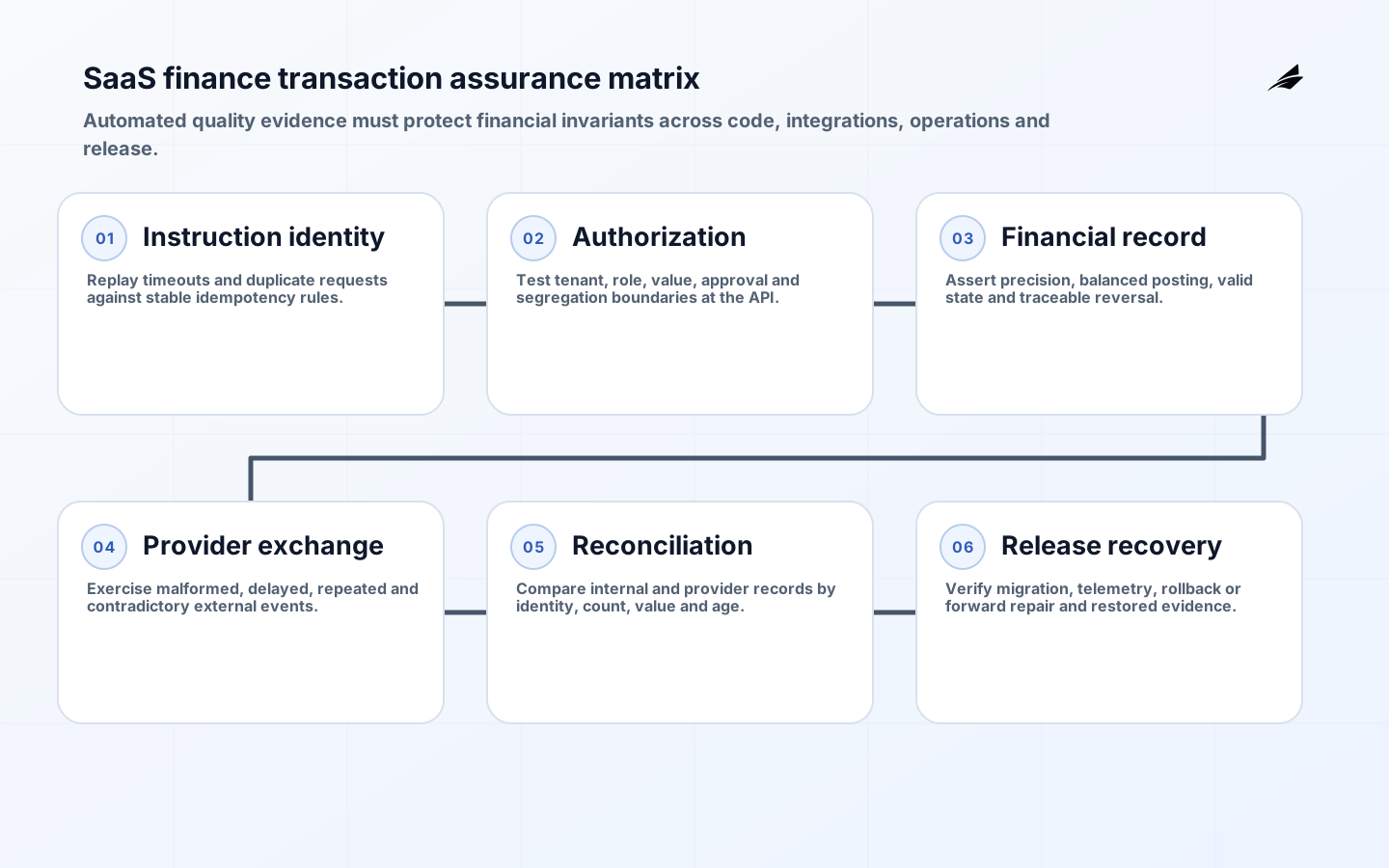
Finance features in a SaaS product are stateful systems of record. Billing, invoices, taxes, credits, approvals, payments and ledger entries must remain correct through retries, partial failure, date boundaries and change. QA automation should protect those financial invariants rather than merely confirm that screens can be clicked.
This checklist organizes automated assurance around transaction identity, balanced records, authorization, reconciliation, observability and release evidence. It is suitable for subscription billing, expense, marketplace, fintech and enterprise finance modules. Regulatory obligations vary, so product, finance, security and legal owners must map the applicable requirements.
1. Write financial invariants before test cases
Define what must always be true: each accepted instruction has one durable identity; postings balance; state transitions are valid; settled records are not silently overwritten; reversals reference the original; currency and rounding rules are explicit; and every material action has an accountable actor. Turn each invariant into positive, negative and recovery tests.
Distinguish business time from system time. Subscription periods, tax dates, settlement dates and reporting cutoffs may use different zones and calendars. Test leap days, daylight-saving changes, month and year end, backdating and late events. Use fixed clocks in lower environments so failures can be reproduced.
| Invariant | Automated test | Failure signal |
|---|---|---|
| No duplicate value | Replay the same instruction and timeout | Duplicate posting or charge |
| Balanced records | Generate valid and invalid posting sets | Non-zero imbalance |
| Valid lifecycle | Attempt every allowed and forbidden transition | Skipped or rewritten state |
| Traceable reversal | Reverse full and partial transactions | Missing original reference |
| Correct precision | Boundary amounts by currency and tax rule | Unexpected rounding delta |
2. Build a layered test model
Use fast unit tests for money types, proration, tax selection and state machines. Property-based tests can explore amount and event combinations while asserting balance and conservation. Contract tests protect APIs and events. Integration tests verify database constraints and external adapters. A smaller end-to-end suite confirms critical user journeys without becoming the only line of defense.
Model-based testing is valuable when transactions have many states. Define valid transitions and let tests generate sequences, including cancellation, dispute and retry. Keep assertions on durable records, not only response codes. UI tests should verify the user’s evidence and authority while domain tests establish financial correctness.
3. Create representative and protected test data
Generate synthetic customers, subscriptions, invoices and payment states with known expected results. Cover multiple currencies, tax jurisdictions, discounts, credits, partial payments, failed collection and refunds. Include malformed and adversarial inputs. Version fixtures with the rule set they exercise so a tax or pricing change does not silently change expected values.
Do not copy production payment or personal data casually. Tokenize or synthesize sensitive fields and restrict test-environment access. PCI DSS scope depends on the payment-card data environment; using provider tokens and hosted collection can reduce exposure, but integration and access still require verification. Test logs for accidental secret or account-data disclosure.
4. Test retries, idempotency and concurrency
A client or worker may retry after a timeout even though the first request succeeded. Send identical and conflicting requests with the same idempotency key. Interrupt processing before and after each durable write. Verify that recovery resumes or compensates without duplicate financial effect and that the client can retrieve the original result.

Run concurrent approval, payment, cancellation and update attempts. Test optimistic locks, unique constraints and queue redelivery. Deliberately reorder events and deliver them late. Exactly-once transport is rarely a safe assumption; durable identity, deduplication and reconciliation should make repeated delivery harmless.
5. Verify integrations and reconciliation
Contract-test payment, tax, banking and accounting adapters against documented schemas and error behavior. ISO 20022 demonstrates why financial messages carry structured business meaning; validate codes, identifiers, dates and parties rather than treating messages as arbitrary JSON or XML. Use provider sandboxes, then controlled certification where required.
Reconciliation is an independent control. Compare internal instructions, provider events, cash movement and ledger postings by count and value. Test missing, duplicate, late and contradictory records. Unmatched items must enter an owned queue with aging and escalation. A green API test is not proof that money and books agree.
| Failure | Expected behavior | Automated evidence |
|---|---|---|
| Provider timeout | Preserve pending state and query safely | No duplicate value |
| Duplicate webhook | Acknowledge without repeated effect | Single state transition |
| Late settlement | Update effective state and reporting | Reconciled date trail |
| Invalid message | Reject or quarantine with reason | No partial posting |
| Internal/provider mismatch | Open owned exception | Count, value and aging visible |
6. Automate authorization and security checks
Test role and resource authorization at the API. Verify segregation of duties for creation, approval, release and administration. Exercise tenant isolation with records from multiple organizations. Check that object identifiers cannot bypass ownership. OWASP ASVS provides a structured basis for application security requirements, while the NIST SSDF connects those practices to the development lifecycle.
Cover session expiry, MFA for privileged functions, export limits, webhook signatures, secret rotation and audit integrity. Negative tests should attempt forbidden state changes and value escalation. Security tests belong in CI where stable, but threat-led penetration testing and design review remain necessary for higher-risk releases.
7. Assert observability and operator evidence
Instrument traces and logs with safe transaction identifiers, tenant, state and dependency result. OpenTelemetry can standardize telemetry, but the product must define meaningful fields. Automated tests should verify that a failed workflow emits the expected event, metric and trace relationship without leaking sensitive values.
Set service objectives for customer-visible finance operations and reconciliation freshness. Monitor pending age, failed posting, imbalance, unmatched value and webhook delay. Alert on conditions that demand action, with runbooks and owners. A dashboard that cannot identify affected records is not sufficient recovery evidence.
8. Make releases reviewable and reversible
Run invariant, contract, security and reconciliation suites on every relevant change. Review database migrations for precision, defaults and backfill. Compare old and new calculations on historical synthetic cases. Deploy progressively by tenant or feature flag, watching both technical and financial signals.
Rollback may be unsafe after financial writes. Design forward repair, dual-read comparison or compatibility before release. Record approvals and artifacts according to risk. Exercise restore and reconciliation, not just backup creation. The NIST SSDF supports integrating such secure practices throughout development rather than adding a gate at the end.
Maintain the assurance system as finance rules change
Assign owners to invariant suites, provider contracts, security checks and reconciliation scenarios. When pricing, tax, payment or accounting rules change, update the rule specification and expected examples before changing code. Review which tenants, currencies and effective dates are affected. Preserve old rule fixtures when historical transactions can still be queried, reversed or reported.
Track escaped defects by failed control rather than only component. A duplicate charge may expose an idempotency, retry and monitoring gap at once. Add the production scenario to the lowest reliable test layer, then strengthen the independent detection that should have caught it. Review flaky tests aggressively; accepting intermittent failure trains teams to ignore the signal most needed during a risky release.
Run periodic control exercises outside normal CI. Restore a representative finance dataset, replay provider events, reconcile balances and verify operator access. Simulate a provider delay across a reporting cutoff. Confirm that customer support can see accurate state without editing records. These exercises test the socio-technical recovery path that unit tests cannot reach.
The QA scorecard should combine suite health, defect escape, reconciliation exceptions, change failure, security findings and time to explain a transaction. Coverage percentage alone is weak evidence. Favor tests that protect a named invariant and can identify affected financial records when they fail.
Define a release evidence packet for material finance changes. It should identify the changed rule and effective date, impacted tenants and records, invariant and integration results, security review, migration rehearsal, reconciliation query, deployment cohort, abort threshold and repair owner. Finance or product owners approve expected behavior; engineering approves technical readiness; operations confirms observability and recovery. Preserve the packet with the released version. When a customer challenges an amount months later, the team can reconstruct which rules and data produced it instead of reverse-engineering history from current code.
Production verification should use safe, read-only assertions wherever possible. Confirm expected configuration, schema version, queue consumers, provider credentials and telemetry before enabling traffic. After release, inspect a controlled set of transactions through completion and reconciliation. Do not create artificial financial movement merely to test availability unless it is clearly isolated and reversible. Time-box enhanced monitoring and record who can stop the rollout.
Related reading
See QA Automation for SaaS Startups, its Implementation Checklist, and Finance Reporting Mistakes and Practical Fixes for broader delivery and reporting controls.
Frequently asked questions
What should be automated first in finance QA? Start with money precision, valid state transitions, idempotency, balanced postings and reconciliation. Failures in these controls can create durable customer and accounting errors.
Are end-to-end tests enough? No. Use unit, property, state-model, contract and integration tests for depth, then keep a focused end-to-end suite for critical customer journeys and operator evidence.
Can production data be copied into test environments? Prefer synthetic data. Production-derived records require explicit authorization, minimization and protection under applicable privacy and payment requirements, and secrets should never be copied casually.
How should a finance release be rolled back? Plan rollback and forward repair before deployment. Once financial records are written, restoring an older binary may be unsafe; compatible operation, reconciliation and controlled repair are often required.
Key takeaways
- Automate financial invariants, not only user journeys.
- Test time, precision, retries, concurrency and reversal explicitly.
- Use synthetic sensitive data and verify tenant and role boundaries.
- Reconcile independent records by count and value.
- Treat telemetry, restore and forward repair as release evidence.
Conclusion
Finance QA automation is a system of transaction assurance. Layered tests establish calculation and state correctness; integration and reconciliation prove that external movement agrees; security checks protect authority; and telemetry makes recovery possible. When these controls run continuously and releases preserve traceability, SaaS teams can change finance capabilities quickly without asking customers to absorb the risk.