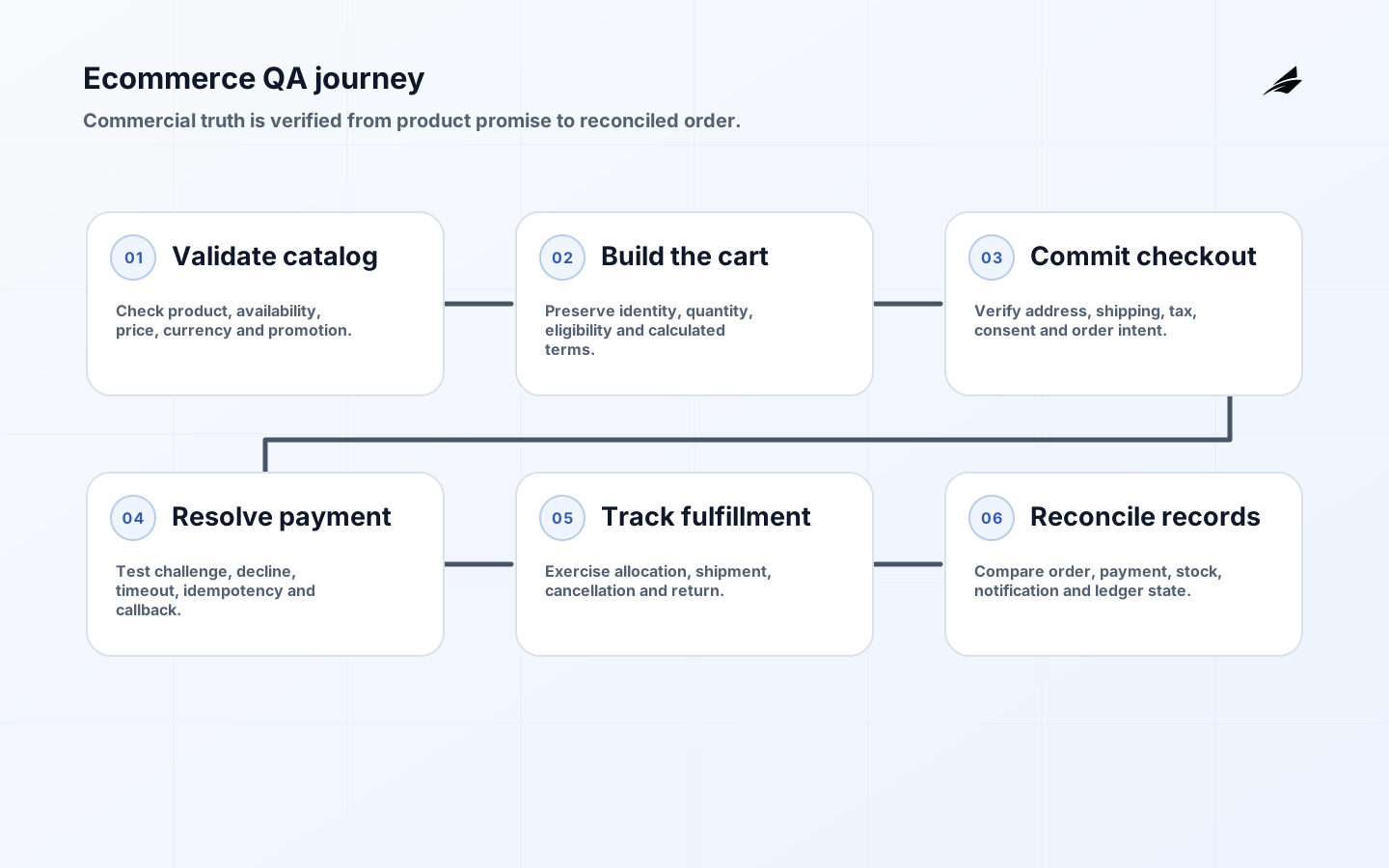
QA automation for SaaS ecommerce protects a distributed commercial journey: product discovery, pricing, inventory, promotion, tax, identity, payment, order creation, fulfillment, notification, return and refund. A browser script that reaches a confirmation page covers only one visible path. Reliable automation proves business state, provider contracts, duplicate handling, accessibility and reconciliation across the systems that make the promise real.
Use this FAQ with the SaaS ecommerce QA practical guide and production implementation checklist. Teams evaluating service scope can also compare the QA automation consulting delivery plan.
What should SaaS ecommerce QA automation cover?
Prioritize revenue, customer trust and operational recovery. Cover product eligibility, price and currency, promotions, stock reservation, shipping, tax, payment outcomes, order state, notifications, cancellation, return and refund. Add tenant isolation, role permissions, subscription or plan entitlements, administrative adjustments and reporting. Map each journey to systems, providers, records and side effects before choosing the automation layer.
Define invariants: an accepted payment has one order or an owned exception; a refund cannot exceed captured value; inventory does not fall below the policy boundary; a promotion applies according to versioned rules; and every administrative change is authorized and logged. Test invariants at domain and integration layers, then verify a focused set through the deployed interface.
| Journey area | High-value automation | Required assertion |
|---|---|---|
| Catalog and price | Availability, variants, currency, tax class and promotions | Displayed and committed terms match authoritative rules |
| Checkout | Guest and account paths, address, shipping and consent | Order intent retains correct items, totals and identity |
| Payment | Authorize, decline, challenge, timeout, capture and refund | Provider and internal ledger reconcile exactly once |
| Fulfillment | Allocation, shipment, partial delivery and cancellation | State and stock follow permitted transitions |
| Operations | Admin adjustment, retry, return and customer support | Role, reason, audit event and downstream effect are correct |
Where should ecommerce tests run?
Put pricing, promotion, tax selection, eligibility and state-machine cases in fast domain tests. Use API tests for validation, permissions and idempotency. Use contract tests for payment, tax, shipping and marketplace providers. Use integration tests with sandboxes and real persistence. Keep browser tests for critical customer and operator journeys, visual or accessibility behavior and deployment confidence.
Do not duplicate every rule in every layer. One exhaustive promotion matrix belongs near the rule engine; browser automation proves that a representative promotion is presented and committed correctly. This reduces suite time and brittle UI maintenance while preserving customer evidence. Tag tests by risk and component so a change runs the relevant subset before the broader scheduled suite.
Automate the ecommerce order journey
Create scenario builders for products, customers, tax regions, inventory and providers. Drive the journey through supported APIs where setup is not under test, then use the browser for the customer action. Assert the visible outcome and query the system of record or event stream for the durable result. Capture order and provider correlation IDs to make failures diagnosable.
Use condition-based assertions for asynchronous state. Playwright's web assertions automatically retry until an expected condition succeeds or times out. That is preferable to fixed sleeps, but an eventually visible confirmation is not enough: assert no duplicate order, correct total, payment reference, stock effect and notification request.
How should payment behavior be tested?
Use provider test modes and documented test instruments for success, decline, authentication challenge, insufficient funds, network timeout, duplicate callback, delayed callback, capture failure, partial refund and dispute where available. Never use real cardholder data in test environments. Keep payment pages and logs free of sensitive authentication data and use provider tokens rather than storing account numbers.
The PCI Security Standards Council's document library is the authoritative place to obtain the current PCI DSS and supporting materials; scope and validation obligations depend on architecture and merchant context. QA automation supports control verification but does not itself establish compliance. Involve qualified security and compliance owners when payment architecture changes.
Make payment creation idempotent. Stripe's idempotent requests guidance describes associating a client-generated key with the first result and rejecting incompatible reuse. Test a crash before request, after provider success but before local persistence, and during callback processing. Reconciliation must surface any provider transaction without the expected order or ledger entry.
How are external integrations kept reliable?
Version provider contracts and preserve representative payloads. Verify signatures, authentication, schema, enums, money precision, time zones, pagination, rate limits, retry headers and error semantics. Simulators should model delay, throttling, malformed responses and duplicate events, not only success. Run scheduled checks against official sandboxes so the simulator does not drift from reality.
For each provider, define timeout, retry, circuit-breaking or queue policy, fallback and customer message. A shipping quote failure may allow a retry; a tax service failure may block checkout in some jurisdictions; a recommendation failure should usually degrade without blocking purchase. Tests must reflect the approved business policy and confirm operators can see and replay failed work.
What accessibility automation is useful?
Automated rules can detect missing names, contrast issues, invalid relationships and some focus problems. Add keyboard navigation, focus order, error association, zoom, reflow, screen-reader and cognitive clarity checks for catalog, cart, checkout and account tasks. WCAG 2.2 is a W3C Recommendation with success criteria; record applicable conformance evidence and manual limitations.
Test dynamic behavior: cart updates announced appropriately, validation errors associated with fields, focus moved or retained intentionally after modals, and payment challenges usable without a mouse. Accessibility regressions often occur in shared components, so combine component checks with complete journey review. Include disabled, loading and error states, not only polished success screens.
How should security tests fit the suite?
Test tenant separation, object-level authorization, admin roles, coupon abuse, price tampering, inventory manipulation, webhook forgery, injection, file upload and account recovery. The OWASP Application Security Verification Standard provides verifiable application security requirements. Map relevant requirements to architecture and test evidence, and commission independent review for material payment or trust-boundary change.
Keep test accounts, API keys and provider credentials in an approved secret store. Rotate and revoke them. Redact screenshots, traces and logs. Prevent tests from sending real email, SMS, shipment or financial side effects by routing to controlled sinks. Audit administrative test actions in shared environments so they cannot be mistaken for fraud or production support work.
What performance evidence matters?
| Measure | Test condition | Business interpretation |
|---|---|---|
| Largest Contentful Paint | Representative product page and device/network profile | Main content becomes visible promptly |
| Interaction to Next Paint | Cart and checkout interactions under representative client work | Interface responds to user input |
| Cumulative Layout Shift | Images, promotions and payment components loading | Content remains visually stable |
| Checkout completion | Expected arrivals with realistic provider delays | End-to-end commercial task meets target |
| Order error rate | Same workload, segmented by reason | Demand is not converted into failed or inconsistent orders |
Google's Web Vitals guidance defines Core Web Vitals around loading, interactivity and visual stability. Lab tests provide repeatability; field data shows actual users, devices and networks. Combine both with backend percentiles, errors, queue lag and provider timing. A fast catalog with a saturated payment callback worker is not a healthy ecommerce service.
How should ecommerce test data be managed?
Generate products, stock, customers and orders with scenario intent. Cover locales, currencies, tax regions, long names, address formats, zero-price items, high quantities, expired promotions and historical orders. Isolate each test and clean through supported APIs. Keep stable golden cases for financial reconciliation, but version expected values when rules change.
Avoid production personal data. Synthetic data should preserve useful distributions and relationships without identifying people. Define retention for order histories, provider events and artifacts. When testing deletion, verify search indexes, analytics feeds and support systems as well as the primary database. A deleted account with retained transaction records needs the approved legal and business policy represented in tests.
What should block an ecommerce release?
Block on failures that threaten payment correctness, authorization, tenant isolation, material price or tax accuracy, order loss, required accessibility, migration integrity or recovery. Allow risk-owned exceptions for lower-impact findings with compensating controls and expiry. Use feature flags and gradual exposure for risky changes, but test flag combinations and removal. Observe orders, payment reconciliation, errors and support signals after release.
A release record should identify build, configuration, changed journeys, executed evidence, provider sandbox status, unresolved risks and rollback or disable path. Reconcile a sample of real orders during stabilization. Keep previous contract and worker versions compatible while events remain in flight. Do not roll back database or event state blindly after customers have acted.
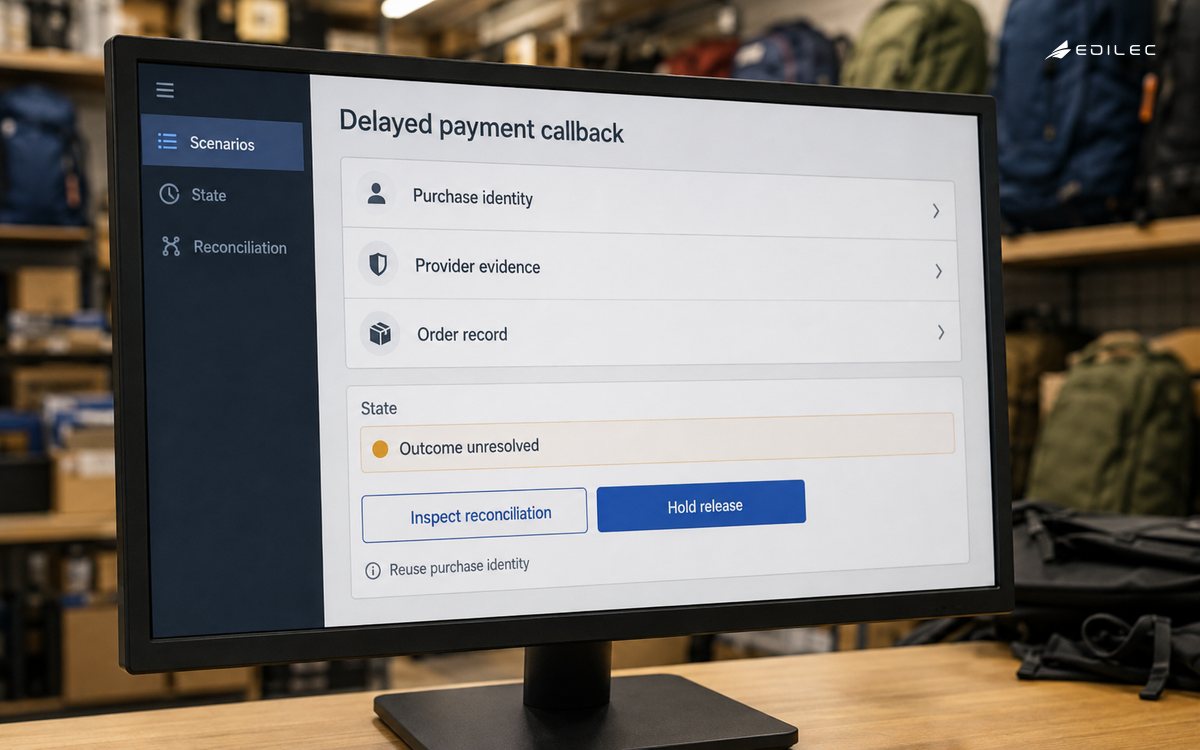
Example: a failed payment callback
Simulate a payment that succeeds at the provider while the callback is delayed and the shopper refreshes checkout. The UI should show a safe pending state, retries must reuse the purchase identity, and reconciliation must attach the provider transaction to one order. Deliver the callback twice, restart the worker and verify one capture, one inventory commitment and one confirmation. The operator queue should expose any unresolved state without offering an unsafe “charge again” shortcut.
Key takeaways
- Model ecommerce QA around durable order, money, stock and customer outcomes.
- Put exhaustive business rules below the browser and preserve focused deployed journeys.
- Test payment and provider retries, duplicates, delays and reconciliation.
- Combine security, accessibility and performance evidence with functional automation.
- Treat test data, secrets, artifacts and provider side effects as controlled assets.
Frequently asked questions
Must every test run in every browser?
No. Run broad domain and API coverage once, then select browser and device coverage from customer usage, contractual support and rendering risk. Execute critical checkout journeys across supported engines and use targeted compatibility tests for components with known differences.
Can AI generate the ecommerce QA suite?
AI can help draft cases and code, but domain owners must define invariants, provider semantics and risk. Review generated assertions carefully and keep credentials and customer data outside unapproved tools. Measure maintenance and defect detection, not generated case volume.
Conclusion
QA automation for SaaS ecommerce succeeds when it protects the commercial record across interface, provider and operational boundaries. Automate rules near the domain, challenge integrations with realistic failure, and reconcile orders, money and stock after every critical journey. That evidence lets teams release quickly without treating customer transactions as the test environment.