QA automation for finance SaaS must prove more than a successful user journey. The system has to preserve authorization, monetary precision, transaction state, ledger balance, audit evidence and recovery through retries, dependency failure and change. This FAQ explains how to design automated tests around financial invariants and use them as release evidence without assuming that automation replaces professional judgment.
Begin with the finance SaaS QA practical guide and implement the transaction assurance checklist. Teams with broader custom systems can compare the risk-based quality assurance guide. Scope depends on the product's financial role, jurisdictions, customer controls and integrations; compliance conclusions require qualified review.
What makes finance SaaS QA different?
A small defect can create a large aggregate financial effect or an audit problem long after the interface appears correct. Tests must cover amounts, currencies, dates, rates, tax, fees, accounting periods, approvals, settlement, reconciliation and immutable history. Define invariants with finance owners: total debits equal total credits where double-entry accounting applies; a transaction has one intended economic effect; closed periods cannot change without controlled adjustment; and every override is attributable.
Map product workflows to financial records and external systems. A payment, invoice or journal can have business, provider and ledger states that change asynchronously. Do not infer success from one API response. Identify sources of truth and eventual-consistency windows, then test state transitions and reconciliation. Preserve effective date, posting date, event time and processing time separately where the business uses them.
| Risk area | Invariant | Automated evidence |
|---|---|---|
| Authorization | Only permitted roles can initiate, approve, post or reverse | Role and segregation-of-duties matrix tests |
| Precision | Amount and currency rules never use unsafe rounding | Boundary and property-based amount tests |
| Posting | Each accepted event creates the intended ledger effect once | Journal and idempotency assertions |
| Period control | Closed periods change only through approved adjustment | Time and permission scenarios |
| Reconciliation | Operational, provider and ledger totals explain differences | Automated control totals and exception queue |
| Audit | Material changes preserve actor, reason, before and after | Immutable event and export verification |
How should the automation strategy be layered?

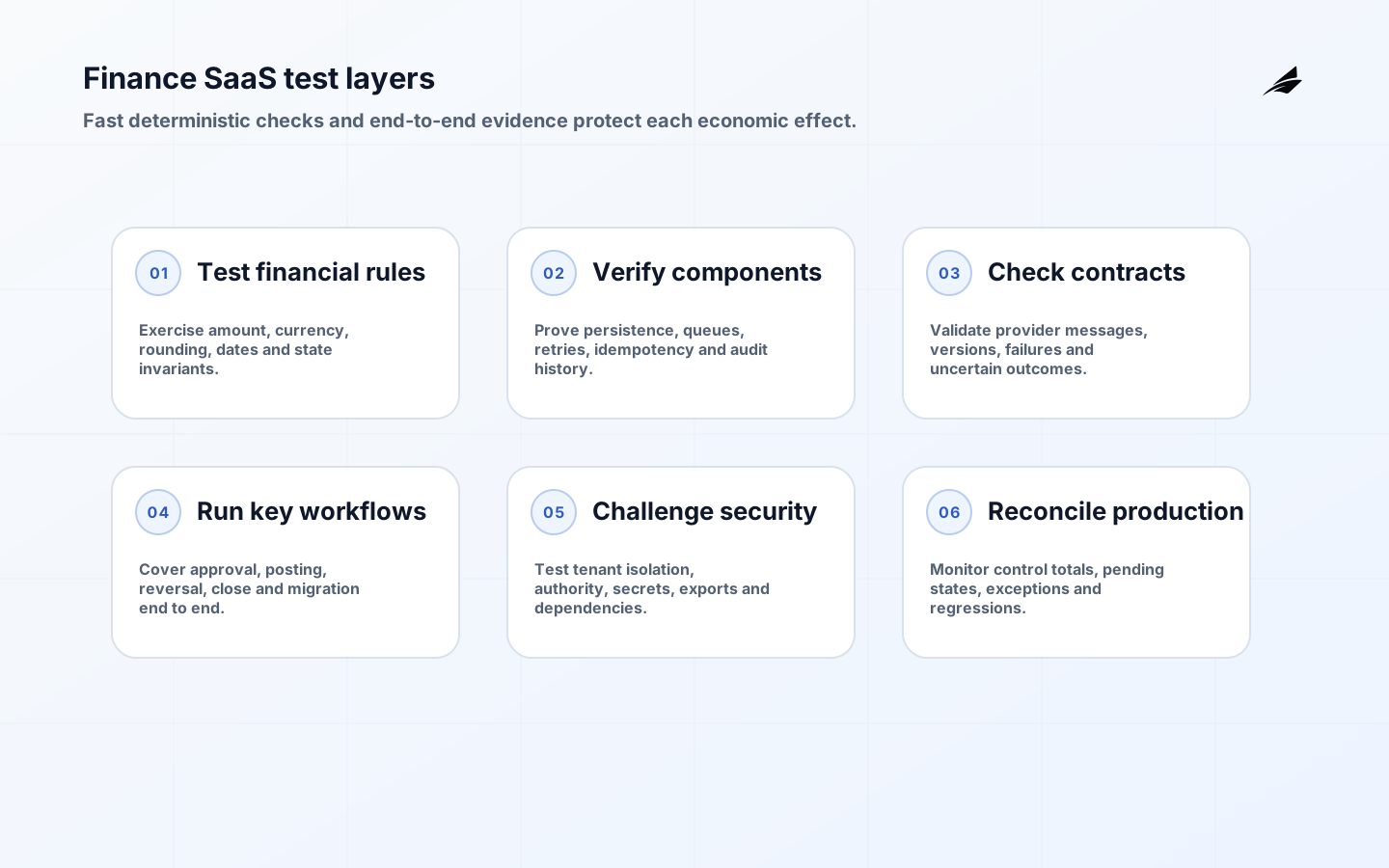
Place most deterministic business-rule tests below the user interface. Unit and property-based tests should cover amounts, calendars, rates and state transitions quickly. Component tests cover persistence and queues. Contract tests verify providers and financial messages. A smaller end-to-end suite proves critical workflows through the deployed stack. Exploratory, accessibility, performance and security testing complement automation because not every meaningful defect can be expressed as a stable assertion.
Build a risk-to-test traceability matrix that names the requirement, control, scenario, environment, data fixture, expected result and owner. The NIST Secure Software Development Framework recommends defining security criteria, protecting software and components, producing well-secured software and responding to vulnerabilities. Integrate those practices with finance controls so the pipeline reports release evidence instead of a disconnected collection of tests.
How should monetary calculations be tested?
Use decimal or integer minor-unit representations according to product requirements; never assume binary floating point is suitable for money. Define currency exponent, rounding mode, sequence, tax jurisdiction, rate source and effective time. Test zero, negative, maximum, minimum, half-way rounding, multi-line allocation, discounts, refunds and foreign exchange. Property tests can assert conservation, such as allocated line amounts summing exactly to the approved total.
Golden examples should come from independently reviewed finance calculations, not from the code under test. Version reference rates and calendars. Test retroactive corrections through adjustment entries rather than silent rewrite when audit policy requires history. Compare report totals with journal or subledger entries and drill from aggregate to transaction. A screenshot match cannot prove accounting correctness.
- Define amount, currency, rounding and date semantics in one owned specification.
- Generate boundary combinations and retain failing random seeds for reproduction.
- Test idempotency under retries, timeouts and duplicated events.
- Verify reversals and corrections preserve original transaction references.
- Reconcile by entity, currency, period, state and provider, not only grand total.
- Require finance-owner review for approved tolerances and exception aging.
How should payment, bank and ledger integrations be tested?
Use provider sandboxes for protocol compatibility but maintain controlled simulators for delays, duplicate callbacks, malformed messages, rate limits, partial responses and uncertain outcomes. Sign and verify webhook messages, enforce replay windows and make handlers idempotent. Model inquiry before retry when an external operation may have succeeded despite a timeout. Contract tests should validate required and optional fields, codes, schema versions and backward compatibility.
ISO 20022 provides a common platform, data dictionary and business process catalog for financial message definitions. Its Payments Standards Evaluation Group covers payment initiation, clearing, settlement, cash management, reconciliation, exceptions and investigations. If the product uses ISO 20022 messages, test business rules and market-practice profiles in addition to XML or JSON validity. A syntactically valid message can still be semantically wrong.
| Failure scenario | Expected behavior | Assertion |
|---|---|---|
| Provider timeout | State becomes pending or inquiry starts | No duplicate economic effect |
| Duplicate callback | Previously processed event is recognized | Ledger and order remain unchanged |
| Out-of-order event | Version or state rule resolves sequence | Invalid regression is rejected or queued |
| Partial batch | Accepted and rejected records are attributable | Control totals and retry set reconcile |
| Ledger unavailable | Posting is durable and retryable | No lost or double journal |
| Rollback after schema change | Old application reads compatible state | Recovery test preserves open transactions |
What security testing belongs in finance QA?
Test authorization at every command and data boundary, including tenant isolation, object-level access, export, approval, support impersonation and administrative configuration. Use the OWASP Application Security Verification Standard as a versioned source of testable web application security requirements. Include session, authentication, validation, cryptography, API and logging controls at a rigor appropriate to the product risk.
If the product stores, processes, transmits or can affect payment card data, determine scope against the PCI Data Security Standard. PCI SSC identifies v4.0.1 as the active revision and explains the limited revision in its publication notice. Do not turn a compliance scan into the security program. Threat model payment pages, webhooks, support access, secrets, dependencies and data exports, and retain remediation evidence.
How should test data be managed?
Prefer synthetic data generated from governed schemas and scenario builders. If production-derived data is necessary, obtain approval, minimize it, de-identify appropriately and prevent reverse mapping. Masking direct names is insufficient when transaction combinations or account details remain identifiable. Keep test environments out of production networks and payment scope where architecture permits, and use test credentials that cannot initiate real movement of funds.
Version fixtures with expected journal, report and reconciliation results. Build personas and tenants that exercise role, entity, currency, tax and close configurations. Reset data deterministically so parallel tests do not share mutable balances. Protect failing artifacts, screenshots and traces because they can contain sensitive inputs. Apply retention limits to test results and revoke temporary access after investigations.
What should run in CI/CD?
On every change, run fast rules, state-machine, authorization, component and contract tests plus static and dependency checks. Run broader integration, migration, performance, resilience and end-to-end suites on staged promotion. Gate releases on critical controls and known-risk policy, not a single coverage percentage. Quarantine only with an owner, reason and expiry; a permanently ignored test is not evidence.
Database and configuration changes need forward and rollback tests with realistic open transactions and reporting history. Compare schemas, indexes, permissions and data transformations. Rehearse blue-green or canary operation when two application versions may process the same event. Keep deployment identity, artifact digest, migration version, test result and approval connected in the release record.
Does QA automation continue in production?
Yes, through safe synthetic checks, control totals, data-quality rules, transaction reconciliation and alerting. Never run destructive test actions against customer records. Use dedicated test tenants and clearly marked instruments. Monitor authorization denials, duplicate suppression, pending transactions, ledger imbalance, reconciliation breaks, refund age and manual adjustments. Route exceptions to owners with enough context to resolve them.
Production incidents should create regression tests where reproducible and lawful. Review escaped defects by control failure: missing requirement, inadequate scenario, environment difference, ignored signal or unsafe release decision. Measure defect escape by consequence, reconciliation exception age, flaky test rate, pipeline duration, rollback success and time to trustworthy evidence. Test count and code coverage are supporting indicators, not proof of financial correctness.
Example: invoice approval release evidence
For an invoice approval change, the pipeline proves submitter and approver separation, threshold routing, currency rounding, period control, duplicate detection, posting idempotency and audit history. Contract simulators delay the ledger response and repeat its callback. A migration fixture contains open approvals across old and new policy versions. Release evidence links requirements, tests, artifact, schema change and approval; production monitors pending postings and reconciliation exceptions. The example shows how a focused control set provides stronger confidence than thousands of UI checks with no financial oracle.
Key takeaways
- Define financial invariants and transaction state with finance and engineering owners.
- Automate rules and contracts below the UI, then keep a focused end-to-end suite.
- Test duplicate, delayed, partial, reordered and uncertain integration outcomes.
- Treat authorization, tenant isolation and audit history as release-blocking controls.
- Use governed synthetic fixtures with independently reviewed expected financial results.
- Continue assurance through production reconciliation, exceptions and incident regressions.
Should AI generate finance SaaS tests?
AI can propose cases, fixtures and code, but qualified owners must review requirements, expected results and coverage. Never use generated expected accounting values without an independent oracle. Keep proprietary code and data within approved tools, scan generated dependencies and run normal review. AI is most useful for widening exploration, not deciding whether a financial control passed.
Conclusion
QA automation for finance SaaS is strongest when tests encode financial and security invariants, exercise asynchronous failure and produce traceable release evidence. Pair fast automation with independent finance review, exploratory work and production reconciliation. That combination protects both delivery speed and the trustworthiness of every recorded economic effect.