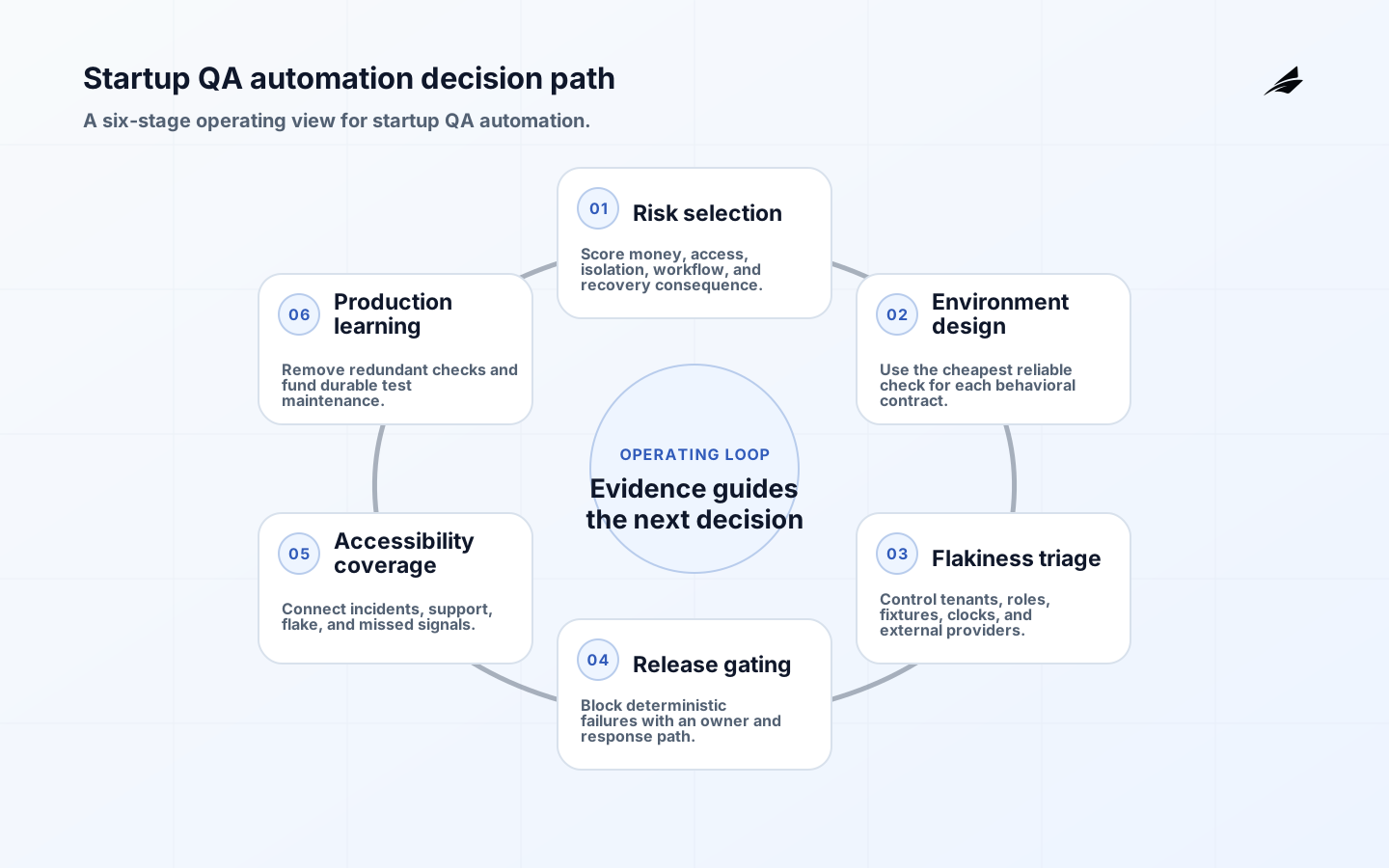
QA automation for SaaS startups works best as a compact risk system. Automate the rules and journeys where a defect would harm money, access, tenant isolation, or customer trust; keep exploratory judgment where the product is still changing; and connect test results to production evidence. The UK service QA guidance reinforces regular testing across the delivery lifecycle. This FAQ answers the decisions that determine whether automation creates confidence or merely creates maintenance.
This FAQ helps founders, product leaders and engineers decide what to automate first, how to avoid fragile suites and when to add dedicated quality capability. Use it with the SaaS QA automation planning guide and implementation checklist. Quality remains a whole-team responsibility even when one person leads the practice.
What should a startup automate first?
Start with failure consequence and change frequency. Automate the business rules that determine price, entitlement, access, calculation and workflow state. Add contract tests where independently changing services, events or external integrations can disagree. Protect one or two critical journeys such as sign-up to first value, purchase to entitlement, or case submission to resolution. Include tenant isolation and role behavior. Leave exploratory investigation, visual judgment and rapidly changing ideas to people until the behavior stabilizes.
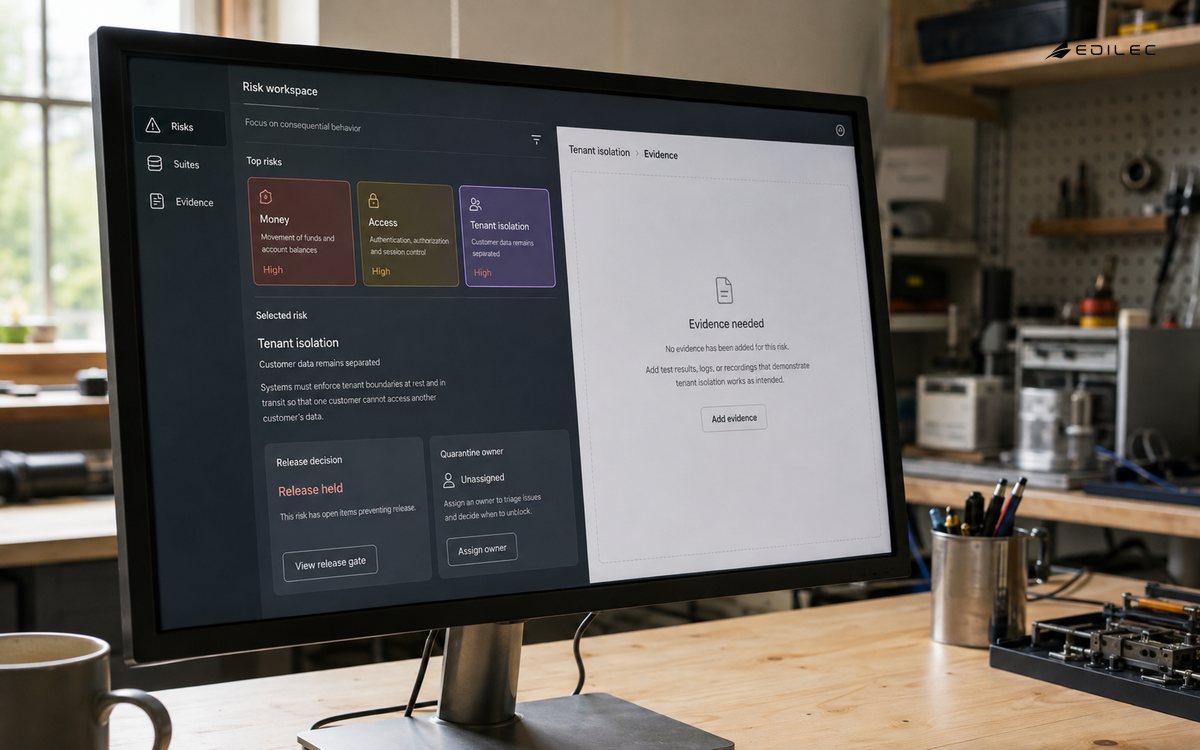
Create a risk map with customer harm, business impact, likelihood, detectability and recovery. A low-frequency data export may deserve more testing than a frequently used color control because a failure can disclose an entire tenant. Write each automated check around an observable contract. Playwright’s best-practice guide recommends testing user-visible behavior, isolating tests and using resilient locators based on roles or explicit contracts rather than implementation details.
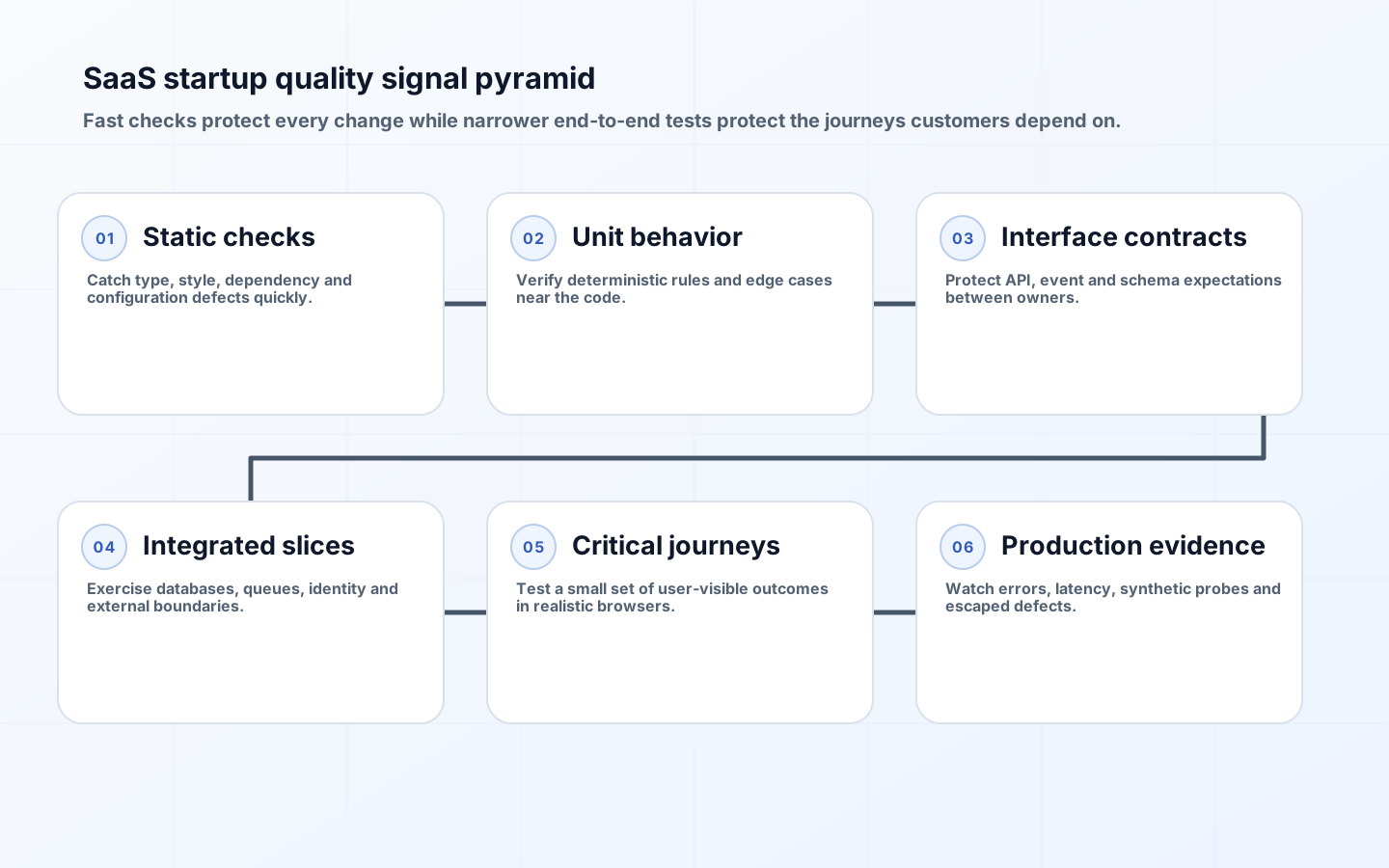
| Test layer | Best use | Common misuse |
|---|---|---|
| Static analysis | Types, lint, dependency and policy checks | Treating a clean build as behavior proof |
| Unit | Pure rules, transformations and edge cases | Mocking implementation details |
| Contract | API, event and schema agreement | Ignoring semantic business compatibility |
| Integration | Database, queue, identity and provider boundaries | Using an unrealistic shared test environment |
| Browser journey | A few customer-visible outcomes | Repeating every unit case through the UI |
| Production | Errors, latency, synthetic probes and escaped defects | Collecting signals without an owner |
How realistic should test environments and data be?
Local and isolated test environments should be cheap and deterministic, while a production-like environment should validate deployment, migrations, identity, network and managed-service behavior. Keep infrastructure and configuration versioned so drift is visible. Do not depend on one permanently shared environment for every check; parallel work will collide. Use ephemeral namespaces, databases or tenant identifiers when practical, and make cleanup observable.
Generate synthetic data that represents boundary conditions: long names, multiple roles, empty states, large accounts, expired subscriptions, time zones, currencies and unusual Unicode. Do not copy production personal data into lower environments by default. If production-derived data is genuinely required, establish lawful use, minimization, masking, access and deletion. Treat test credentials and fixtures as sensitive because they often expose powerful provider or administrator paths.
What causes flaky tests, and how should they be handled?
Flakiness usually comes from uncontrolled time, shared state, eventual consistency, fragile selectors, network dependence, animation, random data or unclear ownership. Use condition-based waiting instead of fixed sleeps, isolate accounts and records, control clocks where possible, and wait for user-visible outcomes. A retry can collect evidence but must not turn a failing check green without review. Track retries separately from first-run passes.
Quarantine only with an owner, reason and expiry. Preserve trace, screenshot, console, network and relevant server correlation IDs so the failure can be diagnosed. Review flaky tests as product or architecture signals: an interface that cannot expose stable roles may also be inaccessible; a workflow whose completion cannot be observed may be hard to support. Delete tests that protect no meaningful decision, but repair those guarding high-consequence behavior.
Which tests should block a release?
Block on fast, deterministic checks that protect critical contracts: build, type and policy checks; high-value unit tests; security scanning appropriate to the product; schema compatibility; migration rehearsal; and a focused smoke journey. Slower suites can inform deployment or progressive exposure. Define the response to failure before it happens. A gate that everyone bypasses under deadline pressure is not a control.
NIST’s SSDF places testing inside a wider secure-development system that also protects repositories, artifacts and vulnerability response. The OWASP ASVS can turn application-security expectations into testable requirements. Select a risk-appropriate baseline and trace each required control to design, automated evidence or a deliberate manual review.
| Release signal | Decision rule | Owner |
|---|---|---|
| Critical behavior | No unresolved failure in money, access or tenant isolation | Product and engineering |
| Migration | Forward and recovery path tested on representative data | Data or platform owner |
| Security | No prohibited exposure; exceptions time-bounded | Security owner |
| Accessibility | Critical journey works with keyboard and assistive checks | Product team |
| Operations | Dashboards, alerts, rollback and support notes ready | Service owner |
How do accessibility and performance fit the automation strategy?
Automated accessibility checks catch only part of the problem. Run them on components and routes, then manually test keyboard order, focus, screen-reader output, zoom, reflow and error recovery across complete journeys. WCAG 2.2 requires complete responsive pages and processes for conformance. Include accessibility criteria in design and acceptance rather than adding a scan before launch.
Set performance budgets for user-visible milestones and service capacity. Test representative data volume and dependency latency, not only a blank demo account. Monitor percentiles, errors and saturation by release and cohort. Load tests should discover the failure shape and verify that alerts fire, while production limits and progressive rollout protect real users. A fast average can conceal slow first-time or large-account experiences.
What belongs in the production quality loop?
Track escaped defects by consequence and missing test signal. Correlate deployment, feature exposure, errors, latency, queue backlog and customer support. Use synthetic probes for the highest-value journeys, but do not let them create real charges or uncontrolled data. Release through flags or cohorts when the architecture supports safe rollback. Verify flag defaults, ownership and removal so temporary controls do not become permanent complexity.
Hold a short quality review at a useful cadence. Examine failed and flaky checks, production incidents, support themes, slow tests and gaps found during exploratory work. Fund fixes to the test system as product work. The goal is not an ever-growing suite; it is lower uncertainty and faster recovery. A good metric combines change throughput with escaped harm, time to detect and time to restore rather than celebrating test count.
Make test ownership and execution cost visible for startup QA automation
Assign every suite to a team that can change both test and product. A platform group may own runners, fixtures and reports, but domain teams own the behavior they release. Code review should ask which risk the test protects, how failure is diagnosed and whether a cheaper layer could provide the same confidence. Require an expiry or review point for temporary regression tests around one migration or incident.
Measure wall time, compute minutes, reruns, environment wait and engineer diagnosis time. Split suites so a developer receives decisive feedback quickly and broader evidence can continue in parallel. Cache dependencies and build artifacts safely, shard independent tests and run high-cost browsers only where they add coverage. Do not optimize execution time by sharing mutable accounts or disabling isolation; that usually transfers cost into flakiness and investigation.
Keep a test-data catalogue with purpose, owner and cleanup. Seed deterministic tenant and role combinations, while generating unique transaction records per run. Track which external providers are simulated and which use sandboxes. Contract tests should verify assumptions about both. Schedule limited production-like verification for changes that sandboxes cannot represent, with controlled accounts and explicit cleanup.
Quality debt belongs in normal planning. Report suites with high flake, slow runtime, weak diagnostics or no recent defect detection. Remove redundant checks after verifying that another layer protects the same behavior. Invest in stable test IDs or accessible roles as product interfaces. A smaller trusted portfolio will block unsafe releases more effectively than thousands of ignored assertions. Review ownership after team changes, archive obsolete test data, and verify that scheduled suites still notify someone able to act. When an incident exposes a gap, add the cheapest durable check that would have changed the release or detection decision, then document which existing checks were insufficient.
Key takeaways: QA automation for SaaS startups
- Prioritize money, access, tenant isolation and core customer outcomes.
- Give unit, contract, integration, browser and production checks distinct jobs.
- Treat flaky tests as owned defects with evidence and expiry.
- Use release gates that teams understand and can act on quickly.
- Connect pre-release automation with production incidents and support evidence.
No single percentage proves quality. Use coverage to find untested important code, then evaluate behavior, integration and operational risk. Critical rules may need exhaustive cases even when the overall percentage is modest.
Hire or contract specialist skill when product consequence, release volume or recurring failures exceed the team’s capability. The specialist should improve strategy, exploratory depth, tooling and coaching, not become the only owner of quality.
They can help stable, simple journeys and broaden participation. Evaluate version control, review, data isolation, debugging, accessibility locators, export and vendor exit. A quick recorder can become expensive if failures cannot be diagnosed.
A startup needs a small, intentional quality system. Fast deterministic checks protect daily change, focused journeys protect customer value, and production evidence closes the loop. By choosing automation according to consequence and maintaining it as product infrastructure, a SaaS team can release quickly without turning speed into avoidable customer risk.
Practical decisions for startup QA automation
Choose coverage by consequence and change. Score customer harm, likelihood, detectability, and recovery effort; protect money, entitlement, authentication, tenant isolation, export, and destructive administration before low-risk visual variation. Write the behavioral contract before the test so UI refactors do not erase its meaning. Use unit or API checks for rules, integration checks for boundaries, and a small browser journey for customer value. Track first-run pass rate separately from retries, quarantine with an owner and expiry, and add the cheapest durable check after an escaped defect.
Related reading for startup QA automation
Compare this guide with QA Automation for SaaS Startups: A Practical Guide to Fast, Reliable Releases, QA Automation for SaaS Startups: A Risk-Based Implementation Checklist, QA Automation for SaaS Consulting: Scope, Cost, Risks and Delivery Plan. During risk selection for startup QA automation, these adjacent articles help connect the implementation choice to ownership, delivery, and operations.
QA Automation for SaaS Startups: A Risk-Based FAQ
What should startup QA automation protect first?
Protect the customer rule or journey where a defect would create the greatest harm, then choose the cheapest test layer that gives a reliable signal.
What is the practical starting point?
Map the riskiest customer outcome, choose its smallest reliable automated check, and connect failure ownership to the release decision.
When should the team scale the approach?
Scale the suite when its signal is trusted, flaky cases have owners, runtime is budgeted, and production feedback is feeding new coverage decisions.
Conclusion: startup QA automation
Startup QA automation works when it follows risk instead of test-count vanity. Protect consequential journeys, keep signals trustworthy, budget execution cost, and use production evidence to decide what deserves the next check.