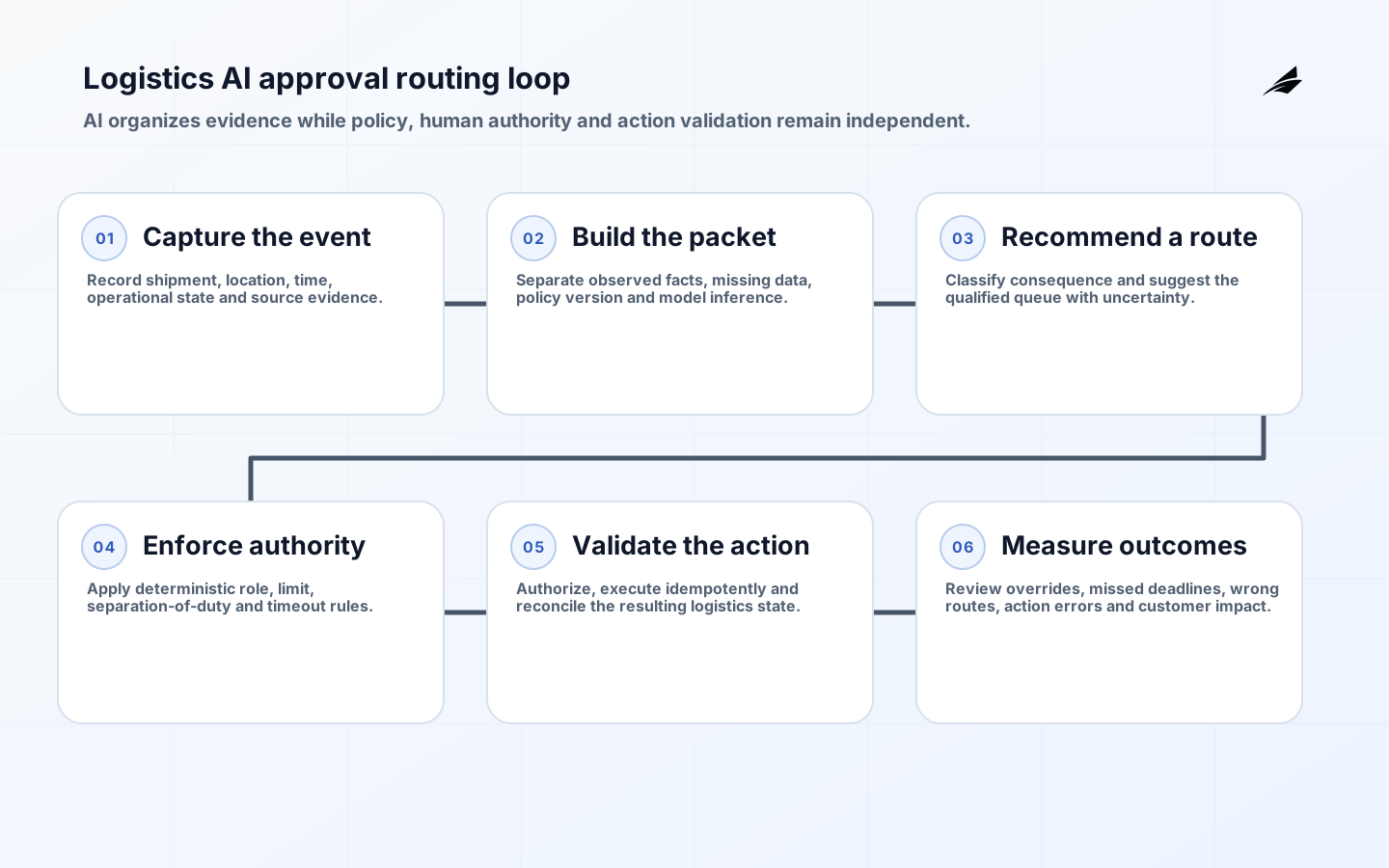
AI approval routing automation for logistics is useful when a high volume of shipments, orders or exceptions must reach the right decision maker with enough evidence to act. The AI may classify a delay, summarize documents or recommend a route, but it should not blur who has authority to release a shipment, waive a fee, change a carrier, accept a compliance exception or override a safety rule. The workflow must separate recommendation, policy, human judgment and the system action that follows.
These answers focus on production controls. The companion logistics AI approval guide and implementation checklist cover broader planning, while the general approval automation checklist helps teams compare patterns outside logistics.
Which logistics decisions are suitable for AI-assisted routing?
Start with decisions that already have a defined owner, evidence packet, policy and service level. Examples include routing a damaged-shipment review, prioritizing a temperature excursion, assigning a documentation exception or recommending which team should inspect a delivery discrepancy. Avoid automating an undefined escalation culture. If experienced operators disagree about authority or evidence, the model will reproduce ambiguity rather than remove it.
Classify decisions by consequence and reversibility. A recommendation to request one missing document is different from releasing regulated goods or changing a route that affects safety. Low-impact, reversible actions may proceed after deterministic checks; material, irreversible or legally significant actions should require an authorized person. Define prohibited actions explicitly.
| Decision type | AI role | Required gate |
|---|---|---|
| Queue assignment | Classify event and suggest responsible team | Deterministic entitlement and fallback queue. |
| Evidence completeness | Identify missing fields or documents | Schema and policy validation before requesting data. |
| Priority recommendation | Summarize impact and time sensitivity | Approved severity rule and operator override. |
| Commercial exception | Prepare options and supporting facts | Authorized human accepts cost and customer consequence. |
| Safety or compliance release | Organize evidence only | Qualified authority makes and records the decision. |
What should the decision packet contain?
Create a structured packet with shipment or order identifier, event time, location, current state, requested decision, source evidence, applicable policy version, consequence of delay and action deadline. Distinguish observed facts from model inferences. Link to original records so a reviewer can verify a summary. Include data freshness and known gaps; stale location or inventory data can make a confident recommendation wrong.

The packet should remain immutable after submission, with amendments appended and attributed. Record the model, prompt or classifier version, retrieved sources, output, deterministic checks, route, reviewer and final action. This supports dispute handling and evaluation. The NIST AI RMF organizes risk work around govern, map, measure and manage; the packet provides evidence across all four.
How should routing and approval authority be implemented?
Keep authority in a versioned policy service or governed rules, not in model text. Resolve approvers by organization, region, amount, commodity, customer, risk and availability. Check that the person is still active and permitted when the approval is made. Delegation should have scope and expiry. A model can suggest the route, but deterministic code should enforce protected queues and separation of duties.
Use explicit states such as pending evidence, pending review, approved, rejected, expired, superseded and action failed. An approval is not complete until the downstream command succeeds and the resulting logistics state is reconciled. Prevent duplicate action with idempotency keys. If policy changes while a request waits, define whether the original or current version applies and show the reviewer.
| Control | Implementation | Evidence |
|---|---|---|
| Least privilege | Scoped reviewer roles and action permissions | Access decision and periodic review. |
| Separation of duties | Requester cannot approve protected exception | Actor history across request and decision. |
| Timeout | Escalate, reassign or expire before operational deadline | Timer event and notified owner. |
| Override | Require reason and stronger authority | Prior recommendation, override reason and outcome. |
| Action confirmation | Validate command and reconcile resulting state | Idempotency key, response and final record. |
How should models and prompts be controlled?
Use the smallest capability that meets the task. Deterministic parsers may be better for standard documents; classification models may route known categories; generative models may summarize unstructured notes. Treat shipment notes, attachments and external messages as untrusted data, not instructions. Restrict tool access and retrieval to the decision purpose and reviewer permissions. The NIST Generative AI Profile identifies risks such as confabulation, data privacy and information integrity that need lifecycle controls.
Version prompts, schemas, models and policies independently. Validate output against a strict structure and reject missing or unsupported claims. Provide a safe unknown outcome. Do not translate a confidence score directly into approval authority unless calibration and consequences support that rule. A low-confidence item should route to a review queue that has capacity, not disappear into a generic exception bucket.
What makes human review meaningful?
Reviewers need time, authority, relevant evidence and a usable interface. Show source facts before the recommendation where anchoring risk matters. Make uncertainty and missing evidence visible. Offer approve, reject, request information and reassign actions with clear consequences. Avoid dark patterns that make the automated recommendation easier to accept than question.
Train reviewers on system limits and escalation. Sample approved and rejected cases, including overrides. Monitor rubber-stamping, unusually fast decisions, repeated requests for missing data and concentration of exceptions in one route. Human review is not a control if the reviewer cannot understand or change the outcome.
How should accuracy and operational value be measured?
Build an evaluation set across regions, customers, carriers, commodities, languages, urgency and exception types. Include rare but consequential cases. Measure route accuracy, evidence completeness, unsupported claims, policy-gate success, override rate and downstream action errors. Segment results rather than relying on one average. Re-run tests after model, prompt, data, policy or workflow changes.
Measure operating outcomes as well: time to qualified decision, queue age, missed deadlines, transfers, reviewer effort, customer impact and cost of wrong actions. Compare against the previous process. A model that improves classification but creates more review work or hides late cases has not improved the logistics system.
How do you secure and recover the workflow?
Protect APIs, documents, service identities and approval links. Apply least privilege, encryption, attachment scanning, rate limits and audit controls. Threat-model prompt injection, manipulated documents, replayed events, identity compromise and denial of service. MITRE ATLAS provides a knowledge base for adversarial threats to AI systems, while NIST SP 800-53 supplies broader access, audit and incident controls.
Design degraded operation. If the model is unavailable, route by deterministic rules or manual triage. If the policy service fails, stop protected actions rather than guessing. Preserve pending requests during outages and reconcile on recovery. Test model rollback, queue replay, credential rotation and correction of a wrong bulk route. Communicate to operations which mode is active.
Walk one temperature-excursion decision end to end
Consider a refrigerated shipment whose sensor reports a temperature excursion. The workflow first verifies device identity, reading time, calibration state, route and commodity threshold. It attaches the relevant telemetry window and checks whether readings from adjacent sensors agree. AI can summarize the event, classify likely severity and identify the qualified quality team, but a governed policy determines whether the shipment must be held. The reviewer sees facts, missing evidence, model inference and the deadline before product viability changes. If the reviewer requests a physical inspection, that request becomes an owned task rather than an email. Approval to release or dispose is recorded with authority and reason before the warehouse system receives an idempotent command.
This scenario exposes controls that a simple accuracy test misses. Late telemetry could arrive after the model recommendation; the policy might differ by commodity or jurisdiction; a reviewer may lack authority for the shipment value; and the warehouse action can fail after approval. Test each boundary. Reconcile the final inventory and customer-notification state, and measure whether the decision arrived before the operational deadline. Retain enough evidence to investigate a later quality claim without keeping unrelated shipment data indefinitely. Similar walkthroughs should cover customs documents, damaged parcels, carrier substitutions and delivery-address changes. Scenario diversity is what turns a general model evaluation into evidence that the logistics approval system works.

Key takeaways
- Automate well-defined routing and evidence preparation before consequential decisions.
- Keep policy and authority outside model output.
- Preserve a complete decision packet from source event through downstream action.
- Design human review for verification and intervention, not passive confirmation.
- Evaluate operational outcomes and maintain a tested non-AI fallback.
Frequently asked questions
Can low-risk logistics approvals be fully automated?
Yes, when the action is bounded, reversible, supported by reliable data and enforced by deterministic policy. Define value and risk limits, monitor exceptions and retain a manual stop. Do not expand autonomy merely because a model's overall accuracy is high; evaluate the exact action and the cost of its worst credible error.
Who is accountable when the recommendation is wrong?
The organization deploying the workflow must assign accountability across business owner, model owner, data owner, reviewer and system operator. A supplier can have contractual responsibilities, but accountability cannot be delegated to an algorithm. Preserve evidence so the organization can understand whether the failure came from data, model, policy, interface, review or action execution.
Conclusion
AI can help logistics teams route exceptions faster when it organizes evidence and reduces search. It should not make authority invisible. Keep policy deterministic, review meaningful, actions independently validated and every decision recoverable. That creates automation that supports operational judgment instead of replacing it with an opaque shortcut.