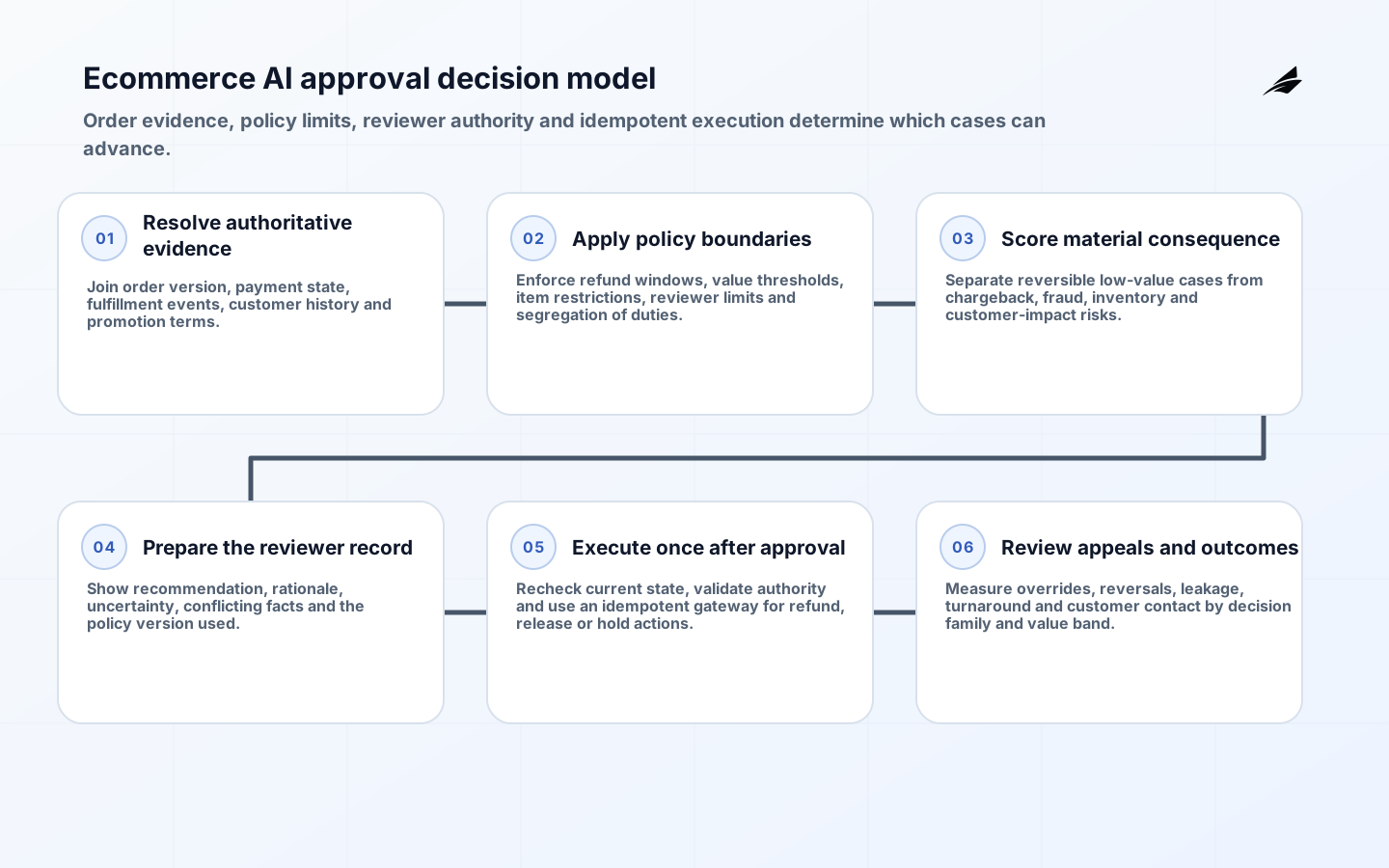
Ecommerce approval queues sit where customer experience, margin protection, fraud controls and payment operations meet. A model may help interpret evidence, but it should not silently decide a high-value refund or release a suspicious order. AI approval routing automation for ecommerce works best when deterministic eligibility rules establish the outer boundary and AI helps summarize, classify or prioritize cases inside it. This checklist covers refunds, promotion exceptions, listing review and order holds, with a focus on authority, reversibility and appeal.
Define the service boundary before selecting technology
Start with a defined decision such as refund eligibility, promotion exception, listing review or order hold release. Observe real cases, including exceptions, reversals and incomplete inputs. Record who initiates the work, which system owns each fact, who may approve an outcome, what makes an action irreversible and how staff recover when an integration fails. This boundary prevents ecommerce approval workflow automation from becoming a vague transformation program. It also exposes policy disagreements before software silently turns them into inconsistent behavior.
For each decision family, document monetary limits, required evidence, prohibited combinations and reviewer authority. A refund packet may include payment status, fulfilment events, return tracking, customer contact and prior exceptions. A promotion override needs the campaign version and margin impact. Define when the decision expires because order state or inventory changes. The system must reject stale packets, use idempotency keys for financial actions and preserve both the recommendation and the policy version applied at the moment of approval.
Architecture and ownership
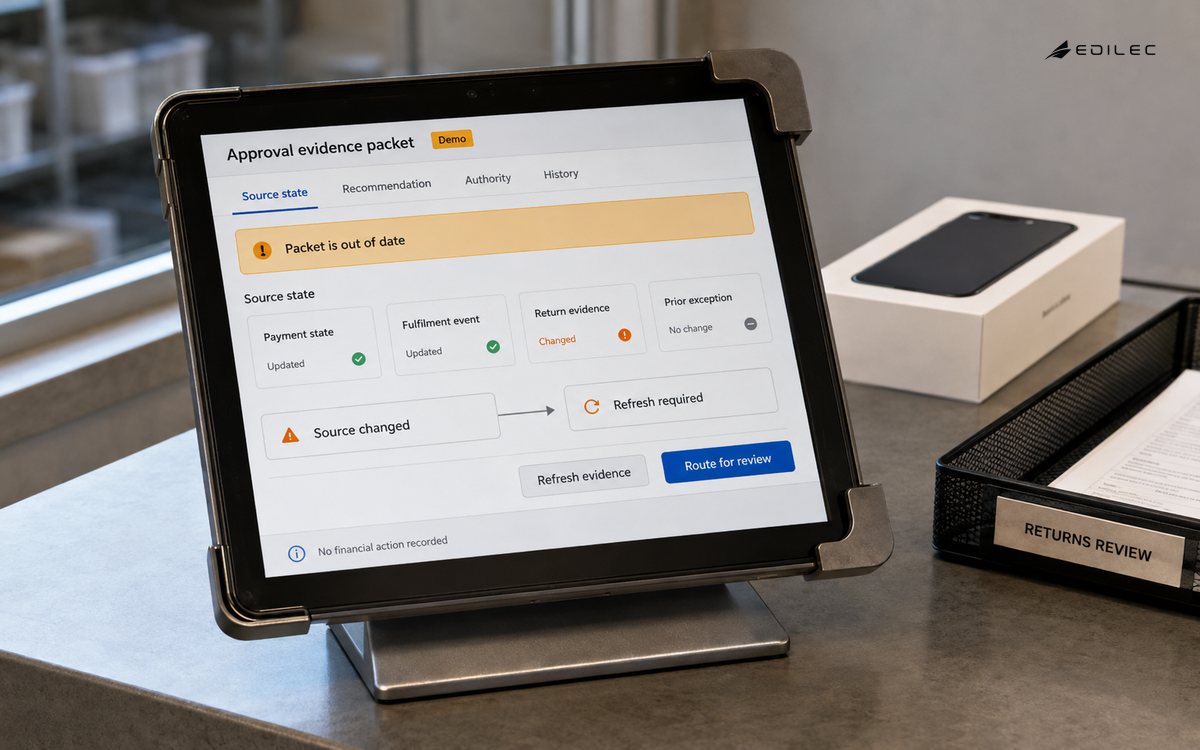
The architecture must preserve authority across order, payment and customer evidence, policy engine with versioned thresholds, risk signal and AI recommendation service, human queue, action gateway and immutable decision log. Each component needs an owner, a versioned contract and observable failure behavior. Avoid direct point-to-point writes from an interface or model into a critical record. A narrow orchestration layer can validate identity, current state, policy and idempotency before an action proceeds, while an audit event records the evidence and rule version used.
| Architecture area | Required design decision | Evidence before release |
|---|---|---|
| order, payment and customer evidence | For this design choice, name the accountable owner, supporting evidence, exception route, and next measurable check. | Approved data-flow and owner |
| policy engine with versioned thresholds | Within this design choice, name the accountable owner, supporting evidence, exception route, and next measurable check. | Authorization and negative tests |
| risk signal and AI recommendation service | When implementing this design choice, name the accountable owner, supporting evidence, exception route, and next measurable check. | Versioned interface plus retry behavior |
| human queue, action gateway and immutable decision log | Before releasing this design choice, name the accountable owner, supporting evidence, exception route, and next measurable check. | Dashboard, alert and recovery runbook |
A six-stage delivery path
Start with historical replay rather than live action. Reconstruct completed cases using only information available at the original decision time, then compare routing and recommendations with the eventual outcome. False positives and false negatives carry different costs, so review them separately by value band and customer segment. In production, introduce read-only recommendations before enabling a narrow reversible action. Cap transaction value, require reviewer confirmation and verify the current order state immediately before execution. Appeals and reversals belong in the pilot evidence.
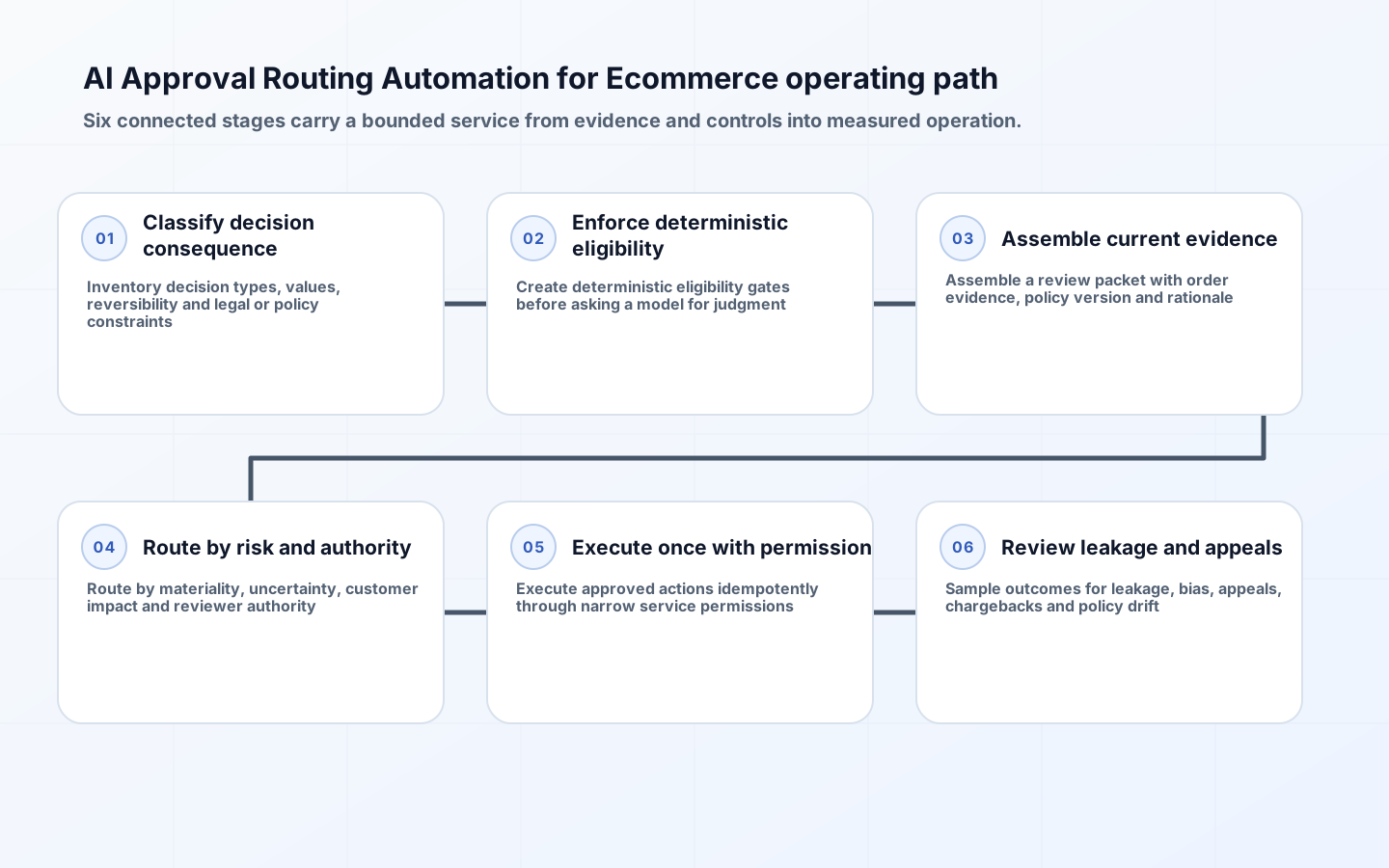
- Inventory decision types, values, reversibility and legal or policy constraints.
- Create deterministic eligibility gates before asking a model for judgment.
- Assemble a review packet with order evidence, policy version and rationale.
- Route by materiality, uncertainty, customer impact and reviewer authority.
- Execute approved actions idempotently through narrow service permissions.
- Sample outcomes for leakage, bias, appeals, chargebacks and policy drift.
Controls and failure modes
Keep policy, authority and transaction execution outside the model. A rules service should enforce refund windows, value thresholds and reviewer limits. The recommendation service receives only the minimum order evidence and returns a structured rationale, uncertainty and missing fields. A separate action gateway validates approval, order version and idempotency before calling payment or commerce APIs. Log access to fraud signals, restrict explanations that could expose detection methods, and give customer-service staff a clear route when the automated packet is incomplete.
| Failure mode | Design response | Operating signal |
|---|---|---|
| Unauthorized refund or credit | Keep payment tools behind value limits and role-based approval. | Value of reversed or exceptional actions |
| Fraud signal overreach | Test segment outcomes and provide a documented appeal path. | False-positive and appeal overturn rate |
| Stale commercial policy | Version rules and invalidate recommendations when policy changes. | Decisions using superseded policy |
| Duplicate action | Use idempotency keys and verify current order state before execution. | Duplicate credits or state writes |
Measure outcomes, not activity
A dashboard should connect technical behavior to the intended operating result. Track decision turnaround by value and exception class; straight-through rate for genuinely reversible low-risk cases; reviewer override and appeal overturn rate; chargeback, refund leakage and customer-contact rate. Segment results by workflow type and material risk instead of hiding poor tails inside a global average. Review a sample of accepted, corrected, escalated and failed cases. When a metric moves, retain enough trace evidence to identify whether the cause was source data, policy, interface behavior, model output, reviewer workload or downstream execution.
Measure turnaround by decision family and value band, then pair speed with leakage, chargeback, appeal and customer-contact outcomes. Reviewer override is useful only when reasons are captured: stale policy, missing evidence, commercial discretion or poor recommendation. Compare segments for uneven holds or denials and investigate material differences. A high straight-through rate is not a goal for irreversible cases. The target is fewer avoidable handoffs for routine decisions while high-consequence cases reach an appropriately authorized person with a complete packet.
Cost, timeline and commercial model
Estimate by decision family, not ticket count alone. Complex integrations, fragmented promotion rules, reviewer scheduling and post-decision monitoring often dominate model cost. A pilot should cap transaction value and include rollback funding. Timeline should be expressed as evidence-bearing stages: discovery, thin-slice build, controlled pilot and measured expansion. Procurement should require source access, documentation, data export, incident support and transition assistance. A lower quote is not cheaper if it omits evaluation, operating ownership or the path away from the chosen provider.
Rehearse the operating model before expansion
A useful rehearsal for AI approval routing automation for ecommerce follows one representative case from intake through final evidence. The team should interrupt the exercise after each transition and ask which record is authoritative, whether the acting identity has permission, whether the rule is current, and whether retrying would create a duplicate outcome. Run the same case with a missing field, delayed dependency and unavailable reviewer. This reveals assumptions that unit tests and polished demonstrations often miss, especially where order, payment and customer evidence meets policy engine with versioned thresholds.
Next, simulate the two most consequential failure modes: unauthorized refund or credit and fraud signal overreach. Operators should identify the alert, inspect the trace without broad production access, contain further actions, communicate with affected users and restore a known state. Record elapsed time and every manual workaround. If the team cannot determine what happened from the retained evidence, the workflow is not ready for a wider cohort, even if its normal path appears efficient.
The ecommerce release record should contain policy versions, decision schemas, value limits, reviewer roles, test orders, action permissions, idempotency design and appeal handling. Include evidence from historical replay and a list of cases excluded from automation. Finance should approve reconciliation and reversal procedures; fraud teams should approve signal handling; customer operations should verify explanations and escalation. This shared packet prevents a fast commercial rule change from bypassing controls embedded across several services.
Exercise a partial refund on a split shipment, a promotion exception after campaign expiry and an order hold with contradictory fraud signals. Change the order between approval and execution to confirm stale-state rejection. Retry the payment callback and verify that no duplicate credit appears. Then remove the assigned reviewer and observe reassignment against service targets. These scenarios test the race conditions and authority changes that simple happy-path demonstrations miss, and they produce evidence directly relevant to financial loss and customer harm.
Practical takeaways
- Anchor AI approval routing automation for ecommerce to one named outcome and accountable owner.
- Treat a defined decision such as refund eligibility, promotion exception, listing review or order hold release as the first deliverable, not an assumption.
- Keep permissions, policy and irreversible actions in deterministic services with review evidence.
- Pilot with representative exceptions and retain a tested manual route.
- Measure decision turnaround by value and exception class alongside quality, risk and human workload.
- Expand only when the current release is supportable, observable and recoverable.
Frequently asked questions
- What should the first engagement deliver? It should deliver a process map, data and authority model, risk register, thin-slice backlog, evaluation plan, cost range and explicit decision on what will remain manual.
- How long should a pilot run? Long enough to include ordinary cases, realistic exceptions and at least one controlled recovery exercise. Calendar duration matters less than representative evidence and a pre-agreed exit decision.
- Can a team buy a platform before discovery? A short technical trial can inform discovery, but procurement should follow the service boundary and control requirements. Otherwise the available product features begin defining the business process.
- Who owns the released service? A business owner is accountable for policy and outcomes; a technical owner is accountable for reliability and change; security, privacy and domain specialists approve relevant controls. A vendor can support these roles but should not replace them.
- How is success demonstrated? Compare the agreed baseline with completed outcomes, corrections, exceptions, failures, cost and user impact. Pair aggregate metrics with case review so a favorable average cannot conceal harmful edge cases.
Conclusion
Ecommerce approval automation should shorten the path to a defensible decision, not remove accountability from it. Deterministic boundaries, current transaction evidence, explicit reviewer authority and idempotent execution are the core design. AI can summarize complex cases and improve prioritization once those foundations exist. Expand decision family by decision family, review appeals and segment outcomes, and preserve a human route for commercial judgment. That combination protects both customer experience and the integrity of money-moving operations.