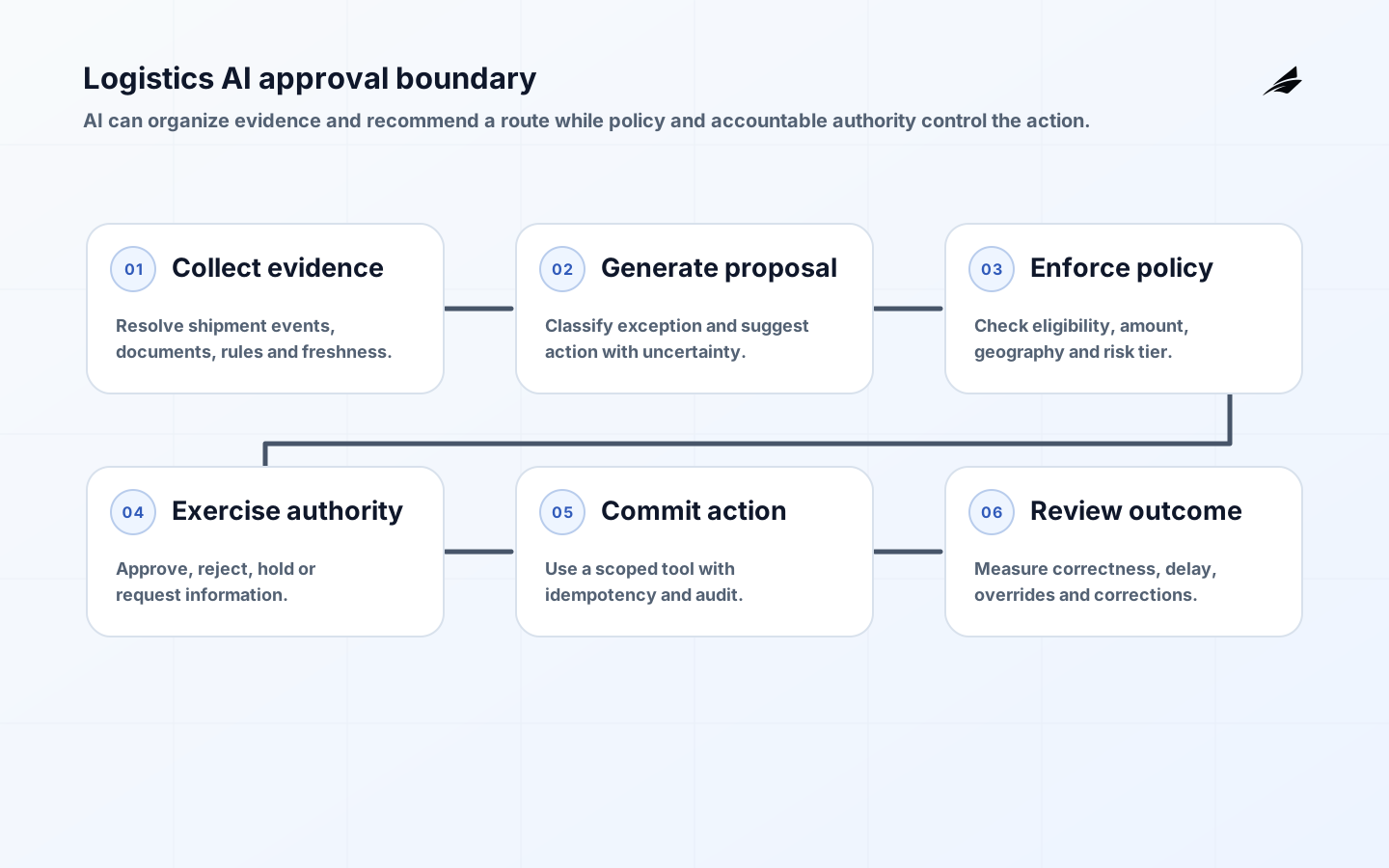
AI Approval Routing for Logistics: A Controlled Implementation Guide requires more than selecting tools or assembling a feature list. The implementation must connect a defined business outcome to data, authority, failure behavior and permanent ownership. This guide explains the decisions a buyer, product leader and delivery team should settle before committing the full build. It uses current primary standards where they define a useful control, while keeping the architecture proportional to the actual workflow and consequence.
The practical goal is an operable service: people can complete the intended work, understand state and exceptions, and recover when a dependency or decision fails. Scope therefore includes discovery, design, integration, security, delivery, rollout and support. The sections below can be used for proposal review, architecture workshops and acceptance planning. Related reading includes AI Approval Routing for Logistics: Controls, Exceptions and Human Review FAQ, Human Approval Design for AI Automation, AI Workflow Approvals: Authority, Evidence and Human Review.
Choose the decision, not the model
Begin with a specific approval such as releasing a shipment hold, accepting a detention charge, choosing an exception owner or approving a route deviation. State the financial, safety, contractual and customer consequences of a wrong approval and the time available. Determine whether AI is needed: deterministic rules may be superior when policy and data are explicit. AI can classify documents, summarize evidence or recommend a route while a policy engine enforces authority. Do not let a model infer permissions or approve its own access to more data or tools.
Create a decision card for each use case: purpose, owner, eligible cases, prohibited cases, input sources, policy authority, action, reversibility and appeal. This card becomes the boundary for evaluation and monitoring. If the desired outcome is shorter queue time, first confirm that delay comes from classification rather than missing documents or insufficient approvers. AI cannot remove an organizational approval that policy still requires.
Build an evidence packet from authoritative events
The reviewer should see the shipment, parties, current milestone, exception, source events, commercial rule, model output and missing evidence in one packet. GS1 EPCIS can inform event semantics, but source quality and partner mapping still require governance. Preserve occurrence time, receipt time and provenance. Keep retrieved documents and model-generated explanation distinct. A fluent summary is not evidence. If required data is stale, conflicting or absent, the workflow should route to investigation or a safe default rather than converting uncertainty into an apparently confident approval.
Assign trust levels to each source and show them to the policy layer. A carrier milestone may be authoritative for one event while a customer email supplies unverified context. Validate document type and sender before extraction. Protect against instructions embedded in attachments or messages that try to redirect an AI component. Store hashes, retrieval identifiers and versions so the evidence packet can be reproduced after source content changes.
| Decision tier | Example | Permitted automation | Required safeguard |
|---|---|---|---|
| Decision tier | Example | Permitted automation | Required safeguard |
| Assistive | Summarize exception evidence | Draft and prioritize | Reviewer sees sources and missing data |
| Low consequence | Route a routine document mismatch | Auto-route within policy | Sample review and deterministic fallback |
| Material | Approve a moderate accessorial charge | Recommend only | Authorized reviewer and amount limit |
| High consequence | Release safety or compliance hold | No autonomous commitment | Independent evidence and named authority |
Separate recommendation, policy and authority
Implement three boundaries. The model proposes a classification or action; deterministic software checks policy, thresholds and eligibility; an authorized person or pre-approved rule commits the consequential action. Encode approval limits by role, tenant, amount, commodity, geography and exception type. Require two-person control where consequences justify it. The model must not choose its own threshold or reviewer. The NIST AI RMF functions—govern, map, measure and manage—support continuous risk ownership, while legal teams should assess whether specific uses fall under obligations such as the EU AI Act.

Represent policy in reviewed rules with effective dates and tests. A change in approval limit should not require retraining a model. The policy service must fail closed or route to human review when it cannot determine eligibility. Log the rule and data used without exposing secrets. Separate a model’s probability from business risk tolerance; identical confidence can lead to different actions for reversible routing and irreversible release.
Design meaningful human review
A review screen must offer enough time, evidence and alternatives for independent judgment. Show what the system recommends, why, what it could not verify and which policy applies. Provide approve, reject, request information, reroute and safe-hold options. Do not preselect approval or penalize reviewers for careful escalation. Measure overrides and downstream correctness by scenario, not as evidence that humans are obstructing automation. Rotate samples of auto-routed low-risk decisions into review so silent deterioration can be detected.
Test reviewer understanding, not only click time. Ask people to explain the evidence and policy behind sampled decisions. Provide keyboard-accessible comparison, source previews and clear stale-data warnings. Prevent queue pressure from silently lowering review quality by monitoring age and staffing. An escalation must reach someone with authority and context. Reviewers should be able to flag a recurring model or source problem for system-level correction.
Evaluate the complete routing system
Offline model accuracy is only one input. Test representative lanes, partners, documents, languages, rare exceptions and policy changes. Measure incorrect approval, incorrect rejection, unsafe delay, unnecessary escalation and calibration at the actual thresholds. Red-team prompt and document inputs if generative components are used. Run shadow mode against historical and live decisions without committing actions, then compare downstream outcomes. Evaluate policy enforcement, queue behavior, identity, explanation and recovery together; a correct recommendation routed to the wrong authority remains a system failure.
Build a labeled evaluation set through independent adjudication and preserve disagreement. Sample by partner, lane, amount and exception rather than overall frequency. Use temporal holdout so evaluation reflects future policy and data changes. Report confidence intervals for rare high-impact failures. In online experiments, constrain exposure and define rollback. Never optimize only for agreement with historical approvals when those approvals contain bias or inconsistent policy application.
| Area | Question | Control |
|---|---|---|
| Evaluation measure | Question | Failure response |
| Incorrect approval | Was an ineligible action allowed? | Stop affected tier and inspect policy plus evidence |
| Incorrect rejection | Was valid work delayed or denied? | Adjust threshold and provide recovery |
| Calibration | Does confidence match observed correctness? | Recalibrate or narrow automation |
| Queue age | Can reviewers act within the decision window? | Add capacity or reduce automated intake |
| Override outcome | Did human intervention improve the result? | Review guidance, evidence and incentives |
Monitor drift, queues and consequences
Production monitoring should connect model version, prompt or feature version, evidence packet, policy version, route, reviewer and committed action. Track data freshness, confidence distribution, escalation rate, override patterns, queue age and downstream corrections. Define stop conditions for source outages, abnormal volume, policy mismatch or error concentration. Keep a deterministic route and manual queue available. Incident response must be able to identify affected decisions, suspend automation, notify owners and reverse or compensate actions where the business process permits.
Maintain a registry of deployed models, prompts, data sources, tools, policies and owners. Link each decision to the registry versions. Monitor for source mix change and missingness, not only feature distribution. Establish periodic review and immediate reassessment after incidents or material policy change. Retirement includes disabling tool credentials, preserving required records and updating dependent procedures so staff do not continue relying on an unavailable recommendation.
Roll out by consequence tier
Classify decisions by consequence and reversibility. Start with summarization and suggested routing for low-risk exceptions, then enable bounded automatic routing where evidence quality and policy are strong. Keep commitment of high-value or safety-related actions under human authority until robust evidence supports another model and applicable law permits it. Expand by lane or customer only after review capacity, fallback and audit retrieval are proven. Document who accepts residual risk and when the use case must be reassessed.
Write explicit promotion criteria between tiers: minimum evaluated cases, maximum harmful error, calibration range, review capacity and successful recovery exercise. Approval should come from business, risk and technical owners. Keep customers informed where automated processing affects their service and provide a contest route where appropriate. Expansion to a new geography or commodity is a new context requiring mapping and testing, not a simple configuration switch.
Key takeaways
- Use AI to recommend or route; keep policy and authority deterministic.
- Show reviewers authoritative evidence, uncertainty and real alternatives.
- Evaluate downstream decision outcomes, not model accuracy alone.
- Expand automation by consequence tier with tested fallback and stop conditions.
Frequently asked questions
Does human approval automatically make AI safe?
No. Review can fail when evidence is poor, time is insufficient, the interface nudges approval or the reviewer lacks authority. Human review must be designed and measured as a control.
When should rules be used instead of AI?
Use rules when policy conditions are explicit, data is reliable and exceptions are enumerable. AI is more useful for unstructured evidence or probabilistic classification, while deterministic software should still enforce permissions and limits.
Should the model generate an explanation?
It may produce a summary, but the interface should link claims to source evidence and policy. Generated prose must not be presented as the reason an action was legally or operationally authorized.
Conclusion
AI approval routing for logistics is dependable only when recommendation, policy and authority remain distinct. The system should assemble traceable evidence, expose uncertainty, support independent review and preserve a safe route when data or models fail. A consequence-tiered rollout grounded in NIST risk practices and applicable obligations lets teams gain speed without obscuring who made the decision or why. Reassess each use case when policy, partners, data sources, model capability or the consequences of error change. Preserve sampled decisions and downstream results long enough to test whether the routing remained beneficial, fair and correct across important logistics contexts.