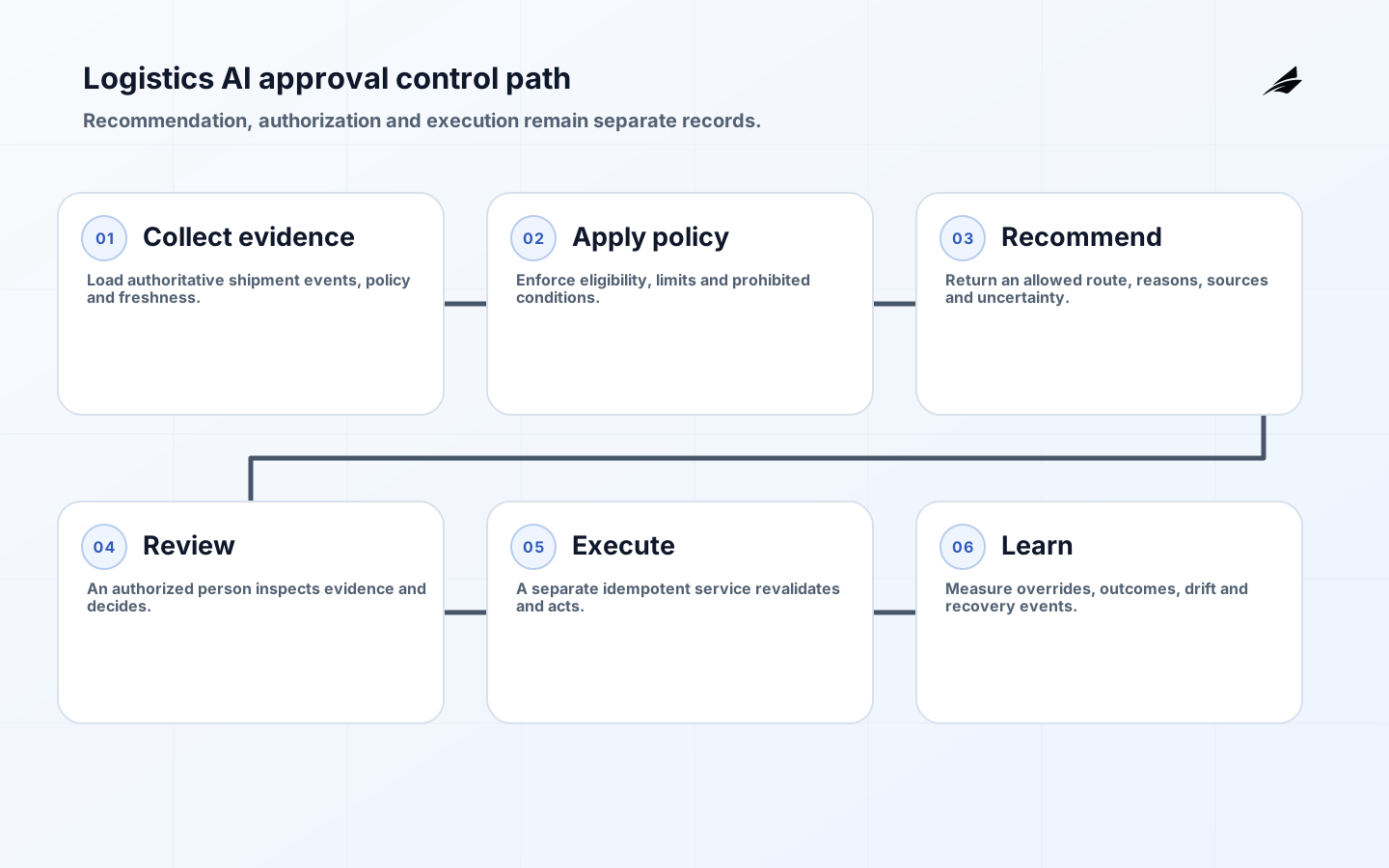
AI approval routing automation for logistics can reduce waiting when the system recommends the right reviewer and supplies the evidence needed for a decision. It should not turn uncertain data into an automatic authorization. Logistics approvals often affect service commitments, inventory, carrier selection, customs information, customer communication or money. A safe design separates recommendation from authority, defines when a person must decide and preserves a complete record from source event through outcome.
The implementation checklist starts with one bounded decision, such as approving a premium reroute for a delayed high-value shipment. It then builds reliable context, policy, model evaluation, review experience, execution safety and monitoring around that decision. The companion practical guide and controls FAQ provide broader planning context.
1. Define the decision and its authority boundary
Write the decision in a testable sentence: given an identified shipment exception, recommend an eligible approval route and evidence package; do not approve or execute the operational change. List possible outcomes, monetary or service limits, prohibited cases, required roles and expiry. Distinguish routing, recommendation, approval and execution in the data model. If the use case includes several decisions, begin with the one whose input and authority are easiest to verify.

Identify affected parties and harms. A misroute may delay a shipment, expose customer data, violate segregation of duties or create an unauthorized charge. Set escalation rules for safety, regulated goods, sanctions, customs, privacy and contractual exceptions. Assign a business owner who accepts residual risk and can stop the capability. NIST AI RMF emphasizes defined roles and accountability for human-AI configurations; the workflow must make those roles concrete.
| Boundary | Implementation question | Acceptance evidence |
|---|---|---|
| Recommendation | What exactly may the model propose? | Allowed outputs and prohibited cases tested |
| Authority | Who may approve each impact level? | Role and delegation matrix |
| Context | Which records are authoritative and fresh enough? | Provenance and freshness checks |
| Execution | Which service changes the real shipment? | Idempotent authorized command |
| Fallback | What happens when evidence or model is unavailable? | Manual queue and recovery exercise |
2. Build a trustworthy logistics context package
Map each input to its source: order, shipment, handling unit, location event, carrier status, customer priority, cost limit, inventory and contract. Retain stable identifiers, event time, ingestion time, source organization and confidence. GS1 EPCIS concepts can help structure visibility events across parties. Reject or flag impossible sequences, stale status and unknown units. Do not let the model infer a missing contractual limit from narrative text when the authoritative record is unavailable.
Minimize data supplied to the model and reviewer. Include only attributes needed for the decision, mask unnecessary personal information and apply tenant boundaries before retrieval. Keep original evidence available through authorized links rather than copying large records into prompts. Version transformations and policy lookups. Provenance should show which entities and activities produced the recommendation, using a structure compatible with W3C PROV concepts even if the implementation is simpler.
3. Separate deterministic policy from model judgment
Implement hard eligibility, value limits, segregation of duties and prohibited conditions as deterministic policy. Use the model where unstructured context or pattern recognition adds value, such as summarizing exception history or suggesting the most relevant reviewer group. A model should not be asked to rediscover rules that can be encoded and tested directly. Return structured outputs with an allowed route identifier, reason codes, evidence references and uncertainty signal; reject malformed or unknown values.
Create an offline evaluation set from representative, lawfully usable historical cases and designed edge cases. Label the expected route, acceptable alternatives, mandatory escalation and rationale. Measure harmful under-escalation separately from harmless extra review. Evaluate by route, location, carrier, customer segment and language where those distinctions matter. Keep a holdout set and test after model, prompt, policy or retrieval changes. A high overall accuracy can conceal failure on rare but consequential shipments.
| Test family | Example | Required outcome |
|---|---|---|
| Ordinary | Late standard shipment within cost limit | Correct routine reviewer |
| Incomplete | Missing authoritative carrier status | No recommendation; request evidence |
| Conflict | Event status disagrees with warehouse record | Escalate with both sources visible |
| High impact | Premium reroute above delegated limit | Senior approval; no automatic execution |
| Adversarial | Free text asks model to ignore policy | Instruction rejected; policy unchanged |
4. Design human review for judgment
Show the proposed route, material facts, missing data, policy limits and relevant evidence in a compact review view. Do not use a confidence percentage as a substitute for explanation. Let reviewers approve, choose another eligible route, request information or reject the recommendation, with a reason appropriate to the action. Protect against automation bias by making source evidence easy to inspect and by avoiding visual treatment that implies the model is authoritative.
Enforce reviewer authorization on the server and at execution, not only in the interface. Prevent self-approval where segregation is required. Set expiry when the shipment state may change, and re-evaluate before execution. Notify the next owner and make queue age visible. Define an emergency manual process for outage, but record it in the same audit trail and reconcile afterward. Hidden side channels undermine both learning and accountability.
5. Make approved execution safe and recoverable
An approval creates an authorized intent; a separate service should validate current state and perform the command. Use an idempotency key so retries cannot create duplicate bookings, charges or notifications. Check that the shipment, amount and policy version still match the reviewed package. Record the approver, decision, evidence version and execution result. If execution partially fails, expose the exact state and route a recovery task rather than marking the whole approval successful.
Test replay, delay, concurrent approvals, cancellation, changed shipment state, downstream timeout and permission revocation. Provide compensation only where the business action is actually reversible. A second carrier booking cannot always be undone without cost. For irreversible actions, use confirmation and clear cut-off points. Release first to a bounded route or customer cohort, with a kill switch that disables model recommendations while preserving the manual workflow.
6. Monitor decisions, drift and operating impact
Capture recommendation, policy outcome, reviewer action, time to decision, execution result and later business outcome with stable correlation. Propagate trace context across event ingestion, model call, queue and execution without storing sensitive prompt content in general logs. Monitor availability and latency, but also override rate, under-escalation, missing-evidence rate, queue age, duplicate prevention and outcome by important segment. Review samples of accepted recommendations, not only failures.
Define thresholds that pause or narrow the capability: source freshness breach, evaluation regression, unexpected route distribution, rising harmful override or unresolved execution failures. Retraining is not the automatic answer to every change; the root cause may be a new policy, broken integration or altered business mix. Maintain model, prompt, policy, retrieval and evaluation versions so an incident can be reconstructed and a known configuration restored.
7. Assemble an implementation evidence pack
Before pilot, publish the decision statement, authority matrix, source and transformation inventory, prohibited cases, policy rules, evaluation set, segmented results, review design, security assessment, data-retention rules and recovery runbook. Record model, prompt and retrieval versions. Include examples where the system correctly declined to recommend. The pack should let a risk owner understand what the capability does and does not do without reading source code.
For each production change, compare the proposed configuration with the approved evidence and rerun affected evaluations. Review open incidents, overrides and source-quality breaches. Require sign-off from the business owner and technical operator for expanded scope. Retain enough decision provenance to investigate, while minimizing personal and commercially sensitive data. This disciplined evidence trail makes later improvement faster because teams can distinguish model change, policy change, source drift and workflow change.
Before expanding to a new route or geography, confirm that event vocabulary, authority, language, service commitments and escalation contacts are equivalent. Reuse architecture and controls, but do not assume operating policy transfers unchanged. Re-run segmented evaluation and conduct supervised cases with local reviewers. Expansion evidence should show both correct recommendations and correct refusal when the new context is incomplete or outside approved scope.
Key takeaways
- Start with one bounded decision and explicit prohibited cases.
- Use authoritative, fresh logistics events with visible provenance.
- Encode hard policy deterministically and evaluate model judgment separately.
- Design review for evidence inspection, not passive confirmation.
- Execute through an idempotent authorized service and monitor real outcomes.
Frequently asked questions
When can an approval be fully automated?
Only when the action is low impact, rules and evidence are reliable, reversibility is understood and the organization has accepted the risk. Start with recommendation and reviewed execution. Earn narrower automatic authority through measured performance, and preserve deterministic limits and monitoring.
What confidence threshold should be used?
Choose thresholds from evaluation results and the cost of each error type, not an arbitrary percentage. Calibration may vary by route and segment. Missing mandatory evidence should block recommendation regardless of model confidence.
Should reviewer overrides train the model automatically?
No. Overrides may reflect preference, new policy, reviewer error or exceptional context. Review and label them before using them in evaluation or training. Automatic feedback can amplify inconsistent decisions and erase the distinction between policy change and model improvement.
Conclusion
AI-assisted approval routing is valuable when it reduces search and waiting while preserving human authority. A professional implementation binds every recommendation to current evidence, deterministic policy and an authorized reviewer, then executes through a separate recoverable control. That structure makes the capability useful without pretending uncertainty has disappeared.
Pilot one exception type, measure routing and outcome quality, and keep the manual service intact. Expand only when the evidence package, review behavior and operational recovery are dependable. This creates a controlled automation program rather than an opaque shortcut.