AI approval routing automation for finance should assemble evidence and send work to the correct authority; it should not quietly acquire authority to commit funds. The safest design separates deterministic policy, AI-assisted interpretation, human approval and transaction execution. That separation makes errors containable and preserves the evidence finance, audit, risk and operations need to explain why a payment, journal, expense or purchase request moved forward.
This FAQ is for controllers, finance operations, procurement, risk and engineering teams. Use the finance approval automation guide to frame the use case and the finance implementation checklist for release evidence. The general AI approval checklist covers patterns outside finance.
Which finance work is suitable for AI-assisted routing?
Good candidates have repeatable intake, known evidence requirements, explicit approval policy and a bounded set of destinations. Examples include classifying invoice exceptions, identifying the likely cost center, checking whether supporting documents are present, summarizing contract terms for a reviewer or selecting the next approval queue. Start where a wrong suggestion is visible and reversible before posting or payment.
Avoid autonomous use where policy is unresolved, source data is unreliable or the action can create material loss without independent control. Credit, fraud, sanctions, tax and regulated reporting decisions may involve specialized models, obligations and accountable review. Define the exact decision and obtain legal, compliance and model-risk interpretation for the organization and jurisdiction. Calling a model output a recommendation does not reduce risk if staff routinely rubber-stamp it.
| Workflow step | Preferred mechanism | Why |
|---|---|---|
| Required-field validation | Deterministic rules | Complete and directly testable |
| Document classification | Bounded model with confidence policy | Handles variable formats but needs evaluation |
| Approval authority | Versioned policy engine | Must reflect delegated limits and separation |
| Ambiguous exception | Named human reviewer | Requires accountable judgment |
| Posting or payment | Controlled transactional system | Needs authorization, idempotency and reconciliation |
| Quality improvement | Reviewed feedback process | Prevents unverified labels from becoming truth |
How should decision authority be modeled?
Create a decision table for amount, entity, cost center, category, project, contract, geography, risk flag and submitter relationship. Name who may request, review, approve, substitute and execute. Encode current delegated authority and separation-of-duty constraints in a versioned policy service. AI may extract or propose policy inputs, but the policy engine should determine the required route from verified values.
Define escalation for missing, conflicting or out-of-policy information. Prevent self-approval and hidden delegation. Time-bound substitutes and record the original and acting approver. Emergency routes need separate authority and retrospective review, not a generic override. A changed policy should affect new decisions predictably while historical approvals retain the policy version and evidence used at that time.
What evidence should the workflow assemble?
Assign a stable request identifier and preserve the source document or system reference. Normalize supplier, amount, currency, tax, purchase order, receipt, contract, cost center and due date while retaining provenance for each extracted field. Validate totals and references against authoritative systems. Treat model-produced values as candidates until confidence and rule checks permit use; never overwrite the original evidence.
Present reviewers with the request, matched records, discrepancies, policy route, model confidence where meaningful, prior actions and an explanation of what remains uncertain. Avoid long generated narratives that hide the decisive facts. Sensitive information should be limited by role, and prompts, outputs and logs should not expose bank, payroll, tax or supplier data beyond approved systems and retention.
How should the AI component be evaluated?
Build a reviewed evaluation set from representative documents, suppliers, languages, entities, layouts and exception types. Separate development and release sets. Score field extraction, classification, route recommendation, abstention and harmful error by subgroup and business consequence. A wrong bank-account field is not equivalent to an imperfect description. Establish thresholds for automatic progression to policy checks, human review and hard stop.
Test prompt injection and hostile document content when generative models read attachments or messages. Constrain tools, retrieve only authorized records, validate structured outputs and keep model text out of executable queries. NIST's Generative AI Profile and the OWASP LLM guidance both support lifecycle risk work; neither replaces use-case-specific validation. Record model, prompt, configuration, retrieval source and policy version for reproducibility.
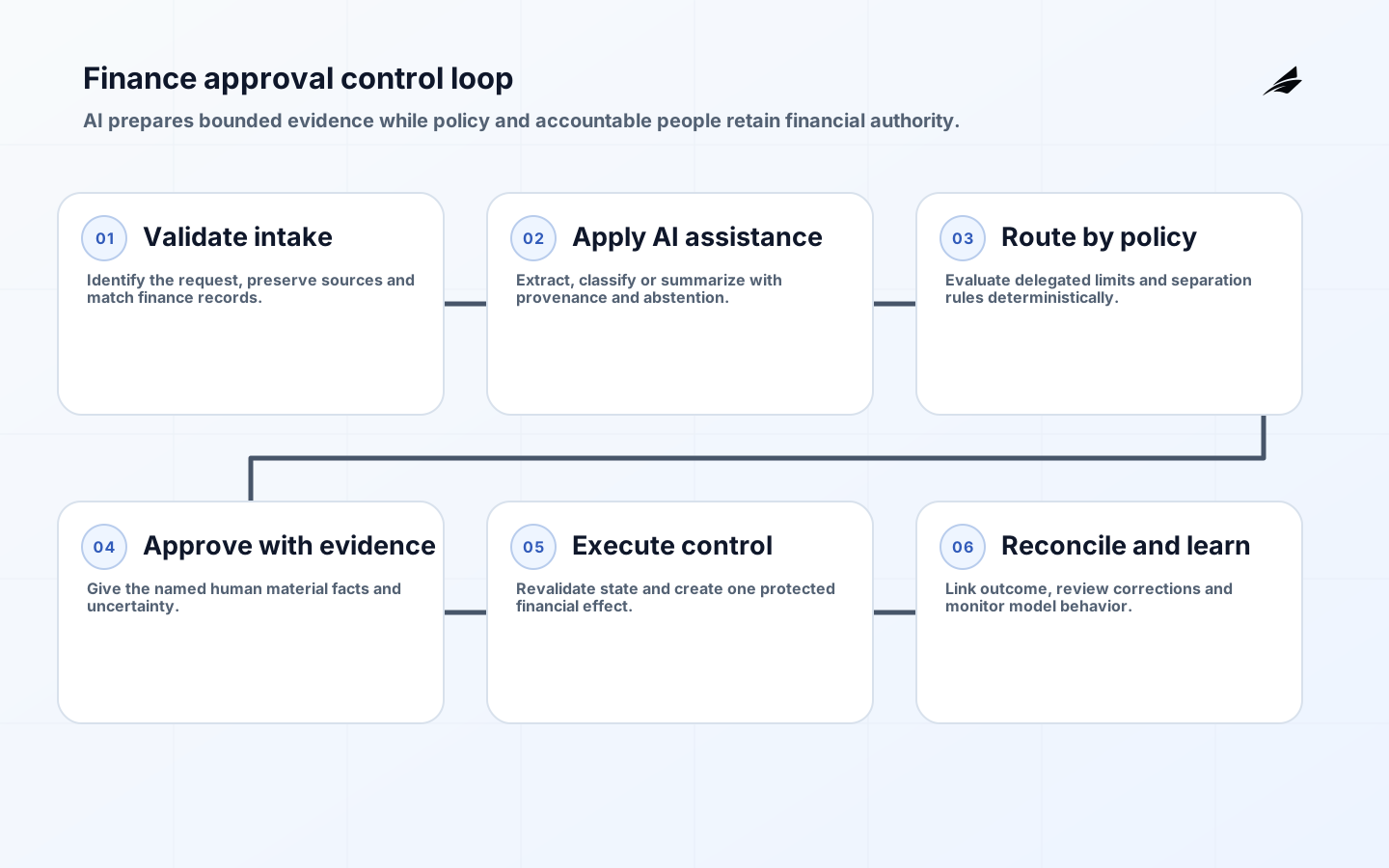
How does the finance approval control loop work?
- Capture the request and immutable source references.
- Validate required fields and match authoritative finance records.
- Use the bounded model to extract, classify or summarize uncertain content.
- Evaluate delegated authority and separation rules deterministically.
- Route evidence to the named reviewer or approver for judgment.
- Execute through a controlled transaction with duplicate protection.
- Reconcile the outcome and feed reviewed errors into monitoring.

Each transition should have an allowed actor, entry criteria, timeout and failure state. Long-running approvals need reminders, escalation and cancellation behavior. Execution should confirm that policy, master data and authorization are still current; an approval should not remain indefinitely valid after supplier details or amounts change. Correlate the approval record to the resulting ERP, payment or journal transaction.
What security and audit controls are required?
Apply least privilege, individual identity, multi-factor authentication where appropriate, managed secrets, encryption, environment separation and restricted production administration. NIST SP 800-53 includes separation-of-duties and least-privilege control families that can inform requirements. Protect model and workflow configuration through review and deployment controls. Do not permit a model to select arbitrary tools, accounts or payment destinations.
Audit evidence should include request, source references, material normalized fields, policy version, model and configuration version, confidence or abstention, route, human actions, timestamps, changes, execution identifier and reconciliation result. Retain only what policy and applicable obligations require. Logs must be tamper-evident enough for their purpose and accessible to authorized investigation without becoming a duplicate store of sensitive documents.
| Risk | Control | Monitoring signal |
|---|---|---|
| Incorrect extraction | Provenance, validation and human review threshold | Correction rate by field and document class |
| Wrong approver | Versioned authority policy and negative tests | Reroutes and policy denials |
| Rubber-stamping | Clear uncertainty and sampled review | Approval time and disagreement pattern |
| Prompt injection | Untrusted-content isolation and constrained tools | Blocked instructions and anomalous tool requests |
| Duplicate payment | Stable identifiers and execution idempotency | Duplicate attempts and reconciliation breaks |
| Model drift | Fixed evaluation set and release gate | Performance by cohort and model version |
How should rollout and monitoring be governed?
Run the workflow in shadow mode first: produce routes and summaries without influencing the live decision, then compare them with reviewed outcomes. Move to assisted routing for a bounded entity, document type and amount band. Keep a fast disable path that returns work to a known manual process. Expand only when correction, exception, review time, control performance and user behavior are acceptable.
NIST AI RMF organizes risk work through Govern, Map, Measure and Manage. Translate those functions into named ownership, use-case context, evaluation, monitoring and response. For banking organizations within scope, the Federal Reserve's April 2026 SR 26-2 revised guidance supersedes SR 11-7 and emphasizes risk-based model governance tailored to model profile and use. Other firms should map applicable internal and external requirements rather than borrowing a banking rule without context.
Monitor abstention, corrections, rerouting, processing time, aged approvals, policy exceptions, duplicate attempts, reconciliation breaks and model performance by material cohort. Review overrides for both valid judgment and policy bypass. Revalidate after model, prompt, data source, workflow or authority changes. Keep rollback artifacts and supplier escalation contacts. A periodic meeting without thresholds or funded remediation is not continuous monitoring.
Design meaningful human review and challenge
Train reviewers on what the model does, known failure modes, confidence limits and when to escalate. Show source evidence beside extracted values and require a reason for selected overrides without creating burdens that encourage superficial clicks. Rotate sampled second review across both approvals and rejections. Measure disagreement, correction and time by scenario so the team can identify automation bias or an interface that hides uncertainty.
Provide a challenge path for requesters and affected suppliers where appropriate. A reviewer should be able to return work for missing evidence, request specialist judgment or reject with a policy-linked reason. Feed confirmed corrections into a governed dataset only after label review; raw overrides may reflect policy exceptions, hurried users or interface defects rather than model truth. Monitor challenge outcomes for recurring control defects.
Key takeaways
- Use AI for bounded interpretation and routing, not implicit financial authority.
- Keep delegated approval and separation rules deterministic and versioned.
- Preserve field-level provenance and original evidence for reviewer judgment.
- Evaluate errors by financial consequence and test hostile document content.
- Release gradually, reconcile execution and monitor human as well as model behavior.
Frequently asked questions
Can AI auto-approve low-value expenses?
A deterministic policy may permit straight-through processing for a tightly bounded class after required evidence and controls pass. The model should not invent the authority. Define amount, category, entity, fraud, duplicate and sampling conditions, then retain an accountable owner and stop mechanism.
Is a generative model required?
No. Rules, conventional extraction, classifiers and workflow engines may be more accurate and easier to validate. Use a generative model only where variable language or documents create a material advantage and the added uncertainty can be governed.
How should return on investment be measured?
Compare total handling time, aged requests, correction work, control exceptions, payment delays and reconciliation breaks with a baseline. Include model, review, integration, security and monitoring cost. Faster routing is not beneficial if errors or rubber-stamping increase financial risk.
Conclusion
Finance approval automation is dependable when AI prepares bounded evidence and accountable policy decides who must act. Preserve provenance, validate models against consequential errors, keep human authority visible and reconcile every executed effect. That architecture can reduce manual routing while strengthening, rather than obscuring, financial control.