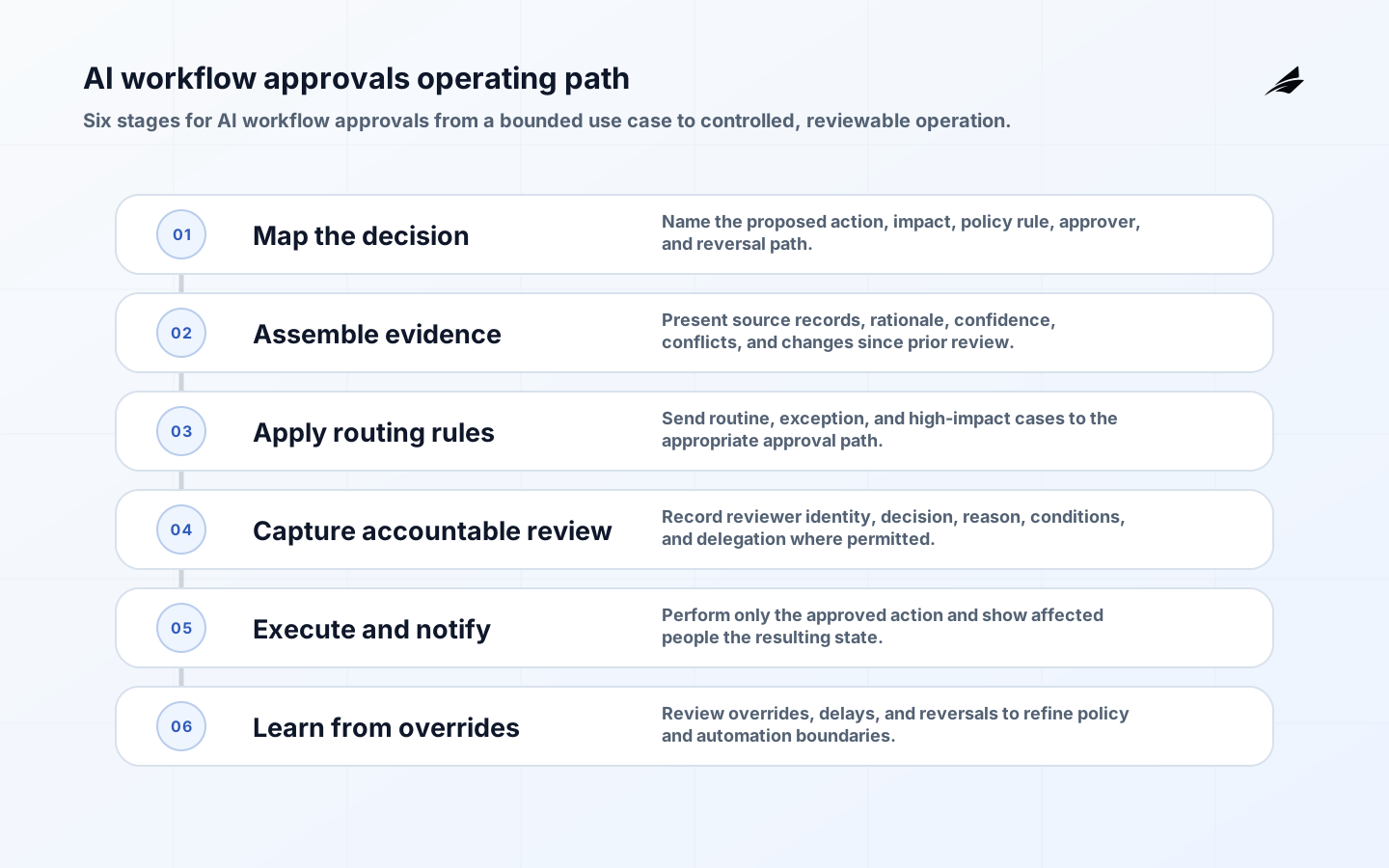
AI workflow approvals are useful when it helps a named person decide which AI-proposed outcomes may proceed automatically and which require accountable review. It becomes risky when a prototype is treated as authority without a clear record of inputs, constraints, and recovery. Start with a narrow workflow such as this: prepare a vendor-payment exception for approval without releasing funds or changing the financial record. The model may accelerate interpretation or drafting, but the system still needs ownership, data rules, and a way to show what happened. The NIST Generative AI Profile is a sound reference because it treats governance and measurement as lifecycle work rather than a one-time technical choice.
Define The Decision
Write the service boundary before selecting a framework or vendor. Name the user, trigger, trusted inputs, permitted output, accountable owner, and handoff. For AI workflow approvals, this prevents an approval screen collects clicks but does not show the evidence needed for a responsible decision. It also creates criteria for deciding what the first release should exclude. A valuable question is: what can the user do after seeing this result, and what must remain outside the system? The plain-language AI workflow approvals guide gives the foundational concepts; this implementation guide focuses on turning those concepts into a reviewable operating path.
| Decision area | Failure to avoid | Evidence to keep |
|---|---|---|
| Scope | A broad promise that no team can test or support. | Named user, trigger, permitted result, and explicit exclusions. |
| Data | Using plausible but unowned, stale, or over-broad inputs. | Source owner, effective date, access rule, and lineage identifier. |
| Authority | Letting generated output silently make a consequential decision. | Approval rule, deterministic validation, and action audit event. |
| Recovery | Treating manual correction as an invisible workaround. | Exception reason, owner, resolution time, and follow-up change. |
Design The Operating Boundary
Place durable controls outside the model. Authenticate the actor, authorize data access and actions at the system that owns them, validate typed inputs, and persist state in a system of record. Model instructions can explain the task and request structured output, but they cannot replace those checks. OWASP's LLM application guidance is useful when reviewing untrusted content, excessive agency, and indirect instructions. For AI workflow approvals, every external source or tool should have a purpose, minimum access scope, timeout, and observable result.
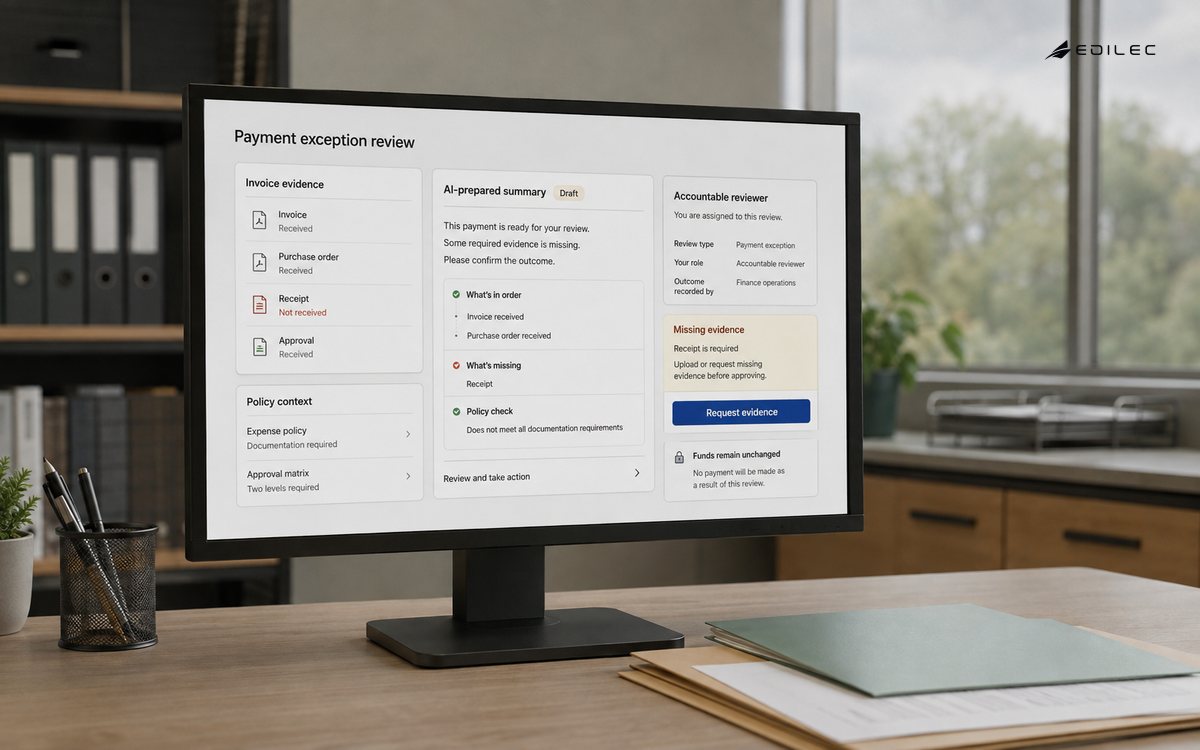
- Define the smallest outcome that proves AI workflow approvals are useful to the founders.
- Separate facts, suggestions, uncertainty, and proposed actions in the user experience.
- Version instructions, policies, schemas, retrieval settings, and integrations that can change behaviour.
- Use stable identifiers so an operator can reconstruct the result without guessing which request is being discussed.
- Route missing, conflicting, or high-impact cases to a named person with the evidence they need.
- Make correction reasons selectable and review them as product evidence rather than private workarounds.
Test The Real Work
Test normal cases alongside the cases people most want software to handle badly: incomplete records, conflicting sources, an unauthorized requester, delayed dependencies, unusual language, and a result that should be refused. Use production-shaped fixtures with known expected evidence and outcomes. A review set should measure whether AI workflow approvals selected the right inputs, made uncertainty clear, and triggered the correct next step, not merely whether output reads well. The UK secure AI development guidance supports this approach by connecting secure design, deployment, and operation.
Measure The Service
Use a small scorecard that combines operational and user signals: completion of the intended task, evidence or citation accuracy, exception age, correction rate, latency, cost per resolved task, and incidents by release version. Sample traces as well as dashboards. For AI workflow approvals, an operator should be able to see the request, source or tool choices, validation results, model configuration, and user-visible outcome without retaining more sensitive data than necessary. The OpenAI Agents guide is a practical technical reference, while the scorecard keeps attention on whether the workflow is actually helping.
| Observed signal | Interpretation question | Next action |
|---|---|---|
| High correction volume | Is the fault in source data, task rules, interface context, or the model behaviour? | Review representative traces with the workflow owner and add a specific regression case. |
| Growing review queue | Are thresholds too cautious, evidence too weak, or ownership unclear? | Classify the queue by reason and fix the largest recurring class before widening scope. |
| Rising cost per completion | Are requests looping, retrieving excess context, or calling redundant services? | Set budgets, inspect expensive traces, and simplify the path before changing models. |
| Unexplained user distrust | Can users see sources, uncertainty, state, and a safe escalation route? | Improve the evidence presentation and test it with the people who resolve exceptions. |
Release With Accountability
Release AI workflow approvals in a sequence that produces evidence: internal review, a limited cohort, a reversible live path, then measured expansion. Assign owners for the workflow, its data, each integration, security review, support queue, and change approval. Decide in advance what result pauses the rollout and how a user will be told about an unavailable or uncertain outcome. This approach makes the first version smaller, but it gives the team a reliable basis for adding coverage instead of accumulating unexamined automation.
Governance And Change Control
Governance for AI workflow approvals should describe the decision policy, approval authority, and evidence presentation in the same practical terms used to run the service: who can change it, what evidence is required, how a change is reviewed, and how the previous state can be restored. Treat delegations change, a policy exception appears, or a workflow becomes more consequential as a production event rather than routine maintenance. The owner should assess whether the change alters the permitted decision, data scope, safety controls, user explanation, or support obligation. Record the outcome in a change log that links to test results and the responsible approver. That modest discipline avoids a common failure mode in which a technically small update changes behaviour but nobody can later explain why.
Build A Review Pack
Keep a compact review pack for AI workflow approvals, made from overrides, late approvals, and decisions reversed after execution. For every example, retain the expected result, the evidence a reviewer should inspect, the unacceptable result, and the recovery action. Refresh the pack when operations expose a new failure class, but preserve a stable core so releases can be compared over time. Invite the people who own source records, resolve exceptions, and answer customer questions to review samples with engineering. Their observations often reveal that a failure is caused by an outdated record, confusing state, or incomplete policy rather than a model defect. A useful review ends with an owner and a measurable follow-up, not a vague request to improve quality.
Turn Feedback Into Improvement
Do not expand AI workflow approvals simply because early users like the experience. First classify feedback by severity, frequency, affected user group, and reversibility. Fix issues that expose protected data, create unsupported decisions, or trap people in an unclear state before pursuing broader coverage or lower costs. Then decide whether the repair belongs in source stewardship, interface design, policy logic, model configuration, evaluation data, or team training. This framing keeps the improvement loop honest: the model is one component of a service with people and systems around it. Publish the decision and its expected signal, then verify after release that the change reduced the observed problem without moving it into an invisible manual process.
- Name the accountable owner for the decision policy, approval authority, and evidence presentation and the person who approves material changes.
- Define which change events must trigger testing, access review, communications, or rollback preparation.
- Keep a representative case pack with expected evidence and a documented reason for each outcome.
- Review correction and override data with operations, security, and the people who own the underlying records.
- Prioritize failures by user impact and reversibility before optimizing speed, appearance, or model cost.
- Close each recurring issue with a specific test, control, owner, and a date to check the effect.
Before the next AI workflow approvals release, run a short operational rehearsal. Ask the workflow owner to trace one normal case, one case with incomplete evidence, and one case that must be stopped or escalated. Confirm that the responsible person can see the current state, identify the authoritative record, explain the policy or validation result, and correct the outcome without an engineer improvising a data repair. This exercise tests the practical quality of AI workflow approvals: not whether the interface looks finished, but whether the service remains understandable when real work is uneven, delayed, or disputed. Record the gaps as release conditions and rerun the same cases after the change.
Key Takeaways
- AI workflow approvals should support one bounded decision before it expands into a broad platform promise.
- Keep authority, permissions, and irreversible changes in deterministic systems and human approval paths.
- Evaluate evidence, exceptions, and recovery as carefully as the visible output.
- Use versioned traces and correction reasons to make failures reproducible and useful.
- Scale only when measured outcomes show the first workflow is trustworthy in real conditions.
Frequently Asked Questions
What is the first thing to build for AI workflow approvals? Start with a narrow, high-frequency task with a known owner, accessible evidence, and a safe fallback. How much human review is required? Match review to impact, uncertainty, reversibility, and legal obligations; low-risk drafts differ from irreversible record changes. What should be logged? Keep the minimum information needed to reconstruct inputs, policy and validation decisions, versioned configuration, and outcome, with retention and access controls. When should a team expand AI workflow approvals? Only after the evaluation set, live exception data, and user feedback show the existing boundary is stable enough to support more work.
Conclusion: Make AI workflow approvals Operable
The value of AI workflow approvals is not a convincing demonstration; it is a repeatable result that the right people can inspect, correct, and improve. Start with an explicit boundary, protect the surrounding systems, test the awkward cases, and let operational evidence determine the next step.