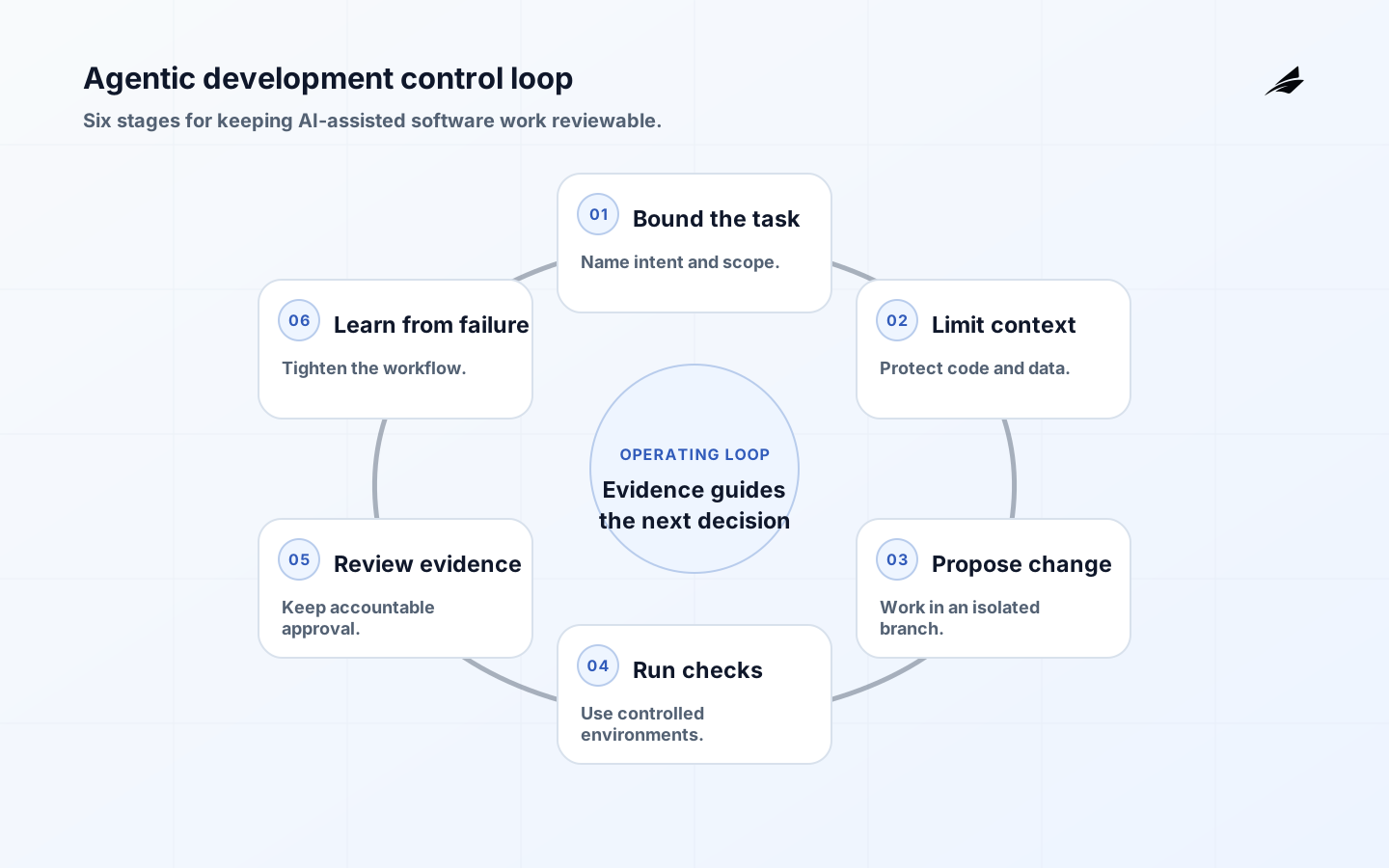
An agentic development platform can help engineers explore a codebase, draft a change, run bounded checks, and prepare a review. It should not erase the distinction between proposing work and accepting responsibility for it. Before a team enables broad access, decide which engineering bottleneck it is meant to relieve: repetitive test setup, issue triage, documentation maintenance, dependency analysis, or a carefully bounded code change. A specific job makes it possible to define expected evidence, authority, and failure handling. It also avoids treating generated code as progress before anyone has established that it is correct, secure, maintainable, and appropriate for the product. NIST's AI Risk Management Framework is useful for connecting this choice to accountable risk ownership. For this design choice, name the accountable owner, supporting evidence, exception route, and next measurable check.
Choose a bounded engineering workflow
Select work with clear inputs, a measurable definition of done, and an existing human review path. For example, an agent may summarize a failing build, propose unit tests for a small defect, or prepare a dependency update for a maintainer to inspect. Do not begin with an instruction to refactor an unknown portion of a production system. Record the repositories, branches, environments, and data classes that are in scope. Define whether the agent may read source, write a local change, open a pull request, execute tests, or call an external service. Each added capability changes the threat model and the operational burden. The platform should make those permissions visible to the engineer who owns the result. Within this workflow step, name the accountable owner, supporting evidence, exception route, and next measurable check.
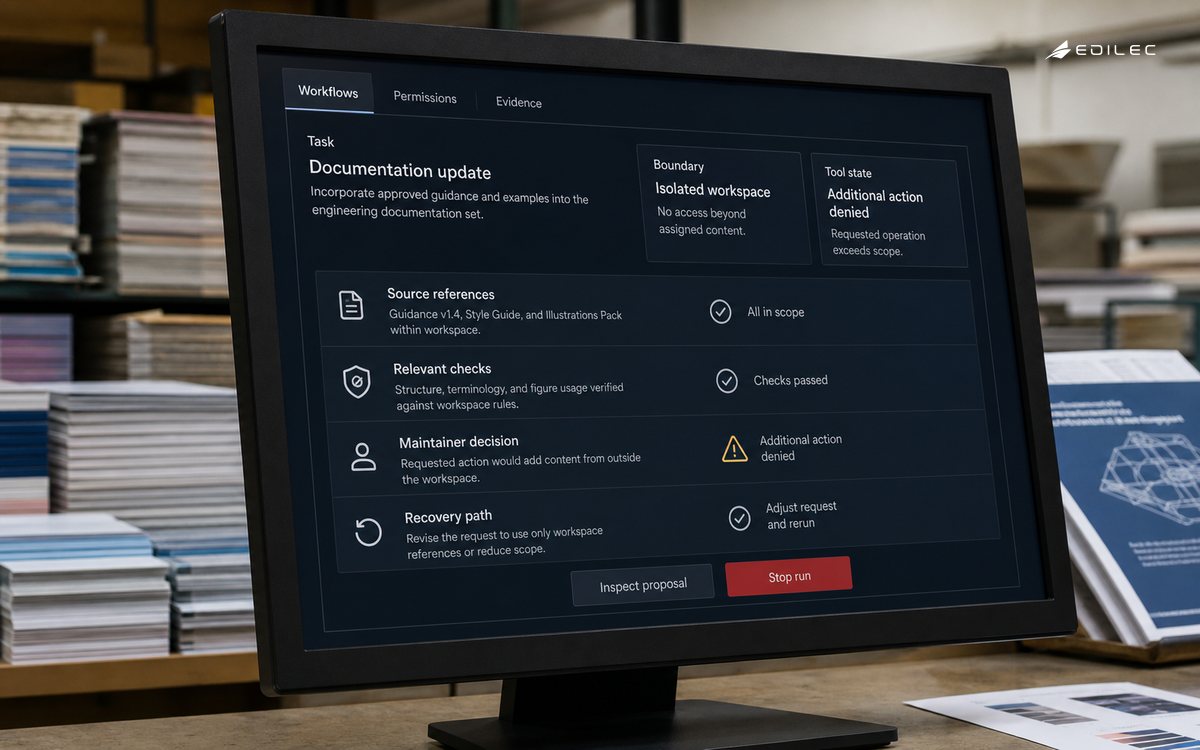
| Capability | Safe first boundary | Review evidence |
|---|---|---|
| Code search | Read approved repositories only. | Query and files consulted. |
| Change proposal | Write to an isolated branch or workspace. | Diff, rationale, and tests. |
| Test execution | Use controlled fixtures and resource limits. | Command, environment, and result. |
| External action | Require narrow credentials and approval. | Target, parameters, and authorization. |
Make context and policy explicit
Agents work from instructions, repository context, tool output, and sometimes tickets or documentation. None of those inputs should be treated as automatically trustworthy. Keep engineering policy in a controlled, reviewable location: coding standards, protected paths, secrets handling, dependency rules, test expectations, and escalation conditions. Tell the agent what it must not do as well as what it may do. Restrict context to the task where possible, because excessive repository or customer-data exposure increases both privacy risk and the chance of a misleading change. Preserve the source references that influenced a proposal so reviewers can distinguish an intentional design choice from an accidental pattern match. When implementing this control, name the accountable owner, supporting evidence, exception route, and next measurable check.
Design review and recovery before autonomy
A useful review asks more than whether a patch compiles. The reviewer needs the requested outcome, affected interfaces, assumptions, tests run, generated or modified files, and any uncertainty the agent encountered. Keep changes small enough to inspect and make rollback routine through normal version control and deployment practice. For changes that affect security, money movement, authorization, or customer commitments, add a named subject-matter review rather than relying on a general code approval. The NIST Secure Software Development Framework reinforces the value of defined roles, verification, and remediation across the lifecycle. Agentic tooling should strengthen those habits, not create an alternate delivery path around them. Before releasing this operating step, name the accountable owner, supporting evidence, exception route, and next measurable check.
| Failure mode | Preventive control | Recovery action |
|---|---|---|
| Wrong repository context | Bind tasks to a declared project and revision. | Discard change and correct task scope. |
| Unsafe command | Allowlist tools and validate arguments. | Stop run and inspect the workspace. |
| Weak test evidence | Require relevant checks before review. | Add tests or route to a specialist. |
| Unexpected external effect | Use sandboxed credentials and confirmations. | Revoke access and reconcile records. |
Secure tools, secrets, and untrusted input
Coding agents can be exposed to malicious instructions in issues, source files, logs, package metadata, and web content. Treat those materials as data, not authority. Tool calls should be narrowly scoped, parameter-validated, logged, and separated by environment. Never provide a broad production credential merely because the agent may need to inspect a deployment. Use short-lived credentials, redact secrets from prompts and traces, and make approval conditions enforceable by the tool layer. The OWASP prompt injection guidance explains why a model cannot reliably decide which content is an instruction. Architecture must carry that burden. While operating this part of the system, name the accountable owner, supporting evidence, exception route, and next measurable check.
Measure engineering outcomes, not output volume
- Measure time to a reviewed, merged, and stable change rather than lines or patches produced.
- Track rework, escaped defects, reverted changes, and review burden by workflow.
- Sample agent-assisted changes for maintainability, accessibility, security, and test quality.
- Record blocked tasks and failure reasons so prompt or tool changes have a factual basis.
- Compare outcomes with a similar non-assisted workflow before declaring a productivity gain.
Metrics deserve context. A shorter cycle can be valuable, but not if it is achieved by pushing discovery, debugging, or security review onto a later team. Segment results by task type and experience level, since a platform may help a well-understood maintenance task while hindering unfamiliar architecture work. Invite engineers to report when the platform made a task harder or obscured a risk; their feedback often identifies missing context or excessive tool authority. The NIST Generative AI Profile supports monitoring for risks that emerge in real use rather than assuming evaluation ends at purchase. When changing this evaluation, name the accountable owner, supporting evidence, exception route, and next measurable check.
Roll out with owned guardrails
Pilot with a small group that includes maintainers, security partners, and delivery leads. Publish the approved workflows, data boundaries, review standards, and support channel. Provide training on how to inspect a generated diff, how to identify an unsupported claim, and when to stop an agent run. Establish a change process for adding tools or repositories, because permissions tend to expand through convenience. The related agent tool permissions guide is a useful companion when deciding how much authority a specific workflow deserves. A platform is ready to broaden only when its normal failures are observable and recoverable. During support for this part of the system, name the accountable owner, supporting evidence, exception route, and next measurable check.
Rehearse agent failures like delivery failures
Run controlled drills before expanding the platform. Give the agent a task with ambiguous requirements, a malicious instruction in an issue, a missing dependency, and a test that passes for the wrong reason. Observe whether it stops, records uncertainty, asks for clarification, and leaves the workspace in a recoverable state. Include a reviewer who has not seen the task so the evidence must stand on its own. This is less theatrical than a feature demonstration and much more useful: it validates the actual boundary between model behavior, tool enforcement, and engineering judgment. To validate this part of the system, name the accountable owner, supporting evidence, exception route, and next measurable check.
Maintain a short decision record for each approved workflow: intended outcome, authority, repositories and data, required checks, human approver, monitoring signals, and rollback route. Revisit it when the model, tools, or deployment environment changes. The record makes cautious expansion possible because it shows what the team has actually proved rather than what it assumes a new capability can do. To govern this part of the system, name the accountable owner, supporting evidence, exception route, and next measurable check.
Key takeaways
- Start with a bounded workflow and state the allowed repositories, tools, and environments.
- Keep policy and task context reviewable; do not trust arbitrary content as instructions.
- Require conventional engineering evidence for every change, including tests and accountable review.
- Constrain credentials and tool parameters so a model cannot turn broad access into broad action.
- Judge the platform by durable delivery outcomes and the quality of its recovery paths.
Frequently asked questions
Can an agent merge its own changes? For low-consequence, fully specified maintenance work, an organization may eventually allow narrowly defined automation, but it should first prove controls and reversal under human oversight. Does using an agent remove the need for code review? No. Review may change shape, but responsibility for interfaces, security, and product behavior remains. Should agents access production? Default to no; use governed observability paths that expose only the information needed. What is the first policy to write? Define permitted tools, data, environments, and the point at which an accountable person must approve the next step. When explaining this part of the system, name the accountable owner, supporting evidence, exception route, and next measurable check.
Conclusion
An agentic development platform can be a strong engineering assistant when its authority is smaller than the team’s ability to inspect and recover from its work. Begin with useful but bounded tasks, preserve ordinary delivery controls, and add autonomy only where evidence shows it is warranted. The related LLM evaluation checklist can help turn that evidence into a repeatable release decision. For this part of the system, test one expected case, one ambiguous case, and one failure with a documented recovery action.
An operating note for this decision
For an agentic development platform, add a release gate that checks the platform itself whenever its model, tool runner, or repository integration changes. Replay a small suite of tasks that include an approved change, an ambiguous request, a secret-like string, and a denied tool action. Review the audit trail as a maintainer would during an incident. The goal is not to prove that the agent is clever; it is to prove that the surrounding system constrains it predictably. This check makes platform maintenance visible alongside ordinary application delivery and prevents a convenient upgrade from quietly widening engineering risk.