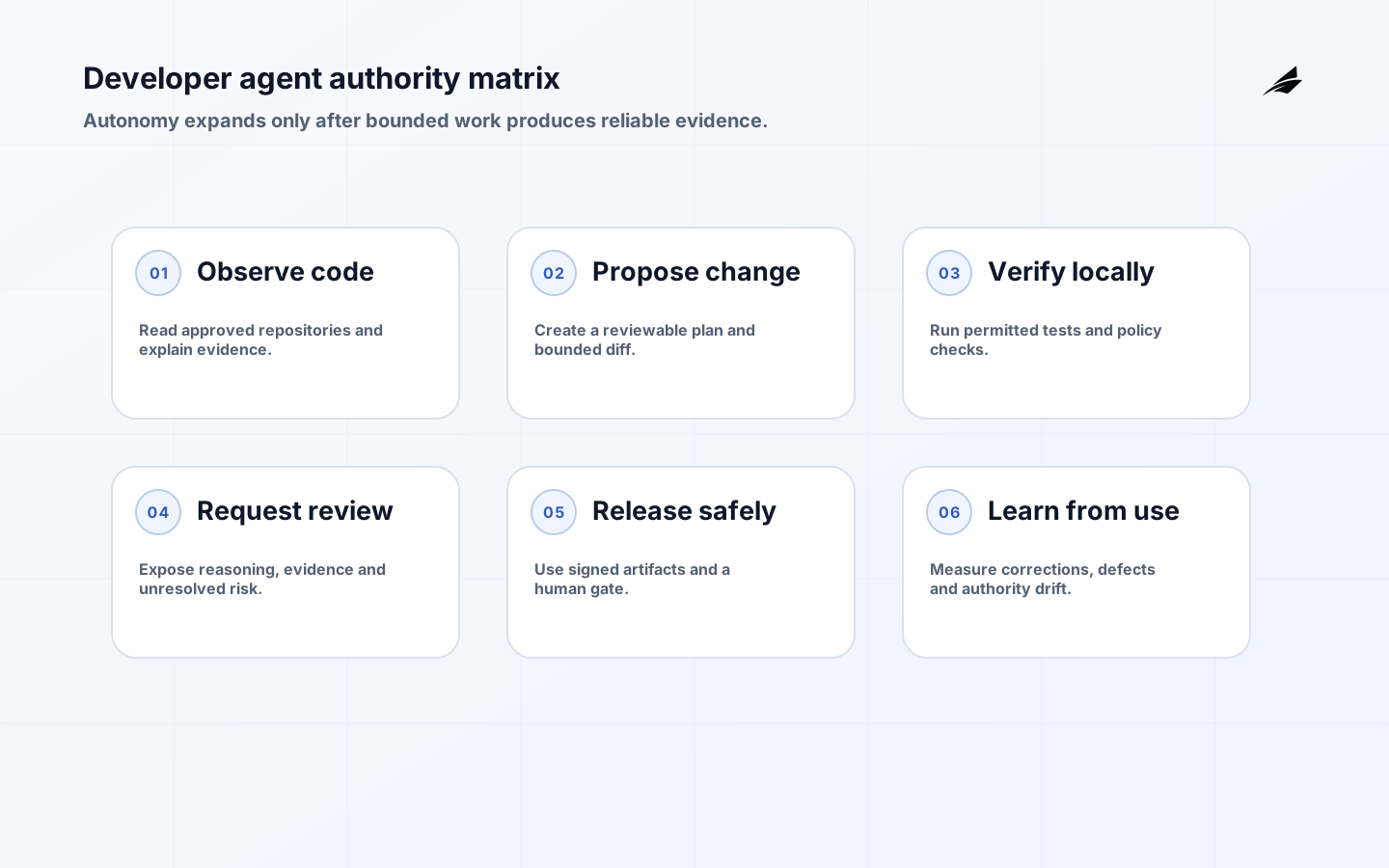
This agentic development platform FAQ addresses a simple but consequential question: how should a software team use systems that can reason about a task and invoke development tools? The answer is rarely 'give it full access' or 'ban it outright.' Developer agents can reduce friction in exploration, testing, documentation, and repetitive change preparation, while also introducing new access, supply-chain, and review risks. A useful evaluation looks at the task, authority, evidence, and recovery path together. It gives engineers better assistance without outsourcing accountability for the code they ship.
What is an agentic development platform?
It is a development environment or service that can take a goal, inspect relevant context, plan steps, use approved tools, and return artifacts such as a patch, test results, or explanation. Some platforms remain primarily interactive; others can carry out longer tool-using tasks. The distinction matters because each added capability expands the permission and monitoring question. A code-completion tool that only suggests text has a different risk boundary from an agent that can read repositories, alter files, run commands, or contact external systems.
| Question | Short answer | What it means in practice |
|---|---|---|
| Is it the same as code completion? | No. Agentic systems may plan and act through tools, not only suggest text. | Review permissions and logs, not just output quality. |
| Can it write production code? | It can propose code, but accountable engineers still own acceptance and release. | Use tests, review, and protected branches. |
| Does it need repository access? | Only to the scope required for its current task. | Use dedicated identities and selected repositories. |
| Can it be trusted to self-check? | Self-checks are useful evidence, not independent assurance. | Run approved checks and independent human review. |
Where can it provide value first?
Start with work that is time-consuming but easy to verify: locating related code, explaining a subsystem with file references, proposing tests for a known bug, preparing a migration plan, or drafting a narrowly scoped change. These tasks let teams observe how the platform handles repository conventions and incomplete context without placing it in charge of a release. Compare outcomes with a baseline that includes review and correction time. The right initial use case is not the one that looks most autonomous; it is the one where the team can learn rapidly and stop safely.
- Acceptance criteria can be stated before the task begins.
- The relevant code and owner are known.
- The platform can work in a sandbox or draft branch.
- A reviewer can validate the result using familiar evidence.
- The action does not require broad credentials or production access.
- Failures can be corrected without a difficult customer or operational recovery.
What are the main security concerns?
Focus on the system around the model: repository and secret access, untrusted instructions in tickets or files, tool execution, generated dependencies, and network pathways. The OWASP Top 10 for LLM applications provides a useful lens for prompt injection, sensitive information exposure, insecure output handling, and excessive agency. The NIST Secure Software Development Framework helps put those concerns in a broader software-delivery practice. Give the platform a dedicated identity, restrict tools, isolate secrets, and preserve logs that support investigation.
| Concern | Practical response | Question for review |
|---|---|---|
| Prompt injection | Treat repository text, issues, and external content as untrusted. | Can content change tool instructions or authority? |
| Secret exposure | Use secret managers and isolated execution; never embed credentials in task text. | Could a prompt, log, or diff reveal a sensitive value? |
| Unsafe command use | Allowlist commands and sandbox filesystem and network capabilities. | What happens if a task requests an unexpected tool? |
| Supply-chain change | Review dependencies and retain build provenance. | Can we identify what created the artifact and from which inputs? |
How should engineers govern it?
Governance should be embedded in ordinary engineering moments: task creation, access requests, code review, CI, release approval, and incident response. Define risk tiers by task authority rather than vendor labels. A read-only summary has a lower burden than a task that writes infrastructure code or changes a dependency. The NIST AI Risk Management Framework can help organize mapping, measurement, and management, while the SLSA specification offers useful supply-chain terminology. Keep the rules usable enough that developers do not need a separate process for every minor task.
- Publish allowed and prohibited task categories.
- Use least-privilege identities and periodic access review.
- Require change evidence that links agent activity to human approval.
- Keep branch protection, testing, and release controls in force.
- Provide a route to report unsafe behavior or misleading output.
- Review patterns of rejected changes and access anomalies regularly.
How do we evaluate results?
Evaluate work products in the context of delivery. Look at time to a reviewed change, completeness of tests and documentation, review burden, defect escape, policy violations, and developer confidence. Segment by task type so a strong result in documentation does not justify autonomous code modification. Use representative tasks with known acceptance criteria when comparing configurations or vendors. A short-term productivity gain that comes with inaccessible reasoning, excessive context exposure, or more post-merge defects is not a durable improvement. Make evaluation an ongoing release practice, not a one-time procurement demonstration.
Frequently asked questions
Govern the agent as a software actor
A useful agentic development platform does more than produce code. It receives a goal, inspects repositories or delivery systems, chooses tools, changes artifacts, and reports an outcome. That makes identity and authority first-order design questions. NIST’s 2026 concept paper on software-agent identity and authorization emphasizes the need to apply identity standards and authorization practices to software and AI agents. In a delivery platform, every agent session should therefore have a named sponsor, a short-lived identity, an explicit repository and environment boundary, and a record of the tools and credentials it used. The model’s ability to propose an action must never be confused with permission to perform it.
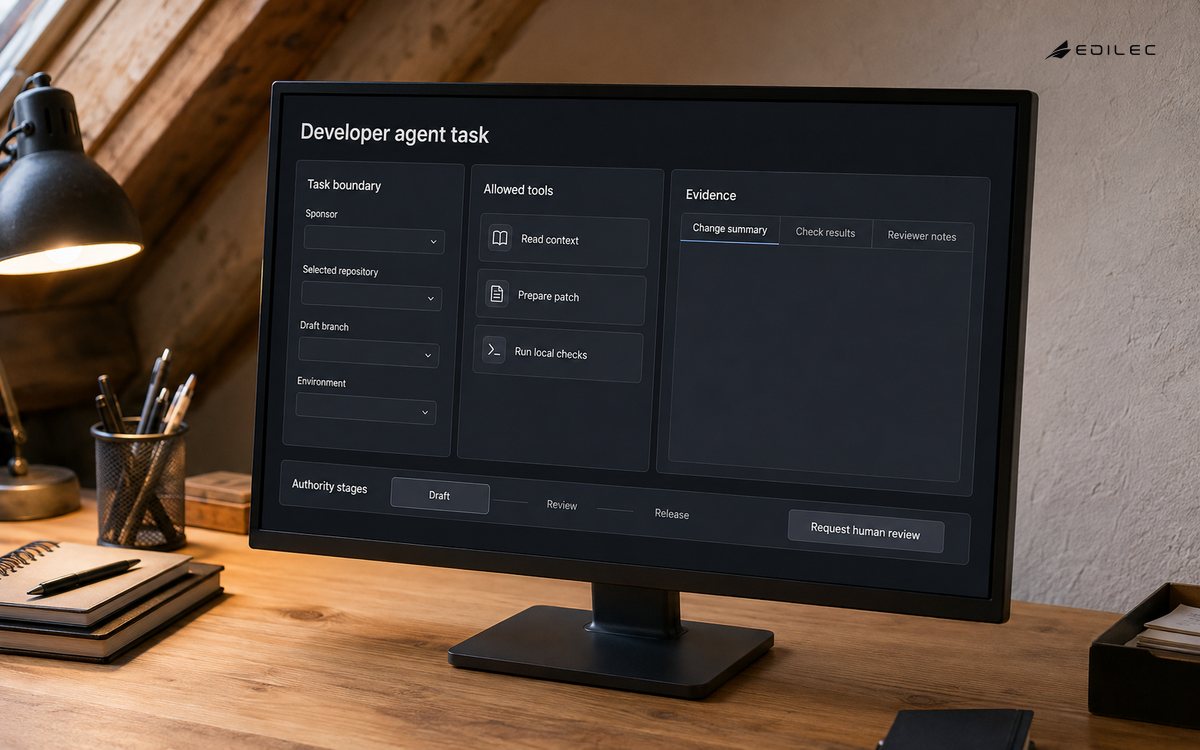
Treat each task class as a separate authority profile. A documentation task may read a repository and open a review request. A dependency upgrade may modify manifests and run tests but should not publish an artifact. A production rollback may require a human incident lead, a constrained deployment identity, and a two-person confirmation. This separation limits the consequence of prompt injection, incorrect planning, compromised dependencies, and accidental scope expansion. It also makes evaluation more meaningful because the team can test whether the agent stayed within a declared boundary, not merely whether the final diff looked plausible.
| Agent task | Maximum initial authority | Evidence before expansion |
|---|---|---|
| Explain or document code | Read approved repositories and create a review request | Accurate citations, no secret exposure, useful reviewer acceptance |
| Implement a bounded change | Edit a branch and run approved local checks | Test results, policy checks, reviewer approval and reversible commit |
| Change dependencies | Propose lockfile and manifest changes without publishing | Provenance, vulnerability review, compatibility tests and rollback plan |
| Operate delivery | Invoke a constrained non-production workflow | Signed artifacts, environment policy, complete audit record and human release gate |
Adoption should start with reviewable work. Pair the bounded tool-permissions guide with an LLM evaluation framework for internal tools and the guide to common evaluation mistakes. Together they provide a practical sequence: define allowed actions, create representative tasks and adversarial cases, require human review where consequence is material, and measure accepted changes, corrections, escaped defects, cost and elapsed time. A platform earns broader authority only after those records show reliable behavior.
- Will agents replace developers? They can change task allocation, but teams still need people who understand requirements, architecture, security, and production consequences.
- Can an agent approve a pull request? Keep review authority with accountable people unless a narrowly justified policy says otherwise.
- Should we allow public models? Follow data, security, contractual, and source-code policies; convenience does not resolve those obligations.
- What is the safest first step? A read-only or draft-change pilot in a sandboxed environment with clear review evidence.
Key takeaways
- Agentic platforms add tool authority, not just better suggestions.
- Adopt first where outcomes are easy to verify and recover.
- Protect repositories, credentials, and delivery paths with least privilege.
- Evaluate reviewed engineering outcomes, not demonstrations alone.
- Keep humans accountable for merged and released software.
Conclusion
A developer agent is most useful when it works inside a system that makes evidence and responsibility clear. Begin with constrained assistance, measure the whole delivery effect, and expand carefully. The companion resources on agent permissions and LLM evaluation failures help frame the next decision.