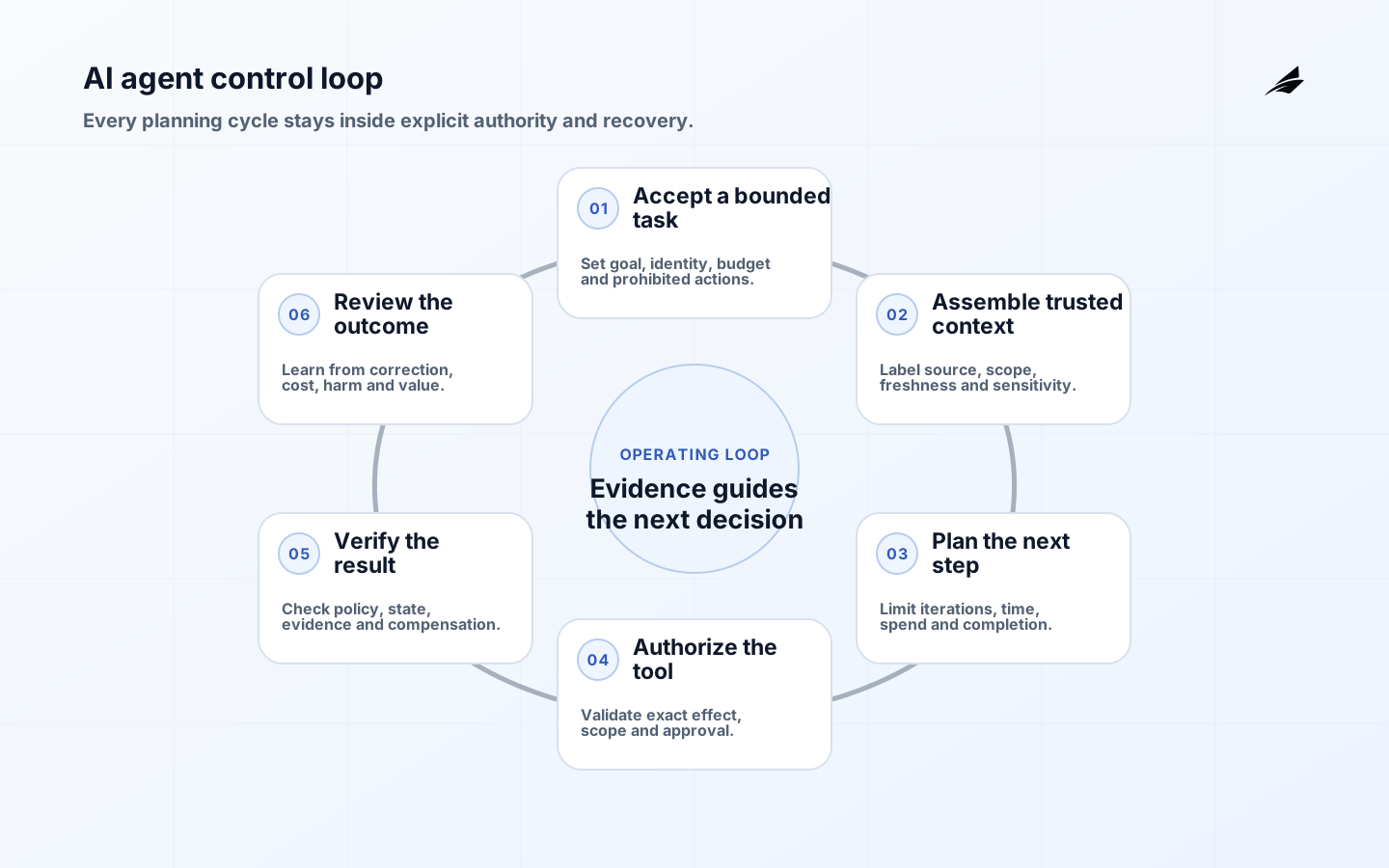
An AI solutions agent is software that uses a model to interpret a goal, select or sequence steps, call tools and adapt from intermediate results. The useful distinction from a chatbot is not personality; it is delegated control over workflow state and external capabilities. That delegation can reduce handoffs in research, support, operations and software work, but it also turns model errors or manipulated context into actions. Production design must bound authority, preserve evidence and provide a deterministic way to stop, recover and reconcile.
This AI solutions agent FAQ complements Edilec's scope, cost and risk guide and implementation checklist. Teams defining organization-wide policy should also use the agent governance checklist and agent governance FAQ. Those pages separate portfolio governance from the technical operating questions answered here.
When is an AI solutions agent a good fit?
Use an agent when the goal is clear but the sequence varies, intermediate information changes the next step, several bounded tools must be coordinated and a reviewer can judge the result. Good early candidates are reversible, observable and supported by a safe manual path. A deterministic workflow is usually better when rules are stable, every branch is known, latency must be predictable or the action carries high consequence with little room for interpretation.
Write the task contract: trigger, goal, allowed inputs, authorized tools, prohibited actions, maximum duration, cost and step limits, approval points, completion evidence, fallback and owner. Define what the agent may decide versus propose. Measure the existing process, including rework and waiting, before automation. NIST's AI RMF supports a continuous govern, map, measure and manage approach; tailor it to the workflow's affected people and consequences.
| Workflow trait | Agent fit | Required boundary | Alternative |
|---|---|---|---|
| Variable research path | Often suitable | Approved sources and no write access | Search plus human synthesis |
| Structured data transfer | Usually weak | Strict schema and validation | Deterministic integration |
| Customer case resolution | Conditional | Policy, approval and escalation | Assisted workflow |
| Financial or access change | High caution | External authorization and limits | Rule-based transaction |
| Open-ended background task | Poor first use | Time, action and spend budget | Bounded queued job |
What components belong in an agent architecture?
A production agent needs an authenticated user or service, task state, orchestrator, model, policy engine, tool registry, retrieval or memory where justified, validation, approval service, audit record, observability and fallback. Keep durable workflow state outside model context. The orchestrator should enforce step, time and cost budgets and know when work is complete. The policy engine should decide authorization from identity, tenant, purpose and action effect; the model should not grant itself permission.
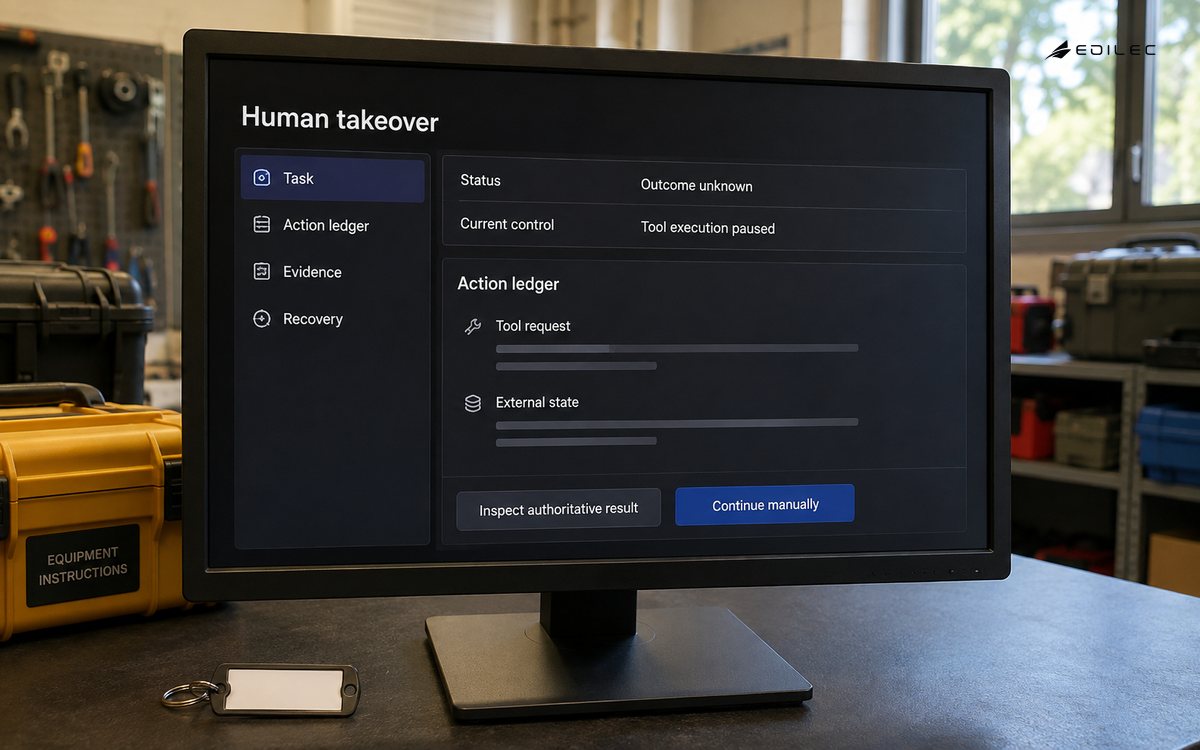
Define typed tool contracts with precise descriptions, schemas, idempotency, side effects, error semantics and ownership. Split broad administrative tools into narrow operations. Separate preview from commit and read from write. Validate parameters against business policy and canonical identifiers. Tool output is untrusted input: it can be malformed, stale or intentionally hostile. Store a compact action ledger that connects task, model and policy revision, tool call, approval, result and compensating action.
How should tools and agent protocols be governed?
Protocols can standardize discovery and invocation but do not make a tool trustworthy. The Model Context Protocol specification explicitly treats tools as arbitrary code-execution paths and emphasizes user consent, control, privacy and appropriate access. Maintain an approved server and tool registry with publisher, version, capabilities, scopes, data destinations, review result and owner. Pin or control changes rather than accepting an unreviewed tool description at runtime.
Authenticate both user and workload, issue short-lived credentials, scope access per tool and task, and prevent token forwarding to unintended recipients. Verify endpoint identity and authorization metadata. Do not place long-lived secrets in prompts or tool arguments. Require a user-understandable preview for consequential operations and bind approval to exact parameters. Rate-limit and isolate tools that execute code, access files, send messages or alter enterprise records. Log denial as well as success.
When should an agent use memory?
Use task memory for state needed to complete current work. Add cross-session memory only when a defined user benefit outweighs privacy, poisoning and staleness risks. Classify memories by source, subject, purpose, confidence, creation time, expiry and access scope. Let users inspect and correct meaningful retained information. Keep authoritative enterprise records in their systems of record; memory may reference them but should not silently become a competing source.
Treat memory writes as an action with validation and policy. Separate user-provided preference, model inference, tool result and approved fact. Prevent one tenant or user from influencing another. Test malicious instructions stored in documents, summaries and prior conversations. Recompute or expire derived memories when source data changes. If the workflow can operate with retrieval from an authoritative source, that is often safer than retaining an unconstrained model-generated summary.
| Control point | Failure to test | Preventive mechanism | Recovery evidence |
|---|---|---|---|
| Task input | Direct or indirect instruction attack | Trust labels and instruction hierarchy | Blocked action record |
| Planner | Loop or goal drift | Step, time and completion limits | Preserved task state |
| Tool | Excessive or wrong-tenant action | Least privilege and parameter policy | Denied call or compensation |
| Memory | Poisoned or stale fact | Provenance, scope and expiry | Correction and deletion |
| Approval | Misleading confirmation | Exact effect and authenticated approver | Approval ledger |
Which security threats are specific to agentic workflows?
Agent systems combine familiar application threats with goal manipulation, tool misuse, excessive agency, memory poisoning, agent-to-agent trust errors and cascading failures. OWASP's Securing Agentic Applications Guide provides builder-focused recommendations. MITRE ATLAS is a living knowledge base of tactics and techniques against AI-enabled systems. Use both to enrich a system-specific threat model, not as checkbox compliance.
Run abuse cases across the full chain: a hostile web page asks the agent to reveal secrets; a compromised connector alters its description; a tool returns instructions disguised as data; an agent persuades a peer to exceed scope; a retry repeats a payment; or a memory entry changes later decisions. Apply isolation, trust separation, input and output validation, independent authorization, transaction limits, egress controls, sandboxing, monitoring and human review according to consequence.
How should an agent be evaluated?
Evaluate complete trajectories, not only final prose. Record whether the agent selected appropriate tools, respected policy, used valid parameters, handled errors, stopped efficiently, cited evidence, sought approval and produced the correct system state. Include ordinary tasks, ambiguous goals, unavailable tools, stale context, malicious instructions, conflicting policies and cancellation. Score severe failures separately so a high average cannot hide one unauthorized action.
Use deterministic assertions for permissions and state, simulation for costly tools, expert review for judgment, and calibrated model graders for scalable but bounded criteria. Validate graders against humans and inspect disagreement. NIST's Generative AI Profile highlights risks including confabulation, information integrity, privacy and value-chain integration. Re-evaluate when models, prompts, tools, memory policy or workflow context changes.
Where should human approval and intervention sit?
Place approval before actions that are irreversible, high-value, externally communicative, access-changing, safety-relevant or outside normal policy. Approval must show action, target, important inputs, effect, uncertainty and available alternative. Do not ask users to approve a vague plan and later substitute parameters. For repeated low-risk actions, policy may permit bounded standing authority with monitoring and easy revocation. Record who approved what and under which policy revision.
Human review is a control only when reviewers have time, evidence, competence and authority to disagree. Measure approval latency, rejection, correction, missed seeded errors and escalation quality. Provide a clean takeover that preserves task state and explains completed actions without forcing the reviewer to reconstruct a transcript. Define after-hours and unavailable-review behavior. The safest fallback may be to stop, not to let the agent continue under broader authority.
How are agents monitored and operated?
Monitor successful task completion, human correction, policy blocks, tool choice and error, steps per task, loops, cancellation, latency, cost, model and prompt revision, memory writes and business outcome. OpenTelemetry's GenAI attributes warn that tool arguments and results may contain sensitive information. Default to metadata, categories and redacted samples, with tightly controlled access to content needed for incident investigation.
Define incidents for unauthorized action, sensitive disclosure, systemic wrong outcomes, runaway resource use, compromised connector and unavailable fallback. Preserve task and action evidence, revoke credentials, disable the narrowest capability, reconcile external systems and notify affected owners. Exercise an emergency stop, tool revocation, model rollback and memory correction before broad rollout. Review cost per successful and accepted outcome, not cost per token or conversation.
How should agent authority expand after launch?
Begin in recommendation or read-only mode with a defined user cohort. Compare proposed actions with human decisions, examine disagreement and identify where policy or context is missing. Add one reversible write capability at a time, with transaction limits and approval. Expansion criteria should include accepted task completion, severe-failure count, correction, escalation, cost, support load and recovery exercise results. Reduce authority automatically when dependencies, evaluation or policy health falls outside tolerance.
AI solutions agent FAQ
Should an agent ever be fully autonomous?
Autonomy should be specific to a bounded action set, environment, budget and time window. Low-consequence reversible work can run without per-step approval when independently authorized and monitored. Broad, indefinite autonomy is not a meaningful production control model.
Is a multi-agent design better?
Only when role separation or parallel specialization creates measurable value. Multiple agents add messages, trust boundaries, latency, cost and failure propagation. Start with one orchestrator and explicit tools; add agents when evaluation proves the need.
Can model confidence control approval?
Not by itself. Confidence may be poorly calibrated and can miss adversarial or policy failures. Base approval on action consequence, identity, data, policy and verified evidence, using calibrated uncertainty only as one input.
Key takeaways
- Use agents for variable but bounded workflows with observable outcomes.
- Keep task state, authorization and transaction policy outside the model.
- Treat tools, memory and peer agents as separate trust boundaries.
- Evaluate trajectories, severe failures, takeover and final system state.
- Operate agents with content-safe telemetry, revocation and reconciliation.
Conclusion: bound autonomy with authority and evidence
An AI solutions agent earns production authority by demonstrating that it can pursue a useful goal inside explicit limits. Define the task contract, narrow tools, govern memory, test hostile trajectories, place approval at consequential effects and rehearse recovery. That architecture lets teams benefit from adaptive execution without allowing model behavior to become the organization's access-control or accountability system.