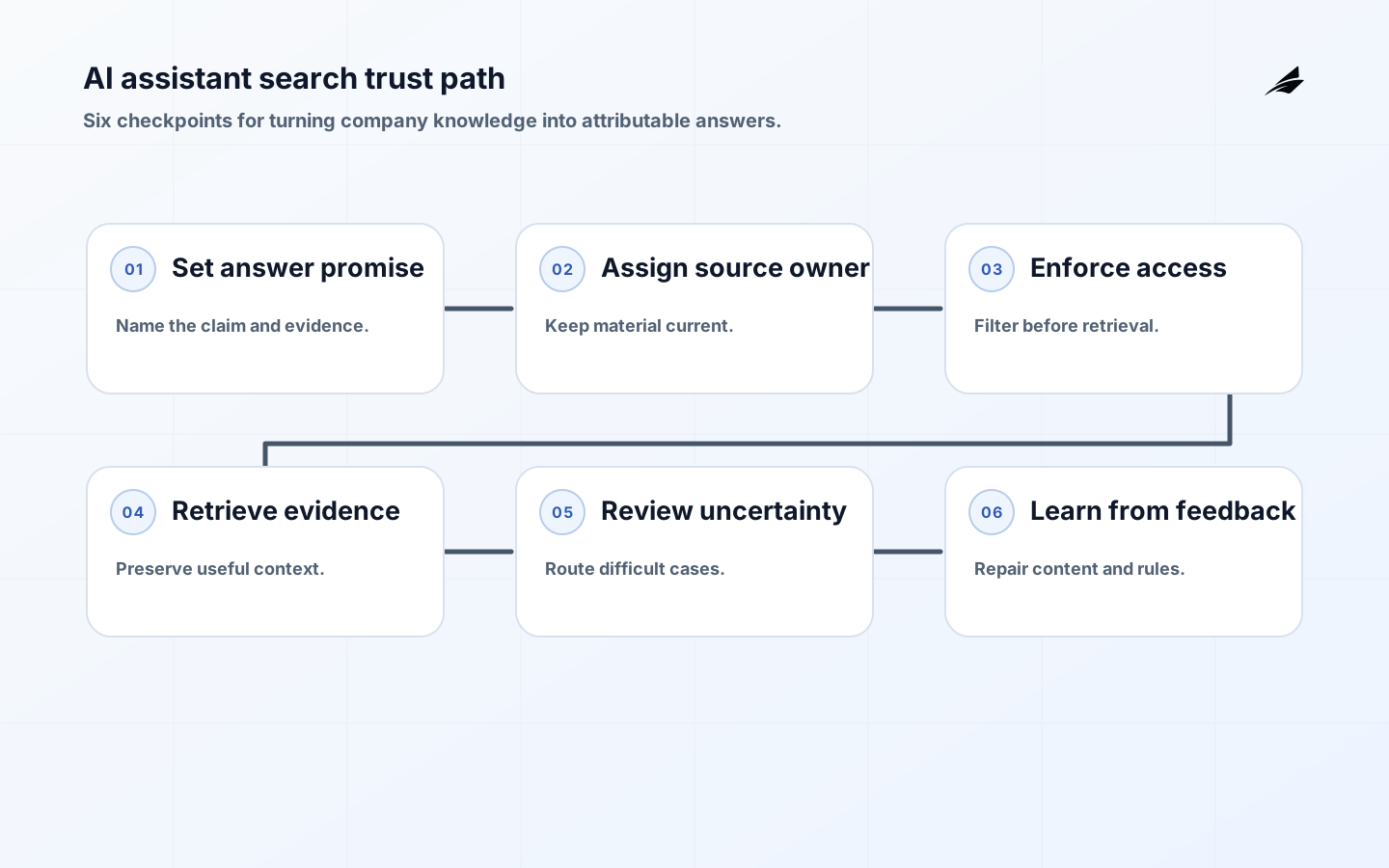
AI assistant search solutions are useful when people lose time locating policy, product, customer, or operational knowledge that already exists but is scattered across systems. The hard part is not making a chat box produce fluent text. The hard part is deciding which records it may use, what an answer is allowed to claim, and how a reader can check it. Begin with one recurring decision, such as answering a support question from approved product material or helping an employee find the current travel rule. A narrow first use case makes access, quality, and escalation testable. It also gives the team a way to tell a useful answer from a merely plausible one. NIST's AI Risk Management Framework is a helpful starting point for treating those choices as ongoing governance rather than a one-time model selection exercise. For this design choice, name the accountable owner, supporting evidence, exception route, and next measurable check.
Define the answer contract before connecting data
Write down the promise made to each user group. A support representative may need a short answer with cited internal articles; a compliance analyst may need the exact source passage and a record of access; a manager may need a summary that clearly states its period and limitations. Specify whether the assistant may synthesize across sources, whether it may infer missing facts, and when it must say that it cannot answer. Name the system of record for every high-consequence claim. This contract prevents a common failure mode: a polished response that silently mixes obsolete guidance, documents from another business unit, and a reasonable-sounding guess. It also gives reviewers concrete acceptance criteria for citations, freshness, permissions, and refusal behavior. Within this data handoff, name the accountable owner, supporting evidence, exception route, and next measurable check.

| Decision | Minimum rule | Evidence to retain |
|---|---|---|
| Audience | Map roles to approved collections, not broad folders. | Role test cases and collection owners. |
| Answer scope | Require sources for factual operational claims. | Displayed citations and retrieval trace. |
| Freshness | Set review dates for volatile content. | Version, effective date, and owner. |
| Escalation | Route uncertainty to a named process. | Reason code and follow-up outcome. |
Prepare knowledge for retrieval, not just ingestion
Search quality starts with content stewardship. Inventory candidate sources, remove duplicates where practical, label authoritative versions, and preserve the context that changes meaning: jurisdiction, product version, effective date, audience, and confidentiality. A large file store is not automatically a knowledge base. Break material into passages only when their boundaries still preserve the surrounding rule, exception, and heading. Keep a stable source identifier so a citation can open the original record rather than a copied fragment. Give content owners a simple route to correct or retire material. For a deeper planning lens, the related RAG knowledge base guide explains why retrieval design and knowledge ownership need to be designed together. When implementing this part of the system, name the accountable owner, supporting evidence, exception route, and next measurable check.
Test retrieval and answer quality separately
A helpful response can fail in two different places. Retrieval may miss the current document, return an irrelevant passage, or include a record the user should not see. Generation may then overstate the evidence, omit a material exception, or use an unsafe tone. Build a small evaluation set from real questions, including ambiguous wording, stale policies, conflicting sources, access-denied cases, and questions that should be handed to a person. Have domain owners judge whether the retrieved evidence is sufficient before judging the prose. Capture why a response passed or failed so a change to chunking, ranking, prompts, or content can be compared honestly. NIST's Generative AI Profile emphasizes measurement and documented risk treatment; a repeatable evaluation set turns that principle into release practice. Before releasing this evaluation, name the accountable owner, supporting evidence, exception route, and next measurable check.
| Test case | What good looks like | What requires intervention |
|---|---|---|
| Known policy question | Current authoritative passage ranks first. | Old or unowned policy appears. |
| Ambiguous request | Assistant asks a scoped clarifying question. | It chooses an unsupported interpretation. |
| Restricted record | No content or metadata crosses the boundary. | A title, excerpt, or citation leaks. |
| No-answer query | Response explains the gap and next route. | Invented detail fills the silence. |
Secure the interaction path and connected tools
Treat user input, retrieved text, and tool responses as untrusted data. A document can contain instructions that attempt to redirect the model, and a user can ask it to reveal hidden material or perform an action outside the requested task. Keep system instructions separate from content, constrain tools to narrow parameters, validate outputs before an irreversible action, and log the decision without unnecessarily retaining sensitive prompts. The OWASP guidance on prompt injection is especially relevant when search is paired with email, ticketing, or workflow tools. Start read-only where possible, then add actions one at a time with approval, idempotency, and clear user confirmation. While operating this part of the system, name the accountable owner, supporting evidence, exception route, and next measurable check.
Operate the service as a knowledge product
- Assign a business owner for each high-value collection and a technical owner for the retrieval service.
- Monitor unanswered questions, weak citations, denied retrieval, latency, and feedback patterns by use case.
- Review content changes that affect regulated, contractual, or safety-relevant answers before they become available.
- Give users a way to report a bad answer with the question, answer, source, and practical impact.
- Retest permission boundaries whenever identity groups, connectors, or source repositories change.
A production assistant needs an incident path as much as it needs a feedback button. Define who can disable a connector, remove a collection, change an answer template, or temporarily restrict access. Decide how the team will notify affected users if an answer was based on a withdrawn document. Record versions of the retrieval configuration and prompt policy so an investigation can reproduce the conditions that produced a response. The NIST Secure Software Development Framework supports this broader discipline of secure change management. Reliability here is not a model score; it is the ability to explain, correct, and safely improve the answers people relied on. When changing this operating step, name the accountable owner, supporting evidence, exception route, and next measurable check.
Plan a measured rollout
Start with a small, trained group whose work provides representative questions and whose feedback can be reviewed quickly. Publish what the assistant can answer, the collections it uses, and the route for sensitive or uncertain requests. Compare its use with the existing process instead of assuming that more questions or more generated text means better work. Look for reduced searching effort, fewer avoidable handoffs, clearer evidence, and fewer repeated questions, while also watching for misplaced confidence or new support burden. Expand only after content owners can meet their review obligations and operational staff can investigate failures. A deliberate rollout protects trust and exposes data-quality problems while they are still tractable. During support for this part of the system, name the accountable owner, supporting evidence, exception route, and next measurable check.
Keep the knowledge service honest
Before each release, walk a real question from identity through retrieval, citation, feedback, and correction. Ask a content owner to inspect the evidence, ask a user without access to attempt the same question, and ask an operator to trace the answer after a source is removed. These rehearsals catch the gaps that a happy-path demonstration misses. They also clarify whether an answer was wrong because the knowledge was absent, the ranking was weak, the permission check failed, or the response overstated its evidence. Give each failure a named owner and a due date. That small operating rhythm keeps an AI assistant search solution connected to the people who can repair its knowledge and boundaries. To validate this part of the system, name the accountable owner, supporting evidence, exception route, and next measurable check.
Decide in advance what will trigger a pause: a material access incident, a pattern of unsupported answers in a consequential workflow, a connector that cannot preserve permissions, or a content owner who can no longer meet review obligations. Pausing a collection is not a failed launch; it is a controlled response to evidence. Keep a simple release record describing sources, retrieval settings, evaluation results, and exceptions. When a user asks why an answer changed, that record makes the answer explainable without reconstructing a hidden chain of prompt edits. To govern this part of the system, name the accountable owner, supporting evidence, exception route, and next measurable check.
Key takeaways
- Define what an answer may claim and how a reader can verify it before choosing a retrieval stack.
- Apply permissions to retrieval and every downstream surface, not only to the final response.
- Evaluate source selection, answer faithfulness, and refusal behavior as distinct capabilities.
- Treat connected tools as constrained actions with validation and clear ownership.
- Run the assistant as a maintained knowledge product with change records and an incident path.
Frequently asked questions
Do AI assistant search solutions need perfect documentation first? No. Begin with an owned, high-value collection and make missing or conflicting knowledge visible rather than waiting for a flawless repository. Should every answer include citations? For operational facts, citations are usually the safest default because they let the reader judge currency and context; conversational tasks may need a different design. Can an assistant search across all company data? Only if the identity, authorization, and collection rules support that scope. In practice, segmented collections with explicit owners are easier to test and govern. How often should it be evaluated? Evaluate before releases, after material content or connector changes, and regularly against representative live questions. When explaining this part of the system, name the accountable owner, supporting evidence, exception route, and next measurable check.
Conclusion
The strongest AI assistant search solutions make institutional knowledge easier to use without making its boundaries disappear. Start with a decision people genuinely need help making, make the evidence visible, and preserve a humane escalation route when the system is unsure. That approach produces a service people can question and improve, not a black box they must either trust or avoid. The companion AI search architecture guide can help teams carry these controls into a broader retrieval program. For this part of the system, test one expected case, one ambiguous case, and one failure with a documented recovery action.
An operating note for this decision
For an AI assistant search launch, schedule a monthly evidence review with the owners of the most-used collections. Bring five real user questions, including one that received a poor answer, and inspect the permission path as well as the citation. If an answer is technically supported but impractical because the source is difficult to open or lacks local context, treat that as a product problem. The review should end with small, owned changes: retire a stale document, clarify a collection boundary, add an evaluation example, or change the escalation wording. This keeps quality work tied to the decisions users are actually making rather than to a generic model score.